




Germany has established itself as one of Europe’s leading blockchain hubs. With a robust regulatory environment, strong enterprise demand, and a growing pool of specialist talent, the country continues to attract investment in decentralized technology across banking, healthcare, logistics, and manufacturing. Whether you are a startup exploring your first smart contract or an enterprise migrating legacy systems to a distributed ledger, choosing the right development partner in Germany is a critical first step.
This guide covers the top blockchain development companies operating in Germany in 2026, complete with locations, team sizes, areas of expertise, and a clear framework for making the right choice.
Germany’s Blockchain Market: Key Stats
Germany is Europe’s largest blockchain market, holding 24.6% of the European market share in 2025. (Market Data Forecast)
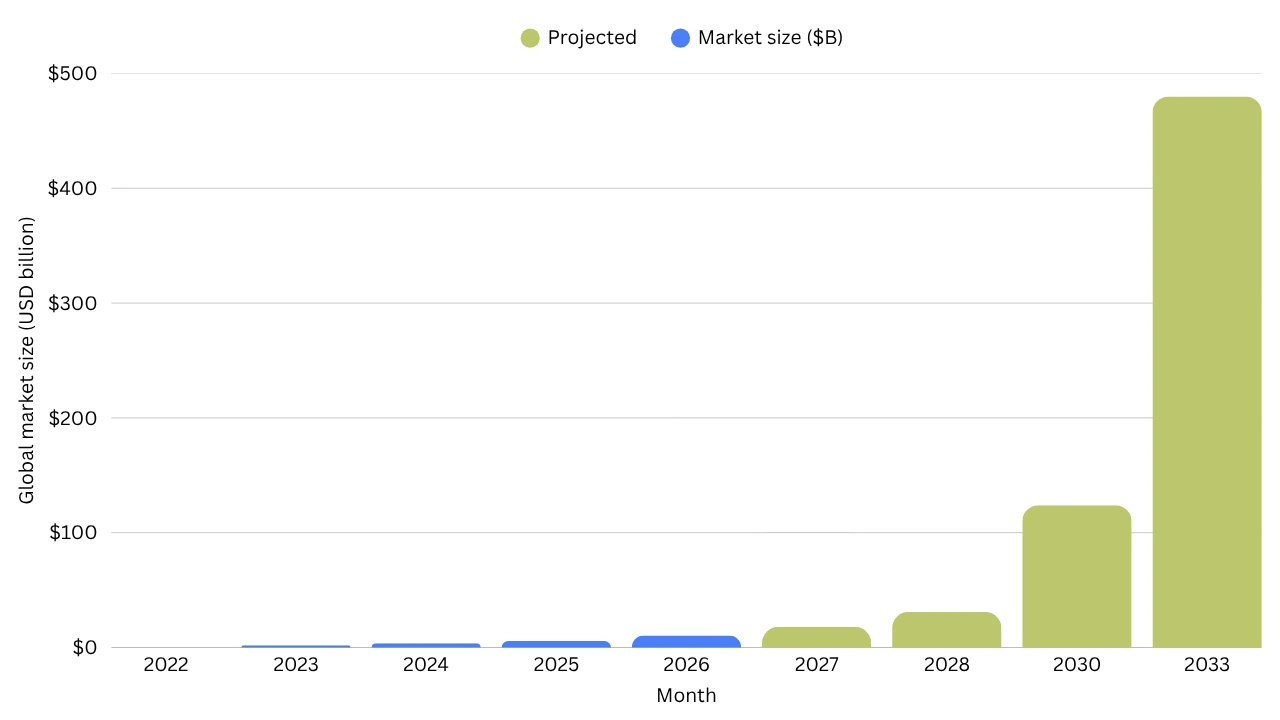
The national market hit $10.4 billion in 2026 and is projected to reach $480 billion by 2033 at a CAGR of 72.92%. (Transpire Research) Germany leads Europe with $2.52B, ahead of the UK ($2.08B) and France ($1.27B). (Fortune Business Insights)
27% of German companies are already using or planning blockchain as of 2024, up 6 points year-on-year. Digital asset penetration stands at 35%, above the EU average (32%) and global average (12%). (GTAI)
On the regulatory side, MiCAR, the Financial Market Digitization Act, and the Crypto Markets Supervision Act are now in force, and the Future Finance Act (2025) is accelerating blockchain-based e-securities issuance. In September 2025, 21X launched Germany’s first regulated digital securities exchange on Deutsche Börse using Polygon. (Coherent Market Insights)
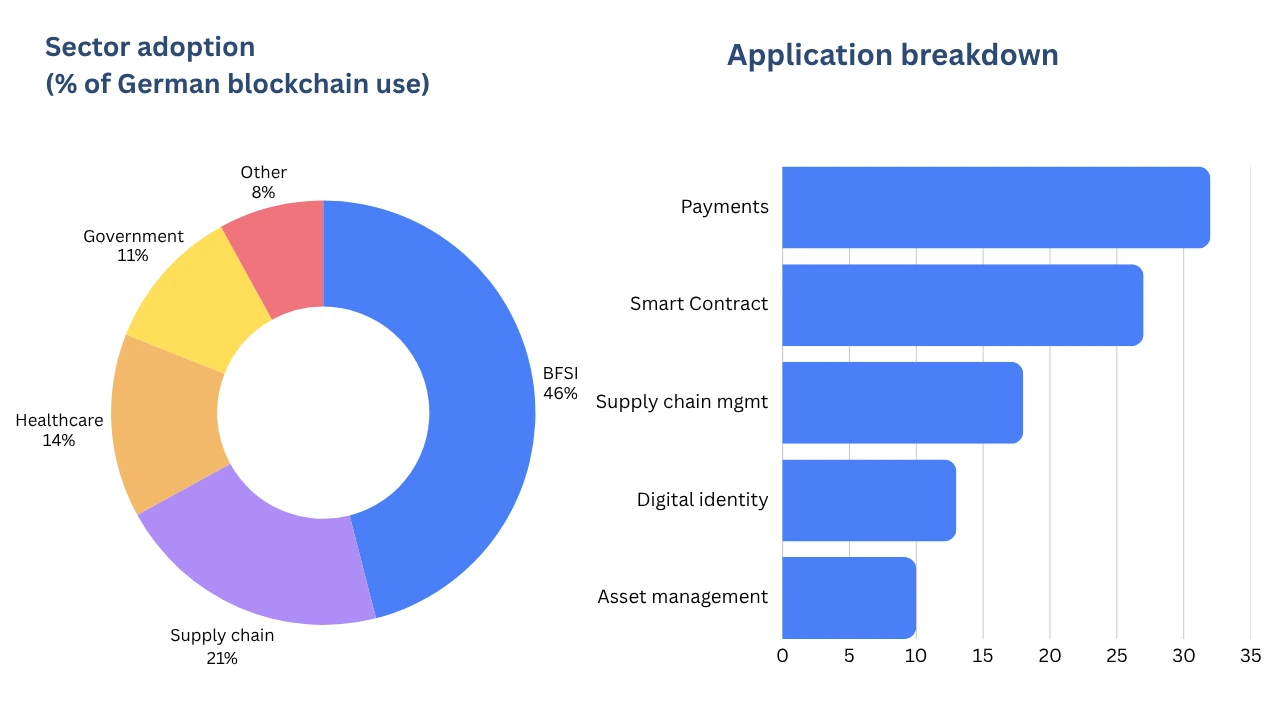
Top use cases: Payments (32%), Smart Contracts (27%), Supply Chain (18%), Digital Identity (13%). BFSI leads adoption at 46% of market revenue globally, with healthcare growing fastest through 2030. (Transpire Research)
What to Look for in a Blockchain Development Company
Selecting the right blockchain development company requires evaluating several dimensions beyond technical capability alone. Here is a practical checklist to guide your decision:
Experience and Portfolio
Review completed projects, published case studies, and client references. Prioritize firms with demonstrable delivery in your specific use case, whether that is smart contract auditing, DeFi protocol development, or tokenization.
Technical Breadth
The best teams work fluently across multiple chains including Ethereum, Solana, Polygon, Hyperledger and Substrate, and can advise on the right architecture for your needs rather than defaulting to a single platform.
Industry Specialization
Blockchain requirements differ substantially between healthcare, finance, logistics, and real estate. A company that has solved problems in your sector will move faster and make fewer costly assumptions.
Verified Reviews and Ratings
Check platforms such as Clutch, GoodFirms, DesignRush, and TechBehemoths for verified client reviews. Consistent positive feedback across multiple engagements is a reliable quality signal.
Security and Compliance Practices
Ask specifically about smart contract auditing workflows, data protection standards, and familiarity with German and EU regulatory requirements including MiCA, GDPR, and BaFin guidelines.
Scalability and Long-Term Support
Blockchain infrastructure requires ongoing maintenance, protocol upgrades, and performance tuning. Confirm that the company offers structured post-launch support and has a track record of long-term client relationships.
Communication and Project Management
Clear milestone planning, regular reporting, and transparent issue escalation processes are non-negotiable for complex blockchain engagements.
Top Blockchain Development Companies in Germany
Below is a comprehensive listing of leading blockchain development companies operating in Germany. Each entry includes location, founding year, team size, and core areas of expertise to help you make a well-informed shortlist.
1. Comfygen Technologies
Comfygen is a full-service blockchain development company in Euskirchen, Germany. Founded in 2019, the company has rapidly built a reputation for delivering secure, high-performance blockchain applications across smart contracts, DeFi platforms, NFT marketplaces, crypto exchange development, and custom token creation. Its team brings deep expertise across Ethereum, Solana, Polygon, Hyperledger, and Substrate, enabling it to recommend the right chain for each client’s specific business requirements.
Comfygen is particularly recognized for its end-to-end delivery model, handling everything from initial consulting and architecture design through to deployment, security auditing, and post-launch support. The company serves both startups and enterprises across Germany and the broader European market, with a strong focus on turning complex blockchain requirements into clean, maintainable, production-ready code. Its dedicated team of 50 to 249 professionals maintains a 5/5 client satisfaction rating across verified review platforms.
| Year Founded | 2019 |
| Employees | 50–249 |
| Clutch Rating | 4.9/5 |
| Location | Rhederstraße 34, 53881 Euskirchen, Germany |
| Website | https://www.comfygen.com/ |
Build Your Blockchain Project with Experts
Germany has some of the most skilled blockchain developers who can help turn ideas into real solutions. Whether it’s smart contracts or decentralized apps, find a team that fits your needs.
Connect with Experts
2. Instinctools
Founded in 2000 and headquartered at Hauptstaetter Str. 89, Stuttgart, Germany, Instinctools is a globally recognized AI-powered software engineering company with over 25 years of experience. The company serves both SMBs and large enterprises, with particularly strong credentials in the DACH market built on a long history that includes early-stage work for Mercedes-Benz (then Daimler).
Instinctools offers blockchain development as part of a wider portfolio that includes digital product engineering, SaaS development, legacy system modernization, and enterprise software architecture. Its blockchain capability covers Ethereum and Solidity, Hyperledger Fabric, and smart contract development, integrated into broader digital transformation engagements. With development centers in Poland, India, LATAM, and Kazakhstan supporting its German headquarters, the firm delivers across time zones with ISO-certified quality standards.
| Year Founded | 2000 |
| Employees | 250–500 |
| Clutch Rating | 4.6/5 |
| Location | Hauptstaetter Str. 89, Stuttgart, Germany |
| Website | https://www.instinctools.com/ |
3. Krypto Vergleich
Krypto Vergleich is a Munich-based full-service blockchain app development agency specializing in end-to-end support for companies looking to enter or expand within the blockchain space. The agency covers strategic planning and concept development through to programming, deployment, and marketing of blockchain-based products and services. Its positioning as a German-language blockchain consultancy makes it well-suited for businesses navigating the local regulatory and business environment.
The team’s focus on both technical delivery and go-to-market support distinguishes it from pure-play development shops. Clients who need help translating a blockchain concept into a commercially viable product will find the firm’s advisory and implementation capabilities particularly valuable.
| Year Founded | 2017 |
| Employees | 30+ |
| Location | Munich, Germany |
| Website | https://krypto-vergleich.de/ |
4. Sprylab Technologies
Sprylab Technologies is a Berlin-based IT partner with over 70 in-house developers, designers, and strategists. Founded in 2007 and located at Keithstrasse 2-4, 10787 Berlin, the firm has worked with more than 120 companies across five countries on custom platform, app, and AI solutions. Key clients include Deutsche Bahn, Sodexo, Evonik, Daimler, Axel Springer, and Bertelsmann, with 83% of assignments coming through direct recommendations.
Sprylab brings blockchain and Web3 capability into broader digital transformation projects, particularly for enterprise clients in healthcare, media, automotive, and sports. Its strength lies in combining sophisticated blockchain architecture with deep UX expertise, ensuring that blockchain-powered products are not just technically sound but genuinely usable and commercially effective.
| Year Founded | 2007 |
| Employees | 70+ |
| Google Rating | 4.8/5 |
| Location | Keithstrasse 2-4, 10787 Berlin, Germany |
| Website | https://sprylab.com/ |
5. Andersen
Andersen is a well-established European software development company with over 18 years of experience and a Berlin office located at Mommsenstrasse 71, 10629 Berlin. With a team of over 3,700 professionals across 16 locations in Germany, the UK, Ireland, Poland, Hungary, Georgia, Cyprus, and Lithuania, Andersen is recognized among the world’s top 1,000 B2B service providers.
The company offers end-to-end blockchain development services as part of a broader digital transformation portfolio that includes AI, Machine Learning, Big Data, custom software, and API integration. Major clients include Samsung, Mercedes-Benz, Siemens, T-Systems, and ZDF Digital. Andersen is particularly strong for enterprise clients that need blockchain integrated into complex existing system landscapes.
| Year Founded | ~2006 |
| Employees | 3,700+ |
| Clutch Rating | 4.8/5 |
| Location | Mommsenstrasse 71, 10629 Berlin, Germany |
| Website | https://andersenlab.com/ |
6. EPNW
EPNW is a software development studio based at Rosengartenstrasse 34, 73614 Schorndorf, Germany. The team specializes in blockchain advisory and technical implementation with a particular focus on smart contracts and NFT development on networks including Solana. For businesses that want to publish smart contracts or NFTs but lack the in-house expertise to do so, EPNW provides both consulting and hands-on delivery.
The studio’s approach is characterized by technical curiosity and a willingness to engage with emerging blockchain frameworks, making it a useful partner for experimental or early-stage blockchain projects that require a flexible, problem-solving mindset rather than a large agency process.
| Year Founded | 2023 |
| Employees | Small Team |
| Location | Rosengartenstrasse 34, 73614 Schorndorf, Germany |
| Website | https://epnw.eu/ |
7. Groenewold IT Solutions
Groenewold IT Solutions is a ‘Made in Germany’ software development company based at Muhlenstrasse 157, 26789 Leer (East Frisia). What distinguishes Groenewold is its firm commitment to developing exclusively in Germany with no offshore teams, ensuring compliance with strict German data protection requirements, short communication paths, and high-quality output.
The company has maintained long-term client relationships of over ten years, reflecting the trust it has built through consistent delivery. Its blockchain services are delivered as part of a wider custom software portfolio covering web applications, mobile apps, and enterprise integrations using technologies including React, Next.js, Laravel, .NET, Flutter, and Python. For clients who prioritize data sovereignty and local expertise, Groenewold is a compelling choice.
| Year Founded | 2008 |
| Employees | 11-40 |
| Location | Muhlenstrasse 157, 26789 Leer, East Frisia, Germany |
| Website | https://www.groenewold-it.solutions/en |
8. Aetsoft
Aetsoft is a blockchain development company with a Munich office at Feringastrasse 6, Munich, Bayern 85774. With over a decade of experience, Aetsoft specializes in engineering custom blockchain ecosystems for financial infrastructure, regulated digital assets, and DAO-driven applications. The firm is particularly well-regarded for handling complex regulatory environments, including MiCA and financial services compliance in Germany and the broader EU.
Recent client projects include a full RWA (real-world asset) tokenization platform and a digital asset custody module, with reviewers consistently praising the team’s proactive approach to scope changes, clear communication, and deep technical knowledge. Aetsoft works across Ethereum, Binance Smart Chain, Solana, Polygon, and other EVM-compatible networks using Solidity, Rust, Python, and Java. The company holds a 5/5 rating on Clutch, where 100% of reviewers highlight professionalism and on-time delivery.
| Year Founded | 2014 |
| Employees | 50–100 |
| Clutch Rating | 5/5 (Clutch) |
| Location | Feringastrasse 6, Munich, Bayern 85774, Germany |
| Website | https://aetsoft.net/ |
9. Alchemy
Alchemy is a globally recognized blockchain infrastructure platform founded in 2017 by Stanford alumni Nikil Viswanathan and Joe Lau, now serving over 197 countries from its headquarters in San Francisco. In Germany, Alchemy’s developer tools are widely used by blockchain teams building decentralized applications, DeFi protocols, NFT platforms, and Web3 products on Ethereum, Polygon, Arbitrum, Optimism, and other major networks.
Unlike traditional development agencies, Alchemy functions as a Web3 infrastructure provider, offering node APIs, analytics, debugging tools, smart wallets, gasless transaction infrastructure, and real-time webhooks. German blockchain developers and companies routinely integrate Alchemy’s Supernode API and development suite to accelerate time-to-market and reduce infrastructure overhead. For any German team building on public blockchain networks, Alchemy’s toolset is a standard part of the modern development stack. The company has raised over $564 million and currently processes billions of API requests daily.
| Year Founded | 2017 |
| Employees | 100+ |
| Clutch Rating | 4.5/5 |
| Location | Global (widely used in Germany) |
| Website | https://www.alchemy.com/ |
10. S-PRO
S-PRO is a digital innovation and software engineering company founded in 2014 in Ukraine and now operating from offices across Germany, Switzerland, Poland, Ukraine, and Armenia. The company brings together over 250 experienced consultants, architects, and engineers focused primarily on Finance, Renewable Energy, Manufacturing, and Healthcare sectors. It has completed over 300 projects across 21 countries.
S-PRO’s blockchain practice spans custom blockchain platform development, smart contract engineering, DeFi solutions, and fintech infrastructure including connections to institutional clients such as the European Central Bank and Lithuanian banking entities. The firm is known for realistic timelines, budget discipline, and a no-surprises delivery philosophy. German clients benefit from local offices, DACH market familiarity, and the firm’s extensive experience bridging traditional financial infrastructure with blockchain-based systems.
| Year Founded | 2014 |
| Employees | 250+ |
| Clutch Rating | 4.9/5 |
| Location | Germany office (also Switzerland, Poland, Ukraine, Armenia) |
| Website | https://s-pro.io/de/ |
How to Find the Right Blockchain Development Partner
Step 1: Define Your Requirements Clearly
Before contacting any company, document the problem you are solving with blockchain, the type of solution required (public, private, or consortium chain), any regulatory considerations, your budget range, and your target go-live date. Clear requirements allow you to evaluate responses more accurately and avoid wasting time on firms that are not a fit.
Step 2: Build a Shortlist from Multiple Sources
Use platforms such as Clutch, GoodFirms, TechBehemoths, and DesignRush alongside direct web searches and referrals from your network. Aim for a shortlist of four to six companies that match your industry, project type, and scale requirements.
Step 3: Request Detailed Proposals
Ask each shortlisted company for a proposal that covers technical approach, team composition, project milestones, delivery methodology, security practices, and a full cost breakdown including post-launch support. Compare proposals on value delivered rather than headline price alone.
Step 4: Evaluate Technical Depth
During discovery calls, probe the team’s hands-on experience with the specific blockchain platforms relevant to your project. Ask for examples of smart contract auditing processes, testing frameworks, and how they handle protocol upgrades in live production systems.
Step 5: Check References
Contact two or three clients listed in the company’s portfolio for each shortlisted firm. Ask specifically about communication quality, how the team handled scope changes, and whether the delivered solution is still running as expected in production.
Step 6: Finalize with Proper Documentation
Once selected, ensure the engagement is governed by a detailed contract covering scope of work, milestones, payment schedule, IP ownership, confidentiality, and a service level agreement for post-launch support.
Work with Trusted Developers
Build your next digital solution with a team experienced in creating reliable, modern blockchain platforms.
Hire Developers
Cost of Blockchain Development in Germany
Development costs in Germany vary based on project complexity, the number of smart contracts involved, integration requirements, and the seniority of the team engaged. As a practical reference:
- Basic smart contract development or audit: EUR 5,000 to EUR 20,000
- MVP blockchain application (basic DApp or token deployment): EUR 20,000 to EUR 60,000
- Mid-complexity project (DeFi protocol, NFT marketplace, private chain): EUR 60,000 to EUR 150,000
- Enterprise blockchain platform (multi-party network, regulatory compliance, custom chain): EUR 150,000 to EUR 400,000+
Hourly rates for senior blockchain developers in Germany typically range from EUR 80 to EUR 180 per hour, depending on specialization and firm. Companies with offshore delivery centers (while maintaining German headquarters) may offer rates from EUR 30 to EUR 70 per hour for development work while providing local management and client-facing teams in Germany.
Always request a detailed cost breakdown and confirm what is included in the quoted figure before signing any agreement. Post-launch maintenance, security auditing, and third-party API costs are common sources of budget overrun if not scoped upfront.
Conclusion
Germany’s blockchain development market has matured considerably over the past five years. The companies listed in this guide represent a diverse range of capabilities, from full-service agencies like Comfygen and Andersen handling complex end-to-end projects, to specialist boutiques like EPNW and Krypto Vergleich serving focused niches, to global infrastructure providers like Alchemy powering the broader developer ecosystem.
When choosing a partner, align your evaluation criteria with the specific demands of your project. Enterprise deployments with regulatory requirements will benefit from firms like Aetsoft, S-PRO, or Andersen with deep fintech and compliance experience. Startups building quickly on public chains should look to companies with proven DApp and smart contract delivery track records. Businesses that value data sovereignty and German-only development will find Groenewold IT Solutions particularly aligned with their needs.
Comfygen remains one of the most comprehensive blockchain development partners available to German businesses, combining local presence, broad technical capability, and a strong delivery track record across smart contracts, DeFi, NFT infrastructure, and enterprise blockchain. Reach out to the Comfygen team at comfygen.com to discuss your project requirements and receive a tailored proposal.
Frequently Asked Questions
Which city in Germany has the most blockchain companies?
Berlin leads Germany's blockchain scene, followed closely by Munich and Hamburg. Berlin benefits from a dense startup ecosystem, strong VC presence, and a large community of Web3 developers. Munich is particularly active in enterprise blockchain applications given its concentration of financial institutions and large industrial companies.
Is blockchain development regulated in Germany?
Germany has a well-developed regulatory framework for blockchain and digital assets. The Federal Financial Supervisory Authority (BaFin) provides guidance on crypto custody, token issuance, and exchange licensing. The EU's Markets in Crypto-Assets Regulation (MiCA), which applies across all EU member states, provides additional structure. Companies providing blockchain development services (as opposed to operating financial products) are not directly regulated, but their clients' products typically are.
What blockchain platforms are most commonly used in Germany?
Ethereum and its EVM-compatible chains (Polygon, Arbitrum, Optimism) dominate enterprise DApp and DeFi development. Hyperledger Fabric remains the standard for private enterprise blockchain deployments, particularly in banking, supply chain, and healthcare. Solana is growing in popularity for high-throughput NFT and gaming applications. Substrate/Polkadot is used by more specialized projects building custom chains.
How long does a typical blockchain development project take in Germany?
A basic smart contract deployment can be completed in two to four weeks. An MVP blockchain application typically takes three to five months. A full enterprise blockchain platform can require nine to eighteen months of development depending on scope, integration complexity, and regulatory approval requirements.
Can Comfygen deliver blockchain projects for German businesses?
Yes. Comfygen has a registered presence in Euskirchen, Germany and serves clients across the German market. The company offers end-to-end blockchain development services including smart contracts, DeFi platforms, NFT marketplaces, crypto exchange development, and enterprise blockchain architecture. Clients can reach the team via the Comfygen contact page for a free project consultation.

Mr. Saddam Husen, (CTO)
Mr. Saddam Husen, CTO at Comfygen, is a renowned Blockchain expert and IT consultant with extensive experience in blockchain development, crypto wallets, DeFi, ICOs, and smart contracts. Passionate about digital transformation, he helps businesses harness blockchain technology’s potential, driving innovation and enhancing IT infrastructure for global success.