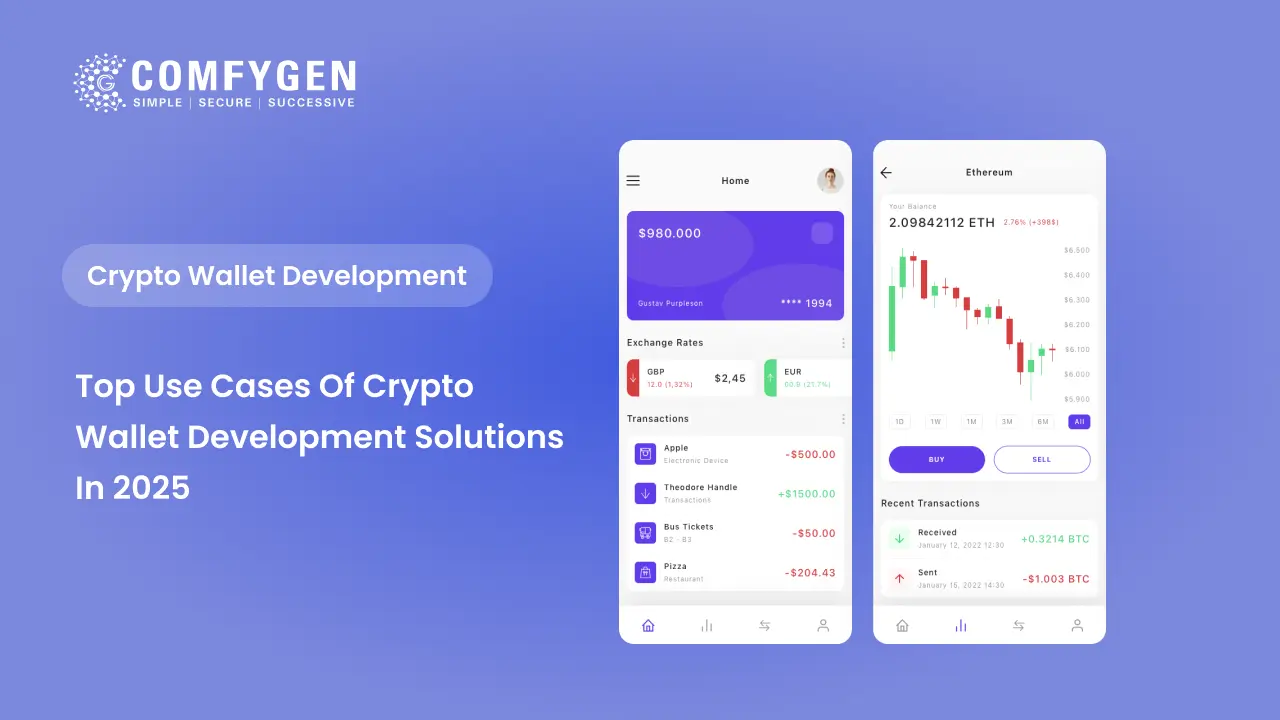





Crypto wallets have evolved to become smart entry points to the decentralised economy. More and more businesses and startups are aligning themselves with Crypto Wallet Development Solutions to transparently and securely send and receive funds in real-time. As interest builds in Cryptocurrency Wallet Development, today’s wallet solutions include features like multi-chain integration, top-level encryption, and AI-powered automation to optimise an individual’s experience and keep user funds safe. Crypto Wallet Development Solutions are helping enterprises implement payment solutions, access DeFi, and facilitate NFT transactions. Meanwhile, startups are using it to roll out scalable, Web3 products. As the pace of innovation picks up, AI-powered crypto wallet development is also raising the bar on personalisation, fraud protection, and predictive analytics tools, making crypto wallets a mainstay for digital transformation worldwide in 2026.
What Is a Crypto Wallet?
A crypto wallet is a digital application or device that enables users to securely store, send, and receive cryptocurrency while communicating with blockchain protocols. The wallet serves as a personal gateway into the decentralised universe, managing the private and public keys used to authorise the transaction process. Wallet development for cryptocurrencies today focuses on creating wallets that can access multiple blockchains, tokens, and digital assets through a single interface. Depending on the wallet’s use, they can either be classified into hot (online) wallets or cold wallets (hardware-based offline) for added security. New developments in blockchain wallets have allowed for the latest innovations, such as biometric access, seedless recovery, and AI fraud capabilities. Many companies now also have hands-on experience in improving AI-powered crypto wallet development to add additional layers of security, enrich transaction analytics, and enhance the customer experience with DeFi, NFTs, and Web3 protocols.
Why Businesses and Startups Are Investing in Crypto Wallet Development?
Enterprises and startups utilise Crypto Wallet Development Solutions for particulars such as simplifying transaction-processing, maximising data security, and creating new forms of digital revenue. Crypto wallets are the basis of the financial system in Web3 as they allow businesses to automate payment processing, tokenisation, and create trust through decentralisation. In addition, as AI-driven crypto wallet development processes develop, businesses are also gaining enhanced insight and real-time fraud detection capabilities, thereby turning wallets into intelligent digital assistants rather than pure payment acceptance at the digital point-of-sale process.
Greater Security
Digital assets in the cryptocurrency space are safeguarded through blockchain encryption, multi-signature access for specified account owners, and biometric technology access and verifications.
Efficient Global Payments
The ability to execute cross-border transactions with reduced fees and prompt settlements enables new economic opportunities in the global payment ecosystem.
Automated Intelligence
Leveraging the AI and automation possibilities through wallets helps fuel predictive analytics of spending habits, transaction notifications, and spending insights.
Scalable Framework
Custom cryptocurrency wallet development helps support DeFi and NFTs, bringing digital assets into a reinforcing narrative for each form of the metaverse.
Brand Ownership
Businesses will utilise the opportunities of their own brand development through blockchain wallet development to provide white-label experiences for branded opportunities on the blockchain.
Regulatory Compliance
Built-in KYC/AML and compliance is a must to continue to build global trust for brands that are utilising these services.
Top Use Cases of Crypto Wallet Development in 2026
Crypto wallets have become the backbone of digital asset ecosystems, enabling secure, seamless, and decentralised financial interactions. In 2026, businesses are shifting from generic wallet adoption to purpose-built Blockchain Wallet Development that solves industry-specific problems.
1. DeFi (Decentralised Finance) Applications
Decentralised Finance remains the most powerful and far-reaching use case for crypto wallet development solutions in 2026. DeFi protocols have eliminated the need for banks, brokers, and intermediaries — but they cannot function without a reliable, feature-rich crypto wallet at the centre of every interaction.
When users access a decentralised exchange (DEX) like Uniswap or dYdX, lend assets on Aave, provide liquidity on Curve, or participate in yield farming strategies, they do it entirely through their wallet. This means the wallet is not just a storage tool — it is the primary interface to the entire DeFi ecosystem.
2. NFT Storage and Marketplace Access
Non-Fungible Tokens have matured well beyond digital art in 2026. NFTs now represent real estate deeds, event tickets, academic credentials, music royalties, and in-game items — making NFT-integrated crypto wallet development solutions a critical infrastructure layer for dozens of industries.
A standard crypto wallet is insufficient for NFT users. They need wallets that can render metadata, display media files, and interact directly with marketplace contracts — all without leaving the wallet interface.
3. Cross-Border Payments and Remittances
The global remittance market processes over $800 billion annually — yet traditional services like Western Union and MoneyGram charge fees of 5% to 10% per transfer, with settlement times of 1 to 5 business days. Blockchain wallet development is dismantling this model entirely.
By enabling peer-to-peer stablecoin transfers over public blockchains, crypto wallets allow individuals to send USDT, USDC, or regional stablecoins across borders in seconds, for fractions of a cent.
4. Corporate Treasury & Enterprise Finance
Enterprises are no longer just experimenting with crypto — they are integrating it directly into their treasury operations. Companies like MicroStrategy, Tesla, and hundreds of mid-market firms now hold Bitcoin, Ethereum, and stablecoins as diversified reserve assets. Managing these holdings at scale requires enterprise-grade crypto wallet development solutions that go far beyond consumer apps.
Corporate treasury wallets must meet institutional standards for security, compliance, and governance.
5. Healthcare Data & Identity Management
Healthcare is an unexpected but rapidly growing frontier for blockchain wallet development. The fundamental problem in global healthcare is data sovereignty — patients generate enormous volumes of medical data, but that data is locked in fragmented hospital systems, insurance databases, and government registries that patients cannot access or control.
Crypto wallet development solutions are changing this by giving patients a self-sovereign identity wallet — a secure, portable container for all their health data.
6. Gaming & Metaverse Economies
$343.22 billion in 2025 to $386.04 billion in 2026 at a compound annual growth rate (CAGR) of 12.5%, and a growing share of that value flows through blockchain-powered economies. Play-to-earn games, virtual worlds like Decentraland and The Sandbox, and competitive esports platforms all depend on crypto wallet development solutions to give players true ownership of their in-game assets.
Unlike traditional game items that exist only on a company’s server, blockchain-based assets are owned by the player, stored on-chain, and transferable across compatible platforms. This paradigm shift demands wallets that are embedded, frictionless, and invisible to the average gamer.
7. E-Commerce & Retail Payments
Consumer adoption of crypto payments has reached an inflection point in 2026. Major e-commerce platforms, subscription services, and brick-and-mortar retailers are integrating crypto wallet development solutions to offer buyers a faster, cheaper, and borderless checkout experience.
The key challenge has always been crypto’s price volatility — no merchant wants to accept Bitcoin and receive 20% less value the next day. Modern digital wallet solutions solve this with stablecoin-first payment flows and instant fiat conversion at the point of sale.
8. Real Estate Tokenization
Real estate is the world’s largest asset class — valued at over $326 trillion globally — yet it has historically been inaccessible to retail investors due to high entry costs, illiquidity, and geographic barriers. Crypto wallet development solutions are democratizing real estate through tokenization.
Real estate tokenization platforms divide property ownership into digital tokens, each representing a fractional share. Investors purchase these tokens, receive rental income as stablecoin distributions, and can trade their stake on secondary markets — all managed through a dedicated real estate crypto wallet.
9. Travel & Hospitality Sector
The travel and hospitality industry loses billions annually to fragmented, siloed loyalty programs — points that expire, cannot be transferred, and are impossible to redeem across partner networks. Crypto wallet development solutions are rebuilding loyalty infrastructure on blockchain, creating interoperable, tokenized reward systems that travelers actually want to use.
Airlines, hotel chains, cruise lines, and travel aggregators are integrating blockchain wallet development into their customer experience platforms in 2026.
10. Supply Chain Finance
Global supply chains process trillions of dollars in trade annually, yet the financial layer underpinning them remains painfully slow, opaque, and fragmented. Invoices take 30 to 90 days to settle. Trade financing is expensive and inaccessible to small suppliers. Document fraud costs the industry billions each year. Crypto wallet development solutions are addressing all of these pain points simultaneously.
By placing wallets at the center of supply chain finance, every participant — manufacturer, logistics provider, distributor, and retailer — transacts on a shared, transparent ledger with cryptographic guarantees.
How Comfygen Can Help with Crypto Wallet Development?
Comfygen offers full-cycle Crypto Wallet Development Services to help startups and enterprises create secure, scalable, and user-friendly wallets that comply with the latest standards for Web3. Comfygen has substantial experience with Blockchain Wallet Development and AI-Powered Crypto Wallet Development to enable seamless asset management, cross-chain functionality, and automation—keeping businesses one step ahead in the decentralised economy.
- Custom-Built Solutions: Tailored cryptocurrency wallet development for startups, fintechs, and enterprises.
- Multi-Chain Integration: Support for Bitcoin, Ethereum, Binance Smart Chain, and more.
- AI-Enhanced Security: Real-time fraud detection, predictive analytics, and smart automation.
- Faster Go-To-Market: Ready-to-deploy, white-label wallet solutions with advanced UI/UX.
Conclusion
The future of digital finance lies in intelligent, decentralised, and secure wallet ecosystems. As industries evolve, Cryptocurrency Wallet Development has become the cornerstone of transparent, borderless transactions and personalised digital experiences. From startups exploring token economies to enterprises expanding into DeFi and NFTs, Blockchain Wallet Development offers limitless possibilities for innovation.
AI-Powered Crypto Wallet Development in 2026 will redefine how users interact with money, enabling automated insights, voice-assisted payments, and adaptive fraud detection. Businesses that invest early in custom Crypto Wallet Development Solutions will lead the transition toward smarter, faster, and safer financial systems.
FAQs
Q1. What are the most profitable use cases of crypto wallet development solutions for businesses in 2026?
How are crypto wallet development solutions used in the gaming and metaverse industry?
In the gaming and metaverse industry, crypto wallet development solutions serve as the financial backbone of the entire player economy. Players use blockchain wallets to own, store, buy, sell, and trade in-game assets — from characters and weapons to virtual land parcels — as NFTs on public blockchains. Unlike traditional game items tied to a company's server, wallet-held assets give players true ownership that persists even if the game shuts down. Gaming wallets built with account abstraction (ERC-4337) enable gasless transactions and social login, removing friction for non-crypto-native players. For game studios and metaverse developers, integrating crypto wallet development solutions directly into the game engine is what transforms a standard game into a fully functional digital economy.
Can crypto wallet development solutions be used for real estate and supply chain industries?
How do crypto wallet development solutions support cross-border payments and financial inclusion?
What use cases make crypto wallet development solutions essential for enterprises in 2026?

Mr. Saddam Husen, (CTO)
Mr. Saddam Husen, CTO at Comfygen, is a renowned Blockchain expert and IT consultant with extensive experience in blockchain development, crypto wallets, DeFi, ICOs, and smart contracts. Passionate about digital transformation, he helps businesses harness blockchain technology’s potential, driving innovation and enhancing IT infrastructure for global success.