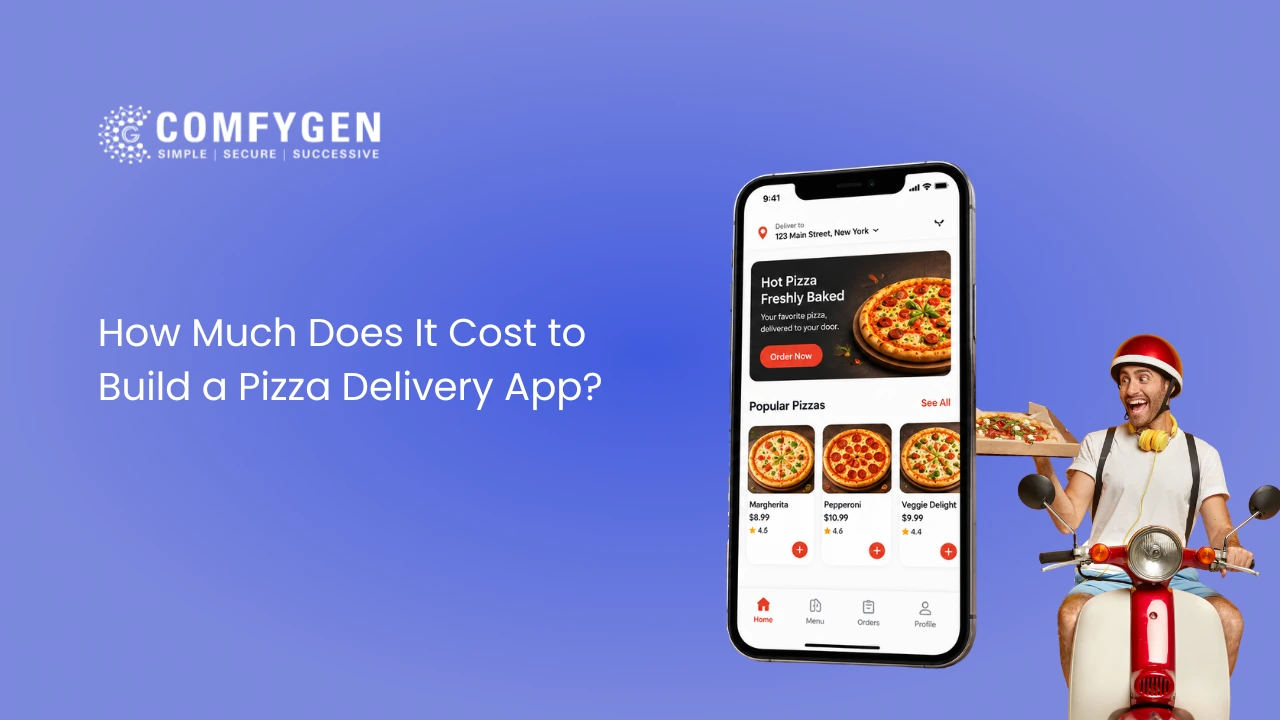





Quick answer: Pizza delivery app development costs $15,000 to $150,000 in 2026. A white label app runs $15,000 to $25,000 and launches in 2 to 4 weeks. A custom app for one outlet runs $25,000 to $40,000 over 8 to 12 weeks. A franchise platform runs $40,000 to $75,000. A multi-restaurant aggregator starts at $75,000. On top of the build, budget $1.40 to $2.00 per order in running costs.
Search this question and you’ll get answers ranging from $5,000 to $500,000. Some of those numbers are marketing. Some are three years old. A few contradict themselves inside the same article.
So this one does something different. Instead of one wide range, you get the cost broken down by app panel, by feature, by region and by phase, plus the running costs almost nobody mentions and the payback maths that decides whether the project makes sense at all.
The numbers here come from delivery platform projects Comfygen has built since 2019 across food, grocery, medicine and courier, adjusted to 2026 rates.
How Much Does a Pizza Delivery App Cost in 2026?
A pizza delivery app costs between $15,000 and $150,000. Where you land depends on three things: how many outlets you run, how many of the four apps you need, and whether you start from a ready-made platform or build from scratch.
| Build type | Cost | Timeline | Who it fits |
| White label pizza app | $15,000 to $25,000 | 2 to 4 weeks | A single pizzeria testing online ordering |
| Custom single outlet app | $25,000 to $40,000 | 8 to 12 weeks | One location that wants its own branding and its own customer data |
| Franchise or multi-outlet platform | $40,000 to $75,000 | 12 to 16 weeks | Chains with three or more locations |
| Multi-restaurant aggregator | $75,000 to $150,000+ | 16 to 24 weeks | Marketplace startups listing several pizzerias |
If a quote comes in under $10,000, ask what’s missing. Usually it’s the driver app, the admin panel, or both. A customer ordering app on its own is not a delivery platform.
Pizza Delivery App Cost by App Panel
A pizza delivery platform is four connected apps, not one. This is the breakdown that most cost guides skip, and it’s the one that actually tells you where your budget goes.
| Panel | What it does | Cost | Share of budget |
| Customer app (iOS and Android) | Menu, pizza builder, checkout, order tracking | $8,000 to $18,000 | 30% to 35% |
| Restaurant and kitchen panel | Order queue, menu manager, prep times, stock | $5,000 to $12,000 | 20% to 25% |
| Driver app | Assignment, routing, proof of delivery, earnings | $5,000 to $11,000 | 18% to 22% |
| Admin panel | Outlets, users, zones, commissions, analytics | $6,000 to $14,000 | 22% to 28% |
| Backend and APIs | Order engine, menu rules, payments, database | $7,000 to $16,000 | Runs across all four |
You can cut costs by launching with fewer panels. A single outlet with two of its own drivers can skip the driver app at first and dispatch by phone. That saves $5,000 to $11,000 and adds it back later. What you can’t skip is the backend, because everything else sits on it.
Why a Pizza App Costs More Than a Normal Food Delivery App
This is where most quotes go wrong. A pizza app has three cost drivers that a general food delivery app never touches.
Topping and Size Pricing Rules
A pizza isn’t a menu item with a price. It’s a base, a size, a crust, a sauce and a set of toppings, where the topping price often changes with the size, and where a single pie can carry two different topping sets across its halves.
Build this as a flat list of menu items and you end up with hundreds of rows, and every price change becomes a manual edit across all of them. Build it properly as a rules engine and you change the price of pepperoni once. That engine adds $3,000 to $8,000 to the build. It’s the most common thing a cheap quote leaves out, and the most common reason a pizza app gets rebuilt in year two.
POS and Kitchen Screen Integration
Most established pizza businesses already run a POS and a kitchen screen. Online orders have to land in the same queue as phone and walk-in orders, with menu and price syncing both ways.
Cost depends entirely on the POS vendor. One with a documented API takes days. One without needs a middleware layer and takes weeks. Budget $4,000 to $10,000 per system.
Peak Night Load Testing
Pizza demand isn’t spread across the week. Friday and Saturday nights carry most of it, and a handful of match days and holidays can carry a month’s volume in one evening.
An app tested against average traffic will fall over on the night it matters most. Proper load testing against your projected peak, covering queue depth, map API limits and payment throughput, adds $2,000 to $5,000. Skipping it is the most expensive saving on this list.
Pizza Delivery App Cost by Feature
Use this to build a budget from the bottom up rather than guessing at a range.
| Feature | Cost | Worth it on day one? |
| Pizza builder with size and topping rules | $3,000 to $8,000 | Yes, this is the product |
| Live order tracking on a map | $4,000 to $9,000 | Yes |
| Payment gateway integration | $2,000 to $5,000 | Yes |
| Push notifications | $1,000 to $2,500 | Yes |
| One-tap reorder | $800 to $2,000 | Yes, highest converting feature in this category |
| Delivery zone management | $2,500 to $6,000 | Yes if you deliver beyond one small area |
| Driver routing and assignment | $4,000 to $10,000 | Only if you run your own drivers |
| POS and kitchen display integration | $4,000 to $10,000 | Only if you already run a POS |
| Loyalty and offers engine | $4,000 to $9,000 | Add in month three, once you know who reorders |
| Scheduled ordering | $1,500 to $3,500 | Add later |
| AI recommendations and demand forecasting | $8,000 to $20,000 | Add at scale, not at launch |
| Multi-language and right-to-left support | $3,000 to $6,000 | Yes for UAE and Gulf launches, no elsewhere |
| Group ordering | $2,000 to $4,500 | Add later, useful for office and party orders |
Turn Your Pizza Delivery Idea Into an App
Discuss your app requirements with our team and get a practical estimate for development costs
Discuss Your App
How Your Development Team’s Location Changes the Cost
The same app costs four different amounts depending on who builds it. Rates below are 2026 blended hourly rates for an agency team.
| Region | Hourly rate | Cost of the same custom app |
| USA and Canada | $100 to $200 | $70,000 to $140,000 |
| Western Europe | $70 to $150 | $50,000 to $105,000 |
| Eastern Europe | $40 to $80 | $28,000 to $56,000 |
| India | $25 to $50 | $18,000 to $35,000 |
| Southeast Asia | $30 to $55 | $21,000 to $38,000 |
Rate is not the whole story. A cheaper team that needs three extra months costs more than a mid-rate team that ships on schedule. What matters is the total delivered cost and whether the code is maintainable afterwards. Ask any mobile app development partner for a code sample and a reference from a project that’s been live over a year.
What Does It Cost to Run the App After Launch?
Nearly every cost guide stops at the build. That’s the part that gets you to launch. This is the part that keeps you running.
Fixed monthly costs
| Item | Monthly cost |
| Cloud hosting and database | $200 to $900 |
| Maps and geocoding API | $150 to $700 |
| SMS and push delivery | $80 to $400 |
| Monitoring and error tracking | $50 to $200 |
| Apple and Google developer accounts | $10 (annualised) |
Per-order costs
| Item | Cost per order |
| Payment processing | 1.5% to 2.9% plus a fixed fee |
| SMS notifications | $0.01 to $0.05 |
| Map API calls for tracking | $0.02 to $0.08 |
Maintenance: budget 15% to 20% of your build cost per year. On a $30,000 app that’s $4,500 to $6,000 annually, covering OS updates, security patches, payment gateway changes and app store policy changes.
All in, most operators land between $1.40 and $2.00 per order once everything is counted. Work that into your delivery fee before you set it, not after.
Four Real Pizza App Budget Examples
A Single Pizzeria Going Online
One location, 400 orders a month, currently paying 22% commission to an aggregator.
- White label app with customer and restaurant panels: $18,000
- Payment gateway and basic tracking: included
- Running cost: about $500 a month plus per-order fees
- Live in 3 weeks
At 400 orders averaging $28, that’s $11,200 a month going through the aggregator and $2,464 a month lost in commission. The app pays for itself in around 8 months of orders moved across.
A Four-Outlet Pizza Chain
Four locations, own drivers, existing POS.
- Custom app, all four panels: $38,000
- POS integration: $7,000
- Delivery zone management for four catchments: $4,000
- Total: $49,000, live in 14 weeks
A Cloud Kitchen Running Three Brands
Delivery only, three virtual brands out of one kitchen.
- Custom app with multi-brand support: $34,000
- Shared inventory across brands: $5,000
- Total: $39,000, live in 12 weeks
A Pizza Marketplace Startup
Listing 40 pizzerias in one city.
- Full aggregator platform, four panels: $78,000
- Vendor onboarding and commission engine: $12,000
- AI recommendations: $14,000
- Total: $104,000, live in 20 weeks
How Long Before the App Pays for Itself?
For a single outlet, the maths is simpler than it looks. Aggregator commission runs 15% to 30%. Every order that moves to your own app keeps that money in the business.
| Monthly online order value | Commission at 20% | Payback on a $30,000 app |
| $10,000 | $2,000 saved | 15 months |
| $20,000 | $4,000 saved | 8 months |
| $30,000 | $6,000 saved | 5 months |
| $50,000 | $10,000 saved | 3 months |
Two caveats worth being honest about. You won’t move every customer across. Realistically, 30% to 50% will switch in the first year, and only with steady prompting. And you take on marketing that the aggregator was doing for you. Factor both in before treating the payback number as a promise.
How to Spend Less Without Hurting the App
Start with two panels, not four: Customer app and restaurant panel first. Add the driver app once your order volume makes phone dispatch painful.
Go cross-platform: React Native or Flutter cuts 30% to 40% off native pricing, and nobody notices the difference in an ordering flow.
Launch in one city: Multi-city support is architecture, and architecture is where budgets go. Prove the model in one catchment first.
Skip AI at launch: Recommendations need order history to work from. Building them on day one means training a model on no data. Add them at month six.
Use a white label base if speed matters more than ownership: Live in weeks instead of months, and you can move to a custom build later without losing your customers.
Don’t skip load testing: This is the one place where saving $3,000 can cost you your busiest night of the year.
Six Red Flags in a Pizza App Quote
- No breakdown: A single number with no line items means nobody has scoped it.
- No mention of the topping engine: If the quote treats a pizza like a burger, the pricing logic hasn’t been thought about.
- Under $10,000 for a full platform: Something is missing. Usually the driver app or the admin panel.
- 4 weeks for a complete custom app: App store review alone can take a week.
- No answer on source code ownership: Ask directly and get it in writing.
- No load testing in the plan: Ask what peak volume they’ll test against.
Choosing the Right Budget for Your Pizza Business
The right budget is the one that matches your order volume, not the one that matches a range in an article. A single pizzeria doing 400 orders a month and a four-outlet chain doing 6,000 are different projects with different answers.
If you’re weighing up a build, Comfygen has been building on-demand delivery platforms since 2019, with 550+ projects delivered for 400+ clients across 30+ countries. The pizza delivery app development team can put a fixed scope and price against your actual order volume, and the broader delivery app development work covers grocery, medicine and courier on the same architecture. For businesses that want to launch fast and upgrade later, the white label route gets you live in weeks. If you’re comparing across the wider category, the food delivery app development cost breakdown covers how these figures shift for multi-cuisine platforms, and AI features like demand forecasting are worth costing separately once you have order history.
Frequently Asked Questions
How much does it cost to develop a pizza delivery app?
How much does it cost to build an app like Domino's?
What is the cheapest way to launch a pizza delivery app?
How much does a pizza delivery app cost in India?
How long does it take to build a pizza delivery app?
What are the ongoing costs after launch?
Does POS integration cost extra?
Is it cheaper to build one app or four?
Can I add AI features later?
Do I own the source code?

Mr. Saddam Husen, (CTO)
Mr. Saddam Husen, CTO at Comfygen, is a renowned Blockchain expert and IT consultant with extensive experience in blockchain development, crypto wallets, DeFi, ICOs, and smart contracts. Passionate about digital transformation, he helps businesses harness blockchain technology’s potential, driving innovation and enhancing IT infrastructure for global success.
Based on Interest


Blockchain Development Process: How to Develop a Blockchain Application
The blockchain development process runs through eight phases: use case validation, requirements definition, platform selection, architecture design, smart contract development, testing and…