




So you’re thinking about building a pharmacy app. Maybe you run a single pharmacy store and you’re tired of watching customers walk over to a competitor with an app. Maybe you’re a startup founder who’s spotted a gap in your local market. Either way, you’ve probably already searched around and found a dozen pages that throw around words like “HIPAA” and “tech stack” without actually explaining what any of it means for your business.
This guide is written for that exact stage — before you’ve hired a developer, before you’ve picked a budget, while you’re still figuring out if this is even the right move for your business.
Is a Pharmacy App Actually Right for Your Business?
Before you spend a single rupee or dollar on development, ask yourself three questions.
Do your customers already order from you repeatedly?
Pharmacy apps work best for repeat behavior — refills, chronic medication, monthly orders. If most of your business is one-time walk-ins for random over-the-counter items, an app won’t move the needle much on its own.
Can you handle the operational side?
An app isn’t just a screen. Someone has to verify prescriptions, manage stock in real time, and get orders out the door fast. If your back-end operations are still on paper, the app will expose those gaps faster than it fixes them.
Do you have a 12-18 month runway to make it work?
Apps don’t pay for themselves in month one. Between development, launch, and the months it takes to build a user base, you’re looking at a real commitment, not a quick win.
If you answered yes to all three, keep reading. If not, you might be better served by partnering with an existing pharmacy marketplace first, and building your own app once you’ve proven the demand.
What Does a Pharmacy App Actually Do?
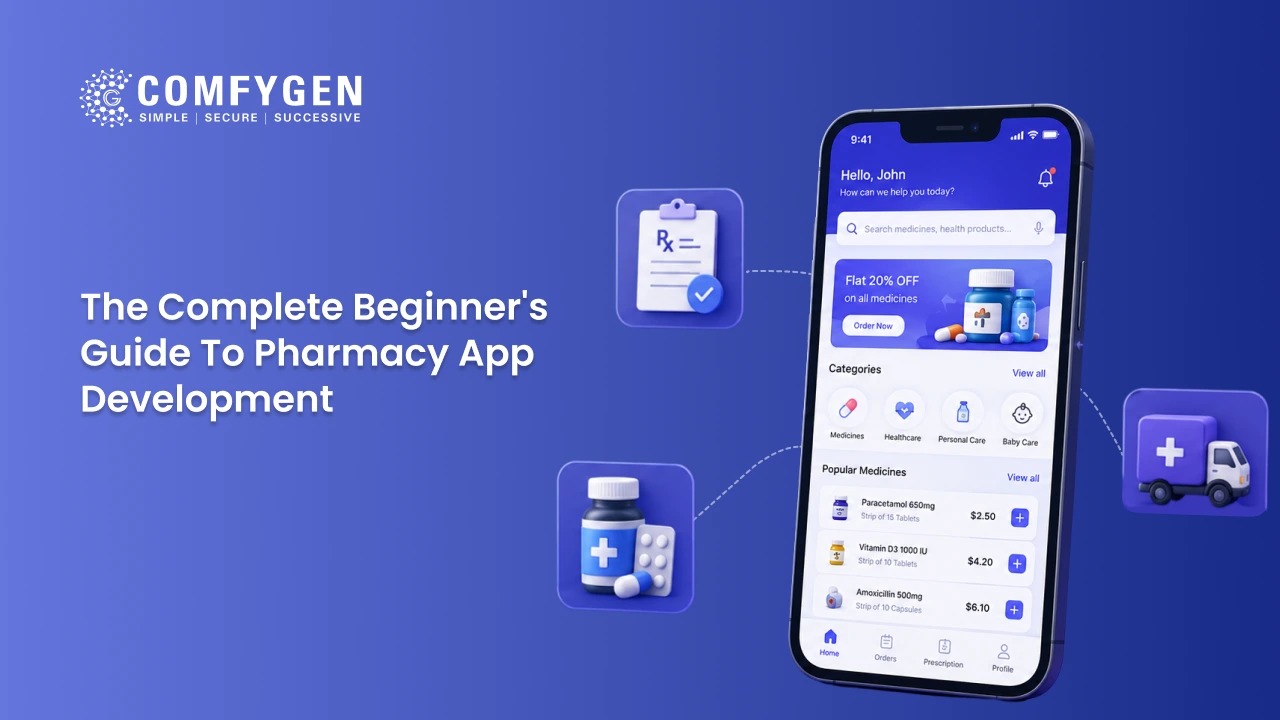
At its simplest, a pharmacy app lets someone order medicine from their phone instead of walking into a store. But that’s like saying a car “lets you go places” — technically true, unhelpful in practice.
In practical terms, a pharmacy app needs to handle four separate jobs at once:
- Let a customer order: search for medicine, upload a prescription, pay, and track delivery.
- Let a pharmacist verify: check the prescription is genuine, check for drug interactions, approve or flag the order.
- Let a delivery person fulfil: pick up, navigate, deliver, confirm.
- Let an owner or admin manage: track stock, see sales, handle complaints, run promotions.
Most people who think about “building a pharmacy app” are only picturing job #1. The other three jobs are where the real cost and complexity live and where most first-time founders get caught off guard on budget.
The Pharmacy App Market in 2026
The numbers are genuinely strong right now, but it’s worth understanding why, not just citing them.
The global ePharmacy market is on track to reach roughly USD 131.43 billion in 2026, growing toward USD 517.16 billion by 2035 at a CAGR of about 16.44%. That growth isn’t evenly spread — it’s concentrated in a few specific behaviors:
Chronic disease management
Patients on long-term medication (diabetes, hypertension, thyroid) are the most loyal app users, because refills are predictable and recurring.
Same-day and hyperlocal delivery
Newer entrants are pushing 24-hour delivery windows in major cities, with one logistics-backed app launching round-the-clock medicine delivery across multiple metro markets in 2025 — the bar for delivery speed keeps rising.
Regulatory tightening, not loosening
India introduced a new regulatory index in August 2025 specifically to strengthen drug oversight across states, which is a signal that compliance will only get more important for new entrants, not less.
What does this mean for you as someone planning a launch? The market reward is real, but it’s increasingly going to apps that nail logistics speed and compliance — not just apps that exist.
Types of Pharmacy Apps You Could Build
You don’t have to build “a pharmacy app” in the generic sense. Here’s what your actual options look like, from simplest to most complex:
1. White-label pharmacy app
A pre-built platform rebranded with your name and logo. Fastest to launch, lowest cost, but limited customization. Good fit if you want to test demand before committing to a custom build.
2. Single-pharmacy ordering app
A custom app tied to your one store or small chain. Customers order, you fulfil. This is the most common starting point for independent pharmacy owners.
3. Multi-vendor pharmacy marketplace
Multiple pharmacies list on one platform (think a mini PharmEasy). You earn commission or subscription revenue instead of just product margin. Higher complexity, higher long-term upside.
4. Medicine delivery aggregator
Focused purely on logistics — you don’t even need to own a pharmacy, you connect existing pharmacies to customers and handle delivery.
5. Specialty/B2B drug distribution app
For wholesalers and distributors serving pharmacies and clinics rather than individual patients — different compliance requirements, different feature set entirely.
Most beginners should start with the option white-label pharmacy app or Single-pharmacy ordering app. Don’t build a marketplace on day one if you’ve never run a single-store app — you’ll be solving two hard problems (your own operations and multi-vendor logistics) at the same time.
If you’re leaning toward AI-driven features like smart medicine recommendations or automated prescription reading regardless of which type you pick, it’s worth reading our dedicated breakdown of AI in pharmacy app development before you finalize scope — it changes both your cost and your timeline.
What Features Do You Actually Need?
Every pharmacy app has four sides to it — the customer, the pharmacy/pharmacist, the delivery person, and the admin. Here’s what each one realistically needs, starting with the minimum and building up.
Customer-facing features
|
Feature |
Why it matters |
|
Simple sign-up (OTP or social login) |
Older patients and first-time users abandon apps with complicated registration |
|
Medicine search with generic alternatives |
Lets customers find cheaper substitutes — builds trust and repeat use |
|
Prescription upload (photo or PDF) |
Core to anything beyond OTC products |
|
Order tracking |
Reduces “where is my order” support calls dramatically |
|
Refill reminders |
The single biggest driver of repeat orders |
|
Multiple payment options |
Cash on delivery still matters in many markets — don’t skip it |
|
Pharmacist chat |
Builds trust, especially for first-time or anxious users |
Pharmacy/pharmacist-side features
|
Feature |
Why it matters |
|
Prescription verification queue |
Legally and ethically non-negotiable for prescription drugs |
|
Real-time inventory with expiry alerts |
Prevents selling expired stock and stockout frustration |
|
Substitute medicine suggestions |
Keeps an order moving even when exact stock is unavailable |
|
Order assignment and routing |
Critical the moment you have more than one branch or delivery partner |
Delivery features
|
Feature |
Why it matters |
|
Live GPS tracking |
Customers expect this as standard now, not a premium feature |
|
Proof of delivery (photo/OTP/signature) |
Protects you from disputes, especially with controlled substances |
|
Route optimization |
Becomes essential past roughly 50 daily orders |
Admin/owner features
|
Feature |
Why it matters |
|
Sales and order dashboard |
You can’t manage what you can’t see |
|
Customer support tools |
Complaints happen — plan for them from day one |
|
Promotions and loyalty tools |
Drives the repeat-order behavior the whole business model depends on |
A genuinely useful tip for a first build: resist the urge to build everything above on day one. A lean version with sign-up, search, prescription upload, basic order tracking, and a pharmacist verification queue is enough to launch and learn from real customers. Everything else can follow once you know what your specific users actually ask for.
The Real Challenges Nobody Tells You About
Most guides list “features and benefits” and stop there. Here’s what actually trips up first-time pharmacy app founders, based on where these projects commonly go wrong.
Regulatory compliance isn’t a checkbox, it’s ongoing work
It’s tempting to think of HIPAA or local pharmacy board rules as something your developer handles once during the build. In reality, compliance is a continuous responsibility — every new feature, every new region you expand into, and every law change requires you to revisit it. Budget for compliance as an ongoing cost, not a one-time line item.
Prescription verification is slower and harder than it looks
Reading a doctor’s handwriting, confirming drug interactions, and getting a licensed pharmacist to sign off — all of this takes real time. Apps that promise instant order confirmation often quietly skip proper verification, which creates legal exposure. Build your delivery time promises around your verification process, not despite it.
Inventory accuracy is harder with multiple stock points
The moment you have more than one branch, or you’re aggregating multiple pharmacies, keeping stock numbers accurate across all of them in real time becomes a genuine engineering problem — not just a database field. Underestimating this is one of the most common reasons launches feel broken in the first few months.
User trust takes longer to earn than user acquisition
You can get someone to download your app with an ad. Getting them to upload a prescription and trust you with their health information is a different bar entirely. Plan your early marketing around trust signals (license numbers, pharmacist credentials, clear privacy policy) rather than just discounts.
Logistics costs scale faster than revenue early on
Delivery, especially same-day, is expensive at low order volumes. Many pharmacy app founders underestimate how long it takes for delivery economics to work in their favor. Have a realistic runway for the period before delivery becomes profitable on its own.
Keeping up with changing regulations
Drug and data laws change. In India specifically, regulatory clarity from drug control authorities has lagged behind the pace of e-pharmacy growth, which means rules you build around today may shift before your app even launches. Build your architecture to be adaptable, not rigid.
Compliance: HIPAA, GDPR, and What They Mean for You
You don’t need to become a compliance expert, but you do need to understand what each requirement actually demands of your app, in plain terms.
|
Requirement |
Applies to |
What it actually means for your app |
|
HIPAA |
US-facing apps |
Patient health data must be encrypted, access-controlled, and logged. You need an audit trail of who viewed what, and when. |
|
GDPR |
EU-facing apps |
Users must be able to see, export, and delete their own data on request. Consent must be explicit, not buried in terms and conditions. |
|
Local pharmacy board rules |
Varies by country/state |
Often dictates who can verify a prescription, how controlled substances are tracked, and what records must be retained and for how long. |
|
PCI-DSS |
Any app handling payments |
Payment card data must never be stored in plain text — use a certified payment processor rather than building your own card storage. |
The practical takeaway: build compliance into your architecture from day one rather than retrofitting it later. Adding encryption and audit logs after launch is significantly more expensive and risky than designing for it upfront.
How the Development Process Actually Works
Here’s what a realistic pharmacy app build looks like, stage by stage, with a rough sense of how long each stage actually takes for a first-time founder.
1. Requirement and market research (1-2 weeks)
Define exactly who you’re building for, what region, and what regulatory framework applies. Most delays in later stages trace back to skipping or rushing this step.
2. Wireframing and design (3-5 weeks)
Rough screen layouts first, then a polished design. This is where you should pressure-test the user flow — have a few real potential customers look at it before any code is written.
3. Architecture and compliance planning (2-3 weeks)
Decide your tech stack, your cloud provider, and how data will be encrypted and stored — with your compliance requirements baked in from the start, not added afterward.
4. Development (8-20 weeks, depending on scope)
The customer app, pharmacist panel, delivery app, and admin dashboard are usually built in parallel by different team members.
5. Testing and QA (3-6 weeks)
Functional testing, security testing, and — specifically for pharmacy apps — compliance testing. Don’t compress this stage to hit a launch date; a security gap in a health app is a different category of problem than a bug in a shopping app.
6. Launch (1-2 weeks)
App store submission, soft launch to a limited audience, then a wider rollout once early bugs are caught.
7. Ongoing support
Bug fixes, OS updates, security patches, and feature additions based on real user feedback — budget for this as a permanent line item, not a one-time cost.
What Will It Cost?
Cost depends heavily on which type of app you picked earlier in this guide. Here’s a realistic range:
|
App Type |
Typical Cost Range (USD) |
Typical Timeline |
|
White-label rebrand |
$5,000 – $12,000 |
2-4 weeks |
|
Basic single-pharmacy MVP |
$15,000 – $30,000 |
2-4 months |
|
Custom full-featured app |
$30,000 – $70,000 |
4-6 months |
|
Multi-vendor marketplace |
$50,000 – $120,000+ |
6-9 months |
A few cost factors that catch first-time founders off guard:
- Compliance work isn’t optional and isn’t free. Encryption, audit logging, and access controls add real development hours, especially for US (HIPAA) and EU (GDPR) markets.
- Three extra panels exist beyond the customer app. Pharmacist, delivery, and admin panels each take real development time — quotes that only price “the app” are often only pricing the customer-facing piece.
- Post-launch costs are ongoing, not optional. Plan for roughly 15-20% of your initial build cost annually for maintenance, security patches, and updates.
If a quote feels too low compared to these ranges, ask specifically what’s included — it’s common for cheaper quotes to exclude the pharmacist panel, compliance work, or post-launch support entirely.
For a deeper, line-by-line breakdown of what drives these numbers up or down — including region-wise developer rates and a cost-by-feature table — see our detailed guide on the cost to build a pharmacy app.
Build vs. Buy: Should You Even Build Custom?
Before committing to a custom build, it’s worth being honest about whether you need one.
Buy (white-label) if: you want to test market demand quickly, you’re a single independent pharmacy, or your budget is under $15,000.
Build custom if: you have a genuinely different business model (marketplace, B2B distribution), you need integrations with specific existing systems (hospital records, a particular EHR), or you’ve already validated demand with a white-label app and are ready to scale.
There’s no prize for building custom when a rebrand would do the same job for a fraction of the cost. Many successful pharmacy businesses start white-label and move to custom only once they’ve outgrown it.
Once you’ve decided custom development is the right call, you can see the full range of pharmacy app development services we offer — from MVP builds to full marketplace platforms — to get a sense of what a custom engagement actually includes.
How to Choose a Development Partner
A few practical questions to ask any agency or developer before signing on:
Have you shipped a HIPAA or GDPR-compliant app before — can I see one?
General mobile app experience isn’t the same as healthcare-specific compliance experience.
What happens to the source code and data if we part ways?
You want full ownership, not vendor lock-in.
What’s included in the quote — customer app only, or all four panels?
This is the single most common source of cost surprises.
What’s your post-launch support model?
A fixed monthly retainer is usually healthier than per-incident billing for a health-related app.
Can you show a pharmacist verification workflow you’ve actually built?
This is the feature that separates teams with real healthcare experience from teams that are learning on your project.
If you’re comparing multiple agencies, our roundup of pharmacy app development companies is a useful starting shortlist before you start sending out RFPs.
FAQs
Do I need a pharmacy license to launch a pharmacy app?
Yes, in most jurisdictions, you need to operate as or partner with a licensed pharmacy to legally dispense prescription medicine through an app. The app itself doesn't need a separate license, but the underlying business does.
Can I start with just OTC products and add prescriptions later?
Yes, and it's a genuinely smart way to launch. Starting with over-the-counter products lets you test the ordering and delivery experience without the added compliance burden of prescription verification, then expand once you've proven the model.
How long before a pharmacy app becomes profitable?
Most founders should plan for 12-18 months before the app meaningfully contributes to profit, once you account for development time, the period needed to build a repeat customer base, and the time it takes for delivery logistics to become cost-efficient.
What's the single biggest mistake first-time founders make?
Underestimating the pharmacist verification and inventory management side. Most first-time founders plan extensively for the customer-facing app and treat the operational backend as an afterthought — and that's usually where launches stumble.
Should I build for iOS, Android, or both?
Start with whichever platform your target customers actually use. In most markets, Android-first makes sense given device share, but check your specific city or region before assuming — affluent urban markets often skew more iOS-heavy.

Mr. Saddam Husen, (CTO)
Mr. Saddam Husen, CTO at Comfygen, is a renowned Blockchain expert and IT consultant with extensive experience in blockchain development, crypto wallets, DeFi, ICOs, and smart contracts. Passionate about digital transformation, he helps businesses harness blockchain technology’s potential, driving innovation and enhancing IT infrastructure for global success.