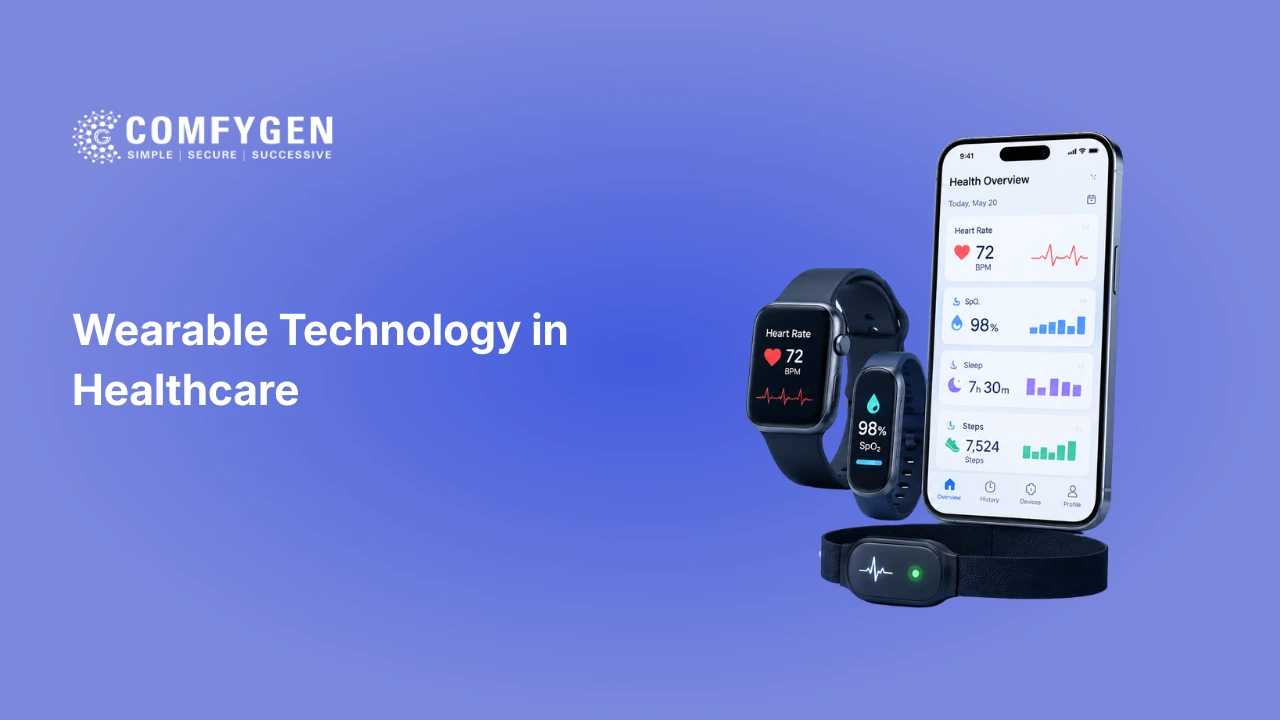





Want to integrate wearable health technology into your healthcare app? We develop custom healthcare apps that provide real-time health monitoring, data insights, and improved patient care.
Healthcare apps are the trendiest and one of the most highly used applications in today’s generation. The health-conscious generation wants to keep track of their vitals and know their health status. This has driven the demand for wearable devices and their compatibility with healthcare apps. Wearable apps have now become a major part of healthcare app development.
Let’s discuss in detail the wearable app development, including types and top features as well as the benefits of wearable technology in healthcare to users;
What Is Wearable Technology in Healthcare?
Wearable technology in healthcare refers to electronic devices worn on or close to the body that continuously monitor physiological data and transmit it to healthcare applications, clinical systems, or remote care providers. These devices capture real-time health metrics such as heart rate, blood oxygen saturation, blood glucose, body temperature, electrical cardiac activity, and physical activity levels.
What separates healthcare wearables from general consumer gadgets is their purpose. A smartwatch that counts steps is a fitness accessory. A wearable ECG monitor that detects atrial fibrillation and alerts a cardiologist is a medical tool. The distinction matters because it determines regulatory requirements, data handling obligations, and how the device integrates with clinical workflows.
For healthcare app developers and digital health product teams, wearable integration is no longer optional. Roughly 35% of US adults are already using wearable healthcare devices, and nearly half have indicated willingness to share that data directly with their healthcare providers. The infrastructure to act on that data, including the apps, APIs, and backend systems that make it clinically useful, is where healthcare app development companies like Comfygen add real value.
Wearable Health Technology Market: 2026 Overview
The numbers confirm what clinicians and digital health investors already sense: wearable healthcare technology is one of the fastest-growing segments in the entire health IT sector.
The global wearable medical devices market was valued at approximately $103 billion in 2025 and is projected to grow to $117.41 billion in 2026, with forecasts pointing to $505 billion by 2034 at a 20% CAGR (Fortune Business Insights, 2026). A parallel estimate from Grand View Research puts 2025 market size at $53.98 billion growing to $168.29 billion by 2030 at a 25.53% CAGR (Grand View Research).
Variations across research firms reflect different scope definitions, but the directional signal is consistent: demand is accelerating across every segment.
Key regional data for 2026:
North America: $53.37 billion, representing 45.7% of global market share
Europe: $33.88 billion, driven by an aging population and rising chronic disease prevalence
Asia Pacific: $19.68 billion in 2026, with India projected to reach $3.29 billion and China $5.31 billion
Asia Pacific growth rate: 13.1–16.4% CAGR, the fastest-growing region globally
Three structural forces are driving this growth:
Chronic disease prevalence: The WHO reported a four-fold increase in diabetic cases over the past few decades. Cardiovascular disease affects 2.4 million Canadians alone. Managing these conditions at scale requires continuous monitoring, not periodic clinical visits.
Remote patient monitoring adoption: CMS expanded CPT codes 99453, 99454, 99457, and 99458 to compensate clinicians for reviewing remotely generated physiologic data. This policy change transformed wearable monitoring from pilot programs into reimbursable nationwide clinical practice.
AI and 5G convergence: By early 2023, global 5G subscribers exceeded 1.1 billion, enabling real-time data transfer speeds that support continuous vital sign streaming. Combined with AI-powered predictive models, wearables can now flag deteriorating patient conditions hours before a clinical event.
For software development firms and healthcare organizations, the opportunity is in building the applications that make wearable data medically actionable.
Types of Wearable Devices in Healthcare
Understanding the device landscape is necessary before deciding how to build around it. Healthcare wearables span a wide range of form factors and clinical applications.
Smartwatches
Consumer smartwatches from Apple, Samsung, Fitbit, and Garmin are the most widely adopted wearable devices globally. Modern models include optical heart rate sensors, SpO2 monitors, skin temperature sensors, and in some cases, single-lead ECG capability. The Apple Watch Series 9 and Samsung Galaxy Watch 7 both carry FDA clearance for their ECG features. For April 2025, Stanford Medicine and Samsung announced a research partnership specifically to refine the Galaxy Watch’s sleep apnea detection.
Continuous Glucose Monitors (CGMs)
CGMs are among the most clinically significant wearable devices in current use. Devices from Abbott (FreeStyle Libre) and Dexcom provide continuous subcutaneous glucose readings every few minutes, transmitted wirelessly to smartphones or dedicated receivers. Abbott’s LibreLinkUp feature allows family members to monitor readings alongside the patient. Dexcom received FDA clearance for its G7 system, which integrates with automated insulin delivery systems. For patients with Type 1 or Type 2 diabetes, CGMs reduce the burden of finger-stick testing and enable much tighter glycemic control.
Wearable ECG Monitors
Cardiac rhythm monitoring has moved well beyond the clinic. Wearable ECG patches like the Zio Patch from iRhythm can continuously record cardiac electrical activity for up to 14 days, capturing arrhythmias that a standard 12-lead ECG would miss entirely. In February 2025, VitalConnect raised $100 million to commercialize its arrhythmia-detecting heart monitor. These devices are designed to transmit data to cardiologists and integrate with hospital cardiac monitoring systems.
Blood Pressure Monitors
Ambulatory blood pressure monitoring has long been a clinical tool, but wearable form factors are making continuous BP tracking practical outside the clinic. BioBeat Technologies received FDA clearance for an ambulatory blood pressure monitoring wearable in the 2024–2025 timeframe. Accurate, continuous BP data is particularly valuable for managing hypertension, where single-point clinic readings often fail to capture the full picture.
Smart Patches and Biosensors
Adhesive patches that monitor temperature, heart rate, respiratory rate, and movement are seeing rapid growth. AI-enabled biosensors that detect multiple biomarkers on a single patch are among the fastest-innovating products in the market. These patches are used for post-surgical monitoring, infection surveillance, and early sepsis detection in hospital settings.
Fitness Trackers and Activity Monitors
Activity monitors from Fitbit, Garmin, and Whoop track steps, calories, sleep stages, heart rate variability, and recovery metrics. While consumer-grade devices don’t meet clinical accuracy standards for most diagnostic purposes, their widespread adoption provides population-level health data at a scale that clinical devices cannot match. Whoop received FDA clearance for an ECG feature, signaling the blurring boundary between consumer fitness and clinical monitoring.
Smart Hearing Aids
Modern hearing aids from manufacturers like Starkey include accelerometers for fall detection, heart rate monitoring, and translation capabilities. They transmit data to companion apps and, through integration APIs, to healthcare provider systems.
Remote Patient Monitoring Devices
Dedicated remote patient monitoring (RPM) systems from companies like Philips, Medtronic, and Withings combine multiple sensors in a structured home monitoring kit. These systems connect directly to clinical monitoring platforms and are designed for post-discharge monitoring of cardiac patients, COPD patients, and patients recovering from surgery.
Medical-Grade vs. Consumer-Grade Wearables
This distinction shapes every decision in healthcare wearable app development, from compliance requirements to integration architecture.
|
Factor |
Consumer-Grade |
Medical-Grade |
|---|---|---|
| Regulatory oversight | Minimal (FTC, general consumer protection) | FDA clearance or CE marking required |
| Clinical accuracy | Variable; adequate for wellness, not diagnosis | Validated against clinical gold standards |
| Data security requirements | Standard app security | HIPAA/GDPR mandatory |
| Integration with EHR | Limited, often requires middleware | Designed for clinical system integration |
| Reimbursement eligibility | Generally not reimbursable | CMS-reimbursable in RPM programs |
| Examples | Fitbit Charge 6, Apple Watch (basic) | Dexcom G7, Zio Patch, BioBeat BP monitor |
Consumer-grade devices like Fitbits and basic Apple Watches are designed for everyday users to track wellness metrics. They’re not validated for clinical decision-making and cannot serve as the basis for diagnosing or treating conditions. Using consumer wearable data to make clinical decisions without appropriate validation is both clinically risky and potentially legally problematic.
Medical-grade wearables are developed under regulatory oversight, validated through clinical research, and in many cases cleared by the FDA or certified under the EU Medical Device Regulation. They’re designed to integrate with existing healthcare systems: EHRs, clinical monitoring platforms, and remote patient monitoring dashboards.
For app development purposes, both have a role. A health tracking app for a wellness platform can reasonably connect to consumer wearables via Apple HealthKit or Google Health Connect. A clinical remote monitoring application must integrate with medically validated devices and meet the full range of regulatory requirements.
Benefits of Wearable Health Technology for Patients and Providers
The case for wearable technology in healthcare is grounded in specific, measurable outcomes, not general enthusiasm for digital health.
Continuous Monitoring vs. Episodic Care
Traditional healthcare is episodic. A patient sees their cardiologist every three months and has their blood pressure measured once in the exam room. That single reading may not reflect the patient’s typical state at all. Wearable devices shift this to continuous monitoring, capturing data across the full range of a patient’s daily life. For conditions like atrial fibrillation, hypertension, and diabetes, this continuity is clinically essential. Wearable cardiac monitors capture data that standard ECGs miss entirely.
Earlier Intervention and Preventive Care
Continuous vital sign data enables predictive alerts before a patient deteriorates to the point of requiring emergency care. Smart patches used in hospital settings for post-surgical patients can flag early signs of sepsis, which is a condition where hours of early intervention significantly affect outcomes. AI-enabled CGMs can predict glucose fluctuations in response to food, activity, and other lifestyle factors, enabling timely insulin adjustments.
Reduced Healthcare Costs and Hospital Visits
Remote patient monitoring reduces the need for in-person visits and, for appropriate patient populations, can safely reduce hospital readmissions. With healthcare systems under constant pressure to do more with constrained resources, keeping stable patients monitored at home rather than in a clinic or hospital is both clinically sound and economically rational.
Patient Engagement and Self-Management
Consumer-grade wearables, while not clinically validated, still encourage patients to take ownership of their health. Tracking daily activity, sleep patterns, and heart rate encourages healthier behavior and gives patients data to discuss with their providers. For chronic conditions where patient behavior drives outcomes, this engagement effect is significant.
Population Health Research
Aggregated, anonymized data from wearable devices is already reshaping public health research. During the COVID-19 pandemic, researchers from the Robert Koch Institute used anonymous wearable device data (pulse, activity, sleep, regional weather data) to forecast outbreak probabilities up to four days in advance (Roche Diagnostics / Roche Healthcare Transformers, 2026). This demonstrates that at-scale wearable data has applications well beyond individual patient monitoring.
Types of Wearable Healthcare Apps
Before building or integrating, it’s worth clarifying what category of application you’re actually building. Healthcare wearable apps fall into three main types.
Standalone Wearable Apps
These run directly on the wearable device without requiring a smartphone connection. They process data on-device and can connect directly to the internet via Wi-Fi or cellular. A fitness tracker that logs activity and syncs to a cloud dashboard without requiring a phone is a standalone app. The technical constraint here is battery life and processing power; complex AI inference typically still happens in the cloud.
Companion Apps
Companion apps run on a smartphone and pair with a wearable device. The wearable handles sensor data capture; the phone handles heavier computation, display, and connectivity. Most consumer health wearable ecosystems (Apple Watch + iPhone, Fitbit + Android, Garmin + Garmin Connect) operate on this model. The app receives data from the wearable, processes and displays it, and can push notifications or alerts to the wearable.
Clinical Integration Apps
These connect wearable devices to healthcare systems: EHRs, clinical monitoring platforms, hospital information systems. They handle the data mapping, compliance requirements, and secure data transmission that turn raw wearable data into clinically usable information. Building this category of app is significantly more complex than building a companion app and requires deep knowledge of healthcare interoperability standards. This is where Comfygen’s healthcare software development capability is most relevant.
Build Your Healthcare Wearable Solution
Transform your healthcare vision into a secure, scalable wearable application with expert development tailored to your business goals.
Start Your Project
Key Features to Build Into Wearable Healthcare Apps
Whether you’re building a standalone, companion, or clinical integration app, certain features are foundational to any healthcare wearable application.
Real-Time Data Synchronization
The ability to sync health data between the wearable device and the app backend in near-real time is the core capability of any wearable healthcare application. This requires reliable Bluetooth Low Energy (BLE) connectivity for local device pairing, WebSocket or MQTT protocols for continuous data streaming, efficient data compression to manage bandwidth and battery consumption, and conflict resolution logic when data gaps occur during connectivity interruptions.
Cross-Device and Cross-Platform Compatibility
A healthcare wearable app that only works on one device or one operating system has limited reach. Cross-platform compatibility across iOS and Android, and across multiple wearable manufacturers (Apple Watch, Fitbit, Garmin, Samsung), requires careful API management. Apple HealthKit, Google Health Connect, and Samsung Health SDK are the three primary data aggregation platforms, each with distinct data models and permission frameworks. Our mobile app development team builds wearable integrations that work across all major platforms without requiring separate codebases.
Health and Fitness Metric Tracking
Core health metrics that wearable apps should track include heart rate and heart rate variability (HRV), blood oxygen saturation (SpO2), blood glucose (for CGM-integrated apps), blood pressure, sleep stages and sleep quality scores, step count and physical activity, respiratory rate, and skin temperature. Each metric requires its own data validation logic to handle sensor noise, outlier detection, and device-specific calibration differences.
Intelligent Alerts and Notifications
Raw health data is not useful to most users. What matters is context. An alert that fires when a user’s resting heart rate spikes above their personal baseline, or when a diabetic patient’s glucose is trending toward hypoglycemia, is clinically meaningful. Building this requires per-user baseline modeling, threshold configuration, and alert delivery that distinguishes between urgent clinical alerts and routine wellness notifications.
Personalization and User Preferences
Effective healthcare wearable apps adapt to the individual user. This includes personal health goal tracking, configurable metric thresholds and alert levels, dashboard customization to surface the metrics most relevant to the user’s condition, and preference settings for notification timing and communication channels.
Role-Based Dashboards for Clinical Use
When a healthcare app serves both patients and clinicians, different users need different views. A patient sees their own data, trends, and alerts. A physician monitoring multiple patients sees an aggregate view with the ability to drill into individual patient data, flag concerns, and document clinical decisions. Building these multi-role dashboards requires role-based access control built into the application architecture from the start.
Offline Functionality
Patients don’t always have reliable internet connectivity. Wearable apps need to store data locally when connectivity is unavailable, then sync automatically when the connection is restored. This requires careful handling of data conflicts when offline-captured data is uploaded alongside real-time data.
Integration with EHR and Clinical Systems
For clinical-grade wearable applications, data must flow into the patient’s electronic health record. This is achieved through HL7 FHIR R4 APIs, which define standardized data formats for healthcare observations, vital signs, and patient data. Without this integration, wearable data sits in a separate silo, disconnected from the clinical context that makes it useful.
Security and Data Protection
Authentication (biometric or multi-factor), data encryption at rest and in transit (AES-256, TLS 1.2+), audit logging of all data access, and automatic session timeout are baseline security requirements for any healthcare application handling personal health data. For applications serving US patients, HIPAA compliance is mandatory. For EU patients, GDPR applies. Our team’s work on HIPAA compliance in mobile health apps covers these requirements in detail.
How to Integrate Wearable Devices into a Healthcare App
Integration is where most healthcare app development projects encounter real complexity. Here’s the structured process our development team follows.
Step 1: Define the Clinical Use Case and Device Scope
Before writing a line of code, be specific about what clinical problem you’re solving. Are you monitoring post-surgical patients for early infection? Managing diabetic patients’ glucose at home? Tracking cardiac patients after a procedure? The use case determines which devices are clinically appropriate, which metrics matter, how frequently data must sync, and what the alert logic should be.
Device scope matters equally. Supporting one device is manageable. Supporting 15 device brands across iOS and Android multiplies integration complexity significantly. Start with the one or two devices that your target users actually use, then expand.
Step 2: Select the Right APIs and Data Protocols
Apple HealthKit
Apple HealthKit is the primary integration point for iOS health wearables. HealthKit provides a centralized health data repository on iPhone that third-party apps (including your app) can read from and write to, with explicit user permission for each data type. Apple Watch data flows through HealthKit automatically.
Google Health Connect
Google Health Connect is the Android equivalent. Released in 2022 and now deeply integrated into Android 14+, Health Connect provides a unified data store for health and fitness metrics from all Android-compatible wearables. Fitbit, Samsung Health, and Garmin all write to Health Connect, making it the single integration target for most Android wearable data.
Device-specific SDKs
Device-specific SDKs are necessary when you need to access proprietary data that isn’t exposed through HealthKit or Health Connect, or when you need lower-level device control. Garmin’s Connect IQ SDK, Fitbit’s Web API, and Samsung’s Health SDK all provide capabilities beyond what platform-level APIs expose.
HL7 FHIR R4
HL7 FHIR R4 is the standard for pushing wearable data into clinical systems. FHIR Observation resources are the appropriate data type for vital sign measurements from wearables. A 2025 case study demonstrated that Garmin wearable data could be mapped into a FHIR-compliant format for the European Health Data Space, and Google has added FHIR-based medical records support to Health Connect.
IoMT (Internet of Medical Things)
IoMT (Internet of Medical Things) connectivity via MQTT or WebSockets handles continuous real-time data streaming from devices to cloud backends, particularly for clinical monitoring devices that transmit continuously rather than in batches.
Step 3: Establish Secure Connectivity and Data Transmission
Bluetooth Low Energy (BLE) is the standard for local device-to-phone data transfer. BLE is power-efficient and sufficient for most wearable data volumes. Implementing BLE correctly requires handling device discovery and pairing, reconnection logic when connections drop, background data collection when the app is not in the foreground, and battery optimization to prevent excessive power drain on the wearable.
Wi-Fi and cellular are used when the wearable has direct internet connectivity or when data must be transmitted to the cloud backend. Clinical monitoring devices for hospital settings typically use Wi-Fi to ensure continuous connectivity.
Data encryption must be applied at every step. Data in transit requires TLS 1.2 or higher. Data at rest on the device requires AES-256 encryption. For any application handling ePHI (electronic Protected Health Information), these are HIPAA Technical Safeguard requirements, not optional enhancements.
Step 4: Data Processing, Validation, and Storage
Raw sensor data from wearables requires processing before it’s clinically useful. This includes:
Noise filtering: Accelerometer data contains motion artifacts that can corrupt heart rate readings. Signal processing algorithms (Kalman filters, moving averages) clean the raw signal before clinical metrics are derived.
Outlier detection: A sudden heart rate reading of 220 bpm in a resting adult is almost certainly a sensor artifact, not a real measurement. Validation logic flags and handles implausible values.
Derived metric calculation: Many clinically useful metrics are calculated from raw sensor data. HRV (heart rate variability) is derived from R-R intervals in ECG data. Sleep stage classification is derived from accelerometer, heart rate, and SpO2 data.
Storage architecture: Use SQLite or Realm for local on-device storage to enable offline functionality. Cloud storage (AWS S3, Google Cloud Storage, Azure Blob) handles the longer-term data archive and enables data sharing across devices and with clinical systems. Data compression reduces storage costs and transmission time for high-frequency sensor streams.
Step 5: Regulatory Compliance and Security Implementation
Compliance must be built into the architecture, not added later.
For US applications: HIPAA compliance requires a signed Business Associate Agreement (BAA) with any cloud service provider that processes health data, role-based access controls, audit logs, breach notification procedures, and a Risk Analysis documenting how ePHI is protected.
For EU applications: GDPR requires explicit consent for health data processing, data minimization (collect only what’s necessary), the right to erasure, and data processing agreements with vendors.
For the application itself: ISO 27001 information security certification and SOC 2 Type II audits provide evidence of security controls that healthcare customers increasingly require from software vendors.
If the application functions as a medical device (it makes clinical claims or is used to diagnose or treat), FDA 510(k) clearance or CE marking under the EU Medical Device Regulation may be required. The FDA has published specific guidance on Software as a Medical Device (SaMD).
Step 6: EHR Integration
Connecting wearable data to EHR systems is what makes it clinically useful for providers. The integration pathway depends on which EHR the target clinical organization uses.
Epic: Integration uses Epic’s FHIR API and Interconnect. Epic supports SMART on FHIR applications that run within the Epic environment. Building an Epic-integrated wearable app requires access to Epic’s developer sandbox (MyChart Developer Program) and navigation of their credentialing process.
Oracle Health (Cerner): Cerner’s FHIR R4 API supports third-party application integration. The HealtheIntent platform provides population health analytics capabilities.
athenahealth, eClinicalWorks, DrChrono: These midmarket EHRs have more accessible FHIR API programs and are often the target for wearable integrations with independent practices and outpatient clinics.
A 2024 HIMSS report found that 78% of healthcare providers using HL7 FHIR experienced faster care coordination, which underscores why FHIR investment pays off in clinical practice.
Step 7: Testing and Quality Assurance
Wearable healthcare app testing is more complex than standard mobile app testing because it requires physical device testing across multiple hardware models, testing under real-world connectivity conditions (BLE dropout, intermittent Wi-Fi), clinical accuracy validation of derived health metrics, HIPAA compliance audit, penetration testing, and performance testing under realistic data volumes (e.g., continuous 24/7 sensor data from 10,000 patients simultaneously).
FHIR and HL7: The Integration Standards That Matter
For anyone building healthcare software that integrates with clinical systems, HL7 FHIR is the most important standard to understand.
HL7 (Health Level Seven International) is the non-profit standards organization that has defined healthcare data exchange standards since the 1980s. HL7 v2.x messages are still the most widely deployed standard in hospitals globally, used for lab results, ADT (admission, discharge, transfer) events, and order communications.
FHIR (Fast Healthcare Interoperability Resources) is HL7’s modern standard, released as the current stable version (R4) in 2019 and adopted as a regulatory requirement by CMS and ONC in the US. Unlike HL7 v2, which uses pipe-delimited text messages, FHIR uses RESTful APIs with JSON or XML payloads. This makes FHIR significantly more accessible to modern web and mobile developers.
For wearable device integration specifically, FHIR Observation resources represent vital sign measurements. A heart rate reading from an Apple Watch, a glucose measurement from a Dexcom, and a blood pressure reading from a wearable cuff all map to FHIR Observation resources with appropriate LOINC codes (the clinical coding system for laboratory and clinical observations).
By the time FHIR R6 launches, the standard is expected to be even more deeply embedded in AI-driven care, remote monitoring, and cross-border data exchange. Organizations investing in FHIR-based wearable integration now are building on infrastructure that will remain relevant.
The practical reality in 2026 is that consumer wearables are still largely disconnected from FHIR. The standard was designed for clinical health data, and mapping consumer fitness metrics to FHIR resources adds complexity without clear benefits for most consumer app use cases. The practical solution for most developers is to use health data aggregation APIs (HealthKit, Health Connect) for consumer wearable integration, and FHIR for clinical system integration.
Turn Your Wearable Healthcare Idea Into Reality
Build feature-rich wearable healthcare applications with seamless integrations, regulatory compliance, and exceptional user experiences from day one.
Talk to Our Experts
AI and Machine Learning in Wearable Health Monitoring
AI is what separates a wearable device that collects data from one that generates clinical insight. In 2026, AI capabilities in healthcare wearables span a range of applications.
Predictive Analytics and Early Warning
Machine learning models trained on historical patient data can identify patterns in wearable sensor data that precede clinical deterioration. A patient’s declining heart rate variability, increasing resting heart rate, and worsening sleep quality over several days may predict a cardiac event before symptoms appear. These early warning systems require models trained on population-level data and personalized to individual baselines.
Autonomous Medical Coding from Wearable Data
When wearable data is integrated into clinical workflows, AI can automatically identify clinically significant findings (an ECG strip showing atrial fibrillation, a sleep study showing sleep apnea events) and suggest appropriate ICD-10 codes, reducing documentation burden on clinicians.
Natural Language Processing for Symptom Context
AI-powered symptom logging allows patients to describe how they feel in natural language (“I’ve felt tired and short of breath since yesterday afternoon”). NLP models extract structured data from these descriptions and correlate them with objective wearable measurements, providing richer clinical context.
Personalized Baseline Modeling
Every person’s physiology is different. A resting heart rate of 55 bpm is normal for a trained athlete but potentially concerning for a sedentary 60-year-old. AI models that establish individual baselines and generate alerts relative to those baselines reduce false positive rates dramatically compared to fixed population thresholds.
Glucose Prediction (CGM + AI)
AI-enabled CGMs can predict glucose fluctuations before they occur based on meal intake patterns, activity levels, and time-of-day rhythms. This capability has transformed diabetes management by enabling proactive rather than reactive insulin adjustments. The Roche Healthcare Transformers article notes that AI-enabled CGMs can predict glucose fluctuations throughout the day and substantially improve diabetes management compared to traditional self-monitoring.
Our AI development and machine learning in healthcare expertise enables us to build these predictive capabilities directly into wearable healthcare applications, connecting real-time sensor streams to trained models for continuous health monitoring.
Data Privacy, HIPAA, and Regulatory Compliance
Data from wearable devices raises significant privacy and regulatory questions that must be addressed in the application architecture, not patched on afterward.
When Wearable Data Becomes ePHI
Not all wearable data is regulated health information. A fitness tracker recording steps is generally outside HIPAA’s scope because it’s not connected to a healthcare provider relationship or insurance transaction. But when that same heart rate data flows into a clinical monitoring platform, gets accessed by a physician, or is used to support insurance coverage decisions, it becomes electronic Protected Health Information (ePHI) subject to HIPAA requirements.
The practical question for developers is whether the application creates, receives, maintains, or transmits ePHI on behalf of a Covered Entity (hospital, physician practice, health plan). If yes, the software developer is a Business Associate and must sign a Business Associate Agreement and implement HIPAA’s three categories of safeguards.
HIPAA Technical Safeguards for Wearable Apps
- Encryption: All ePHI must be encrypted in transit (TLS 1.2+) and at rest (AES-256). This applies to data stored on the device, data transmitted over Bluetooth, and data stored in the cloud backend.
- Access controls: Unique user identification for every user, automatic session logout, role-based access limiting each user to only the data their role requires.
- Audit controls: Every access to ePHI must be logged with user identity, timestamp, and action taken.
- Integrity controls: Mechanisms to detect unauthorized alteration of ePHI.
- Transmission security: End-to-end encryption for all data transmission, including the BLE connection between wearable and phone.
GDPR for European Wearable Health Apps
The General Data Protection Regulation classifies health data as a special category requiring explicit consent for processing. This means users must actively opt in to health data collection (pre-ticked boxes don’t count), they can request erasure of their data, and the app must specify exactly what data is collected, how it’s used, and how long it’s retained. Data minimization principles restrict collection to what’s genuinely necessary.
India: DPDP Act 2023
India’s Digital Personal Data Protection Act, which came into force in 2023, classifies health data as sensitive personal data requiring specific consent. Healthcare app developers serving Indian users must implement consent management that meets DPDP requirements alongside any international standards.
FDA Regulation of SaMD
If your wearable application makes clinical claims (“this app diagnoses atrial fibrillation”), it may qualify as Software as a Medical Device under FDA regulations. The FDA distinguishes between software that is merely used in a healthcare context versus software that performs a diagnostic or therapeutic function. Applications in the latter category require FDA clearance (510(k)) or approval before they can make clinical claims in the US market.
Real-World Use Cases of Wearable Technology in Healthcare
The clinical evidence for wearable technology in healthcare is no longer theoretical. These are deployments generating real outcomes.
Diabetes Management with CGMs
Abbott’s FreeStyle Libre system is used by millions of patients globally to monitor glucose levels continuously. The system alerts patients and their connected caregivers when glucose trends toward hypoglycemia or hyperglycemia. AI-enabled versions predict glucose changes before they occur, enabling earlier intervention. Clinical studies have shown that CGM use reduces HbA1c by meaningful margins compared to finger-stick monitoring alone.
Cardiac Rhythm Monitoring
iRhythm’s Zio Patch is applied to the chest and worn continuously for up to 14 days, capturing a continuous ECG recording. The patch is then returned and analyzed by AI to identify arrhythmias, which are submitted to a cardiologist for review. This approach captures rare but clinically significant events that a 24-hour Holter monitor routinely misses.
Remote Post-Surgical Monitoring
Hospitals are using wearable vital sign patches to monitor patients at home after discharge. Smart patches measuring heart rate, respiratory rate, temperature, and SpO2 can detect early signs of post-surgical complications, potentially reducing readmissions and enabling earlier intervention when complications do occur.
COVID-19 Public Health Forecasting
During the COVID-19 pandemic, researchers from the Robert Koch Institute used aggregated, anonymized wearable data (pulse, activity, sleep, temperature, regional weather data) to forecast COVID-19 outbreak probabilities up to four days in advance. This represents a new application of wearable data for population health surveillance at a scale that was previously impossible.
Sleep Apnea Detection
In April 2025, Stanford Medicine partnered with Samsung specifically to refine the Galaxy Watch’s sleep apnea detection capabilities and investigate AI-enabled solutions for continuous sleep health management. Sleep apnea is significantly underdiagnosed; a wearable that can flag likely cases for follow-up sleep study referral could meaningfully improve diagnosis rates at scale.
Bring Connected Healthcare to Life
Design and deploy wearable healthcare applications that enable real-time monitoring, actionable insights, and improved care experiences.
Discuss Your Requirements
Wearable Health App Development Cost
Development costs for wearable healthcare apps vary significantly based on clinical complexity, integration scope, compliance requirements, and the number of devices and platforms supported.
By Project Scope
|
Scope |
Description | Cost Range |
Timeline |
|---|---|---|---|
| Consumer Health App | Companion app for 1-2 consumer wearables, wellness tracking, HealthKit/Health Connect integration | $20,000–$60,000 | 3–5 months |
| Clinical Companion App | Wearable integration + clinical alerts + patient-provider data sharing, HIPAA-compliant | $60,000–$150,000 | 5–9 months |
| Remote Patient Monitoring Platform | Multi-device integration, EHR connectivity (FHIR), clinical dashboards, AI-powered alerts | $120,000–$280,000 | 8–14 months |
| Enterprise RPM or Hospital Platform | Multi-location, multi-role, full EHR integration (Epic/Cerner), AI/ML pipeline, FDA SaMD compliance | $250,000–$500,000+ | 12–20 months |
Key Cost Drivers
Compliance requirements are the biggest single variable. HIPAA infrastructure (encryption, RBAC, audit trails, penetration testing) adds $25,000–$80,000 on top of base development. FDA SaMD clearance pursuit adds $50,000–$200,000+ in additional compliance and testing cost.
EHR integration with Epic or Oracle Health adds $30,000–$80,000 per EHR system due to credentialing, sandbox access, and production validation complexity.
Number of supported devices multiplies testing and maintenance effort. Every additional device manufacturer requires its own SDK integration and ongoing testing as those SDKs are updated.
AI/ML capabilities (predictive alerts, anomaly detection, personalized baselines) add $30,000–$100,000 depending on the complexity of the models and whether you’re building custom models or integrating existing platforms.
India-Based Development Advantage
Offshore development teams in India with healthcare domain expertise typically bill at $25–$65/hour vs. $100–$200/hour for US-based agencies, delivering 40–60% cost savings for equivalent technical scope and compliance quality. The critical qualification is demonstrated healthcare experience, including HIPAA-compliant builds, HL7 FHIR integration experience, and familiarity with FDA SaMD guidance.
Why Choose Comfygen for Wearable Healthcare App Development
Comfygen is a healthcare and mobile app development company based in India, delivering custom wearable healthcare applications, clinical monitoring platforms, and health tracking solutions for clients across the US, UK, Australia, and international markets.
Our wearable healthcare development capabilities include:
Full-stack mobile app development for iOS and Android with native HealthKit, Google Health Connect, and device-specific SDK integration.
Healthcare app development expertise covering the full clinical application spectrum, from patient-facing wellness apps to hospital-grade remote monitoring platforms.
HL7 FHIR R4 integration experience connecting wearable data streams to EHR systems including Epic, Oracle Health, athenahealth, and others.
HIPAA-compliant architecture built from the ground up, including encryption, RBAC, audit trails, and BAA-ready infrastructure.
AI development capabilities for predictive health analytics, anomaly detection, personalized alert systems, and machine learning pipelines for wearable data.
IoT development expertise in BLE device connectivity, IoMT architecture, and real-time sensor data processing.
Contact Comfygen for Wearable Healthcare App Development:
- WhatsApp: +91 958-786-7258
- Email: sales@comfygen.com
FAQs
What is wearable technology in healthcare?
What are the main types of wearable devices used in healthcare?
What is the difference between medical-grade and consumer-grade wearables?
How do wearable devices connect to healthcare apps?
What is FHIR and why does it matter for wearable health integration?
What AI capabilities can be built into wearable health apps?
How much does it cost to develop a wearable healthcare app?
How does Comfygen approach wearable healthcare app development?

Mr. Saddam Husen, (CTO)
Mr. Saddam Husen, CTO at Comfygen, is a renowned Blockchain expert and IT consultant with extensive experience in blockchain development, crypto wallets, DeFi, ICOs, and smart contracts. Passionate about digital transformation, he helps businesses harness blockchain technology’s potential, driving innovation and enhancing IT infrastructure for global success.