




The global healthcare IT market is moving fast. Industry estimates put it at roughly $0.55 trillion in 2026, growing at a compound annual rate of around 16 percent through 2031, as hospitals, clinics, and health-tech startups replace paper records and outdated tools with modern systems. Healthcare software development sits right in the middle of that shift.
If you are planning to build healthcare software, whether it is an EHR system, a telemedicine app, a hospital management tool, or a mobile health app, this guide walks you through what to build, how to stay compliant, what it costs, and how to choose the right development partner.
What Is Healthcare Software Development?
Healthcare software development is the process of designing, building, testing, and maintaining digital tools that hospitals, clinics, pharmacies, insurers, and patients use to manage health information, deliver care, and run healthcare businesses. It covers a wide range of products, including electronic health records (EHR), telemedicine platforms, hospital management systems, medical billing software, patient engagement apps, and software built into connected medical devices.
Software development for healthcare carries more weight than most other industries. A bug in a shopping app annoys a few customers. A bug in medical software development can delay treatment, expose patient records, or trigger regulatory fines. That is why developing software for the healthcare industry has to account for compliance, data security, and interoperability with existing systems from day one, not as something bolted on later.
Healthcare Software Development Market: Why Now Is the Right Time
Several forces are pushing healthcare providers and entrepreneurs toward custom healthcare software development at the same time.
- Market growth: The global healthcare IT market is projected to grow from roughly $0.55 trillion in 2026 to $1.16 trillion by 2031, at a CAGR near 16 percent. The software segment specifically is growing even faster than services.
- Mandatory interoperability rules: Regulators in the US and EU are pushing hospitals to make patient data portable, which is driving fresh demand for EHR integration and data exchange tools.
- Cloud migration: Healthcare providers are replacing on-premises systems with cloud-native platforms, which is reshaping how new healthcare management software gets built and deployed.
- AI adoption: AI-driven analytics, clinical decision support, and diagnostic tools are moving from pilot projects to production systems inside hospitals and clinics.
- Patient expectations: Patients now expect the same convenience from healthcare apps that they get from banking or food delivery apps, which is fueling demand for mobile healthcare software development.
For startups and healthcare providers, this means there is real budget and real urgency behind healthcare software development projects right now, but it also means the bar for compliance and user experience keeps rising.
Types of Healthcare Software You Can Build
Developing software for the healthcare industry covers far more than EHRs and appointment booking. Here is a practical breakdown by category.
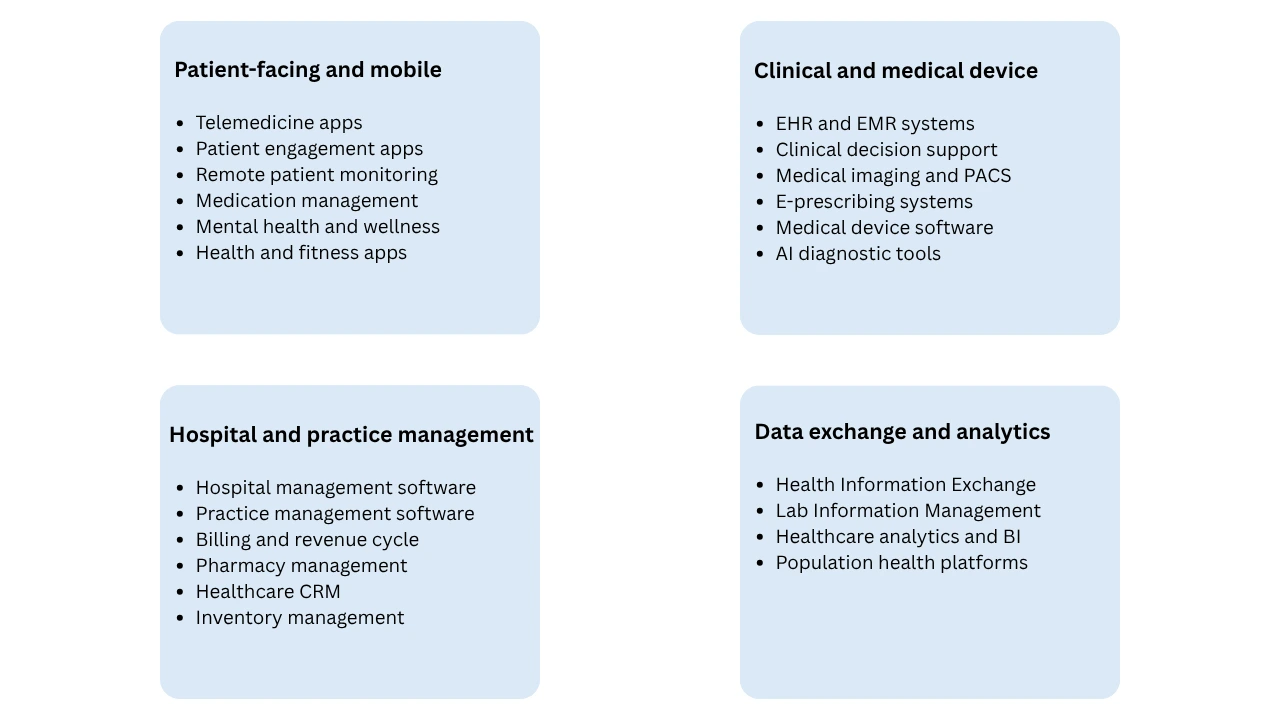
Patient-Facing and Mobile Healthcare Software
This category is where mobile healthcare software development matters most, since patients interact with these tools directly from their phones.
- Telemedicine apps for video consultations, e-prescriptions, and remote follow-ups.
- Patient engagement apps for appointment booking, lab results, and care plan tracking.
- Remote patient monitoring apps that pull data from wearables and connected devices to track vitals in real time.
- Medication management apps for prescription reminders and refill tracking.
- Mental health and wellness apps with mood tracking, guided exercises, and teletherapy booking.
- Health and fitness apps for nutrition health tracking, activity monitoring, and preventive care nudges.
Clinical and Medical Device Software
This is the more regulated end of medical software development, often classified as Software as a Medical Device (SaMD).
- Electronic Health Records (EHR) and Electronic Medical Records (EMR) for storing and sharing patient medical histories across providers.
- Clinical Decision Support Systems (CDSS) that help clinicians make evidence-based decisions at the point of care.
- Medical imaging and PACS software for storing, retrieving, and sharing X-rays, MRIs, and CT scans.
- E-prescribing systems for digital medication orders sent directly to pharmacies.
- Medical device software embedded in or connected to physical devices, where safety classification and certification requirements apply.
- AI-powered diagnostic tools that flag anomalies in scans or lab results for clinician review.
Hospital and Practice Management Softwar
This is where most healthcare management software development requests come from, since it directly affects day-to-day operations.
- Hospital management software for scheduling, admissions, discharge and transfer (ADT), and staff coordination.
- Practice management software for doctor appointment scheduling, billing, and front-desk workflows in clinics.
- Medical billing and revenue cycle management (RCM) software for claims, reimbursements, and financial reporting.
- Pharmacy management software for inventory, prescription processing, and point-of-sale billing.
- Healthcare CRM software for managing patient communication, follow-ups, and referrals.
- Medical inventory management software to track supplies, equipment, and medication stock levels.
Data Exchange, Analytics, and Information Systems
- Health Information Exchange (HIE) software for secure data sharing between hospitals, labs, and insurers.
- Laboratory Information Management Systems (LIMS) for sample tracking and lab result sharing.
- Healthcare analytics and business intelligence software for tracking outcomes, costs, and operational performance.
- Population health management platforms that help providers manage care for patient groups, not just individuals.
Build Healthcare Software That Enhances Patient Outcomes
Leverage modern technologies like AI, cloud computing, and interoperability standards to create intelligent healthcare solutions that improve operational efficiency and patient engagement.
Request a Custom Quote
Custom Healthcare Software Development vs Off-the-Shelf Solutions
Most healthcare providers and entrepreneurs face this decision early on. Both paths work, depending on the situation.
Off-the-Shelf Healthcare Software
Ready-made platforms deploy faster and cost less upfront. The tradeoff is limited customization, ongoing license fees that add up over time, vendor lock-in that makes switching expensive, and security or compliance gaps if the vendor does not support your specific region.
Custom Healthcare Software Development
A custom build is the better fit for healthcare providers and startups with workflows that off-the-shelf tools cannot handle well, or for anyone planning to scale fast. With custom healthcare software development, security and compliance are built in from the ground up instead of configured around someone else’s defaults, the product matches your exact clinical or operational workflow, and you fully own the system rather than renting access to it. The tradeoff is a longer timeline and a higher upfront investment, which usually pays off for organizations planning to operate at scale or differentiate on user experience.
Key Challenges in Healthcare Software Development
Software development for healthcare systems comes with challenges that do not show up in most other industries. Here is what to plan for.
Regulatory Compliance: HIPAA, GDPR, and More
Every healthcare software development project has to align with the regulations that apply to its users. In the US, that means HIPAA for protected health information. In the EU, it means GDPR. Software handling children’s health data needs to account for COPPA, and software built as a medical device may need FDA clearance in the US or a CE mark under EU MDR.
Practical approach: map out applicable regulations during the planning phase, not after development starts, and build audit trails, encryption, and access controls into the architecture from day one.
Interoperability: HL7, FHIR, and DICOM
Healthcare systems rarely operate in isolation. A new EHR system needs to exchange data with labs, pharmacies, insurers, and other hospitals. That is where data exchange standards come in: HL7 and FHIR for clinical data exchange, and DICOM for medical imaging.
Practical approach: design APIs around FHIR from the start rather than retrofitting interoperability later, which is far more expensive.
Data Privacy and Security
Healthcare data is one of the most valuable targets for cyberattacks, since a single patient record can be sold for far more than a stolen credit card number. End-to-end encryption, role-based access control, regular security audits, and penetration testing are not optional extras here.
Integration With Legacy Systems
Most hospitals run on a mix of systems, some of them decades old. Integrating new healthcare software development projects with legacy EHRs, PACS, or billing systems often means building custom connectors and data transformation layers, and testing thoroughly with both real and synthetic data before going live.
Designing for Multiple User Roles
A single hospital system might serve doctors, nurses, administrative staff, and patients, all with different needs and technical comfort levels. Role-specific interfaces, accessibility (WCAG compliance), and iterative usability testing with real users are what separate software people actually use from software that gets abandoned after a week.
Healthcare Software Development Process: Step by Step
Building healthcare software is not a straight line from idea to launch. It is an Agile process with extra checkpoints for compliance, healthcare app security, and clinical validation built in at every stage, because a missed requirement here costs far more to fix after launch than during planning. Here is how the process actually plays out, stage by stage.
Step 1: Market and Requirements Research
Every healthcare software development project starts with understanding who will actually use the system and what regulations apply to them. This stage involves talking to the real end users (doctors, nurses, administrative staff, or patients depending on the product), studying how competing products solve the same problem, and mapping out the specific compliance requirements for the target market early, since HIPAA, GDPR, or FDA rules can change the entire technical approach.
For a product like a telemedicine app, this stage also means deciding upfront whether the software needs to support health insurance billing, e-prescriptions, or multi-language patients, since each of those changes the requirements list significantly. The output of this stage is a requirements document and a feature priority list that both the client and development team sign off on before any design work begins.
Step 2: UI/UX Design
Healthcare software usually serves more than one type of user, and each one needs a different interface. A clinician scanning a dashboard between patients needs dense information laid out for speed. A patient using a mobile app at home needs something closer to a consumer app: simple, reassuring, and forgiving of mistakes.
This stage focuses on user flows, navigation, and information hierarchy for each role, with accessibility built in from the start rather than checked at the end. Most healthcare software needs to meet WCAG accessibility guidelines, since patients using the software often include older adults or people with visual or motor impairments. Healthcare software design decisions made here directly affect adoption: a confusing interface is one of the most common reasons hospital staff abandon new software within the first few weeks.
Step 3: Prototyping and Wireframing
Before any production code gets written, the design moves into a clickable prototype that mimics the real software’s flow without the backend behind it. This lets clinicians, administrators, or patient focus groups click through actual screens, test workflows like booking an appointment or reviewing a lab result, and flag problems while changes are still cheap to make.
Wireframes at this stage also double as a blueprint for the engineering team, mapping out every screen, component, and state (loading, error, empty) before development starts. Skipping this step is one of the most common reasons healthcare software projects run over budget, since rework after development has started costs significantly more than a design revision.
Step 4: Architecture and Compliance Planning
This is where the technical blueprint gets built. The team selects the tech stack, decides how data will move between systems, and documents exactly how the architecture will satisfy the regulations identified in Step 1.
For most projects, this means designing APIs around HL7 and FHIR standards so the software can exchange patient data with EHRs, labs, and insurers without custom one-off integrations later. It also means deciding where data lives (cloud, on-premises, or hybrid), how it gets encrypted at rest and in transit, and how access controls will be enforced by role. For software that may qualify as a medical device, this stage also includes mapping out the FDA’s Software as a Medical Device (SaMD) framework requirements, since that classification affects almost every decision downstream, including how much documentation the team needs to produce.
Step 5: Development
Coding happens in parallel sprints, with backend and frontend built side by side and reviewed against the architecture plan from Step 4. Security is not a separate phase bolted on afterward. Encryption, authentication, and access control get implemented alongside features, because retrofitting security into a finished system is slower and riskier than building it in from the start.
Depending on the project, this stage covers everything from EHR integration and database design to building the mobile clients for iOS and Android. Healthcare projects typically work in two-week sprints, with a working demo at the end of each one so the client can see real progress and catch misalignments early rather than at the final handoff.
Step 6: Security Hardening
Once core features are built, the team runs a dedicated security pass: penetration testing, vulnerability scanning, and a review of every place patient data enters, moves through, or leaves the system. This stage exists separately from regular QA because healthcare data breaches are expensive and far more damaging to trust than a typical software bug.
Practices here generally follow OWASP’s security testing guidance, with extra attention to authentication strength, session handling, and making sure third-party libraries or APIs used in the build do not introduce unvetted security gaps.
Step 7: Testing
Testing for healthcare software goes further than checking whether buttons work. It includes unit and integration testing for individual features, system testing for how everything works together, and usability testing with real clinicians or patients wherever the project allows it, since lab testing alone misses problems that only show up under real-world conditions, like a nurse trying to log vitals one-handed while holding equipment.
For software handling sensitive workflows, like dosage calculations or diagnostic suggestions, this stage also includes testing against edge cases and incorrect inputs, not just the expected happy path, since the cost of a missed error is much higher in healthcare than in most other software categories.
Step 8: Compliance Verification
Before launch, the finished product gets reviewed line by line against the compliance requirements set in research and compliance planning.
For US-facing software handling patient data, this means a final check against the technical, physical, and administrative safeguards described in the HHS HIPAA Security Rule. EU-facing software gets checked against GDPR data protection requirements, and software classified as a medical device gets reviewed against the applicable FDA or EU MDR documentation standards. This stage produces the audit trail and compliance documentation that the organization will need if a regulator or partner ever asks for it.
Step 9: Deployment and Launch
Launch usually happens in phases rather than all at once. A hospital might pilot the system in one department before rolling it out organization-wide, or a consumer health app might launch to a small beta group before a full public release. This staged approach catches problems while the blast radius is small.
This stage also includes preparing training materials and onboarding sessions for end users, since even well-designed software needs a short learning curve, and a confused first impression can hurt adoption regardless of how solid the underlying product is.
Step 10: Maintenance and Monitoring
Healthcare software is never really finished. Regulations change, clinical workflows evolve, and new integration needs come up as a hospital or health-tech business grows. This final stage covers performance monitoring, bug fixes, security patches, and feature updates over the life of the product, plus periodic compliance reviews to make sure the software still meets current HIPAA, GDPR, or FDA requirements as those rules get updated.
Looking for a Trusted Healthcare Software Development Partner?
Our experienced healthcare development team specializes in building secure, compliant, and scalable software solutions for hospitals, clinics, healthcare startups, and medical device companies worldwide.
Get a Free Project Assessment
Tech Stack for Healthcare Software Development
The right tech stack depends on the type of healthcare software you are building, but these are the categories that come up in almost every project.
|
Layer |
Common Technologies |
Why It Matters |
|
Frontend (web) |
React, Next.js, Angular |
Fast, accessible interfaces for clinician and admin dashboards |
|
Mobile |
Flutter, React Native, native iOS/Android |
Patient-facing apps for telemedicine, monitoring, and engagement |
|
Backend |
Node.js, Python, .NET, Java |
API layer connecting frontend, database, and third-party systems |
|
Database |
PostgreSQL, MongoDB, encrypted cloud storage |
Secure storage of patient and operational data |
|
Interoperability |
HL7, FHIR APIs, DICOM |
Data exchange with EHRs, labs, and imaging systems |
|
Cloud and DevOps |
AWS, Azure (HIPAA-eligible services), Docker, Kubernetes |
Scalable, compliant hosting with controlled access |
|
Security |
OAuth 2.0, AES-256 encryption, audit logging |
Meeting HIPAA/GDPR technical safeguard requirements |
Cost to Develop Healthcare Software
Healthcare software development cost depends on app complexity, platform, region of the development team, and how deep the compliance requirements go. As a general range, expect anywhere from $20,000 for a simple app to $250,000 or more for a complex, AI-driven platform.
Cost by App Complexity
Simple: Basic apps with core features like appointment booking and patient records, typically $20,000 to $50,000.
Medium: Apps with additional features such as telemedicine video, billing, or CRM integration, typically $50,000 to $100,000.
Complex: Apps with AI integration, real-time monitoring, and advanced analytics, typically $100,000 to $250,000 or more.
Cost by Platform
|
Platform |
Timeline (Months) |
Estimated Cost |
|
Android |
3 to 8 |
$25,000 to $80,000 |
|
iOS |
5 to 9 |
$35,000 to $100,000 |
|
Cross-platform |
7 to 10 |
$50,000 to $130,000 |
Cost by Development Region
|
Region |
Hourly Rate (Estimate) |
|
India |
$20 to $40 |
|
UAE |
$50 to $120 |
|
Europe |
$70 to $150 |
|
USA |
$100 to $200 |
Hidden Costs to Plan For
Compliance and legal costs (HIPAA, GDPR): $3,000 to $40,000 or more, depending on jurisdiction and audit scope.
Legacy system integration: $10,000 to $25,000 or more.
Annual maintenance and updates: $5,000 to $18,000 or more per year.
Data storage and security: $2,000 to $8,000 or more per year.
Compliance testing and audits: $3,000 to $12,000 or more.
Third-party licensing fees (APIs, tools): $2,000 to $13,000 or more per year.
How to Choose a Healthcare Software Development Company
Rather than relying on rankings alone, evaluate a medical software development services provider against these criteria.
- Healthcare-specific experience: Have they actually shipped EHR systems, telemedicine apps, or hospital management software, not just generic mobile apps?
- Compliance track record: Can they speak fluently about HIPAA, GDPR, HL7/FHIR, and walk you through how they handle audits?
- Security practices: Do they build in encryption, access control, and regular security testing as standard practice, not as an add-on?
- Mobile and cross-platform capability: If patient-facing apps are part of your roadmap, can they handle native iOS, Android, and cross-platform development well?
- Post-launch support: Healthcare software needs ongoing maintenance as regulations and clinical needs change. Ask about their support model before signing.
- Transparent process: Look for a partner who shares a clear development roadmap, realistic timelines, and upfront pricing rather than vague estimates.
Why Choose Comfygen for Healthcare Software Development
- Hands-on mobile and full-stack experience: Comfygen is one of the best healthcare app development company that builds healthcare apps, laboratory app, medicine delivery app natively for iOS and Android as well as cross-platform with Flutter and React Native, which matters for mobile healthcare software development specifically.
- Compliance-first approach: Every healthcare project is built around HIPAA and GDPR requirements from the planning stage, not bolted on at the end.
- End-to-end delivery: From EHR integration to telemedicine platforms to hospital management systems, the team handles the full development lifecycle in-house.
- Transparent engagement: Clear timelines, defined milestones, and direct communication throughout the project.
- Post-launch support: Ongoing maintenance, monitoring, and updates after launch, not just a handoff.
Final Words
Healthcare software development is not just about writing code. It is about understanding clinical workflows, building in compliance from day one, and designing for people who range from tech-savvy clinicians to patients who have never used a health app before.
Whether you are planning an EHR system, a telemedicine platform, or a mobile health app, getting the planning and compliance groundwork right early will save significant time and money later. If you have a project in mind, Comfygen’s team can walk you through a realistic scope, timeline, and cost estimate based on your specific requirements.
Frequently Asked Questions
How much does healthcare software development cost?
Costs typically range from $20,000 for a simple app to $250,000 or more for a complex, AI-driven platform. The exact number depends on app complexity, platform choice, compliance scope, and the development team's location.
How long does it take to build healthcare software?
A simple app can take 3 to 5 months. A medium-complexity app with telemedicine or billing features typically takes 5 to 9 months. Complex platforms with AI or real-time monitoring can take 9 to 14 months, partly due to compliance and certification timelines.
What is the difference between an EHR and an EMR?
An EMR (Electronic Medical Record) is a digital version of a patient's chart within a single practice. An EHR (Electronic Health Record) is broader and designed to be shared across multiple providers, giving a fuller picture of a patient's health history.
Does all healthcare software need HIPAA compliance?
Any software that creates, stores, or transmits protected health information for US-based patients or providers needs to be HIPAA compliance in mobile health apps, regardless of whether it is a hospital system or a simple medication reminder app.
Can healthcare software be built as a mobile app?
Yes. Patient-facing tools like telemedicine, remote monitoring, and medication management work well as mobile apps, while clinical and administrative systems often combine a web dashboard with companion mobile apps for on-the-go access.
Do we need a custom solution, or will an off-the-shelf tool work?
Off-the-shelf tools work well for standard workflows and smaller budgets. Custom healthcare software development is worth the extra investment when your workflows are unique, you plan to scale significantly, or you need full ownership of the system and its data.

Mr. Saddam Husen, (CTO)
Mr. Saddam Husen, CTO at Comfygen, is a renowned Blockchain expert and IT consultant with extensive experience in blockchain development, crypto wallets, DeFi, ICOs, and smart contracts. Passionate about digital transformation, he helps businesses harness blockchain technology’s potential, driving innovation and enhancing IT infrastructure for global success.