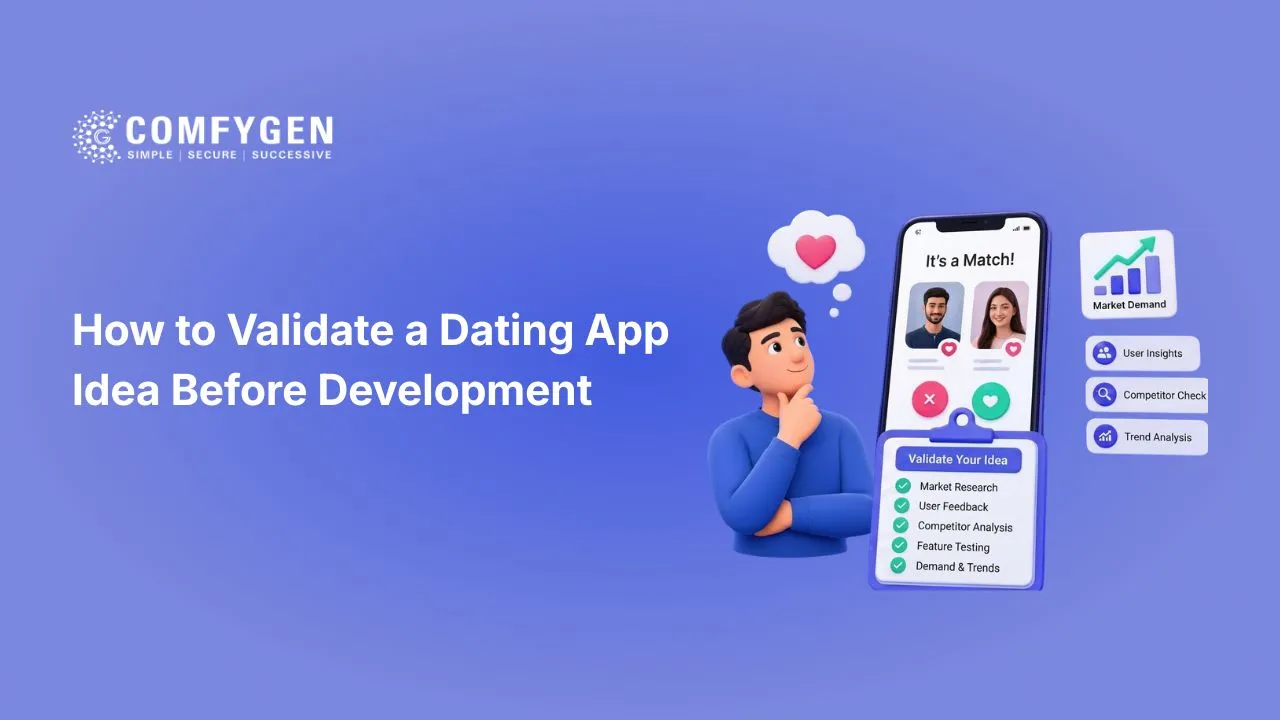





A dating app idea can look promising on paper and still fail after launch. The key question is not Can you build it? But will the right users use it, trust it, and pay for it?
Before investing in UI/UX design, app development, AI matchmaking, real-time chat, or marketing, validate the idea with real users. Proper validation helps you identify the target audience, understand their problems, study competitors, test demand, and decide which features are worth building.
For startups planning dating app development, this process can reduce unnecessary costs and turn an untested concept into a product supported by real market evidence.
What Is Dating App Idea Validation?
Dating app idea validation means testing your audience, problem, value proposition, features, business model, and market demand before committing to full development.
You can validate an idea through:
- Market and competitor research
- User interviews and surveys
- Landing pages and waitlists
- Clickable prototypes
- MVP testing
- Pricing experiments
- Early-access signups
The goal is not to prove that everyone needs your app. It is to find enough evidence that a specific group has a problem your dating platform can solve.
Why Validate a Dating App Idea?
Dating platforms must solve several challenges, including user acquisition, match quality, trust, safety, retention, and monetization. Building a complete product based on assumptions can waste development time and budget.
Validation helps you:
- Identify your ideal users
- Find a genuine dating problem
- Discover gaps in existing apps
- Prioritize MVP features
- Test your value proposition
- Understand pricing expectations
- Identify privacy and safety requirements
- Reduce unnecessary development work
1. Define Your Audience and the Problem
Who is the app for? What problem will it solve?
People who want to date is too broad. Your audience could be professionals seeking serious relationships, long-distance daters, niche communities, or users looking for better local matches.
Then identify a specific problem, such as irrelevant matches, fake profiles, excessive swiping, poor verification, spam, privacy concerns, or weak matchmaking.
Your value proposition should explain who you serve, what problem you solve, and why your solution is different.
2. Research Competitors and Real Users
Study major dating apps and niche platforms that target similar audiences. Compare their:
- Matching systems
- Profile and discovery features
- Messaging
- Verification
- Pricing
- Privacy controls
- User reviews
Negative reviews can reveal opportunities. For example, repeated complaints about fake profiles may indicate a need for better verification, while complaints about irrelevant matches may point to a better recommendation system.
Then interview potential users. Ask what apps they use, what frustrates them, why they stop using dating platforms, what makes them trust a profile, and what they would pay for.
Focus on actual behavior and past experiences, not hypothetical answers.
3. Test Your Value Proposition
Create a simple statement covering:
Audience + Problem + Difference
For example:
“A dating platform for busy professionals that reduces irrelevant matches through preference-based recommendations.”
Test different versions through surveys, landing pages, advertisements, or prototype screens. Measure which message generates the strongest response.
4. Create a Landing Page and Prototype
You do not need a finished application to test demand.
Build a landing page explaining the audience, problem, benefits, key features, and early-access offer. Track actions such as email signups and waitlist registrations.
Next, create a clickable prototype covering the core journey:
Sign Up → Profile → Preferences → Discovery → Match → Chat
Let potential users test it. Watch where they hesitate, get confused, or abandon the flow. Fixing these issues before development can save significant time and cost.
5. Prioritize Your Dating App MVP
Do not build every feature in version one. Your dating app MVP should test the core product idea.
Depending on your concept, it may include:
- Registration and profiles
- Preferences
- Profile discovery
- Matching
- Real-time chat
- Push notifications
- Profile verification
- Block and report
- Admin controls
Advanced features such as AI recommendations, voice/video calls, premium filters, and virtual gifts can come later after users show demand.
6. Validate Matching, Location, Privacy, and Safety
Test what users consider a good match. Factors may include age, location, interests, relationship goals, lifestyle, and compatibility.
If you plan a location-based dating app, find out how important proximity is and how much location information users are willing to share.
Also validate expectations around verification, reporting, blocking, unmatching, spam prevention, moderation, and privacy. Trust and safety can directly affect adoption and retention.
AI should support a validated need, such as recommendations or moderation, rather than being added simply because it is popular.
7. Test Monetization Before Full Development
Potential dating app revenue models include:
- Premium subscriptions
- Profile boosts
- Premium filters
- Virtual gifts
- Advertising
- Paid matchmaking features
Do not assume users will pay. Test which benefits they value and what pricing they consider reasonable.
Common Validation Mistakes
Avoid building before speaking with users, relying only on friends and family, copying established dating apps, adding too many MVP features, ignoring privacy and safety, and assuming downloads or positive comments prove demand.
If users show weak interest, changing the idea before development is much easier than rebuilding a launched product.
When Should You Start Dating App Development?
You do not need perfect validation. You need enough evidence to justify the next investment.
A practical process is:
Idea → Research → User Interviews → Competitor Analysis → Value Proposition → Landing Page → Prototype → MVP → User Testing → Full Development
Use feedback and measurable results at each stage to decide whether to continue, improve, or change direction.
Conclusion
Validating a dating app idea before development helps you identify the right audience, confirm the problem, prioritize features, test monetization, and reduce unnecessary development costs.
The strongest validation does not come from someone saying, “That sounds like a good idea.” It comes from users taking action through signups, prototype testing, repeated usage, and paid conversions.
If you are planning dating app development, validate the audience, problem, product, and business model before making a major development investment. Once the evidence supports your concept, you can move into UI/UX design, development, matchmaking, verification, chat, AI features, and other platform capabilities with greater confidence.
FAQ’s
How do you validate a dating app idea before development?
Do I need an MVP to validate a dating app idea?
How do I know if my dating app idea has market demand?
How can I make my dating app different from Tinder or Bumble?
Can a dating app development company help validate my idea?

Mr. Saddam Husen, (CTO)
Mr. Saddam Husen, CTO at Comfygen, is a renowned Blockchain expert and IT consultant with extensive experience in blockchain development, crypto wallets, DeFi, ICOs, and smart contracts. Passionate about digital transformation, he helps businesses harness blockchain technology’s potential, driving innovation and enhancing IT infrastructure for global success.