




The cost to develop an app like Bigo Live starts at $15,000 for a basic live streaming MVP on one platform. A full Bigo Live style social streaming app with virtual gifts, PK battles, multi-guest rooms and creator payouts costs $28,000 to $50,000 and takes 10 to 14 weeks. An advanced platform with voice rooms, host agencies, AI moderation and multi-region scaling starts at $55,000. Monthly streaming, CDN and maintenance costs come on top of the build.
Bigo Live proved a simple idea: people will pay, in real time, to support a creator they like. A viewer buys coins, sends a glowing gift during a stream, and the host thanks them by name a second later. That small moment, repeated millions of times, is a serious business model.
Many founders now want an app like Bigo Live for a region, language or niche that the big platforms don’t serve well. Before you speak to developers, though, it helps to know where the money actually goes.
This guide breaks down the Bigo Live clone app development cost by feature, by build level and by build path. It also covers the monthly bills after launch. The ranges reflect how Comfygen scopes social live streaming projects. Comfygen has delivered 550+ projects for 400+ clients in 30+ countries since 2019.
What Is Bigo Live and Why Build an App Like It?
Bigo Live is a social live streaming app launched in 2016 by Singapore-based BIGO Technology, now part of JOYY Inc. It’s available in more than 150 countries. Hosts go live to sing, dance, chat or game. Viewers send virtual gifts bought with coins, and hosts turn those gifts into real earnings.
The wider market keeps growing. According to Mordor Intelligence, the live streaming market is set to grow from USD 97.39 billion in 2026 to USD 318.56 billion by 2031, at 26.74% a year. Asia-Pacific held about 44% of the market in 2025, and mobile apps made up more than half of it. That’s exactly where apps like Bigo Live and Tango are strongest.
So the opportunity isn’t to copy Bigo feature for feature. Instead, smart founders build a focused version for an audience that’s underserved:
- A regional language community the big apps ignore
- A niche such as music, gaming, fitness or astrology
- Better payout terms that attract hosts from other apps
- Stronger moderation for brand-safe or family-friendly streaming
How an App Like Bigo Live Works and Makes Money
Every Bigo-style app runs on the same loop:
- A host goes live in a few taps.
- Viewers join, chat and follow the host.
- Viewers buy coins with real money.
- Viewers send coins as animated gifts during the stream.
- The host collects gift value, often shown as “diamonds,” and withdraws it as cash.
- The platform keeps a share of every transaction.
Every other feature exists to make this loop happen more often. PK battles push fans to gift more. Beauty filters make hosts comfortable going live more often. Leaderboards make top gifters want to stay visible.
Beyond gift commission, an app like Bigo Live usually earns from:
- Coin pack sales, with bigger bundles at better rates
- VIP or noble memberships with badges and perks
- Paid one-on-one video calls
- Entry fees for premium or private streams
- In-app ads and sponsored events
Example: How the Coin Economy Splits $100 in Gifts
The numbers below are illustrative, not Bigo’s actual rates. Still, they show why payout design matters as much as the code.
| Step | Amount |
| Viewers spend on coins | $100 |
| Apple or Google store fee (15% to 30%) | $15 to $30 |
| Host payout (example: 40% of gift value) | $40 |
| Left for the platform before running costs | $30 to $45 |
Set your payout rate too low and hosts leave. Set it too high and streaming bills eat your margin. That’s why the coin economy should be planned before development starts.
How Much Does It Cost to Build a Live Streaming App Like Bigo Live?
The cost to build a live streaming app like Bigo Live depends on how many social features you launch with:
| Build level | What you get | Estimated cost | Timeline |
| Live streaming MVP | One platform, streaming SDK, go-live, live chat, profiles, followers, basic admin panel | From $15,000 | About 8 weeks |
| Bigo Live style social app | Virtual gifts, coins and wallet, PK battles, multi-guest rooms, creator payouts, levels, moderation | $28,000 to $50,000 | 10 to 14 weeks |
| Advanced Bigo-level platform | Voice party rooms, host agencies, AI recommendations and moderation, mini-games, multi-language, multi-region scaling, web app | $55,000 and up | 14 to 20 weeks |
The MVP covers one platform. Building both Android and iOS from one codebase with Flutter costs far less than two separate native apps.
Ready to Launch an App Like Bigo Live?
Get a clear cost estimate, plan essential features, and build a live streaming app that fits your budget.
Calculate Your App Cost
Bigo Live Clone App Development Cost by Feature
Features drive most of the budget. The ranges below assume a build on a streaming SDK, which is a ready-made video toolkit from providers like Agora, ZEGOCLOUD or Amazon IVS.
| Feature | Estimated cost | Why it costs this much |
| Sign-up, profiles, follow system | $1,500 to $3,000 | Phone, email and social login, profile editing |
| Go-live broadcasting | $3,000 to $8,000 | Camera capture, stream keys, reconnect on weak networks |
| Real-time chat and reactions | $2,000 to $5,000 | Chat servers, spam limits, heart animations |
| Virtual gifts, coins and wallet | $4,000 to $9,000 | In-app purchases, coin ledger, gift animations |
| PK battles and multi-guest rooms | $4,000 to $10,000 | Mixing several live feeds with under one second of delay |
| Voice party rooms | $3,000 to $7,000 | Audio-only rooms with seats, hosts and gifting |
| Beauty filters and AR effects | $3,000 to $8,000 | Licensed face-filter SDK plus custom effects |
| Paid one-on-one video calls | $3,000 to $6,000 | Per-minute billing and call quality control |
| Levels, badges and VIP tiers | $2,000 to $5,000 | Points rules, rankings and perk logic |
| Host agency and payout panel | $3,000 to $6,000 | Agency accounts, commission splits, KYC and withdrawals |
| Content moderation | $3,000 to $8,000 | AI checks for nudity and abuse, plus a human review queue |
| Admin panel and analytics | $3,000 to $8,000 | User control, gift pricing, payouts and revenue reports |
You can’t simply add these rows together, because many features share the same backend work. As a result, the total usually lands lower than the sum.
Features of an App Like Bigo Live: Viewer, Host and Admin Panels
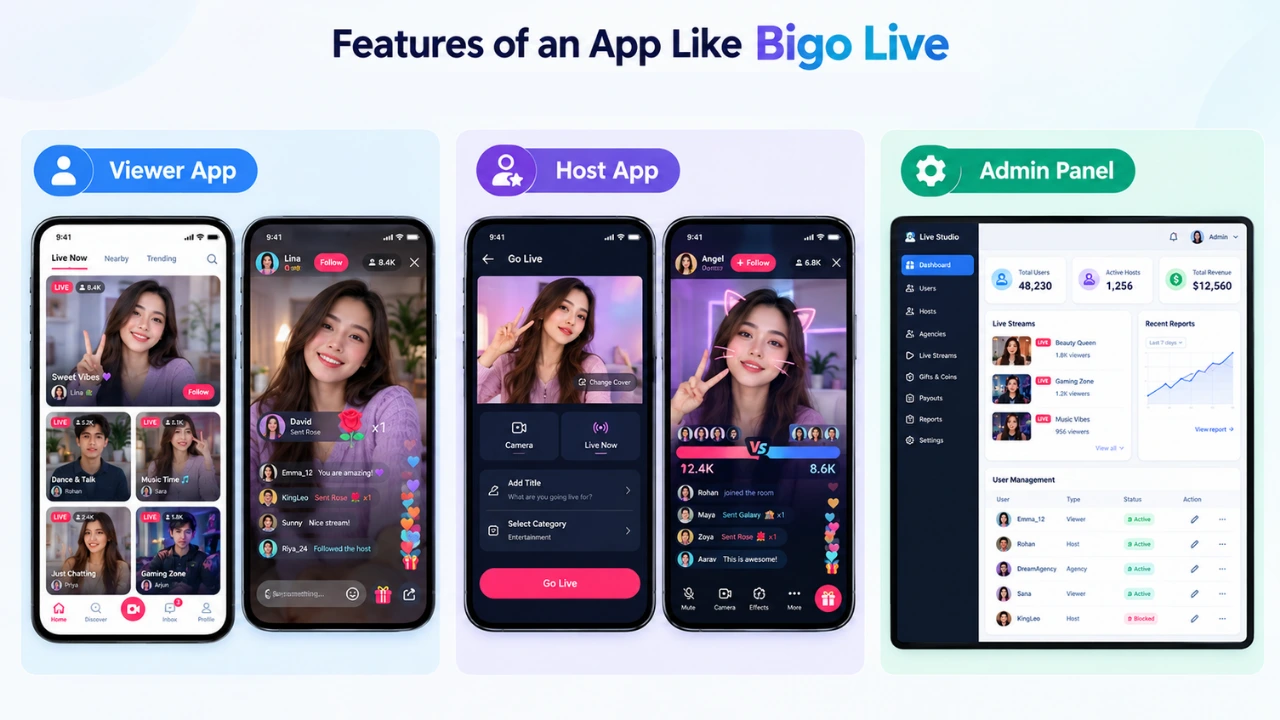
Viewer app
- Sign-up with phone, email or social login
- Home feed with live now, nearby and trending hosts
- Live chat, reactions and gifts
- Follow hosts and get go-live alerts
- Coin store, wallet and VIP membership
- Leaderboards for top gifters
- Report and block buttons
Host app
- Go live in three taps
- Beauty mode, filters and stickers
- Invite guests and start PK battles
- Voice room hosting
- Earnings dashboard and withdrawal requests
- Moderator tools to mute, kick and block
- Stream stats for viewers, gifts and new fans
Admin panel
- User, host and agency management with KYC
- Live stream monitoring and takedown
- Gift catalog, coin pricing and commission settings
- Payout approvals
- Revenue, retention and stream quality reports
- Roles and permissions for your team
Key Factors That Affect the Cost to Develop an App Like Bigo Live
1. Real-Time Video for PK Battles and Multi-Guest Rooms
Latency is the delay between what a host does and what viewers see. A single host talking to fans can use HLS, which is cheap to deliver but runs a few seconds behind. PK battles and multi-guest rooms, however, need WebRTC, a real-time technology with under one second of delay. Guests can’t talk naturally with a five-second lag. WebRTC takes more work to build and usually costs more per minute to run.
2. Coin Economy, Payouts and App Store Rules
Coins are digital goods, so on iOS and Android they usually have to be sold through Apple and Google in-app purchases. Apple’s App Store Review Guidelines cover both in-app purchase rules and the safety tools required for apps with user-generated content. Host withdrawals, on the other hand, need KYC checks, payout limits and fraud controls. Together, these add backend work most first quotes miss.
3. Moderation and Safety
Live content can’t be edited before viewers see it. Therefore, a Bigo-style app needs AI checks for nudity and abuse, a fast report queue and human moderators. Paid private calls also need age checks and stricter rules. Skipping this can get your app removed from the stores.
4. Platforms and Tech Choices
Cross-platform frameworks like Flutter and React Native share one codebase across Android and iOS, which usually cuts 30% to 40% of the cost. Native code (Swift and Kotlin) still wins for heavy beauty filters and AR effects. Adding a web app typically costs another $5,000 to $12,000.
5. Development Team Location
The same Bigo Live style social app, about 900 to 1,100 development hours, can cost $90,000 to $220,000 with a US team. With an experienced India-based team, the same app costs $18,000 to $55,000. That gap comes almost entirely from hourly rates, not quality.
6. Audience Size and Regions
An app built for 500 concurrent viewers is very different from one built for 50,000. Launching across several countries also means servers in more regions, more languages and local payment methods.
Custom Build vs Bigo Live Clone Script: Which Costs Less?
| Option | Upfront cost | Time to launch | Best for |
| Bigo Live clone script | $8,000 to $30,000 | 4 to 8 weeks | Testing a market quickly |
| Custom app on a streaming SDK | $28,000 to $50,000 | 10 to 14 weeks | Most startups that want their own product |
| Custom app with own media servers | $55,000 and up | 14 to 20 weeks or more | Very large audiences or strict data control |
White-label apps and clone scripts launch fast. However, check source code ownership, update support and how hard it is to change the gift system before you buy. Rebuilding a rigid script later often costs more than building right the first time. For most founders, a custom app on a streaming SDK offers the best balance of speed, control and cost.
Monthly Running Costs of a Bigo Live Style App
Your build cost is paid once, but these costs return every month:
- Streaming SDK usage, often billed per 1,000 minutes of video
- CDN bandwidth, which grows with every viewer and every minute watched
- Cloud servers for chat, gifts and the coin ledger
- AI moderation, usually billed per minute or per image checked
- Payment gateway and payout fees
- Maintenance at 15% to 20% of the build cost each year
Bandwidth is the line most founders underestimate. For a worked example with real numbers, the guide to live streaming app development cost shows how 1,000 viewers on a one-hour stream turn into a monthly CDN bill.
How Long Does It Take to Build an App Like Bigo Live?
A Bigo Live style social app usually takes 10 to 14 weeks:
| Phase | What happens | Duration |
| Scoping | Audience, peak viewers, coin economy and payout rules | 1 to 2 weeks |
| Architecture | WebRTC or HLS, SDK choice, CDN, monthly cost estimate | About 1 week |
| UI/UX design | Go-live flow, player, gift and PK battle screens | 1 to 3 weeks |
| Development sprints | Backend, coin system, Android and iOS apps, admin panel | 6 to 8 weeks |
| QA and load testing | Peak-viewer tests, slow networks, real devices | 1 to 2 weeks |
| Store submission and launch | App Store and Google Play review, monitoring on | About 1 week |
Some phases run side by side, which keeps the total shorter than the sum of the rows. The full step-by-step process is covered in this guide on how to build a live streaming app.
How to Reduce the Cost of a Bigo Live Style App
- Launch with gifting, PK battles and the wallet first, since they connect directly to revenue
- Use a streaming SDK for version one instead of building media servers
- Go cross-platform with one codebase for Android and iOS
- Use HLS for single-host streams and keep WebRTC for battles and guest rooms
- Add moderation in layers, starting with filters and reports
- Load test before launch, because a crash on your first big night costs more than testing
Common Mistakes When You Build an App Like Bigo Live
- Launching without hosts. Viewers won’t stay in empty rooms, so sign up a starting group of creators before you open.
- Unclear payouts. Slow or confusing withdrawals destroy host trust fast.
- Weak moderation. One harmful stream can get the app pulled from the stores.
- Overbuilding version one. Ship the core gifting loop, then add features based on real usage.
- Copying the brand. Building similar features is fine, but never reuse Bigo’s name, logo, gift artwork or code.
Build Your Bigo Live Style App With Comfygen
Comfygen plans every social streaming build around three questions: how many people will watch, how fast the video must arrive and how the app will earn. From coin economy design and WebRTC setup to PK battles, payouts, moderation and store launch, the team handles complete live streaming app development for Android, iOS and web.
Real-time video is already part of the team’s production work. WebRTC video consultations it has built are load-tested to hold call quality at 150+ concurrent sessions before release. Comfygen is ISO 9001:2015, ISO/IEC 20000-1:2018 and ISO 27001 certified, with a 97% client retention rate and offices in Jaipur, Toronto and Euskirchen. Share your idea and audience size, and you’ll get a scoped plan, a timeline and a monthly running-cost estimate before the build starts.
Frequently Asked Questions
How much does it cost to develop an app like Bigo Live?
How long does it take to build an app like Bigo Live?
How does Bigo Live make money?
How much does a Bigo Live clone script cost?
Is it legal to build an app like Bigo Live?
What are the monthly running costs of an app like Bigo Live?
Can I build an app like Bigo Live for Android and iOS at the same time?
What technology does an app like Bigo Live need?

Mr. Saddam Husen, (CTO)
Mr. Saddam Husen, CTO at Comfygen, is a renowned Blockchain expert and IT consultant with extensive experience in blockchain development, crypto wallets, DeFi, ICOs, and smart contracts. Passionate about digital transformation, he helps businesses harness blockchain technology’s potential, driving innovation and enhancing IT infrastructure for global success.