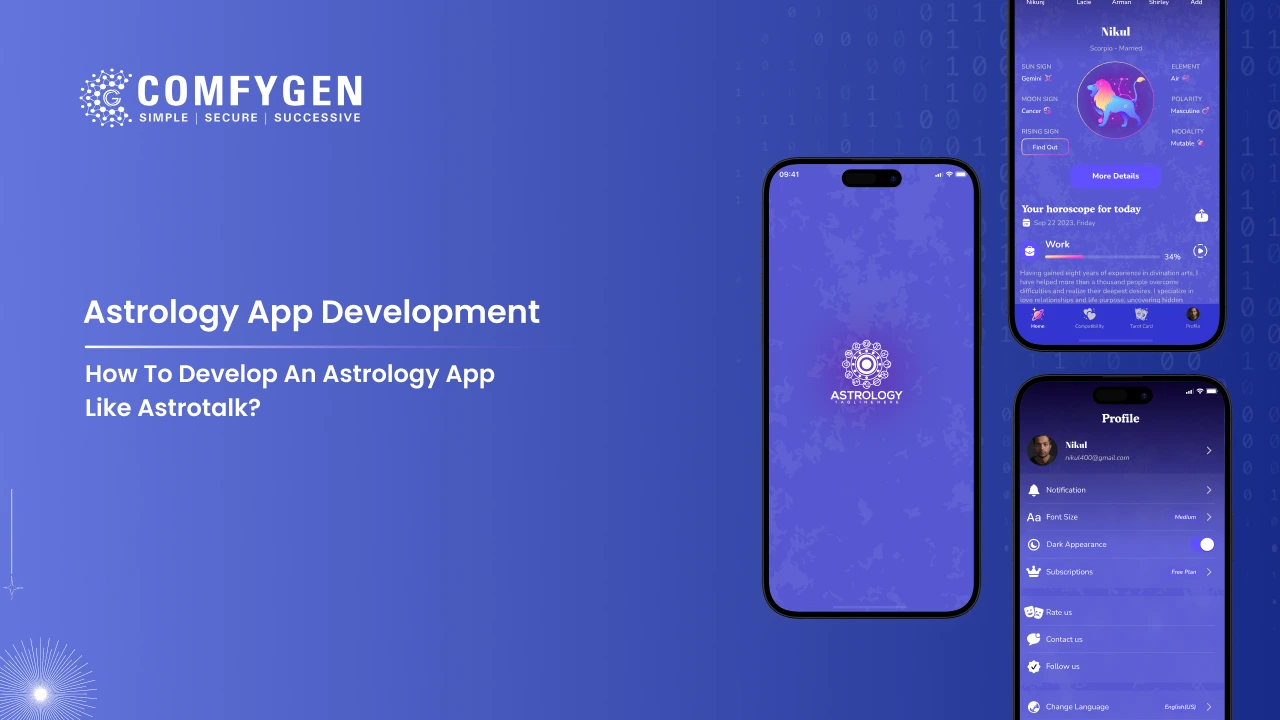





Building an app like AstroTalk costs $18,000 to $45,000 for a working MVP and $55,000 to $120,000 for a full marketplace with video calls, AI matching and multi-language support. An MVP takes 14 to 18 weeks. A clone script costs $4,000 to $12,000 and launches in 3 to 5 weeks, although it cannot handle custom commission logic or your own astrology engine.
The hard part isn’t the horoscope screens. Instead, it’s three systems most founders underestimate: a chart engine that gets the Lagna right, a per-minute billing ledger that never double-charges, and an astrologer payout flow your supply side actually trusts.
TL;DR
- AstroTalk is not a horoscope app. Rather, it’s a two-sided marketplace where users pay by the minute to talk to verified astrologers, and consultations drive roughly 90% of revenue.
- The platform crossed ₹1,176 crore in FY25 operating revenue and became India’s 133rd unicorn, so the model is proven at scale.
- To build an app like AstroTalk, you need three systems: a chart calculation engine, an astrologer marketplace with payouts, and a prepaid wallet tied to a per-minute billing meter.
- An MVP runs $18,000 to $45,000 over 14 to 18 weeks, while a full AstroTalk-scale platform runs $55,000 to $120,000 over 7 to 11 months.
- An AstroTalk clone script is cheaper and faster, but you give up control over commission structures, astrology calculation settings and anything outside the vendor’s roadmap.
- Supply is harder than demand, because thirty well-vetted astrologers beat three hundred average ones.
Why Founders Want to Build an Astrology App Like AstroTalk
The numbers stopped being speculative a while ago.
AstroTalk’s operating revenue went from ₹283 crore in FY23 to ₹651 crore in FY24 and ₹1,176 crore in FY25, which is roughly four times in two years. Then, in early 2026, the company became India’s 133rd unicorn after serving more than 4 crore users across five countries.
One figure deserves a closer look, since most write-ups get it wrong. You’ll see FY25 profit reported as both ₹250 crore and roughly ₹33 crore, and both are right. Total revenue reached ₹1,214 crore with adjusted profit before tax at ₹285 crore, up 125%. However, reported PAT dropped because of a one-time employee expense of about ₹120 crore, most of it non-cash. Strip that out, and the business is comfortably profitable.
The part founders usually miss is where growth comes from now. International markets contributed about 20% of operating revenue in FY25 and 37% of the topline in FY26, with the US alone accounting for more than 60% of that. So the diaspora opportunity is no longer a side bet, and it changes how you scope iOS app against Android from the start.
Retention is the other reason this category works. People return during career changes, relationship trouble and health scares, which are recurring life events rather than one-time purchases. As a result, AstroTalk sees around 700,000 daily active users against 20,000+ astrologers, with sessions priced between ₹10 and ₹200 per minute.
AstroTalk App Development: The Business Model You’re Actually Copying
Before any feature list, get clear on how money moves.
A user recharges a prepaid wallet. Then every minute of chat or call debits that wallet in real time. The platform keeps a commission, usually 20% to 35%, while the astrologer keeps the rest. Payouts settle weekly or twice a month.
Secondary revenue arrives later. AstroTalk Store launched in November 2024 with an internal test budget of ₹30 lakh, then took ₹40 crore once demand showed up. It crossed ₹140 crore in its first year and now runs at over ₹200 crore ARR across 300+ SKUs.
Sequence matters here. Consultations come first, and commerce second, only once people trust you. In practice the way astrology apps make money shifts as the user base matures, so the mix below describes a platform three or four years in rather than one at launch.
| Revenue stream | Share of revenue |
| Per-minute consultations (commission) | 60–65% |
| Premium reports (kundli, matchmaking, career) | 10–15% |
| Subscriptions and wallet packs | ~10% |
| Spiritual commerce and pooja booking | 8–10% |
| Sponsored listings and partnerships | 5–8% |
Get a Custom AstroTalk-Like App Solution
We build fully customized astrology apps tailored to your business goals and audience.
Request a Demo
AstroTalk Clone App vs Custom Build vs White Label
This is the first real decision, and it shapes everything after it. Most guides skip it entirely.
| Factor | AstroTalk clone script | White label platform | Custom build |
| Upfront cost | 4,000–12,000 | 10,000–25,000 + monthly | 18,000–120,000 |
| Launch time | 3–5 weeks | 4–8 weeks | 14 weeks to 11 months |
| Source code owned | Sometimes, often licensed | Rarely | Always |
| Custom commission tiers | No | Limited | Yes |
| Own ayanamsa and chart settings | No | Rarely | Yes |
| Scales past ~50k users | Usually not | Depends on vendor | Yes |
| Monthly vendor fee | Sometimes | Almost always | None |
| Best for | Testing demand in one city | Regional operators who won’t customise | Anything you plan to raise money on |
When an AstroTalk Clone App Makes Sense
A clone script is reasonable in two situations. First, when you want to validate demand in one language or one city before committing real money. Second, when you already run an astrology business with your own astrologers who simply need an app rather than a product company.
When AstroTalk Clone App Development Goes Wrong
The failure pattern stays consistent. The script handles a flat 25% commission, so when you want tiered rates for senior astrologers the vendor quotes you for a custom module. The script ships one ayanamsa setting, and your astrologers disagree with the charts. The script rounds partial minutes in the platform’s favour, and users complain. Each fix then costs more than the original licence.
Our view, after building consultation marketplaces since 2019: if you intend to raise funding or cross 50,000 users, start custom. Investors ask who owns the code, and “we licence it” is a bad answer during due diligence. But if you’re testing an idea with your own money, a clone script for three months is a fair way to learn what you actually need.
How to Build an Astrology App Like AstroTalk: The Three Systems That Matter
Split the build into three surfaces, because most teams underestimate the second and third.
1. The User App
- Onboarding that captures date, exact time and place of birth
- Free kundli, dasha and panchang so people get value before paying
- Astrologer discovery filtered by language, specialisation, price and rating
- Prepaid wallet with recharge, offers and first-consultation free credits
- Chat and voice or video call with a live per-minute balance counter
- Consultation history, ratings and follow-up booking
2. The Astrologer App That Keeps Supply From Churning
This side decides whether you have a business at all. Astrologers need an availability toggle, a live queue, an earnings dashboard, withdrawal requests and a rate card they control. If the earnings screen confuses them, supply churns within a month, and no amount of user marketing saves you.
3. The Admin Panel Behind an Astrology Marketplace App
Verification workflows, commission control, dispute handling, refund logic, chat moderation and payout reconciliation all live here. AstroTalk vets astrologers manually before listing them, and that quality gate is a real moat.
The Chart Engine: Where Most Astrology Apps Break
Your app has to generate birth charts, planetary positions, dashas, doshas and panchang data correctly. Astrologers spot errors immediately, so one wrong Mangal Dosha result ends your credibility in a single review.
Getting the Ascendant (Lagna) Calculation Right
The ascendant, or Lagna, is the zodiac sign rising on the eastern horizon at the moment of birth. It’s the most error-prone calculation in the whole system, for three reasons.
First, it changes roughly every two hours, so a birth time that’s off by ninety minutes produces a different Lagna and a completely different chart. Second, it needs exact latitude and longitude rather than just a city name, because a city spans enough degrees to shift a borderline case. Third, it depends on the house system you pick, since Placidus, used in most Western apps, produces different house cusps from Whole Sign, which most Vedic apps use.
Build a validation set early. Take 100 birth records where the chart is already known and confirmed, run them through your engine, then compare. Do this before a single user signs up.
Ayanamsa: The Setting That Starts Arguments
Ayanamsa is the offset between the tropical zodiac used in Western astrology and the sidereal zodiac used in Vedic astrology. Dozens of accepted values exist, and since they disagree by about a degree, a planet can land on either side of a sign boundary depending on which one you choose.
| Ayanamsa | Used by |
| Lahiri (Chitrapaksha) | Government of India standard, most North Indian astrologers, the safe default |
| Raman | Common in parts of South India |
| KP (Krishnamurti) | Required for KP astrology and sub-lord calculations |
| Fagan-Bradley | Western sidereal practitioners |
Pick one, make it configurable in the admin panel, then state it inside the app. Astrologers who disagree with your charts usually accept them once they know which ayanamsa you run. Platforms that hide this setting, on the other hand, keep answering the same support ticket forever.
Build or License the Kundli Calculation Layer
You have two paths.
License a Vedic astrology API: ProKerala, VedicRishi, AstrologyAPI, Divine API and RoxyAPI all offer kundli, dasha, panchang and matching endpoints, so you go live in days.
Build on Swiss Ephemeris: You get full control over ayanamsa, house systems and chart styles, with no per-call cost. However, you also add 8 to 12 weeks of specialised work. Open-source Python libraries such as VedAstro and core-astrology-engine sit on top of Swiss Ephemeris, which shortens this considerably if your team already does Python development.
Here is what API pricing actually looks like in 2026:
| Provider | Entry pricing | Notes |
| VedicRishi (standard) | ~$25/mo, 30,000 requests/day | Basic charts, dasha, panchang, numerology |
| VedicRishi (advanced) | ~50/mo,100,000requests/mo,+0.003 overage | Adds matching, dosha reports, gemstones |
| VedicRishi (ultra) | ~$200/mo, 1M requests/mo | Full report set |
| AstrologyAPI / Prokerala | Credit wallet, weighted per call | Endpoints cost different credit amounts, so model this carefully |
| VedAstro (open source) | From ~$1/mo, free tier available | 47 ayanamsa systems, 596 calculations |
Watch the credit-wallet billing. Because a kundli call and a matchmaking call consume very different credit amounts, a flat “requests per month” estimate understates your bill. Most teams therefore license first and migrate to their own Swiss Ephemeris layer once per-call cost starts to hurt, usually past 50,000 monthly active users.
Per-Minute Billing: The Hardest Part of AstroTalk Clone App Development
This is accounting software wearing a chat interface, so treat it that way.
The wallet has to debit balance every sixty seconds during a live session, warn the user before it hits zero, then end the session cleanly when it does. Every debit writes to both the user’s transaction history and the astrologer’s earnings ledger, and those two must reconcile exactly.
Handle these edge cases during the build rather than after a user complains:
| Edge case | What should happen |
| Network drops mid-call | Pause the meter, hold the session open 60–90 seconds, then resume or refund the gap |
| Wallet empties mid-session | In-app warning at 2 minutes remaining, graceful cutoff, no negative balance |
| Partial minute at session end | Define the rounding rule and publish it, otherwise you’ll get refund disputes |
| User starts two sessions at once | Block it, or the ledger goes out of sync |
| Astrologer disconnects | Full refund of that session, logged against the astrologer’s reliability score |
| Gateway succeeds but callback fails | Idempotent recharge handling, so nobody gets charged twice |
Build audit logs from day one. When an astrologer disputes a payout six months in, the log is the only thing that settles it.
Tech Stack for an AstroTalk-Like App
Keep it boring and scalable.
| Layer | Recommended |
| Mobile apps | Flutter or React Native for one codebase; native Kotlin and Swift when call quality is the priority |
| Web | React.js or Next.js |
| Backend | Node.js or Python, with billing as a separate service |
| Database | PostgreSQL for transactions, MongoDB for chat and reports, Redis for session state |
| Real-time | Agora, Twilio or 100ms for calls; Socket.io or Firebase for chat |
| Chart engine | Swiss Ephemeris, or a licensed Vedic API |
| Payments | Razorpay or Cashfree for India, Stripe for international, with payout rails |
| AI layer | OpenAI or Gemini for report generation, with a RAG pipeline over your own astrology corpus |
| Infrastructure | AWS or Google Cloud |
One note on billing. Run it as its own service with its own database connection, because when it sits inside the main API and that API slows under load, the meter drifts and users get charged for minutes they never used.
Launch Your Astrology App Today
Turn your idea into a fully functional astrology platform like AstroTalk with expert guidance and scalable tech.
Get Started Now
How to Build an App Like AstroTalk, Step by Step
Step 1: Pick a Wedge, Not a Market
Don’t launch a general astrology marketplace. Instead, pick something narrow: Tamil-language astrologers, Vedic matchmaking only, or career readings for working professionals in one metro. A narrow wedge means you solve supply with forty astrologers rather than four hundred.
Step 2: Lock the MVP Feature Set
Free kundli, astrologer listing, wallet, chat and payouts. That’s it. Video calls, live streams and commerce all move to phase two. Teams that try to ship everything at once usually reach paying users two months later than teams that don’t.
Step 3: Build and Validate the Chart Layer
License an API or build on Swiss Ephemeris, set your ayanamsa, then run the 100-chart validation set described above. Nothing else should start until the charts check out.
Step 4: Recruit Astrologers in Parallel
Start 6 to 8 weeks before launch, recruiting through regional networks, YouTube channels and existing astrologer communities. Run a verification call before listing anyone. Aim for 30 to 50 verified astrologers covering two or three languages at launch, because below that, wait times climb and first-time users leave before their first paid minute.
Plan supply-side ranking early too. New astrologers need visibility, or they leave. So reserve part of the discovery feed for fresh listings, otherwise the first twenty profiles absorb everything.
Step 5: Ship the Wallet and Billing Engine
See the edge case table above. This is where to spend your senior engineering time, and it’s usually the point at which teams decide to hire mobile app developers with marketplace ledger experience rather than general app experience.
Step 6: Add Chat and Calling Infrastructure
Chat carries most consultations, since it’s cheaper and less intimidating for first-timers. Build it on a managed real-time layer rather than from scratch, and mask phone numbers so personal contact details never surface.
Step 7: Launch Narrow, Then Instrument Everything
Ship to one city or one language segment. After that, watch three metrics: first-recharge conversion, repeat consultation rate within thirty days, and astrologer earnings per active hour. Fix whichever leaks first.
Cost to Develop an App Like AstroTalk in 2026
Scope, region and how much astrology logic you license rather than build all move this number.
| Scope | What you get | Cost (USD) | Cost (INR) | Timeline |
| Clone script | Pre-built platform, light branding | 4,000–12,000 | ₹3.5–10 Lakh | 3–5 weeks |
| MVP | Kundli, listings, wallet, chat, payouts | 18,000–45,000 | ₹15–38 Lakh | 14–18 weeks |
| Growth build | Voice and video, AI matching, admin depth, multi-language | 55,000–120,000 | ₹46 Lakh–₹1 Cr | 7–11 months |
| Full platform | Live streams, commerce, ML ranking, own chart engine | 120,000–250,000+ | ₹1–2.1 Cr+ | 12+ months |
Indian agencies charge roughly $25 to $50 an hour against $100 to $200 in North America, which is why most builds in this category happen in India. The same hourly gap drives astrology app development cost across every feature tier, not just the marketplace ones.
Ongoing Costs Most Estimates Hide
- Real-time calling minutes through Agora or Twilio, which scale with session volume
- Astrology API calls, especially on credit-weighted plans
- Payment gateway fees plus payout transfer charges
- Cloud and CDN
- Maintenance at 15% to 20% of build cost annually
- User acquisition, which is almost always the biggest line, since AstroTalk spends roughly a quarter of revenue on marketing
What a New Platform Actually Earns
Everyone quotes AstroTalk’s revenue, yet few people model what a new entrant makes. So here’s the arithmetic for a small platform in month six.
Assume 5,000 monthly active users, 8% converting to a paid session, an average session of 12 minutes at ₹25 per minute, and a 30% commission.
- Paid sessions: 400 per month
- Gross consultation value: 400 × 12 × ₹25 = ₹1,20,000
- Platform commission at 30%: ₹36,000
- Premium reports, 3% of MAU at ₹399: ₹59,850
- Monthly gross: roughly ₹95,850
That works out to about ₹11.5 lakh a year against a build that cost ₹15 lakh to ₹38 lakh. So the business works, although it works on repeat behaviour and scale rather than on month six. Plan your runway for 18 months, not 6.
The lever that moves this most isn’t user count. Rather, it’s average session length and repeat rate, and both come down to astrologer quality.
AI Features Worth Adding to an App Like AstroTalk
Skip the idea of replacing astrologers with a chatbot, because people pay for a human voice and that is the product. AI earns its place in narrower spots instead.
| AI module | What it does | Business impact |
| Astrologer matching | Pairs question type, language and availability with the right astrologer | Higher first-session satisfaction and repeat rate |
| Report generation | Drafts kundli, career and compatibility reports | High-margin product with no astrologer scheduling |
| Churn prediction | Flags users about to stop recharging | Lets you time an offer before they leave |
| Moderation | Catches abusive messages and off-platform contact attempts | Fewer disputes, less leakage |
| Horoscope personalisation | Uses the full chart plus behaviour instead of sun sign alone | Measurably better daily open rates |
On that last row: personalised birth chart readings consistently lift daily active usage over generic sun-sign content, because the output feels specific to the reader. If you’re measuring the effect, track daily open rate, session length and seven-day return rate before and after the change. Generic horoscope content tends to plateau on all three.
When you add a conversational layer, a RAG pipeline over your own astrology corpus beats raw LLM output. Ground it in classical texts and your own report templates, then keep a human astrologer review step for anything a user pays for. Most AI astrology apps that feel accurate are doing exactly this rather than calling a model directly, and the generative AI work sits mostly in the retrieval layer rather than the model itself.
Compliance and App Store Rules
This gets skipped, and it causes rejections.
Apple
Fortune-telling apps fall under App Review Guideline 4.3 on spam and duplication, so reviewers are strict with astrology apps that look like templates. Guideline 5 rules then apply to how you handle personal data. Avoid any claim that promises a specific outcome, particularly around health, money or legal matters.
Google Play
Similar restrictions apply to misleading claims. Astrology is permitted as entertainment and guidance, though not as prediction of medical or financial results.
Both stores
Carry a visible disclaimer. Never let astrologers promise cures, guaranteed court outcomes or investment returns, and moderate for this actively, because one astrologer’s chat transcript can trigger a takedown.
Birth Data Counts as Sensitive Personal Data
Date, exact time and place of birth identifies a person. Under India’s DPDP Act you therefore need explicit consent, a stated purpose and a deletion path. Under GDPR the same applies for EU users, along with data residency considerations. Encrypt at rest and in transit, then write a privacy policy that says what you actually do rather than generic boilerplate.
Mistakes That Kill Astrology Apps
- Launching with weak supply: Twenty average astrologers will sink a good app, since users judge the whole platform by their first consultation.
- Treating the wallet as a checkout page: Per-minute billing needs audit logs and reconciliation from day one.
- Ignoring off-platform leakage: Astrologers and users will try to move to WhatsApp, taking your commission with them. So mask numbers, moderate contact sharing, and make staying worth it.
- Over-engineering the chart engine first: Six weeks on divisional charts while no astrologers are listed is six wasted weeks.
- Hiding the ayanamsa: Astrologers will dispute your charts, so tell them which system you use and let them see it.
- No deletion path for birth data: That’s a compliance problem and an app store problem at the same time.
Hire Experts to Develop Your Astro App
Work with experienced developers to build a AI-based astrology app.
Talk to an Expert
Build Your App Like AstroTalk With Comfygen
The hard parts of an app like AstroTalk aren’t the horoscope screens. Rather, they’re billing accuracy under load, call reliability on a weak connection, and a payout system your astrologers trust enough to stay on.
Comfygen has built consultation marketplaces, real-time communication layers and multi-party payment systems since 2019, across 550+ projects for 400+ clients in 30+ countries, with 97% client retention. If you want a realistic cost and timeline against your actual requirements, our astrology app development team will walk through the scope with you.

Mr. Saddam Husen, (CTO)
Mr. Saddam Husen, CTO at Comfygen, is a renowned Blockchain expert and IT consultant with extensive experience in blockchain development, crypto wallets, DeFi, ICOs, and smart contracts. Passionate about digital transformation, he helps businesses harness blockchain technology’s potential, driving innovation and enhancing IT infrastructure for global success.
Based on Interest

Blockchain Development Process: How to Develop a Blockchain Application
The blockchain development process runs through eight phases: use case validation, requirements definition, platform selection, architecture design, smart contract development, testing and…