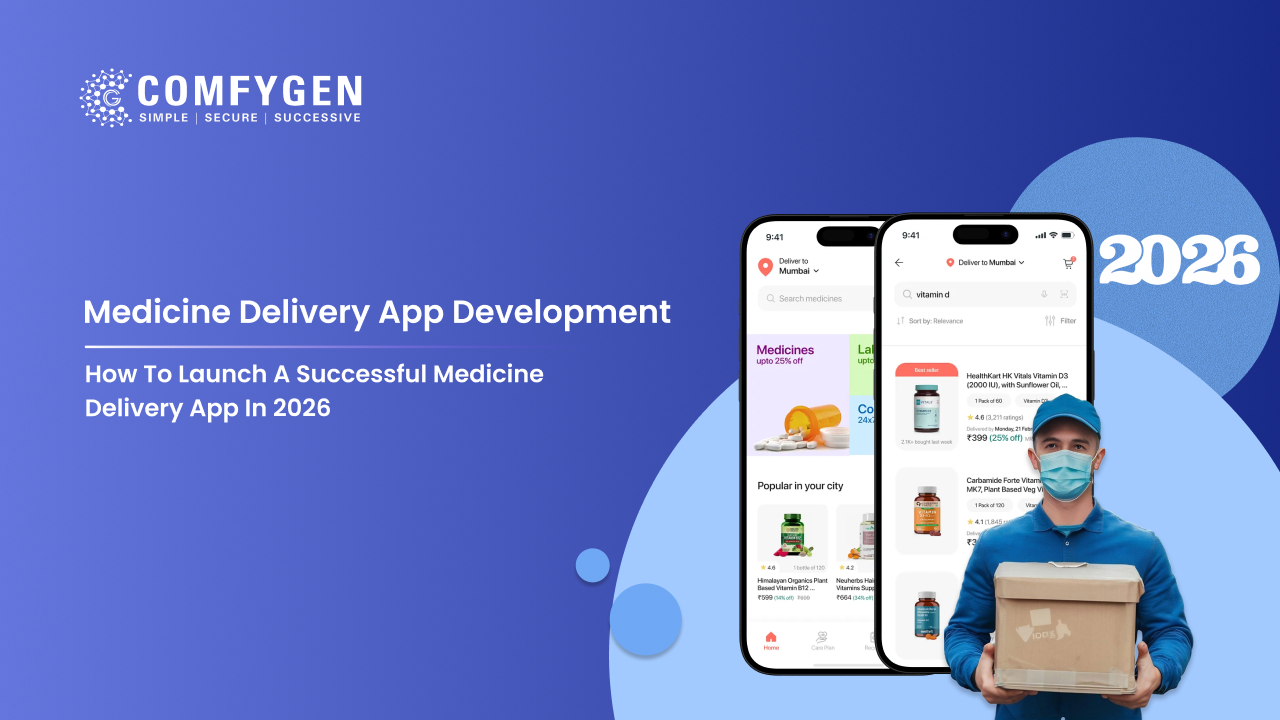





The healthcare industry is rapidly evolving, and digital solutions are playing a major role in improving accessibility and convenience. One of the fastest-growing segments is medicine delivery app development, which allows users to order prescription and OTC medicines online with doorstep delivery. In 2026, launching an online medicine delivery app is not just a trend—it’s a smart business opportunity for startups, pharmacies, and healthcare companies.
In this guide, Comfygen Technologies explains everything you need to know about building a successful medicine delivery app, from market insights to development cost and technology stack.
Market Stats
The medicine delivery app market is experiencing rapid growth, driven by the rising adoption of teleconsultation services and the growing demand for convenient online healthcare solutions. The global ePharmacy market is projected to surpass $136 billion in revenue, with India emerging as one of the fastest-growing regions due to increasing smartphone penetration and digital healthcare adoption.
Leading platforms such as PharmEasy, App Like Tata 1mg, and Netmeds are setting industry benchmarks by offering integrated online medicine delivery apps that combine AI-driven recommendations, wearable device integration, and quick commerce capabilities. These advanced features enable seamless digital pharmacy solutions and support comprehensive healthcare app development for end-to-end health management.
Global & Regional Market Trends (2026 Projections)
- ePharmacy Market Growth: The global ePharmacy market is expected to reach approximately $136 billion in 2026, growing at a Compound Annual Growth Rate (CAGR) of around 13.84%, according to data from Mordor Intelligence.
- India’s Boom: India’s online pharmacy market is predicted for massive expansion, with some forecasts suggesting a growth to over $5.4 billion in the next few years, driven by virtual consultations and digital adoption.
- Key Drivers: Telemedicine adoption, e-prescription generation, demand for convenience, and rapid delivery (quick commerce) are major growth catalysts.
What is Medicine Delivery App
A medicine delivery app is a digital healthcare solution that allows users to order prescription and over-the-counter medicines, health products, and even book lab tests online with doorstep delivery. Acting as a digital pharmacy, these apps connect users with nearby pharmacies, enable easy prescription uploads, and ensure secure order processing. Modern online medicine delivery apps also offer features like dose reminders, real-time order tracking, discounts, and virtual doctor consultations. This makes medicine delivery app development especially valuable for patients with chronic conditions, elderly users, and those seeking convenient, on-demand healthcare services.
Why Businesses Invest in Medicine Delivery Apps in 2026
In 2026, a medicine delivery app is no longer an optional digital tool—it has become a necessity for pharmacies, startups, and healthcare businesses. An online medicine delivery app enables faster medicine fulfillment, seamless prescription management, and 24/7 customer service. With the growing demand for digital healthcare solutions, medicine delivery apps for businesses help build customer trust, improve convenience, and increase repeat orders through a smooth and reliable user experience.
The global e-pharmacy market is expanding at a CAGR of over 15%, with more than 60% of users preferring to order medicines online for both regular and emergency needs. Investing in medicine delivery app development ensures long-term scalability, operational efficiency, and higher customer retention, making it a profitable and future-ready business model.
Comfygen Technologies is a trusted medicine ordering app development company, offering end-to-end solutions for startups, entrepreneurs, and small businesses. With deep expertise in healthcare app development, Comfygen Technologies helps you launch a secure, scalable, and growth-driven pharmacy app to successfully establish and expand your online pharmacy business.
Build Your Medicine Delivery App Today
Medicine Delivery App Market Trends in 2026
In 2026, the medicine delivery app market is booming, driven by rapid AI integration, expanding telehealth services, wearable-based remote patient monitoring, and the growing demand for quick commerce medicine delivery. Businesses are focusing on personalized digital healthcare, seamless EHR/EMR integration, drone-based delivery models, and enhanced blockchain security to protect prescriptions and patient data. Emerging markets such as India are witnessing accelerated growth, supported by rising internet penetration and increasing consumer expectations for convenient online health management solutions.
Key Trends Shaping the Market
- AI & Personalization: AI-powered systems enable early illness prediction, treatment recommendations, and personalized health insights, while smart chatbots improve user support and engagement.
- Telehealth Integration: Video consultations, instant e-prescriptions, and centralized digital health records (EHR/EMR) are becoming standard features in modern medicine delivery apps.
- Remote Patient Monitoring (RPM): Apps sync with wearables and IoMT devices to track real-time vitals, helping reduce hospital visits and improve chronic care management.
- Quick Commerce (Q-Commerce): Users now expect rapid or even instant medicine delivery, driving adoption of fast, on-demand pharmacy delivery models.
- Data Interoperability (India Focus): Initiatives like India’s ABDM aim to connect hospitals, pharmacies, and apps, enabling seamless, longitudinal healthcare data exchange.
- Advanced Technologies: Geofencing for location-based services, blockchain development for prescription security, and IoT-enabled devices are enhancing app efficiency and trust.
- Digital Therapeutics (DTx): Evidence-based digital treatments, especially for mental health and chronic conditions, are gaining strong adoption.
Market Drivers & Growth
- Shift in Consumer Behavior: Strong preference for online consultations and medicine ordering
- Rising Internet Penetration: Expanding access in Tier-2 and Tier-3 cities
- Post-Pandemic Digital Shift: Continued reliance on digital healthcare platforms
- Market Expansion: Rapid global e-pharmacy growth, with India showing high CAGR
Business Models for Medicine Delivery App Development
Choosing the right medicine delivery app business model is crucial for building a scalable and profitable digital pharmacy platform. In 2026, healthcare businesses adopt flexible models based on target audience, operational capacity, and revenue goals. At Comfygen Technologies, we help startups, pharmacies, and enterprises implement the most suitable medicine delivery app development model aligned with their growth strategy.
Core Business Models
1. Inventory-Based Model (Direct Sales)
- How it works: The app owner manages its own warehouse, stocks medicines, and handles order fulfillment directly to customers, operating as a virtual pharmacy.
- Best for: Large pharmacies, pharmacy chains, or businesses seeking full control over inventory, pricing, and delivery.
- Revenue Model: Profit margins on medicine sales.
2. Marketplace / Aggregator Model
- How it works: The platform connects multiple local pharmacies with customers without owning inventory. Pharmacies fulfill orders, while the app manages discovery and payments.
- Best for: Startups and businesses aiming for wide product variety with minimal logistics investment.
- Revenue Model: Commission per transaction, featured listings, and in-app advertising.
3. Subscription Model
- How it works: Users pay a recurring monthly or annual fee to access benefits such as free or discounted delivery, priority support, and exclusive health content.
- Best for: Building long-term customer loyalty and predictable recurring revenue.
- Revenue Model: Subscription fees and premium memberships.
4. Hybrid Model
- How it works: Combines inventory-based and marketplace models or integrates telemedicine services for online consultations before medicine delivery.
- Best for: Businesses seeking flexibility and comprehensive healthcare app development, including telehealth integration.
- Revenue Model: Mixed income from sales margins, commissions, and subscriptions.
Monetization Strategies for Medicine Delivery Apps
- Commission-Based: Charge partner pharmacies a percentage on each order
- Delivery Fees: Offer standard, express, or scheduled delivery options
- Premium Subscriptions: Monthly or yearly plans with exclusive perks
- In-App Advertising: Sponsored listings and promotions for health brands
- Partnerships: Collaborate with insurance providers and healthcare companies
Key Features of a Medicine Delivery App
To succeed in the competitive digital healthcare market, a medicine delivery app must offer a seamless, secure, and user-friendly experience for all stakeholders. At Comfygen Technologies, we design feature-rich medicine delivery apps that improve customer satisfaction, streamline pharmacy operations, and ensure scalable growth.
Here Are The Key features:
User App Features
- Easy sign-up/login and profile management
- Advanced medicine search with filters
- Prescription upload and validation
- Real-time order tracking
- Multiple secure payment options
- Order history, reordering, and dose reminders
Pharmacy Panel Features
- Order and prescription management
- Inventory and stock control
- Medicine availability updates
- Pricing and discount management
- Sales reports and analytics
Delivery Partner Features
- Order assignment and status updates
- GPS navigation and route optimization
- Delivery history and earnings tracking
Admin Panel Features
- User, pharmacy, and delivery management
- Commission and revenue control
- Analytics, reports, and dashboard insights
- Security, compliance, and system monitoring
These essential medicine delivery app features help businesses deliver faster services, improve operational efficiency, and build a reliable online medicine delivery app. With expertise in healthcare app development, Comfygen Technologies ensures your app is future-ready and compliant with industry standards.
Step-by-Step Medicine Delivery App Development Process
Developing a medicine delivery app starts with in-depth market research and feature planning for user, pharmacy, and admin panels. The process includes intuitive UI/UX design, selecting the right technology stack, and building core features like prescription uploads, secure payments, and order tracking. Ensuring HIPAA/GDPR compliance, pharmacy app development system integration, rigorous security and performance testing, strategic app launch, and continuous post-launch maintenance are essential for scalability, stability, and long-term success.
1. Market Research & Planning
The process begins with in-depth market research to study competitors like PharmEasy and Tata 1mg, identify target users such as elderly patients and chronic care users, and understand key pain points. Based on insights, businesses define the medicine delivery app business model, unique value proposition, and an MVP feature set.
2. Legal & Compliance Requirements
Healthcare apps must strictly follow data protection regulations. Compliance with HIPAA (USA), GDPR (EU), and local healthcare laws ensures patient data privacy, secure transactions, and regulatory approval before launch.
3. UI/UX Design for Healthcare Apps
Wireframes and user flows are created for login, medicine search, cart, checkout, and tracking. High-fidelity UI/UX designs focus on simplicity, accessibility, and trust to deliver a smooth online medicine delivery app experience.
4. Technology Stack Selection
Choosing the right technology is critical. Frontend development may use React Native or Flutter for cross-platform apps, while backend systems rely on scalable technologies like Node.js and Express to manage users, inventory, orders, and payments.
5. App Development & System Integration
Frontend and backend development builds core functionalities such as medicine catalogs, user profiles, and order processing. Integrations include payment gateways, GPS tracking, SMS/email notifications, and prescription OCR for faster verification.
6. Key Feature Implementation
- Customer Panel: Search medicines, upload prescriptions, payments, order tracking
- Pharmacist Panel: Inventory management, prescription approval, order handling
- Admin Panel: User and pharmacy management, analytics, commissions
- Delivery Panel: Order assignment, navigation, delivery status updates
7. Testing & Quality Assurance (QA)
Comprehensive testing is performed, including functional, performance, security, UI/UX, and device compatibility testing to ensure the app is reliable and secure.
8. Launch & Marketing
After successful testing, the app is deployed on Google Play Store and Apple App Store. Digital marketing strategies such as SEO, social media promotion, and paid advertising help attract and retain users.
9. Post-Launch Support & Maintenance
Post-launch, Comfygen Technologies continuously monitors app performance, collects user feedback, fixes bugs, releases updates, and scales infrastructure while adding advanced features like teleconsultation and AI-based recommendations.
Technology Stack Required for Medicine Delivery App Development
Choosing the right technology stack is essential for building a secure, scalable, and high-performing medicine delivery app. At Comfygen Technologies, we use modern and reliable tools to ensure smooth operations, data security, and long-term scalability for online medicine delivery app development.
Frontend (Mobile App Development)
- Android: Kotlin, Java
- iOS: Swift
- Cross-Platform: React Native, Flutter
Backend (Server-Side Development)
- Frameworks: Node.js, Express.js, Laravel
- APIs: RESTful APIs for user, order, inventory, and payment management
Database & Storage
- Databases: MySQL, PostgreSQL, MongoDB
- Cloud Storage: AWS S3, Google Cloud Storage
Payment & Notification Integrations
- Payment Gateways: Razorpay, Stripe, PayPal
- Notifications: SMS, Email, Push Notifications (Firebase)
Maps, Tracking & Security
- Maps & GPS: Google Maps API
- Security: SSL encryption, OAuth 2.0, HIPAA/GDPR compliance
Cloud & DevOps
- Cloud Platforms: AWS, Google Cloud
- DevOps: Docker, CI/CD pipelines
Cost to Develop a Medicine Delivery App in 2026
Developing a medicine delivery app in 2026 typically costs between $15,000 and $300,000+, depending on app complexity, features, and scalability requirements. A basic MVP medicine delivery app with core functionalities like medicine ordering, prescription upload, and order tracking may cost $15,000–$40,000. Mid-level solutions with pharmacy integrations and secure payments range higher, while enterprise-level medicine delivery platforms with multi-vendor systems, telemedicine, AI capabilities, and advanced security can exceed $150,000–$300,000+. Development timelines usually span 3 to 12+ months, with medicine delivery development cost influenced by compliance, real-time tracking, and healthcare data security needs.
Cost by App Complexity
- Basic MVP (3-6 months): $15,000 – $40,000+
- Features: User registration, prescription upload, basic ordering, payment, tracking.
- Standard/Mid-Level (6-9 months): $40,000 – $150,000+
- Adds: Advanced search, multiple payment options, pharmacy management, basic analytics, reviews.
- Enterprise/Advanced (9-15+ months): $150,000 – $300,000+
- Adds: Multi-vendor, telemedicine, AI Development recommendations, subscription models, loyalty, complex analytics, stringent compliance.
Key Cost Factors
- Features: Prescription management, e-prescriptions, doctor consultations, dosage reminders, real-time tracking, multi-vendor support.
- Platform: Native (iOS/Android) costs more than cross-platform; web portals add to the total.
- Integrations: Pharmacy inventory systems, payment gateways, GPS, EMR/EHR.
- Compliance: HIPAA/GDPR, data security, and regulatory standards add significant cost and complexity.
- Development Team: Location and expertise (UI/UX, backend, testing) influence pricing.
How to Choose the Right Medicine Delivery App Development Company
Selecting the right medicine delivery app development company is a critical step toward building a secure, scalable, and successful online pharmacy platform. A reliable development partner not only delivers high-quality code but also understands healthcare regulations, user experience, and long-term business growth. The right company will help you transform your idea into a compliant, feature-rich online medicine delivery app tailored to your market needs.
1. Healthcare & Pharmacy Domain Expertise
Choose a company with proven experience in medicine delivery app development and healthcare app development. Domain knowledge ensures proper handling of prescriptions, pharmacy workflows, and regulatory requirements.
2. Knowledge of Compliance & Security Standards
Healthcare apps must comply with regulations like HIPAA, GDPR, and local pharmacy laws. Ensure the company follows strict data security practices to protect sensitive patient information.
3. Strong Portfolio & Case Studies
Review previous projects related to online medicine delivery apps or e-pharmacy platforms. A strong portfolio reflects technical capability and industry understanding.
4. Customization & Scalability Options
The right partner should offer customized solutions that can scale as your business grows—from MVP to enterprise-level medicine delivery platforms.
5. Advanced Technology Stack
Ensure the company uses modern, scalable technologies for mobile apps, backend systems, cloud infrastructure, and third-party integrations.
6. Transparent Pricing & Development Process
Look for clear pricing models, defined timelines, and a structured development process to avoid hidden costs and delays.
7. Post-Launch Support & Maintenance
Ongoing support, regular updates, performance monitoring, and feature enhancements are essential for long-term success.
Conclusion
Launching a successful medicine delivery app in 2026 presents a powerful opportunity to tap into the fast-growing digital healthcare market. With rising demand for online pharmacies, telehealth integration, and on-demand medicine delivery, businesses can achieve scalable growth by choosing the right business model, features, and technology stack. Partnering with an experienced medicine delivery app development company like Comfygen Technologies ensures a secure, compliant, and future-ready solution that drives long-term success.

Mr. Saddam Husen, (CTO)
Mr. Saddam Husen, CTO at Comfygen, is a renowned Blockchain expert and IT consultant with extensive experience in blockchain development, crypto wallets, DeFi, ICOs, and smart contracts. Passionate about digital transformation, he helps businesses harness blockchain technology’s potential, driving innovation and enhancing IT infrastructure for global success.