




Building a medicine delivery app like 1mg costs $12,000 to $25,000 and takes 10 to 18 weeks. Add telemedicine, AI, or a multi-vendor marketplace and it runs $30,000 to $60,000 over 20 to 32 weeks.
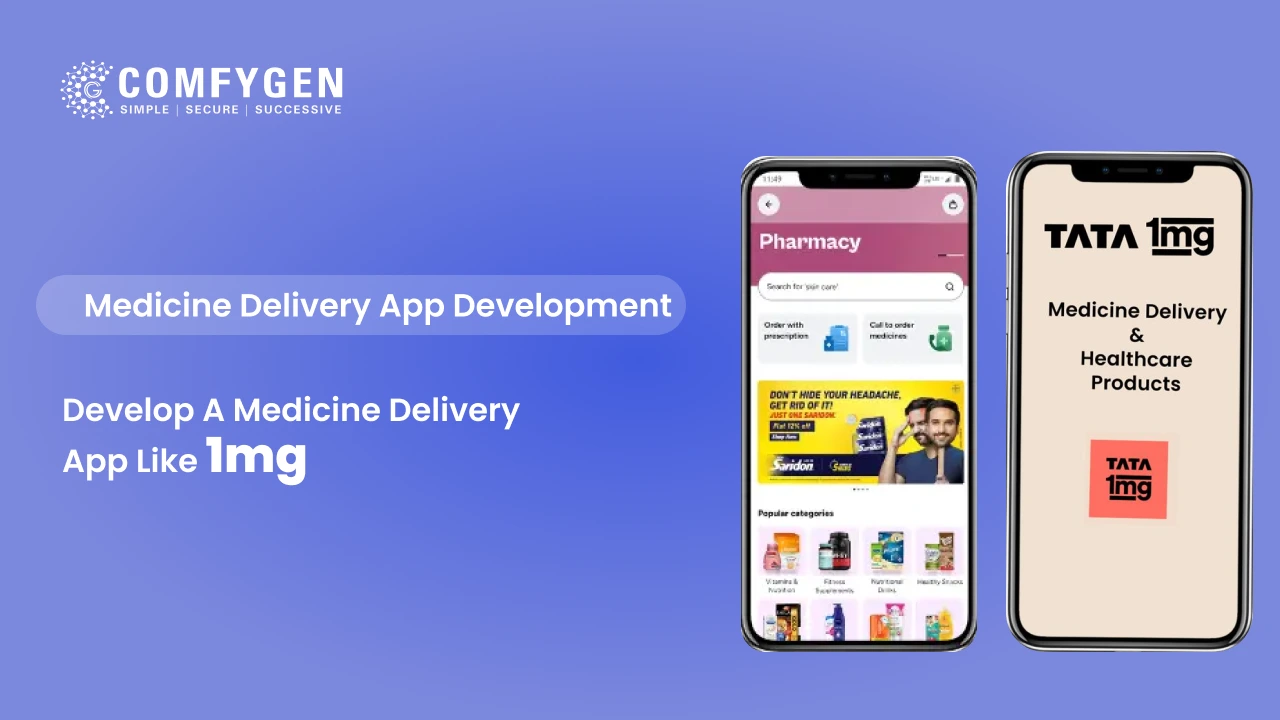
If you are planning to enter this booming market, building a medicine delivery app like 1mg can be a profitable business opportunity. This guide covers the business model, the full feature list, a real cost breakdown, and the compliance rules you have to follow before launch.
Current Market Stats on the Medicine Delivery Industry
The online medicine market is growing from $123.91 billion in 2026 to $436.29 billion by 2033, at 19.7% CAGR. Mobile apps make up 66.2% of that spending.
India’s e-pharmacy sector is a big part of that growth. Tata 1mg reported around 20% year-on-year revenue growth in FY25, reaching close to ₹2,390 crore. That is one company in one country, and it shows how much room the category still has.
What is a Medicine Delivery App Like 1MG?
A medicine delivery app is an online platform where users can order medicines from their phone and get them delivered to their home. Doorstep medicine delivery apps like 1mg make the process fast, safe, and convenient.
A 1mg-style app is a healthcare platform, not just a shop. Customers can:
- Order medicines and get them delivered at home
- Upload a prescription and have a pharmacist check it
- Book lab tests with sample collection at home
- Talk to a doctor by video, voice, or chat
- Store health reports in one place
- Buy wellness products and supplements
- Track their order live on a map
The delivery part is what people notice. The prescription checking and stock management are what make it work.
Why Build a Medicine Delivery App for Your Business in 2026?
The online pharmacy industry is experiencing massive growth, and 2026 is the perfect time to invest in a medicine delivery app. With digital healthcare expanding rapidly, users now prefer quick, convenient, and contactless access to medicines rather than visiting traditional pharmacies. Below are the key reasons why building a medicine delivery app is a highly profitable opportunity.
More People Buy Medicine Online Now
Ordering food and groceries by app changed what people expect from every other shop, including the pharmacy.
Running Costs are Lower
One app reaches customers across a whole city. Opening five physical outlets to reach the same people costs far more.
Repeat Orders are Automatic
People on long-term medication for diabetes, blood pressure, or thyroid buy every month. An app with refill reminders captures that. A counter waits for them to remember.
Contactless Delivery Stayed
Habits formed during the pandemic did not reverse. Home delivery is now the default for many buyers, not the backup.
Business Models for Medicine Delivery Apps
Before starting medicine delivery app development, selecting the right business model is crucial. Here are the most effective models used by leading pharmacy apps:
Marketplace Model (Like 1mg, PharmEasy)
Multiple pharmacies are listed on your platform. Users browse, compare, and order medicines directly from these sellers.
Revenue Source: Commission on every successful order.
Single Pharmacy Model
Ideal for individual medical stores that want to take their business online.
You manage your own inventory and deliver to customers through your in-house team.
Aggregator Model
You collaborate with various local pharmacies and manage deliveries through your own delivery fleet.
This model ensures faster delivery and competitive pricing.
Subscription-Based Model
Customers pay monthly for discounts, priority delivery, and free consultations.
Revenue: predictable monthly income and better customer retention.
Most platforms start with one and add a second within two years. Build so that is possible without a rewrite.
How to Build a Medicine Delivery App Like 1MG
Building a medicine delivery app like 1mg requires proper planning, the right features, and a structured 1mg-like medicine delivery app development approach. Here is a simple and informative breakdown of each step to help you understand the complete process:
1. Market Research and Planning
Study 1mg, PharmEasy, Netmeds, and Apollo. Look at what they do well and where customers complain. Reviews on the Play Store are the cheapest research you will ever do. Decide who you are for: a city, a condition, a price point, or a service level nobody else offers.
2. Requirement Gathering and Analysis
This step involves defining the features and functionalities of the app:
- User Stories: Create user stories to understand the user’s perspective. For example, “As a user, I want to be able to search for medicines quickly.”
- Feature List: Compile a list of must-have features such as user registration, medicine search, order placement, payment integration, and delivery tracking.
3. Choosing the Technology Stack
Selecting the right technology stack is crucial for app performance and scalability:
- Frontend Development: For the user interface, technologies like React Native or Flutter can be used for cross-platform medicine delivery development.
- Backend Development: Use robust backend technologies like Node.js, Ruby on Rails, or Django.
- Database: Opt for scalable databases such as MongoDB, PostgreSQL, or Firebase.
- Cloud Services: Amazon Web Services (AWS), Google Cloud, or Microsoft Azure can be used for hosting and managing the backend infrastructure.
Flutter and React Native are cross-platform tools. One team writes the code once and it runs on both Android and iOS, which cuts cost by roughly 15% to 25% versus building twice.
4. Designing the App Screens
Wireframes first, then full design, then a clickable prototype. Test the checkout with real users, including people over 55. A large share of medicine buyers are older, and a design that works only for people who grew up with apps will lose them.
5. Build the Customer App
Search, prescription upload, cart, payment, tracking, reorder. This is the part customers judge you on.
6. Build the Pharmacy, Admin, and Delivery panels
The pharmacy panel handles the order queue and prescription checks. The admin panel handles users, vendors, reports, and commissions. The delivery app handles pickup, navigation, and proof of delivery. Without these three, the customer app has nowhere to send orders.
7. Testing
Thorough testing is crucial to ensure the app works flawlessly:
- Unit Testing: Test individual components and functionalities.
- Integration Testing: Ensure different parts of the app work together seamlessly.
- User Acceptance Testing (UAT): Conduct testing with real users to gather feedback and identify any issues.
- Performance Testing: Ensure the app performs well under different conditions, including high traffic.
8. Launch in One City
Ship to one area, fix what breaks, then expand. Launching in five cities at once means five sets of problems arriving together.
9. Keep Improving
Collect feedback, fix bugs, and ship updates. Plan 15% to 20% of the build cost per year for this.
Ready to Build Your Own
Medicine Delivery App?
How Much Does It Cost to Build a Medicine Delivery App Like 1MG?
|
Build type |
Cost |
Timeline |
|
1mg-style app, single platform |
$12,000 – $18,000 |
10–14 weeks |
|
1mg-style app, Android and iOS |
$18,000 – $25,000 |
14–18 weeks |
|
Add telemedicine module |
+ $4,000 – $9,000 |
+ 3–5 weeks |
|
Add AI recommendations |
+ $3,000 – $7,000 |
+ 2–4 weeks |
|
Add multi-vendor marketplace |
+ $5,000 – $12,000 |
+ 4–6 weeks |
|
Full-featured platform |
$30,000 – $60,000 |
20–32 weeks |
Cost by module
|
Module |
Cost |
|
Platform build, single |
$6,000 – $12,000 |
|
Platform build, cross-platform |
$10,000 – $18,000 |
|
Basic UI/UX design |
$1,500 – $3,000 |
|
Advanced UI/UX design |
$3,000 – $5,000 |
|
User profiles, basic |
$800 – $1,800 |
|
User profiles with saved prescriptions |
$1,800 – $3,500 |
|
Medicine catalog, basic |
$1,200 – $2,500 |
|
Catalog with filters and smart search |
$2,500 – $4,500 |
|
Order management and tracking |
$1,200 – $3,000 |
|
Payment gateway integration |
$800 – $2,000 |
|
Prescription upload with OCR |
$1,500 – $4,000 |
|
Pharmacy and vendor integration |
$2,000 – $5,000 |
|
Push notifications |
$400 – $900 |
|
Lab test booking |
$2,000 – $4,500 |
|
AI recommendations |
$3,000 – $7,000 |
|
Telemedicine with video consultation |
$4,000 – $9,000 |
|
Blockchain for prescription records |
$8,000 – $18,000 |
|
Analytics and reporting |
$1,500 – $4,000 |
|
HIPAA and GDPR compliance work |
$1,500 – $4,000 |
Running costs after launch
|
Item |
Cost |
|
Cloud hosting |
$200 – $2,000 a month |
|
Yearly maintenance |
15% – 20% of build cost |
|
Payment gateway fees |
1.5% – 3% of order value |
|
Customer support tools |
$300 – $1,500 a year |
A cheaper way in: a white-label medicine delivery app starts at $5,000 and launches in 4 to 8 weeks. The core is already built. You add branding, catalog, and delivery rules.
Get An Estimated Cost to Develop an
App Like 1MG?
Essential Features to Include in a Medicine Delivery App
Building an app like 1MG requires incorporating several key features to ensure a seamless and user-friendly experience. Here are some essential features to include:
Customer app
- Signup with email, phone OTP, or social login
- Medicine search by brand, generic, and salt name
- Substitute suggestions when an item is out of stock
- Prescription upload from camera or gallery
- Live order tracking on a map
- Lab test booking with home sample collection
- Doctor consultation by video, voice, or chat
- Refill subscriptions and dose reminders
- UPI, cards, wallets, net banking, and cash on delivery
- Order history with one-tap reorder
- Health records storage
Pharmacy panel
- Order queue sorted by urgency
- Prescription check screen with approve, reject, and query actions
- Stock management with expiry and low-stock alerts
- Sales dashboard
- Offer and discount management
Delivery app
- Pickup and drop list
- Route guidance
- Proof of delivery by OTP, photo, or signature
- Earnings and payout history
- Cash collection record for COD orders
Admin panel
- Manage customers, pharmacies, and delivery agents
- Stock view across all vendors
- Reports on orders, revenue, and commissions
- Coupons, push campaigns, and referrals
- Compliance log of every dispensed order
Challenges & Compliance Requirements
Developing a medicine delivery app like 1MG comes with its unique set of challenges. Here are some key challenges and how to address them:
1. Regulatory Compliance
Challenge: The pharmaceutical industry is highly regulated. Ensuring that the app complies with various laws and regulations can be complex.
Solution:
- Understand Regulations: Familiarize yourself with local, national, and international regulations related to online medicine sales.
- Hire Experts: Consult legal experts specializing in healthcare and pharmaceutical laws.
- Documentation: Ensure all necessary licenses and approvals are in place before launching the app.
2. Data Security and Privacy
Challenge: Handling sensitive medical data requires robust security measures to protect user privacy.
Solution:
- Encryption: Use end-to-end encryption for data storage and transmission.
- Compliance: Adhere to data protection laws such as GDPR and HIPAA.
- Regular Audits: Conduct regular security audits to identify and fix vulnerabilities.
3. Inventory Management
Challenge: Managing a vast inventory of medications, including availability, expiration dates, and batch tracking, can be daunting.
Solution:
- Automated Systems: Implement an automated inventory management system to track stock levels, expiration dates, and reordering processes.
- Real-Time Updates: Ensure real-time synchronization between the app and the inventory system to avoid discrepancies.
- Supplier Integration: Integrate with suppliers’ systems for efficient stock management and restocking.
4. Delivery Logistics
Challenge: Ensuring timely and accurate delivery of medications is critical for customer satisfaction and safety.
Solution:
- Route Optimization: Use route optimization algorithms to plan the most efficient delivery routes.
- Real-Time Tracking: Implement real-time tracking for deliveries so customers can monitor their orders.
- Partnerships: Collaborate with reliable logistics partners to ensure timely and safe delivery.
5. User Experience and Trust
Challenge: Building a user-friendly interface and gaining user trust are crucial for the app’s success.
Solution:
- Intuitive Design: Invest in a clean, intuitive design to ensure a seamless user experience. Use feedback loops to continuously improve the interface.
- Transparent Information: Provide comprehensive information about medications, including uses, side effects, and reviews, to build trust.
- Customer Support: Offer robust customer support through multiple channels like chat, email, and phone to address user queries and concerns promptly.
By anticipating and addressing these challenges, you can create a reliable and user-friendly medicine delivery app that meets regulatory requirements and provides a seamless experience for users. This not only ensures compliance and security but also builds trust and loyalty among users, which is crucial for the app’s long-term success.
How Comfygen Can Help Build An App Like 1MG
Comfygen has built medicine delivery apps since 2019, including MyMelemo on Google Play. 550+ projects delivered, 400+ clients, 97% client retention, across 30+ countries.
What that means for a 1mg-style build:
- The edge cases are already solved. Partial stock, rejected prescriptions, failed cold-chain deliveries.
- Compliance goes into the architecture at design time, not as a patch later.
- All four panels ship together, so the pharmacy is not processing orders on WhatsApp after launch.
- You own 100% of the source code, design files, and database. No licence fee after handover.
Every medicine delivery app development engagement is quoted against a written scope before work starts, so change requests get priced before they are built rather than after.
Top Medicine Delivery Apps to Study
Discover the best medicine delivery apps in India offering online consultations, lab test bookings, and fast home delivery of medicines with easy prescription management.
|
App |
What it does well |
|
Tata 1mg |
Medicine delivery, doctor consultation, lab tests, and detailed drug information in one place |
|
PharmEasy |
Medicine delivery, lab test booking, and subscription refills with strong repeat-order design |
|
Netmeds |
Wide product range with reliable home delivery |
|
Apollo Pharmacy |
Multi-store network with a strong offline brand behind the app |
|
MedPlus Mart |
Store-based delivery with easy prescription upload |
|
Practo |
Doctor appointments combined with medicine delivery |
|
Truemeds |
Focus on affordable generic substitutes |
|
MediBuddy |
Medicine ordering plus health checks and wellness services |
Closing
An app like 1mg is a real business opportunity, but it is a compliance and operations business as much as a technology one. Get the prescription workflow, the stock accuracy, and the delivery rules right, and the app itself becomes straightforward.
Where the budget actually goes is a separate question. The medicine delivery app development cost moves most on how many of the four panels you build on day one and whether you start custom or white-label.
Frequently Asked Questions
How much does it cost to build a medicine delivery app like 1mg?
A 1mg-style app costs $12,000 to $25,000. Add telemedicine, AI, or multi-vendor support and it runs $30,000 to $60,000. A white-label version launches from $5,000.
How long does it take to develop an app like 1mg?
A 1mg-style app takes 10 to 18 weeks. Adding telemedicine or a multi-vendor marketplace extends that to 20 to 32 weeks. A white-label launch takes 4 to 8 weeks.
What features does an app like 1mg need?
Medicine search with substitutes, prescription upload with pharmacist checking, live order tracking, lab test booking, doctor consultation, refill subscriptions, multiple payment options, and a compliance log in the admin panel.
Can I build a PharmEasy or Netmeds clone instead?
Yes. The core build is the same. PharmEasy leans on diagnostics and subscriptions, Netmeds on catalog range. Cost and timeline stay in the same $12,000 to $25,000 and 10 to 18 week range.
Is it legal to sell medicine through an app?
Yes, with conditions. In India you need valid licences, a registered pharmacist approving Schedule H and Schedule X orders, and compliance with data privacy rules. Requirements differ by country.
Do I own the source code?
With Comfygen, yes. Clients own 100% of the source code, design files, database, and infrastructure credentials, with no licence fee after handover.
What is the cheapest way to launch an app like 1mg?
White-label at $5,000 to $12,000, live in 4 to 8 weeks. Prove demand first, then invest in a custom build once you know which features customers actually use.

Mr. Saddam Husen, (CTO)
Mr. Saddam Husen, CTO at Comfygen, is a renowned Blockchain expert and IT consultant with extensive experience in blockchain development, crypto wallets, DeFi, ICOs, and smart contracts. Passionate about digital transformation, he helps businesses harness blockchain technology’s potential, driving innovation and enhancing IT infrastructure for global success.