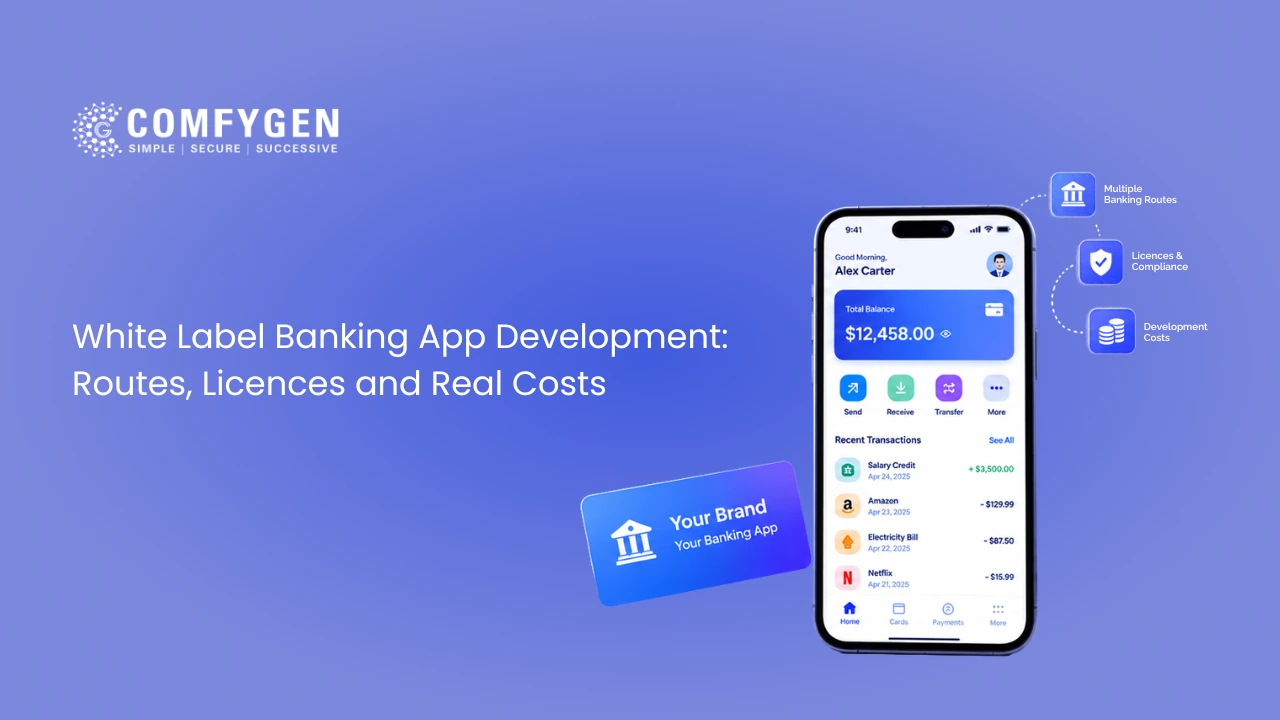


A white label banking app is banking software built by one company and sold to another to launch under its own brand. Software costs run $25,000 to $700,000 depending on route, and the licence you need to operate is a separate budget that the platform vendor does not provide.
That second sentence is the one that catches people out. A white label platform gives you the app, the ledger and the integrations. It does not give you permission to hold or move customer money. Depending on the market, that permission comes from a sponsor bank, an e-money licence, a payments authorisation or a co-branding arrangement with a licensed bank, and it has its own timeline and its own capital requirement.
This guide prices both, and keeps them separate, because mixing them is why published cost estimates for the same product range from $25,000 to $2 million.
Software cost by route
| Route | What you get | Software cost | Time to launch |
| Platform licence plus branding | Vendor’s app, your logo, colours and copy | $25,000 to $80,000 setup, then $2,000 to $10,000 a month | 2 to 4 months |
| Platform plus custom front end | Vendor’s rails, your own app experience | $60,000 to $150,000 | 4 to 7 months |
| BaaS integration build | Your app and ledger logic on a BaaS provider’s rails | $90,000 to $250,000 | 6 to 10 months |
| Full custom on your own core | Everything yours | $250,000 to $700,000+ | 10 to 18 months |
Those are software figures only. Licensing comes next, and for a regulated product it is frequently the larger number.
Licensing by market: the budget nobody quotes
The route to operating permission depends entirely on where you launch. Confirm current thresholds with the regulator before building a business case, since capital requirements change.
| Market | Usual route | What it requires | Rough timeline |
| United States | Sponsor bank partnership | No licence of your own, but the bank runs full due diligence on you | 4 to 9 months |
| United Kingdom and EU | E-money institution licence, or an agent arrangement under one | Regulatory capital plus a licence application | 9 to 18 months |
| India | PPI authorisation from the RBI, or co-branding with a licensed bank | ₹5 crore net worth at application, ₹15 crore by the end of the third financial year | 9 to 15 months |
| UAE | Stored Value Facility authorisation from the CBUAE | Capital and governance requirements set by the regulator | 9 to 18 months |
| Singapore | Major Payment Institution licence from MAS | Base capital and safeguarding requirements set by the regulator | 9 to 18 months |
The India figures come from the RBI’s Master Directions on Prepaid Payment Instruments, which also cap balances at ₹10,000 for small PPIs and ₹2,00,000 for full-KYC PPIs. If the product plan involves holding more than that per customer, the route changes.
In the United States, the sponsor bank route looks like the easy option and is not. Under the 2023 Interagency Guidance on Third-Party Relationships issued by the Federal Reserve, FDIC and OCC, a bank partnering with a fintech has to run due diligence before the relationship starts, negotiate contracts with audit rights and clear compliance ownership, and monitor the arrangement for its whole life. The guidance is explicit that using a third party does not reduce the bank’s own responsibility. In practice this means the bank will ask you for policies, controls, financials and an audit trail before it signs, and the diligence cycle is usually 4 to 9 months.
What a white label platform does not give you
Worth stating plainly, because vendor marketing is quiet about all four.
It does not give you a licence: Covered above. The platform is software.
It does not transfer compliance responsibility: KYC, AML monitoring, sanctions screening, suspicious activity reporting and consumer protection obligations stay with whoever holds the regulatory permission. If that is your sponsor bank, the bank will push the operational burden onto you by contract.
It does not give you differentiation: Every licensee of the same platform ships broadly the same product. If the plan is to win on experience, budget for the custom front end route rather than the branding route, because changing a flow you do not own is usually not possible.
It does not give you your data model: Exit terms matter more than launch terms. Ask how customer records, ledger history and transaction data come out, in what format, and at what cost, before signing. Firms that skip this find out at renewal.
Feature costs
| Feature | Cost | Build time |
| Onboarding with KYC and document capture | $9,000 to $22,000 | 4 to 6 weeks |
| Account opening and ledger setup | $10,000 to $25,000 | 4 to 7 weeks |
| Balances, statements and transaction history | $6,000 to $14,000 | 3 to 4 weeks |
| Payments and transfers | $10,000 to $26,000 | 4 to 8 weeks |
| Card issuing and card controls | $12,000 to $30,000 | 5 to 9 weeks |
| Bill payments and recurring transfers | $7,000 to $16,000 | 3 to 5 weeks |
| Savings or deposit products | $8,000 to $20,000 | 4 to 6 weeks |
| Lending or credit module | $18,000 to $45,000 | 7 to 12 weeks |
| AML monitoring and sanctions screening | $12,000 to $30,000 | 5 to 8 weeks |
| Admin console and operations tooling | $10,000 to $24,000 | 4 to 7 weeks |
| Notifications and in-app support | $5,000 to $11,000 | 2 to 4 weeks |
| Reporting and regulatory returns | $8,000 to $20,000 | 4 to 6 weeks |
The lending module is the one most often scoped late. It brings credit decisioning, affordability checks, collections and its own regulatory surface, and it rarely fits inside a standard white label platform. Lenders usually need it built, often alongside a separate credit scoring system.
Operations tooling is the other underestimate. Staff need to freeze a card, reverse a transaction, reopen a closed account and answer a dispute. Without that console, every exception becomes a developer ticket.
White label, BaaS or custom
| Criteria | White label | BaaS integration | Full custom |
| Time to launch | 2 to 4 months | 6 to 10 months | 10 to 18 months |
| Software cost | $25,000 to $80,000 plus monthly | $90,000 to $250,000 | $250,000 to $700,000+ |
| Ongoing | Licence fee, often plus revenue share | Per-account and per-transaction fees | Infrastructure and team |
| Product control | Limited | Good | Total |
| Own the code | No | Front end and logic yes, rails no | Yes |
| Switch provider later | Hard | Moderate | Not applicable |
Choose by what you are actually testing. If the question is whether customers want the product at all, white label answers it in a quarter for the price of a small build, and that is the right answer. If the product thesis depends on an experience or a product type the platform cannot express, white label will not get you there and the money spent proving that is wasted.
Banks and credit unions that already hold a licence usually skip white label entirely and go to a BaaS integration or a custom build on their existing core, since the licence was the expensive part and they already have it. That work generally sits inside a wider mobile banking programme rather than standing alone.
If the plan is a standalone digital bank rather than a branded app on someone else’s licence, that is a different build with a different cost base, covered on Comfygen’s digital bank build page. Firms serving Sharia-compliant markets have a third set of product requirements again, handled through Islamic banking app development.
Running costs of white label banking app
- Platform licence: $2,000 to $10,000 a month on the branding route, more with volume tiers
- Revenue share: many vendors and BaaS providers take a cut of interchange or transaction fees, and this becomes the largest line item at scale
- Per-account fees: common on BaaS, charged monthly per active account
- Compliance operations: staff for KYC review, alert handling and reporting, which is a headcount cost rather than a software one
- Maintenance on custom code: 15% to 20% of build cost a year
- Annual audit and penetration testing: $5,000 to $15,000
The revenue share is worth modelling before signing. A 20% to 40% cut of transaction economics is normal, and at scale it can exceed what a custom build would have cost in total.
Where white label banking projects overrun
Sponsor bank or vendor diligence starts late: It runs 4 to 9 months and does not move faster because development is ready. Start it in week one.
The branding route gets chosen for a product that needs customisation: Teams pick the cheapest route, discover three flows they cannot change, then pay again for the custom build.
Operations tooling deferred: Covered above. It is not optional once real customers exist.
Compliance treated as the vendor’s problem: It is not, and the contract will say so.
Exit terms unread. Data portability and notice periods decide what the relationship costs in year three.
How Comfygen approaches these builds
Comfygen has built fintech products since 2019, with 550+ projects for 400+ clients across 30+ countries and 97% client retention, under ISO 9001:2015, ISO/IEC 20000-1:2018 and ISO 27001. Target markets include the USA, UK, UAE, Canada, Singapore and India, which is the same spread the licensing table above covers.
On a white label banking programme:
- The first workshop settles market and licensing route, because that decides the budget more than the feature list does
- Vendor or sponsor diligence starts in parallel with design, never after
- Product requirements are tested against the shortlisted platform’s actual limits before a route is committed
- Operations tooling ships in the first release
- Exit and data portability terms are reviewed before contracts are signed
Conclusion
White label banking is priced in two currencies. One is software, and it behaves like any other build: predictable, scopeable, quotable. The other is regulatory permission, and it behaves nothing like software, because it runs on the regulator’s timetable and the sponsor bank’s risk appetite.
Published estimates for this product swing from $25,000 to $2 million because some of them count only the first currency and some count both. Decide the market and the licensing route first, then price the software against it. In that order the numbers stop contradicting each other.
Frequently asked questions
How much does a white label banking app cost?
Software costs $25,000 to $700,000. A branded version of a vendor's app runs $25,000 to $80,000 plus $2,000 to $10,000 a month. A BaaS integration runs $90,000 to $250,000. A full custom build runs $250,000 to $700,000 or more. Licensing is a separate budget.
Do I need a banking licence for a white label banking app?
How long does it take to launch a white label banking app?
What is the difference between white label banking and BaaS?
What does a white label banking platform not include?
Can a credit union or small bank use a white label banking app?
What ongoing costs come with a white label banking app?

Mr. Saddam Husen, (CTO)
Mr. Saddam Husen, CTO at Comfygen, is a renowned Blockchain expert and IT consultant with extensive experience in blockchain development, crypto wallets, DeFi, ICOs, and smart contracts. Passionate about digital transformation, he helps businesses harness blockchain technology’s potential, driving innovation and enhancing IT infrastructure for global success.