




Clinics that are still running scheduling from a WhatsApp group and billing from a spreadsheet eventually hit a wall. Patient volume grows, staff can’t keep records straight across departments, and insurance claims start slipping through the cracks. At that point, the conversation shifts from “which software should we buy” to “what does it actually take to build or customize the right system for us.”
That second question is what this guide answers. Below, we walk through what clinic management software development actually involves: the modules you can’t skip, the technology choices that matter, what compliance requires, realistic cost ranges, and how to evaluate a development partner before you commit a budget.
What Is Clinic Management Software Development?
Clinic management software development is the process of designing, building, and deploying a digital system that runs the operational, clinical, and financial side of a healthcare practice — patient registration, appointment scheduling, electronic health records (EHR), billing and insurance claims, pharmacy/inventory tracking, staff management, and regulatory compliance — inside one connected platform.
The word that matters most here is “connected.” A scheduling tool with a billing module bolted on isn’t a clinic management system; it’s two tools sharing a login screen. The point of proper software development for clinic management is that patient data, appointments, billing, and clinical notes all reference the same underlying record, so nothing has to be re-entered, reconciled, or chased down across systems.
This is also where clinic management software differs from an EHR. An EHR’s job is to capture and store clinical data — diagnoses, prescriptions, lab results. A clinic management system sits a layer above that: it handles the operational and financial workflows (scheduling, billing, staffing, reporting) and typically integrates with an EHR rather than replacing it.
Off-the-Shelf vs. Custom: Why “Best Software” Isn’t the Right Question Anymore
Most clinics start by comparing ready-made platforms — tools like Kareo, AdvancedMD, athenahealth, DrChrono, CureMD, eClinicalWorks, Practice Fusion, Greenway Health, and Meditab all offer solid out-of-the-box scheduling, EHR, and billing features, and they’re a reasonable starting point for a single-doctor practice with standard workflows.
The limitation shows up as a clinic grows. Multi-branch operations, specialty-specific consultation workflows (pre-procedure intake, group bookings, recurring care plans), or any plan to integrate deeply with a pharmacy system, diagnostic lab, or national health exchange tend to outgrow what a generic SaaS tool’s API allows. At that point, clinics either pay for expensive custom modules bolted onto a platform they don’t control, or they commission a purpose-built system.
If any of the following apply to your practice, custom clinic management software development is worth seriously evaluating:
- You operate more than 2–3 branches or plan to scale to multiple locations
- You run specialty workflows that off-the-shelf templates don’t support well (fertility clinics, dental chains, diagnostic networks, multi-specialty hospitals)
- You want to eventually license or white-label your platform to other clinics
- You need deep integration with pharmacy systems, diagnostic labs, or insurance APIs that generic vendors don’t support out of the box
- Data residency or compliance requirements in your country require infrastructure control that a third-party SaaS vendor can’t guarantee
Build vs. Buy vs. Customize: An Honest Comparison
There’s no universally “right” answer here — the right path depends on your scale, budget, and how specific your workflows are. Here’s a practical framework:
| Factor | Buy Off-the-Shelf | Customize Existing Platform | Build Custom |
| Timeline | 2–6 weeks to deploy | 2–4 months | 5–12+ months |
| Upfront cost | Low (subscription-based) | Moderate | Higher upfront, lower long-term per-feature cost |
| Customization | Limited to vendor’s roadmap | Moderate — bound by platform architecture | Full control |
| Integration depth | Limited to published APIs | Moderate | Unlimited |
| Long-term ownership | None — you’re renting | Partial | Complete — you own the codebase and data |
| Best for | Single clinics, standard workflows, fast launch | Growing practices with moderate custom needs | Multi-branch chains, specialty clinics, platform ambitions |
The mistake we see most often: a clinic with several branches buys an off-the-shelf tool to launch quickly, hits a customization ceiling within a year, and ends up paying for a full custom build anyway — after having already paid for the subscription. If you can see specialty workflows or multi-location growth coming, it’s usually cheaper over a 3-year horizon to build it right the first time.
Build a Smarter, Compliant Clinic Management System Today
Looking to streamline operations, reduce manual workload, and ensure full healthcare compliance? Our experts can help you design and develop a clinic management solution tailored to your needs.
Get a Free Consultation
Core Modules Every Clinic Management System Needs
These aren’t “nice to have” feature checkboxes — they’re the modules a production system actually requires, with realistic build context for each.
Patient Management
Registration, demographic data, medical history, consent management, document uploads, and (where applicable) national health ID integration. This is foundational — every other module reads from this record.
Appointment Scheduling Engine
Multi-doctor, multi-branch, real-time slot management with conflict detection. For specialty clinics running pre-procedure consultations, follow-ups, or group bookings, this module gets complex fast and deserves dedicated design time rather than a generic calendar widget.
Electronic Health Records (EHR) Integration
Structured clinical notes, prescription management, lab result linkage, and diagnostic imaging references. Getting this data model right early matters — retrofitting a poorly structured EHR schema later is far more expensive than designing it properly the first time.
Billing and Revenue Cycle Management (RCM)
Invoicing, insurance claim submission and tracking, payment reconciliation, and outstanding-dues management. For multi-specialty clinics, this single module often takes as long to build as the rest of the system combined.
Pharmacy and Inventory Management
Drug dispensing workflows, expiry tracking, reorder alerts, and controlled-substance compliance — important if your pharmacy app development needs are tied directly into the clinic’s dispensing workflow.
Telemedicine Integration
WebRTC-based video consultation with in-call prescription writing and automatic note-saving to the patient record. Post-2021, telemedicine is table-stakes, not a differentiator.
Reporting and Analytics
Clinical outcome dashboards, financial performance, doctor productivity, and patient retention metrics — most clinics want this, but few scope it into the initial build, which causes painful retrofits later.
Staff and HR Management
Roster scheduling, leave tracking, performance records, and payroll integration.
How to Develop Clinic Management Software: Step-by-Step Process
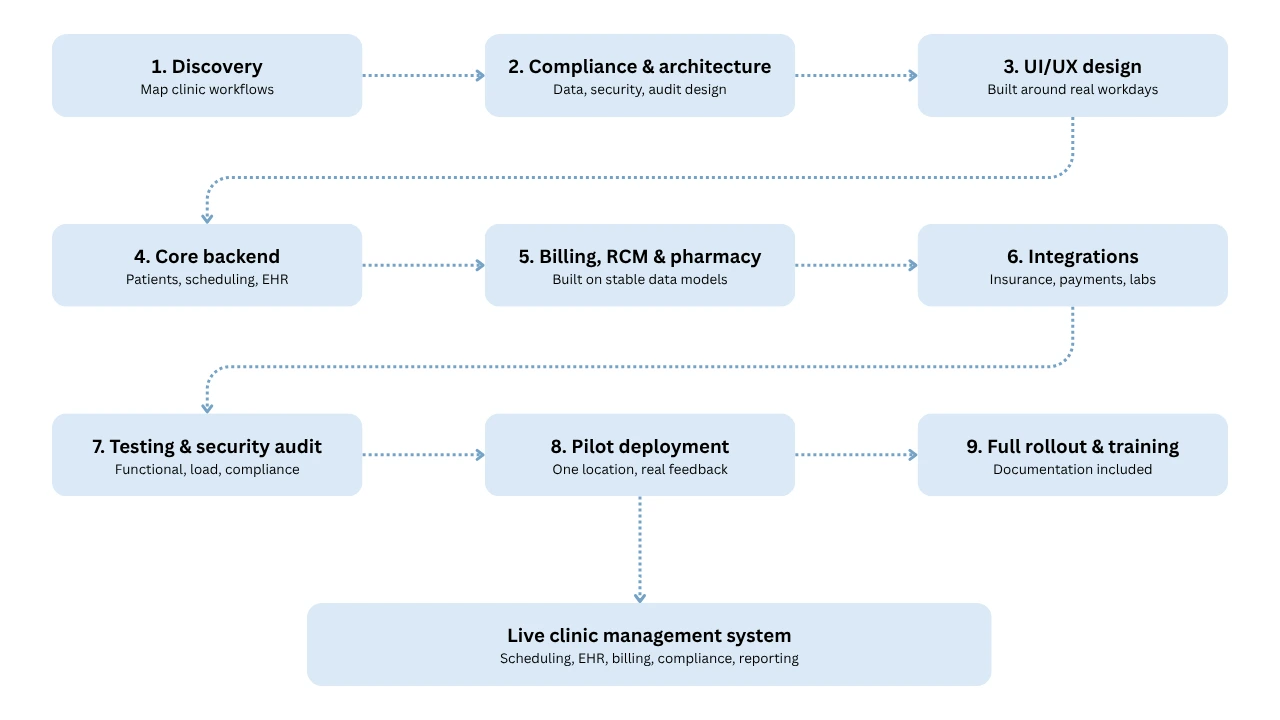
Most vendors will show you a process chart with neat boxes and arrows. In real projects, it rarely moves in such a straight line. But the steps below are the general order things happen in — whether you build with an in-house team or an outsourced healthcare software development company.
Step 1: Start with discovery, not a feature list
This step decides whether the project goes well or badly. Many clinics start by saying “we need scheduling and billing” and stop there. But the real questions matter more: How many branches do you have? What departments handle different types of visits? Which outside systems do you need to connect with — insurance, pharmacy software, the lab, maybe a government health portal?
Skipping this step is the number one reason projects grow out of control later.
Step 2: Plan compliance and architecture first
Decide where patient data will be stored, what encryption you’ll use, and how you’ll track who accessed or changed a record. Do this before any code is written. You can add these things later, but it costs much more.
Step 3: Design the UI/UX around real workdays
The goal isn’t a pretty mockup. It’s a layout that fits how front-desk staff, doctors, and patients actually work. A scheduling screen with three extra clicks may not sound like much. But multiply that across every booking, every day, for a year — it adds up to real lost time.
Step 4: Build the core backend first
This means patient management, the scheduling engine, login/authentication, and the EHR data layer. Every other part of the system depends on these being solid.
Step 5: Build billing, RCM, and pharmacy/inventory next
These modules come after the patient and scheduling data is stable, since they rely on it.
Step 6: Connect the integrations
This includes insurance claim APIs, payment gateways, SMS or WhatsApp alerts, lab systems, and (where needed) national health exchange integration, like ABDM for clinics in India.
Step 7: Test thoroughly and run a security audit
This isn’t a quick check. Given how sensitive patient data is, you need proper functional testing, load testing, and a full compliance review.
Step 8: Run a pilot at one location
Don’t roll out to every branch at once. Test with real staff at one location first. They’ll find problems a demo never shows you. It’s far cheaper to fix issues at one branch than after a full rollout.
Step 9: Train your staff and document everything
This step gets skipped more than it should. Even a well-built system fails if staff don’t know how to use it properly.
Tech Stack for Clinic Management App Development
Vendors will have opinions here, but the underlying logic is fairly consistent across well-built systems:
Backend
Node.js or Python (Django/FastAPI) are the most common choices. Node handles real-time scheduling and notification systems well; Python’s libraries are stronger for clinical data processing and any machine-learning components (like appointment demand forecasting or clinical decision support).
Database
PostgreSQL is the standard choice for the primary data store — it handles complex relational queries across patient, appointment, billing, and inventory tables with strong data integrity. A secondary document store (like MongoDB) is sometimes used for unstructured clinical notes, but it shouldn’t be the primary store for structured medical and billing data.
Frontend
React for web admin dashboards; React Native or Flutter for cross-platform doctor and patient mobile apps.
Cloud infrastructure
AWS, GCP, or Azure, chosen based on regional data residency requirements and managed database/security service availability in your target country.
Interoperability standard
HL7 FHIR is the global standard for healthcare data exchange. Building to FHIR from the start means your system can talk to external labs, referral networks, and national health exchanges without custom integration work every time you add a new partner.
Web, Mobile, or Both? Choosing the Right Platform
This decision affects both cost and rollout speed:
- Web-only: Sufficient for clinics where front-desk and doctor workflows happen on desktop/tablet at fixed locations. Faster and cheaper to build and maintain.
- Web + mobile (patient-facing): Needed if you want patients to book appointments, view records, or join teleconsultations from their own phones — increasingly expected by patients in 2026.
- Web + mobile (doctor-facing): Useful for doctors who round between departments or locations and need schedule/EHR access on the move, similar to how a doctor appointment app extends scheduling beyond the front desk.
A reasonable approach for most clinics: launch web-first for internal operations, then add a patient-facing mobile app once the core system is stable — rather than building all three simultaneously and stretching the timeline and budget.
Compliance and Data Security in Medical Software Development
Patient health data is among the most heavily regulated categories of data anywhere in the world, and compliance has to be designed into the architecture from day one — not added after launch. Key requirements for medical software development for clinics include:
HIPAA (United States)
Governs how patient health information is stored, transmitted, and accessed. The HHS Office for Civil Rights’ Security Rule requires administrative, physical, and technical safeguards for electronic protected health information (ePHI). For a deeper look at how this applies specifically to mobile health apps, see our guide on HIPAA compliance in mobile health apps.
GDPR (Europe)
GDPR (Europe) and equivalent data protection laws elsewhere: Require explicit patient consent, the right to access and delete personal data, and breach notification obligations.
Data residency
Many countries require patient health data to be stored on servers physically located within national borders. This is easy to overlook if a vendor defaults to a US- or EU-hosted cloud region without specifying it.
Encryption
Data at rest and in transit should use AES-256 (or equivalent) encryption at minimum, with role-based access control limiting who can view or modify records.
Audit trails
Every record access, edit, and deletion needs a timestamped, user-attributed log. This isn’t optional — it’s essential for regulatory scrutiny and medico-legal protection if a dispute ever arises.
Data retention
Medical records typically must be retained for a legally defined minimum period (commonly 5–7+ years, depending on jurisdiction and specialty), which needs to be reflected in your backup and archival design from the start.
Consent management
Patients increasingly have a legal right to view, modify, and revoke consent for how their data is used — this needs a dedicated module, not a checkbox buried in onboarding.
Need a Custom Clinic Management Solution? Let’s Build It Together
Get a secure, compliant, and easy-to-use clinic management system designed for your clinic’s unique workflow. Talk to our development team today.
Request a Quote
Cost of Clinic Management Software Development
Cost depends heavily on scope, feature complexity, platform choice (web vs. web+mobile), compliance requirements, and the development team’s location and experience. Here’s a realistic breakdown:
By software complexity
| Software Type | What’s Included | Estimated Cost |
| Basic Clinic Management Software | Scheduling, basic billing, patient records | $30,000 – $60,000 |
| Advanced Clinic Management System | EHR integration, telemedicine, prescription tracking, analytics | $60,000 – $150,000 |
| Comprehensive Multi-Branch Suite | Full EHR, RCM, pharmacy/inventory, multi-location support, advanced compliance architecture | $150,000 – $500,000+ |
By feature/module
| Module | Estimated Cost |
| Patient management & scheduling | $10,000 – $20,000 |
| EHR integration | $20,000 – $40,000 |
| Billing & RCM | $10,000 – $30,000 |
| Telemedicine capability | $20,000 – $50,000 |
| Analytics & reporting | $15,000 – $30,000 |
| Compliance & security implementation | $10,000 – $30,000 |
By platform
| Platform | Estimated Cost |
| Web-based only | Starting around $12,000 |
| Mobile app add-on (per platform: iOS or Android) | Additional $20,000 – $50,000 |
Ongoing costs: Post-launch maintenance — security patches, updates, and minor feature additions — typically runs 15–20% of the initial development cost annually. Budget for this; it’s not optional for software handling patient data.
A note on cheap quotes: an unusually low quote for a full clinic management system development project is a signal to ask more questions, not fewer. Cutting corners on compliance, testing, or data architecture at the build stage routinely costs more to fix later than it would have cost to build correctly the first time.
Development Timeline: What to Realistically Expect
| Project Type | Realistic Timeline |
| Single-specialty clinic, basic scheduling + billing + EHR | 4–6 months |
| Multi-feature system with telemedicine, pharmacy, and analytics | 7–9 months |
| Multi-branch enterprise platform with full compliance architecture | 10–14 months |
Compressing a 10-month project into 6 months almost always means cutting testing time or compliance review — not actually building faster. If a vendor promises to dramatically shrink a realistic timeline without explaining what they’re cutting, ask directly what gets dropped.
Why Comfygen for Clinic Management Software Development
Comfygen is a healthcare software development company that has worked across telemedicine, EHR systems, laboratory app development, pharmacy software, and clinic operations platforms.
- Healthcare-specific expertise: Our team builds with HIPAA, data security, and EHR interoperability requirements designed in from the architecture stage — not patched on afterward.
- Custom-fit, not template-fit: We map your actual clinic workflows before writing requirements, rather than starting from a generic feature checklist.
- Scalable by design: Whether you need a single-location scheduling and billing system or a multi-branch platform with pharmacy and lab integrations, the architecture is built to add modules later without a rebuild.
- Support that continues after launch: Healthcare regulations and patient needs change — our team provides ongoing updates, troubleshooting, and training rather than disappearing after deployment.
Conclusion
Clinic management software development isn’t about picking the flashiest platform off a comparison list — it’s about understanding your clinic’s actual workflows, mapping out the compliance requirements that apply to your data, and choosing between buying, customizing, or building based on where your practice is headed over the next few years, not just where it is today.
Get the discovery and architecture stage right, and the rest of the build — from the scheduling engine to billing to compliance — follows a predictable path. Get it wrong, and even a well-coded system ends up needing an expensive rebuild within a year or two.
If you’re evaluating whether to buy, customize, or build a clinic management system from scratch, talk to our team — we’re happy to walk through your specific workflows and give you a realistic scope and cost estimate before you commit a budget.
FAQs
How long does it take to develop clinic management software?
A basic single-clinic system with scheduling, billing, and EHR typically takes 4–6 months. A full multi-branch platform with telemedicine, pharmacy, and advanced compliance architecture usually takes 10–14 months. Timelines compressed without cutting scope are rare — most "faster" timelines mean reduced testing or compliance review.
What is the cost of clinic management software development?
Costs typically range from $30,000–$60,000 for a basic single-clinic system to $150,000–$500,000+ for a comprehensive multi-branch platform with full EHR, billing, pharmacy, and compliance architecture. The exact figure depends on module scope, integrations, and platform choice (web vs. web+mobile).
Should I buy off-the-shelf software or build a custom clinic management system?
Off-the-shelf tools work well for single clinics with standard workflows and a need to launch quickly. Custom development makes more financial sense if you operate multiple branches, run specialty workflows that generic templates don't support, or plan to eventually license your platform to other clinics — the long-term cost of customization ceilings usually exceeds a custom build's upfront cost.
What features should clinic management software include?
At minimum: patient management and scheduling, EHR integration, billing and revenue cycle management, prescription tracking, reporting and analytics, and compliance/security controls. Telemedicine integration and pharmacy/inventory management are increasingly standard additions rather than optional extras.
Is clinic management software the same as an EHR system?
No. An EHR focuses on capturing and storing clinical data — diagnoses, notes, lab results. Clinic management software handles the operational and financial layer — scheduling, billing, staffing, and reporting — and typically integrates with an EHR rather than replacing it.
What compliance standards apply to clinic management software development?
In the US, HIPAA governs how patient health data is stored and transmitted. In the EU, GDPR applies. Most jurisdictions also have data residency, retention, and consent management requirements that need to be designed into the system architecture from the start rather than retrofitted after launch.

Mr. Saddam Husen, (CTO)
Mr. Saddam Husen, CTO at Comfygen, is a renowned Blockchain expert and IT consultant with extensive experience in blockchain development, crypto wallets, DeFi, ICOs, and smart contracts. Passionate about digital transformation, he helps businesses harness blockchain technology’s potential, driving innovation and enhancing IT infrastructure for global success.
Based on Interest

Cloud Kitchen Management Software Development: Features, Process, Cost & Compliance Guide
Quick Summary: Cloud kitchen management software development brings order aggregation, kitchen display systems, inventory tracking, and analytics into one dashboard, replacing the…