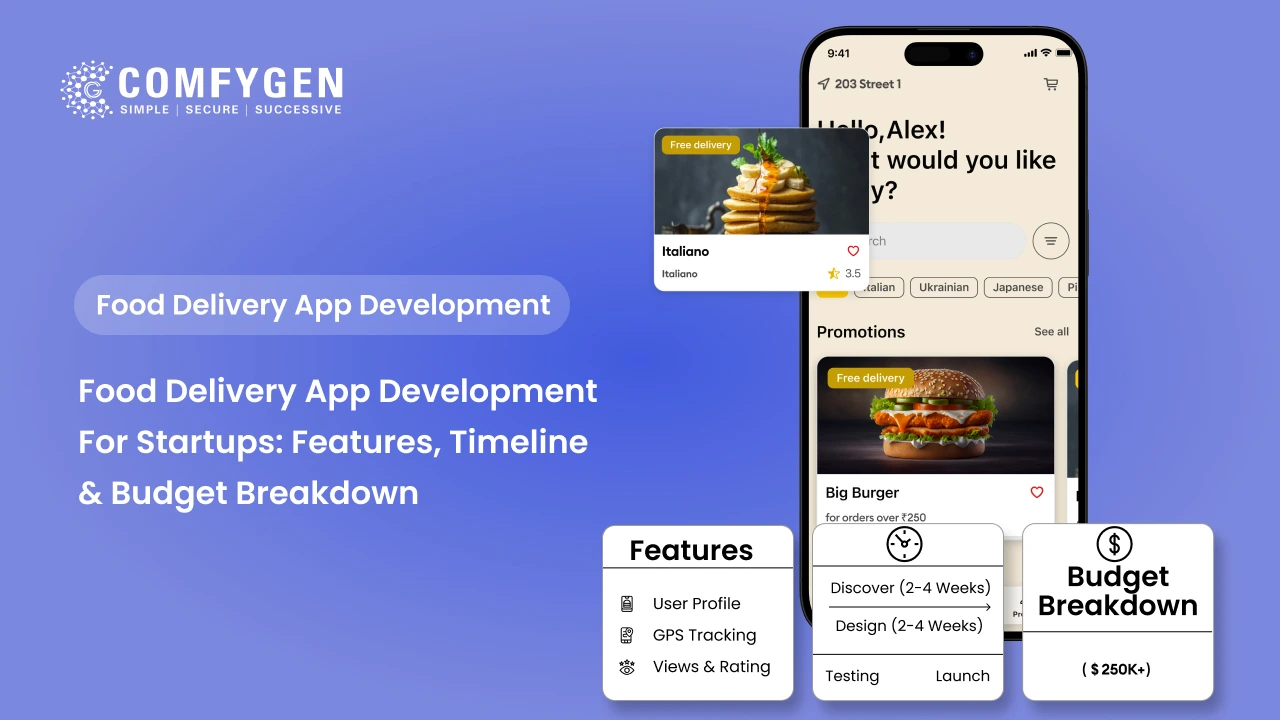





The on-demand food delivery industry has experienced massive growth over the last few years, creating profitable opportunities for startups looking to enter the digital food ecosystem. With customers increasingly relying on apps like Swiggy, Zomato, and Uber Eats for quick and convenient food delivery, building a robust online platform has become a business necessity rather than an option.
If you are a startup planning to build your own on-demand food delivery platform, understanding the features, development timeline, and complete cost breakdown is essential. In this detailed guide, we’ll explore everything you need to know about Food Delivery App Development, including essential components, technology architecture, development stages, and budget insights — with real, startup-friendly inputs from Comfygen Technologies, a trusted Food Delivery App Development Company.
Understanding Food Delivery App Development for Startups
A complete guide for startups planning to build a powerful food delivery application. Explore essential features, development stages, timeline, and budget insights to launch a scalable and profitable food delivery app with the expertise of Comfygen Technologies.
What Is Food Delivery App Development?
A food delivery app is a modern mobile solution that allows users to browse restaurant menus, place orders, make secure payments, and track their delivery in real time. It streamlines the entire ordering process, making the experience fast, convenient, and user-friendly.
At Comfygen, we build highly intuitive interfaces for iOS, Android, and cross-platform systems. Our UI/UX approach ensures smooth navigation, clean layouts, and an effortless user experience.
A powerful food delivery app includes dedicated modules for user registration, restaurant listings, menu browsing, delivery management, and customer reviews. These features enhance the platform’s functionality, improve user trust, and boost overall engagement.
The design incorporates high-quality visuals, easy-to-read menu screens, quick load times, and secure payment gateways—ensuring both reliability and visual appeal.
According to a study by Statista titled “Food Delivery Apps: Usage Statistics and Market Share” published in Global App Trends (2025), over 55% of smartphone users worldwide use food delivery apps at least once every month. This insight highlights the growing adoption and importance of food delivery applications in today’s digital lifestyle.
Why Startups Are Investing in Food Delivery App Development
The food delivery industry has rapidly transformed into one of the most lucrative and innovation-driven digital markets. For startups, this sector offers a rare blend of high profitability, scalability, and long-term market stability, making it one of the most attractive investment opportunities today. With consumer lifestyles shifting toward convenience, faster delivery, and digital-first ordering, startups are capitalizing on this momentum by building modern, feature-rich food delivery applications.
1. High Revenue Potential & Multiple Monetization Channels
Food delivery apps open the door to diverse and continuous revenue streams. Startups can generate income through delivery charges, restaurant commissions, subscription plans, surge pricing, and in-app advertising. Additional premium features — such as VIP memberships, loyalty programs, and exclusive restaurant partnerships — further boost profitability. This multi-layered monetization model enables faster ROI and long-term business sustainability.
2. Wider Consumer Reach Beyond Physical Boundaries
Digital food delivery platforms help startups and restaurants reach a broader audience without geographical limitations. Unlike traditional dine-in establishments, food delivery apps allow brands to serve customers across neighborhoods and cities, thanks to GPS-based location services and real-time delivery tracking. This expanded reach not only drives higher order volumes but also strengthens brand visibility and market positioning.
3. Strong Brand Building & Customer Loyalty
Launching a dedicated food delivery application gives startups full control over their brand presence. Through personalized user experiences — including AI-powered food delivery app development recommendations, targeted discounts, push notifications, and loyalty rewards — businesses can significantly increase customer retention. Custom design elements such as brand colors, logos, themes, and promotional banners help strengthen brand identity and encourage repeat orders.
4. Data-Driven Business Growth
Food delivery apps provide startups with access to powerful insights, including customer preferences, order patterns, peak hours, and trending cuisines. This data-driven intelligence allows businesses to optimize menus, refine marketing strategies, and enhance operational efficiency. When startups use data effectively, they achieve higher customer satisfaction and smarter decision-making, ultimately improving revenue performance.
5. Integration of AI, Automation & Modern Technologies
Today’s food delivery landscape is powered by advanced technologies such as AI, ML, and automation — all of which improve the overall operational and customer experience.
Smart chatbots automate customer support, predictive analytics help forecast demand, and AI-driven suggestions personalize the ordering experience. Automated order management and delivery route optimization ensure quicker deliveries and reduced operational costs. These innovations give startups a competitive edge in a crowded market.
6. A Market Full of Untapped Niches & Opportunities
Despite major players like Uber Eats, Swiggy, and Zomato, the market remains far from saturated. Startups can still build successful niche-based platforms for:
- Healthy meals & fitness diets
- Homemade/chef-based meals
- Vegan or organic food
- Corporate meal programs
- Hyperlocal tiffin services
Each niche offers massive potential for innovation and growth, making it easier for new businesses to stand out.
7. Faster, Cost-Effective Development with the Right Tech Partner
With modern frameworks, APIs, and on-demand food delivery app development tools, startups can build secure, scalable food delivery apps without high upfront investments. Partnering with a trusted Food Delivery App Development Company like Comfygen Technologies ensures access to expert developers, UI/UX specialists, QA engineers, and integration experts — all working together to reduce risks, lower costs, and accelerate time-to-market.
Types of Food Delivery Apps (Startup-Friendly Models)
The food delivery industry offers multiple business models that startups can adopt based on their target audience, operational capabilities, and revenue goals. Choosing the right model is crucial because it determines your platform’s scalability, profitability, and overall market positioning. Below are the most effective and startup-friendly food delivery app models, each with unique advantages and growth opportunities.
1. Aggregator Model (Marketplace Model)
This is one of the most popular and budget-friendly models for startups. In the aggregator model, your app acts as a bridge between customers and restaurants, allowing users to browse menus, place orders, and track deliveries.
How It Works:
Restaurants handle meal preparation and delivery, while your platform manages the ordering experience.
Why Startups Prefer It:
- Low operational cost
- No need to manage delivery fleets
- Unlimited restaurant partnerships
- Fast to launch & easy to scale
Best For: Startups looking to build a platform similar to Zomato or Uber Eats at minimal investment.
2. Delivery-Only Model (Logistics Support Model)
In this model, your startup provides delivery services to restaurants that don’t have their own delivery fleet. You manage the logistics while restaurants focus on cooking.
How It Works:
Restaurants prepare the food → Your delivery team handles pickup & delivery → You earn commissions & delivery fees.
Why Startups Prefer It:
- Strong demand from small restaurants & cloud kitchens
- Higher commission opportunities
- Better control over delivery speed & customer satisfaction
Best For: Startups wanting to offer services similar to Swiggy Genie or independent delivery fleets.
3. Full-Stack Food Delivery Model (End-to-End Platform)
This is a complete food delivery ecosystem where your startup manages everything from order placement to delivery.
How It Works:
Your company handles the platform, restaurant partnerships, delivery, customer service, and branding.
Why Startups Prefer It:
- Maximum control over operations
- Strong brand authority
- High customer loyalty
- Multiple income streams
Best For: Startups aiming to build a branded, premium food delivery experience.
4. Cloud Kitchen / Virtual Kitchen App Model
Cloud kitchens are becoming one of the fastest-growing opportunities for startups. These kitchens operate without dine-in services and rely entirely on delivery platforms.
How It Works:
Your app allows cloud kitchens to list their menus and serve customers exclusively through your delivery system.
Why Startups Prefer It:
- Extremely low overhead
- Perfect for niche food businesses (vegan, fitness meals, tiffin services)
- High margins and recurring daily orders
Best For: Startups wanting to create a Zomato or Swiggy for cloud kitchens.
5. Restaurant-Owned Food Delivery App Model
Some restaurants or chains want their own branded delivery app. Startups can develop these apps for clients or build them for specific restaurant partners.
How It Works:
A single restaurant or chain uses the app for online ordering, table booking, and delivery.
Why Startups Prefer It:
- High exclusivity and better brand recognition
- Zero commission sharing
- Long-term customer loyalty
Best For: Restaurant businesses, franchise owners, or startups offering white-label food app development services.
6. Niche Food Delivery App Model (Trending Startup Opportunity)
This is an emerging and highly profitable model. Startups can target specific audiences with specialized delivery solutions.
Examples of Niches:
- Healthy meal delivery
- Organic & vegan food delivery
- Tiffin or homemade food delivery
- Corporate meal delivery
- Pet food delivery
- Diet-based or fitness meal solutions
Why Startups Prefer It:
- Less competition
- Higher customer loyalty
- Easily scalable with strong branding
Best For: Startups looking for unique and high-retention markets.
Essential Food Delivery App Features Every Startup Needs
A successful food delivery app development requires more than just basic ordering and delivery capabilities. Startups must integrate smart, user-centric, and technology-driven features that enhance convenience, speed, and reliability. From real-time tracking and secure payments to AI-powered personalization and advanced restaurant dashboards, these essential features form the backbone of a high-performing food delivery platform designed to scale.
1. Customer App Features
Your customers expect a seamless, fast, and intuitive app experience.
- User registration & login
- Smart search with filters
- Restaurant listings
- Menu with pricing & customization
- Real-time order tracking
- Secure online payments
- Order history and re-order
- Smart notifications
- Ratings & reviews
- 24/7 in-app support
2. Restaurant App Features
- Menu and pricing management
- Order acceptance & management
- Delivery partner assignment
- Live order updates
- Earnings & payout dashboard
- Offers & coupon management
3. Delivery Partner App Features
- Profile verification
- Availability toggle
- Order acceptance & navigation
- GPS-based optimized routes
- Delivery status updates
- Wallet, earnings & payouts
- Ratings and feedback
4. Admin Dashboard Features
- Restaurant management panel
- Customer management
- Delivery agent control
- Commission & pricing configuration
- Order analytics
- Revenue reporting
- Promo code management
Advanced Features for 2025
To stand out from competitors, consider adding:
- AI-based meal recommendations
- Smart order scheduling
- Multi-city support
- Automatic delivery assignment
- Wallet integrations
- Loyalty programs & reward systems
What Tools And Technologies Are Used In Food Delivery App Development?
Building a high-performing food delivery app development requires a robust mix of modern tools, programming languages, frameworks, and third-party integrations. These technologies ensure smooth user experiences, real-time updates, secure payments, and scalable backend operations. Below is the essential tech stack commonly used to develop reliable and fast food delivery applications.
Frontend Stack
- React Native / Flutter (Cross-platform)
- Swift (iOS)
- Kotlin (Android)
Backend Stack
- Node.js
- Python (Django)
- PHP (Laravel)
- Java / Spring Boot
- Cloud hosting (AWS, GCP, Azure)
Third-Party Integrations
- Google Maps API
- Twilio / MSG91
- Razorpay / Stripe / PayPal
- Firebase push notifications
Food Delivery App Development Process at Comfygen Technologies
At Comfygen Technologies, our food delivery app development process is designed to deliver fast, scalable, and high-quality results. From initial research and UI/UX planning to backend development, integrations, testing, and launch — each stage follows a structured, efficient, and industry-proven workflow. Our goal is to help startups build powerful food delivery apps that are secure, user-friendly, and ready for rapid market growth. Below is the process of developing reliable and fast food delivery applications:
1. Market Research & Strategy Planning
Using data-driven insights, the team identifies:
- Competitor strengths & gaps
- Target audience needs
- Scalable revenue models
- USP opportunities
2. UI/UX Wireframing & App Flow
Comfygen designs intuitive app layouts with:
- Clean navigation
- Engaging UI
- Frictionless ordering process
3. Multi-Panel App Development
Each panel is synchronized for real-time tracking, order management, and automated workflows. Comfygen develops all required panels:
- Customer App
- Restaurant App
- Delivery Partner App
- Admin Dashboard
4. QA, Testing & Security
Comfygen performs:
- Manual & automated testing
- Security audits
- Payment gateway testing
- Real-user performance testing
5. Deployment & App Store Launch
Your app is launched on:
- Google Play Store
- Apple App Store
- Cloud hosting for backend
6. Post-Launch Support & Maintenance
This ensures long-term app stability and high user retention. comfygen offers:
- Version upgrades
- Bug fixes
- New feature enhancements
- Server monitoring
Development Timeline – How Long Does It Take?
The development timeline for a food delivery app depends on its complexity, features, and technology stack. From initial planning and design to backend development, testing, and deployment, each phase requires careful execution. On average, a fully functional food delivery app can take anywhere from a few weeks to several months to build. Below is a breakdown of what influences the overall timeline.
Basic Food Delivery App
Timeline: 4–6 weeks
- User app
- Basic admin
- Simple restaurant panel
Mid-Level Food Delivery App
Timeline: 8–12 weeks
- Multi-panel system
- Real-time tracking
- Advanced admin
Advanced App (Like Swiggy/Zomato)
Timeline: 14–20 weeks
- Complex features
- Smart AI recommendations
- Automated delivery assignment
- Multi-city expansion support
Factors That Can Extend the Timeline
- Customizations
- Third-party integrations
- Multi-language support
- Unique features
Food Delivery App Development Cost Breakdown
Understanding the total cost of food delivery app development is essential for startups planning their budget and investment strategy. The overall cost depends on features, design complexity, technology stack, development hours, and third-party integrations. In 2025, businesses must evaluate each component — from UI/UX to backend architecture — to estimate an accurate and realistic development budget. Below is a complete breakdown to help startups understand where their money goes and how to optimize costs.
How the Cost Breaks Down in Food Delivery App Development (2025 Guide)
Food delivery apps involve multiple user interfaces, real-time functionalities, and integrations, all of which contribute to the development cost. Here’s a clear, structured breakdown:
1. UI/UX Design Costs
A seamless interface and smooth user experience are crucial for customer retention.
Cost factors include:
- Wireframes & screen layouts
- Visual design
- User journey flow
Estimated Cost: $1,500 – $6,000
2. Mobile App Development (Frontend)
This covers the development of all app interfaces:
- Customer App
- Restaurant App
- Delivery Partner App
Cost depends on:
- Cross-platform vs. native development
- Number of screens
- Real-time tracking integration
Estimated Cost: $8,000 – $25,000
3. Backend Development & APIs
The backend powers the app’s core operations including:
- User authentication
- Order management
- Restaurant panels
- Delivery assignment
- Payment processing
- Admin dashboard
Cost depends on:
- Server architecture
- Database setup
- API development
- Admin panel requirement
Estimated Cost: $10,000 – $30,000
4. Third-Party Integrations
Food delivery apps require multiple integrations such as:
- Payment Gateways: Stripe, Razorpay, PayPal
- SMS/OTP Services: Twilio, MSG91
- Maps & Routing: Google Maps API
- Push Notifications: Firebase
Estimated Cost: $1,000 – $5,000
5. Real-Time Features (Advanced Functionalities)
Features like live delivery tracking, order status updates, and GPS routing increase complexity.
Includes:
- Geolocation services
- Live order updates
- Real-time driver tracking
Estimated Cost: $3,000 – $10,000
6. Admin Panel Development
A powerful admin panel helps startup founders manage:
- Restaurants
- Menus
- Delivery agents
- Payments
- Withdrawals
- Complaints & support
Estimated Cost: $2,500 – $8,000
7. Quality Assurance & Testing
Testing ensures the app is bug-free, high-performing, and secure.
Includes:
- Manual testing
- Automated testing
- Performance optimization
Estimated Cost: $1,500 – $6,000
8. Deployment & Launch Costs
This includes launching on App Store & Play Store, configuration, backend deployment, and basic cloud setup.
Estimated Cost: $500 – $2,000
9. Post-Launch Maintenance (Optional but Important)
Food delivery apps require continuous updates, fixes, and server monitoring.
Monthly Cost: $500 – $2,000
Total Estimated Cost Range (2025)
Depending on the scale and features:
- Basic Food Delivery App: $15,000 – $25,000
- Mid-Level App with Real-Time Features: $25,000 – $45,000
- Advanced App Like Swiggy/Zomato/UberEats: $45,000 – $80,000+
Why Startups Choose Comfygen Technologies
Startups trust Comfygen Technologies because of our industry expertise, innovative development approach, and commitment to delivering fast, scalable, and high-performing food delivery applications. We provide end-to-end support—from strategy and design to development and launch—ensuring startups get a reliable, future-ready product built with the latest technologies.
- Expertise in On-Demand Food Delivery App Development
- Startup-Friendly Custom Packages
- End-to-End Food App Development Services
- Highly Scalable Architecture
- Advanced Features for Future-Ready Apps
- Faster Delivery Timelines
Conclusion
Building a food delivery app in 2025 requires the right strategy, strong technology, and a development partner who understands the unique needs of startups. With a clear understanding of features, timeline, and cost breakdown, you can take confident steps toward launching a scalable, profitable platform. Comfygen Technologies helps startups turn ideas into high-performance food delivery apps that stand out in a competitive market.
Ready to build your food delivery app? Hire expert developers from Comfygen Technologies today!
1. What is the average cost to develop a food delivery app?
Depending on features, the cost ranges between ₹2,50,000 and ₹25,00,000.
2. How long does it take to build a food delivery app?
4–20 weeks based on app complexity.
3. Can I build an app like Swiggy or Zomato?
Yes. Companies like Comfygen Technologies specialize in building advanced, scalable, Swiggy/Zomato-like applications.
4. Do startups need an MVP version first?
Yes. An MVP helps launch quickly, gather feedback, and reduce initial investment.
5. Which is the best Food Delivery App Development Company?
Comfygen Technologies is recognized for delivering high-quality, scalable, and affordable food delivery app solutions for startups and enterprises.

Mr. Saddam Husen, (CTO)
Mr. Saddam Husen, CTO at Comfygen, is a renowned Blockchain expert and IT consultant with extensive experience in blockchain development, crypto wallets, DeFi, ICOs, and smart contracts. Passionate about digital transformation, he helps businesses harness blockchain technology’s potential, driving innovation and enhancing IT infrastructure for global success.