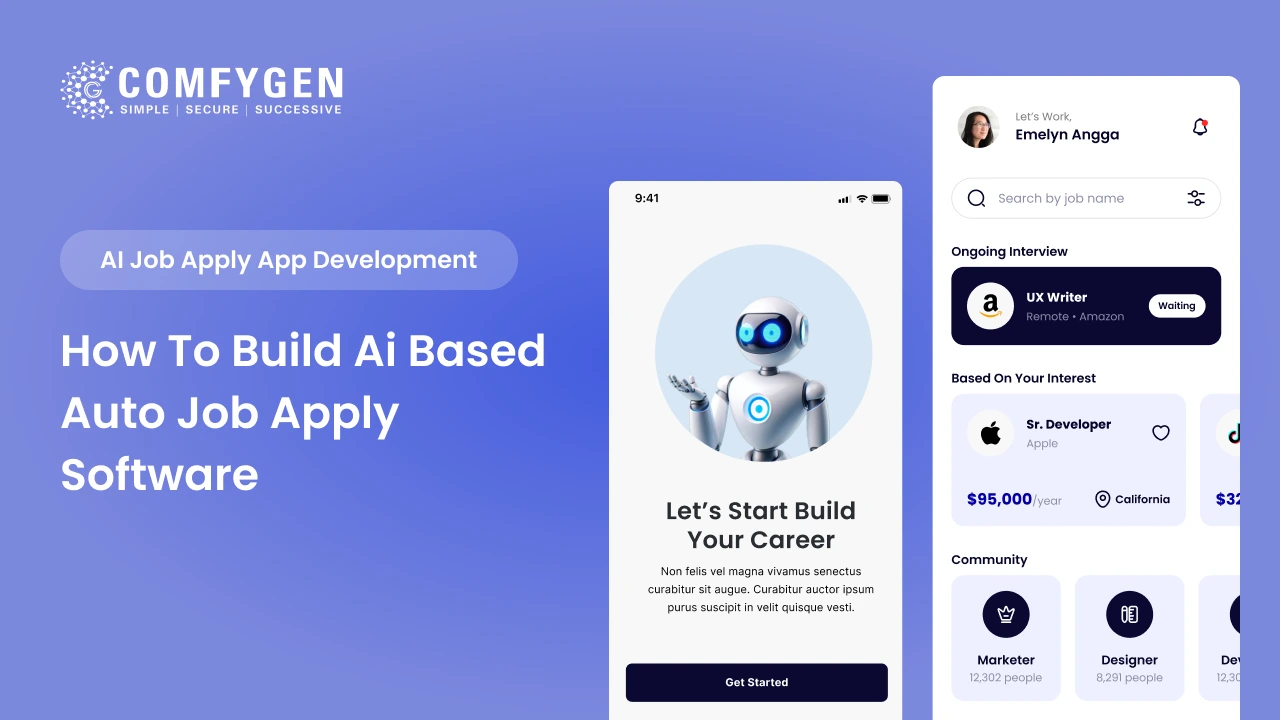


An AI-based job apply app costs $25,000 to $60,000 for an MVP and $90,000 to $200,000+ for a full platform with resume parsing, candidate ranking and recruiter dashboards. A working MVP takes 4 to 6 months.
The build has two sides. The candidate side handles profile building, AI job matching and automated applications. The recruiter side handles job posting, AI screening and an applicant tracking system. Most of your budget goes to the second one, because that is the side people pay for.
If you are a founder, a staffing agency or an HR tech company planning this build, this guide covers what to include, what it costs, which laws apply and where most projects go wrong.
Why 2026 is a strange moment to enter this market
Something broke in hiring over the past two years. AI tools made it trivial for a job seeker to send 200 applications in an afternoon. Recruiters now open a posting and find 400 applications, most of them generated, most of them a poor fit.
That flood created the real business opportunity. The money is no longer in helping people apply faster. It is in helping employers sort the pile.
This matters for your product decision. A candidate-side auto-apply tool is a crowded, low-price market where users pay $10 a month and churn in six weeks. A recruiter-side screening platform sells to companies at $300 to $3,000 a month and keeps them for years. Most successful products in this space start on the candidate side to build supply, then sell to the employer side.
Plan for both from day one, even if you launch one first.
What an AI job apply app actually contains
People use one phrase for three different products. Before you budget anything, work out which one you are building.
| Product type | Who pays | Core job | Typical build cost |
| Auto-apply assistant | Job seekers | Finds matching roles and submits applications | $25,000 to $45,000 |
| Job portal with AI matching | Employers posting roles | Connects both sides, ranks candidates | $50,000 to $120,000 |
| AI recruitment platform or ATS | Companies and agencies | Screens, scores and tracks applicants through hiring | $90,000 to $200,000+ |
The third one is the hardest build and the strongest business. It is also where your competitors already sit, so your product needs a clear reason to exist beyond “but with AI”.
Core features to plan for
Candidate side
- Profile builder with resume upload and auto-fill from an existing CV
- AI job matching based on skills, experience and salary expectations
- One-tap apply and bulk apply with per-application customisation
- Resume tailoring that adjusts wording for each role
- Application tracker showing status across every job applied to
- Job alerts by role, location and salary band
- Interview preparation prompts based on the job description
Recruiter side
- Job posting with distribution to external boards
- AI resume parsing that pulls skills, dates and education into structured fields
- Candidate ranking against the job requirements with a visible score
- Shortlisting rules the recruiter sets and can override
- Applicant tracking pipeline from applied through to offer
- Interview scheduling with calendar sync
- Communication templates and bulk messaging
- Hiring analytics covering time to hire, source quality and drop-off points
Admin side
- User and role management
- Subscription and billing management
- Content moderation for job posts
- Fraud detection for fake listings and fake profiles
- Audit logs, which you will need for the compliance section below
Fraud detection is the one founders skip and regret. Fake job postings are a serious problem on every open portal, and a single scam story can end a young marketplace.
The AI layer: what you are really paying for
This is where budgets move most, so it helps to see the parts separately.
Resume parsing
Turning an uploaded PDF into clean structured data. Good parsers hit 90% or better on standard CVs and fall apart on unusual layouts. You can build this with an LLM, use a specialist API, or combine both. Costs rise with the number of languages and formats you support.
Semantic job matching
Keyword matching misses a candidate who wrote “managed a team of eight” when the job asks for “people management experience”. Vector embeddings and a vector database such as Pinecone or pgvector solve this. Budget for the ongoing query costs, not just the build.
Candidate scoring: Ranking applicants against a role. This is the feature recruiters pay for and the one that carries the most legal risk, which the compliance section covers.
AI application agents: Filling and submitting forms on external sites. This is technically fragile. Every job board changes its form layout, and many actively block automation. If this is central to your product, expect ongoing maintenance rather than a one-time build.
Interview automation: Scheduling, reminders and sometimes video screening. Comfygen builds this as a standalone product too, and our AI interview scheduling software development work covers the calendar and candidate communication side in more depth.
Tech stack that works for this build
| Layer | Practical choices | Why |
| Mobile app | React Native or Flutter | One codebase for iOS and Android keeps cost down |
| Web app | Next.js or React | Recruiters work on desktop, so the web app matters more here than in most products |
| Backend | Node.js or Python with FastAPI | Python wins if your AI work is heavy |
| Database | PostgreSQL | Mature, and pgvector adds semantic search without a second database |
| Vector search | pgvector, Pinecone or Weaviate | Needed for real job matching |
| AI models | OpenAI, Anthropic or an open model you host | Hosting your own costs more upfront and less per request at volume |
| Search | Elasticsearch or OpenSearch | Job search needs filters, facets and speed |
| Queue | Redis or RabbitMQ | Bulk parsing and matching must run in the background |
| Hosting | AWS or GCP | Both have managed services for everything above |
Choosing between React Native and Flutter here usually comes down to your team rather than the product. Our guide on picking a tech stack for a mobile app goes through that trade-off properly.
What it costs to build
| Component | Hours | Cost range |
| Discovery, UX and UI design | 150 to 250 | $4,000 to $9,000 |
| Candidate mobile app | 350 to 500 | $9,000 to $18,000 |
| Recruiter web dashboard | 300 to 450 | $8,000 to $16,000 |
| Backend and APIs | 350 to 550 | $9,000 to $20,000 |
| Resume parsing and AI matching | 250 to 500 | $7,000 to $20,000 |
| ATS pipeline and workflow | 200 to 400 | $5,000 to $15,000 |
| Admin panel | 120 to 200 | $3,000 to $7,000 |
| Testing and QA | 180 to 300 | $4,000 to $10,000 |
| Compliance and security work | 80 to 200 | $2,500 to $8,000 |
MVP total: $25,000 to $60,000
Full platform: $90,000 to $200,000+
Three things push these numbers around more than anything else. Number of languages supported. Whether you integrate with external job boards, which adds weeks per integration. And whether you need enterprise security certification, which can add $15,000 or more on its own.
Running costs catch people out too. AI model calls, vector database queries and hosting usually land between $800 and $5,000 a month once you have real traffic, before any salaries. Annual maintenance typically runs 15% to 20% of the original build cost, a pattern covered in our breakdown of mobile app maintenance costs.
If budget is the constraint, cut scope rather than quality. Our notes on reducing app development cost cover which cuts are safe.
Realistic timeline
| Phase | Duration |
| Discovery and specification | 2 to 3 weeks |
| Design | 3 to 4 weeks |
| Core development | 10 to 16 weeks |
| AI integration and tuning | 4 to 6 weeks, overlapping |
| Testing and compliance review | 3 to 4 weeks |
| Launch and store approval | 1 to 2 weeks |
A focused MVP lands in 4 to 6 months. A full platform with ATS and external integrations runs 8 to 12 months.
How these platforms make money
- Employer subscriptions: The most reliable model. Tiered by job posts, users or hires.
- Pay per job post: Easier to sell to small businesses that hire twice a year.
- Candidate premium: Profile boosts, resume review, unlimited applications. Low price point, high churn.
- Featured listings: Employers pay for placement at the top of relevant searches.
- Placement fee: A percentage on successful hires. High value per deal, slow and hard to enforce.
- API licensing: Selling your parsing or matching engine to other HR products.
Most platforms run employer subscriptions as the base and add one or two others. Starting with candidate-only revenue is the common mistake, because it caps your ceiling early.
Compliance: the part most guides skip
Hiring is a regulated activity in a way that most app categories are not. If your platform scores or ranks candidates, several laws apply directly to you, not just to your customers.
New York City Local Law 144 requires an annual independent bias audit for any automated employment decision tool used to screen candidates in NYC, and employers must notify candidates it is being used. The city’s Department of Consumer and Worker Protection publishes the rules. Build the audit trail your customers will need, or they cannot legally use your product.
The EU AI Act classifies AI used in recruitment and candidate selection as high risk. That brings requirements around risk management, data quality, human oversight, logging and transparency. The official EU AI Act summary sets out the obligations and timelines. If you plan to sell in Europe, this shapes your architecture rather than your paperwork.
Data protection. GDPR in Europe and India’s DPDP Act both apply to candidate data, which is sensitive by nature. Plan consent capture, retention limits and deletion from the start.
Practical implications for your build:
- Log every automated decision with the inputs that produced it
- Keep a human override on every ranking and rejection
- Show candidates why they were matched or filtered
- Test your model for disparate impact across protected groups before launch
- Set and enforce data retention windows
This work costs real money. It also becomes a selling point, because enterprise buyers now ask for it in procurement.
Where these projects usually go wrong
Building the auto-apply feature first: It is the flashiest part and the most fragile. Job boards change and block it constantly.
Launching with an empty marketplace: No jobs means no candidates, and no candidates means no employers. Solve one side first, usually by aggregating public listings or by signing a small set of employers before launch.
Treating the AI as the product: Recruiters do not buy models. They buy fewer hours spent reading CVs. Measure and sell that.
Skipping fraud controls: Fake postings and scam recruiters appear faster than founders expect.
Ignoring the recruiter’s existing tools: If your platform does not connect to the ATS and calendar they already use, adoption stalls no matter how good the matching is.
Building this with Comfygen
Comfygen has delivered mobile and AI development since 2019, with 550+ projects for 400+ clients across 30+ countries and a 97% client retention rate. Our teams work across React Native, Flutter, Python and the AI tooling this kind of platform depends on.
For a hiring platform, the work usually starts with a scoping session: which side of the market you serve first, which AI features earn their cost, and what compliance your target markets demand. That conversation saves more budget than any technology choice.
If you want to scope a build, our mobile app development team can work through the feature set and give you a costed plan. If you already have a specification and need engineers, you can hire mobile app developers for the stack you have chosen. For broader AI product thinking, our piece on AI app ideas for startups covers adjacent opportunities.
Frequently asked questions
How much does it cost to build an AI job apply app?
How long does development take?
Should I build for job seekers or employers first?
What AI features actually matter?
Which tech stack suits a job portal app?
Do hiring laws apply to my platform or only to my customers?
How do job portals make money?

Mr. Saddam Husen, (CTO)
Mr. Saddam Husen, CTO at Comfygen, is a renowned Blockchain expert and IT consultant with extensive experience in blockchain development, crypto wallets, DeFi, ICOs, and smart contracts. Passionate about digital transformation, he helps businesses harness blockchain technology’s potential, driving innovation and enhancing IT infrastructure for global success.