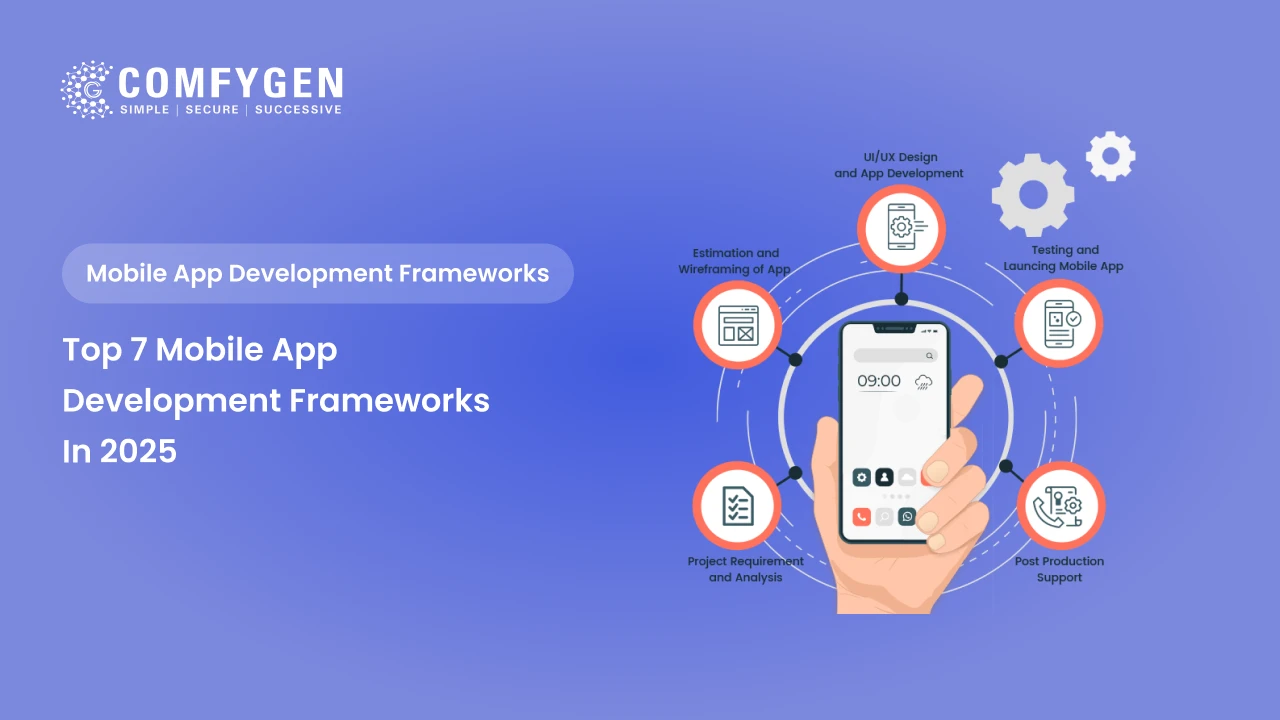





The global mobile application market was valued at approximately $258.8 billion in 2023 and is projected to surpass $1.36 trillion by 2035, growing at a CAGR of over 14%. Behind every successful app — whether it’s a fintech platform, a healthcare portal, or an on-demand delivery service — is a carefully chosen mobile app development framework.
Yet in 2026, choosing the right app development framework is harder than ever. The ecosystem has exploded. New frameworks emerge, established ones undergo architectural overhauls (React Native’s New Architecture, Flutter’s Impeller engine), and AI capabilities are now baked directly into development toolchains.
The wrong framework choice can double your timeline, drain your budget, and create technical debt that haunts future releases. The right one can cut development time by up to 30%, enable seamless multi-platform deployment, and give your team the velocity needed to stay competitive.
At Comfygen, we’ve built 250+ mobile apps across industries — from healthcare to e-commerce to blockchain — using every major framework on this list. In this guide, we share what actually works in production, not just on paper.
What is a Mobile App Framework?
A mobile app development framework is a structured software platform — comprising pre-written code, libraries, APIs, and development tools — that provides developers with a foundation to build mobile applications more efficiently.
Think of it like the steel frame of a skyscraper. Architects don’t design every beam from scratch; they work within a proven structural system. Frameworks do the same for app developers: they abstract away repetitive low-level work so teams can focus on building unique features.
A well-chosen app development framework delivers:
- Faster development cycles through reusable components and pre-built UI elements
- Consistent code quality via enforced patterns and built-in testing tools
- Cross-platform compatibility allowing a single codebase to target iOS, Android, web, and desktop
- Scalability and security out of the box
- Active community support for troubleshooting and continuous improvement
The key distinction that matters most for business decisions: native frameworks build for one platform, while cross-platform frameworks let you write once and deploy everywhere.
Types of Mobile App Development Frameworks
Understanding the category of a framework is essential before comparing individual options. There are four primary types:
Native Frameworks
Built specifically for one platform. Examples: Swift/SwiftUI (iOS), Kotlin/Jetpack Compose (Android). Deliver peak performance and full hardware access but require separate codebases for iOS and Android — roughly doubling development cost and time.
Cross-Platform Frameworks
A single codebase compiles to native code for multiple platforms. Examples: Flutter, React Native, Kotlin Multiplatform. The dominant choice in 2026 due to cost efficiency and near-native performance.
Hybrid Frameworks
Web technologies (HTML, CSS, JavaScript) wrapped in a native container. Examples: Ionic, Apache Cordova. Easier to build but trade some performance for speed of delivery.
Progressive Web App (PWA) Frameworks
Web apps that behave like native apps — installable, offline-capable, and push-notification-enabled — without going through app stores. Ideal for content-heavy platforms that already have strong web presence.
Key Factors to Consider Before Choosing an App Development Framework
Before we rank the best frameworks for app development, these are the questions every business and app development team must answer:
- Target Platforms: Are you building for iOS only, Android only, or both? Do you also need web and desktop coverage?
- Performance Requirements: Does your app involve heavy graphics, real-time data, AR/VR, or complex animations? If so, performance benchmarks matter more than development speed.
- Team Expertise: A JavaScript-heavy team will onboard React Native in days. Forcing them into Dart (Flutter) adds weeks of ramp-up time. Match the framework to your talent, not just the trend.
- Time to Market: Startups validating an MVP need rapid deployment. Cross-platform frameworks like Flutter and React Native consistently reduce time-to-market by 20–35% compared to building separate native apps.
- Budget: Building two separate native apps (iOS + Android) typically costs 1.5x to 2x more than a cross-platform approach. Factor in long-term maintenance too — one codebase is always cheaper to maintain.
- Scalability and Long-Term Support: Is the framework backed by a major organization (Google, Meta, Microsoft)? Does it have an active community? Will it still be relevant in 3–5 years?
- AI and Third-Party Integration: In 2026, many top frameworks now support direct AI API integration (Flutter with Google Gemini, React Native with OpenAI wrappers). If AI features are part of your roadmap, this matters.
Top 7 Mobile App Development Frameworks in 2026
1. Flutter — Best for Visually Rich Cross-Platform Apps
Flutter has emerged as the market leader among mobile app development frameworks in 2026. It powers over 53,000 live applications globally and is the go-to choice for teams that need pixel-perfect UI consistency across iOS, Android, web, and desktop from a single codebase.
What sets Flutter app development apart is its rendering engine. Rather than wrapping native UI components, Flutter renders its own widgets using the Impeller engine (the default since recent versions), delivering smoother animations and more predictable performance than frameworks that depend on platform-specific rendering bridges.
| Developed by | |
| Language | Dart |
| Market Share | ~46% among cross-platform developers in 2026 |
Key Features:
- Hot reload for instant UI previews during development
- Rich widget library with full Material Design and Cupertino (iOS-style) support
- Impeller rendering engine for 60/120fps performance
- Native Google Gemini AI integration support
- Single codebase covering iOS, Android, web, and desktop
Best For: Consumer apps, fintech, e-commerce, startups needing rapid multi-platform deployment, and apps requiring heavy UI customization.
Real-World Examples: Google Pay, eBay Motors, Alibaba (Xianyu), BMW app, ByteDance apps
Watch Out For: Dart is not as widely known as JavaScript — budget for team onboarding time. App bundle sizes can be larger than React Native.
Build Future-Ready Mobile Apps With the Right Framework
2. React Native — Best for JavaScript Teams and Enterprise Apps
React Native remains the most widely adopted cross-platform mobile development framework in enterprise environments. Its defining advantage: if your team already builds with React for the web, transitioning to React Native requires minimal ramp-up.
The New Architecture (stable since 2024) was a landmark overhaul. It replaced the old asynchronous JavaScript bridge with a synchronous native module system (JSI), significantly reducing UI lag and enabling concurrent rendering. Expo — the recommended starting point for new React Native app development projects — now handles build tooling, native configuration, over-the-air (OTA) updates, and deployment with near-zero friction.
| Developed by | Meta (Facebook) |
| Language | JavaScript / TypeScript |
| Community | Largest among cross-platform frameworks |
Key Features:
- JavaScript/TypeScript — massive talent pool
- New Architecture with synchronous native module calls
- Expo ecosystem for streamlined setup and OTA updates
- Native UI component rendering (not WebView)
- Extensive library ecosystem
Best For: Enterprise mobile apps, customer-facing platforms, cross-platform MVPs, and teams already skilled in React.
Real-World Examples: Instagram, Shopify, Discord, Microsoft Office Mobile, Walmart
Watch Out For: Complex animations may require dropping into native code. Framework upgrades can demand significant refactoring (documented by Shopify’s engineering team).
3. Kotlin Multiplatform (KMP) — Best for Shared Business Logic with Native UI
Kotlin Multiplatform is the most significant rising force among popular mobile development frameworks in 2026. Its approach is different from Flutter and React Native: rather than sharing the entire app (including UI), KMP focuses on sharing business logic, data layers, and network calls while letting each platform retain its native UI (SwiftUI for iOS, Jetpack Compose for Android).
This philosophy appeals strongly to mature engineering teams that refuse to compromise on native UI quality but still want to eliminate duplicated backend logic. Apps like Duolingo, McDonald’s, Netflix, and Cash App already use KMP in production.
| Developed by | JetBrains |
| Language | Kotlin |
| Status | Stable since Nov 2023; Google officially supports KMP for Android/iOS since Google I/O 2024 |
Key Features:
- Share 40–70% of codebase (business logic, networking, data)
- Full native UI on each platform — zero UX compromise
- Google officially supports KMP for Android/iOS
- Compatible with Compose Multiplatform for full UI sharing when needed
- Kotlin’s modern language features and safety
Best For: Teams with native iOS/Android expertise who want code sharing without UI compromise. Ideal for finance, healthcare, and enterprise apps where native feel is non-negotiable.
Real-World Examples: Duolingo, McDonald’s, Netflix, Forbes, Cash App
Watch Out For: Requires maintaining separate UI layers. Smaller team = consider Flutter or React Native instead. iOS tooling still maturing.
4. SwiftUI — Best for Apple-Ecosystem Apps
If your product targets Apple’s ecosystem exclusively, SwiftUI is the definitive native app development framework in 2026. It replaced the older UIKit/Storyboard approach with a declarative syntax that makes building complex UIs significantly cleaner and faster.
SwiftUI integrates directly with Apple’s latest platform capabilities — Live Activities, App Intents, WidgetKit, visionOS (Apple Vision Pro), and every new API announced at WWDC. No cross-platform framework can match this depth of integration.
| Developed by | Apple |
| Language | Swift |
| Platforms | iOS, iPadOS, macOS, watchOS, tvOS, visionOS |
Key Features:
- Declarative Swift syntax for clean, readable UI code
- Native integration with all Apple platform APIs
- Full support for visionOS / Apple Vision Pro
- Excellent performance with zero bridge overhead
- Deep Xcode tooling integration
Best For: iOS-first products, Apple Watch apps, iPad productivity tools, and any business where the customer base is predominantly Apple users.
Watch Out For: iOS-only. If you need Android, you’re building an entirely separate app.
5. Apache Cordova — Established Hybrid Framework
Apache Cordova (formerly PhoneGap) is one of the oldest frameworks for app development on this list. It wraps web applications in a native container and accesses device hardware through a plugin system. While it has been largely superseded by Ionic with Capacitor for new projects, Cordova still powers a large number of legacy applications and remains a valid choice for simple apps that prioritize broad platform coverage at minimal cost.
| Developed by | Nitobi Software (Apache Software Foundation) |
| Language | HTML5, CSS3, JavaScript |
| Type | Hybrid |
Key Features:
- Access native device APIs via plugins
- Supports iOS, Android, Windows, and more
- Large plugin ecosystem
- Open-source and free
Best For: Simple utility apps, legacy projects requiring maintenance, and organizations extending existing web apps to mobile on a tight budget.
Watch Out For: Limited access to newer platform APIs. Performance ceiling is lower than modern frameworks. For new projects, Ionic with Capacitor is the better modern equivalent.
6. Ionic — Best for Web Developers Building Mobile Apps
Ionic was founded in 2012 a leading hybrid app development framework for web developers who want to build mobile apps without learning an entirely new language. It uses standard web technologies wrapped in a native container, with a rich library of pre-designed UI components that mimic native iOS and Android patterns.
Ionic’s superpower is its compatibility with all major JavaScript frameworks — Angular, React, and Vue — making it the most accessible entry point for frontend web teams expanding into mobile. It also excels at building Progressive Web Apps (PWAs), which are increasingly viable as browsers open access to more native device features.
| Developed by | Max Lynch and Ben Sperry (along with Adam Bradley) of Drifty Co. |
| Language | HTML, CSS, JavaScript (Angular, React, or Vue) |
| Type | Hybrid |
Key Features:
- Works with Angular, React, and Vue
- 100+ pre-built UI components
- Capacitor (modern replacement for Cordova) for native device API access
- Strong PWA support
- One codebase for web, iOS, and Android
Best For: Content apps, loyalty programs, PWAs, internal business tools, and web development teams entering mobile without heavy native expertise.
Real-World Examples: MarketWatch, McDonald’s Turkey, Sworkit fitness app
Watch Out For: Not suitable for performance-heavy applications (games, real-time 3D, heavy animations). Relies on WebView rendering which has inherent performance ceilings.
7. NativeScript — Best for Direct Native API Access via JavaScript
NativeScript is a lesser-known but powerful app development framework that translates JavaScript/TypeScript directly to native iOS and Android code — without a WebView. This gives it performance characteristics closer to native development while allowing web developers to use familiar JavaScript syntax.
Unlike React Native, which uses a bridge, NativeScript uses a direct binding to native APIs, which can be advantageous for apps requiring granular device access.
| Developed by | Bulgarian company Telerik (Progress) |
| Language | JavaScript, TypeScript, or Angular/Vue |
| Type | Cross-platform (native) |
Best For: JavaScript teams who need deeper native API access than Ionic but don’t want to learn Dart (Flutter) or deal with React Native’s architecture complexities.
Not Sure Which Framework Fits Your App?
Framework Comparison Table: At a Glance
|
Framework |
Language |
Platform Coverage |
Performance |
Best For |
Learning Curve |
|---|---|---|---|---|---|
| Flutter | Dart | iOS, Android, Web, Desktop | ★★★★★ | Visually rich cross-platform apps | Medium |
| React Native | JavaScript/TS | iOS, Android (Web via libraries) | ★★★★☆ | Enterprise, JS teams | Low–Medium |
| Kotlin Multiplatform | Kotlin | iOS, Android | ★★★★★ | Shared logic + native UI | High |
| SwiftUI | Swift | Apple ecosystem only | ★★★★★ | iOS/Apple-first products | Medium |
| Apache Cordova | HTML/JS | iOS, Android, more | ★★★☆☆ | Legacy/simple apps | Low |
| Ionic | HTML/JS/TS | iOS, Android, Web (PWA) | ★★★☆☆ | Web development, PWAs, light apps | Low |
| NativeScript | JavaScript/TS | iOS, Android | ★★★★☆ | JS devs needing native access | Medium |
How Comfygen Helps You Pick and Build with the Right Framework
At Comfygen, we’re a mobile app development company that doesn’t choose a framework just because it’s popular. We pick the one that works best for your product, your team, and your timeline.
With years of expertise in mobile app development since 2019, our team has successfully delivered a diverse range of applications across industries such as healthcare, fintech, e-commerce, logistics, and more. We bring deep production expertise in technologies like Flutter, React Native, Kotlin Multiplatform, Ionic, and SwiftUI.
Our framework selection process includes:
- Discovery workshop to understand your business goals, user personas, and technical requirements
- Performance benchmarking for your specific use case (e.g., real-time data, complex animations, offline functionality)
- Total cost of ownership (TCO) analysis across your top 2–3 framework options
- Architecture design that scales from MVP to enterprise-grade deployment
Whether you’re building a cross-platform consumer app, an enterprise mobile solution, or a hybrid web-mobile product, we align your technology choices with your business outcomes — not just developer preferences.
Conclusion
The seven mobile app development frameworks landscape in 2026 is more capable — and more complex — than ever. Flutter leads in cross-platform UI performance. React Native dominates enterprise JavaScript teams. Kotlin Multiplatform is redefining how mature teams share logic without sacrificing native quality. SwiftUI and Jetpack Compose deliver unmatched native experiences for platform-specific products. And frameworks like Ionic and Expo lower the barrier to entry for web teams and startups.
The single most important insight: no framework wins universally. The best app development framework for your project is the one that matches your team’s expertise, your timeline, your performance requirements, and your long-term product roadmap.
Choosing the wrong one early is an expensive mistake. Choosing the right one is a competitive advantage.
If you’re unsure where to start, Comfygen’s mobile development team is ready to help you evaluate your options and build with confidence.
Contact Now:
Email: sales@comfygen.com
WhatsApp No.: +91-9587867258
FAQs
What is the most popular mobile app development framework in 2026?
Which mobile app frameworks are best for cross-platform development?
What is the best framework for a startup building a mobile MVP?
Is Xamarin still relevant in 2026?
What is the difference between hybrid and cross-platform mobile app frameworks?
How do I choose the right app development framework for my project?

Mr. Saddam Husen, (CTO)
Mr. Saddam Husen, CTO at Comfygen, is a renowned Blockchain expert and IT consultant with extensive experience in blockchain development, crypto wallets, DeFi, ICOs, and smart contracts. Passionate about digital transformation, he helps businesses harness blockchain technology’s potential, driving innovation and enhancing IT infrastructure for global success.