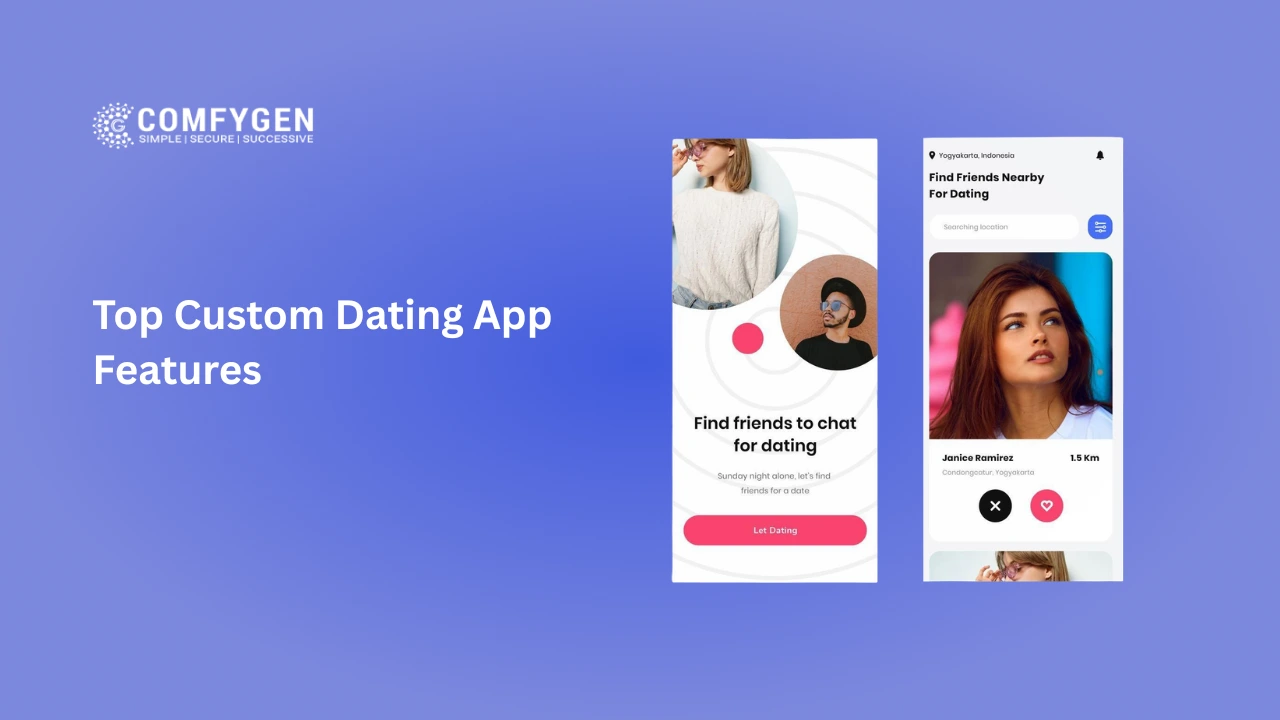





Building a dating app is not the same as building just another social platform. When someone opens a dating app, they are doing something deeply personal — they are looking for a human connection. That emotional weight means every feature you build, every interaction you design, and every safety measure you implement directly shapes whether your app becomes a trusted companion or gets deleted after three days.
The global dating app market crossed $6.18 billion in revenue in 2024 and is projected to nearly double to $12.52 billion by 2026. Yet despite this massive growth, most new dating apps fail within their first year. The reason is almost always the same: they launch with generic features copied from Tinder without understanding why those features work — or what users actually need beyond the swipe.
Custom dating app development gives you the power to build features around a specific audience, a specific relationship intent, or a specific cultural context. Whether you are targeting Gen Z users who want video-first interactions, South Asian users who want horoscope-based compatibility, or working professionals who want to match within their industry — a custom approach lets you solve a real problem rather than compete on identical ground.
This guide covers every dating app feature that matters in 2026 — from the must-have basics to the AI-powered tools that drive real retention — with practical context on what to build first and why.
The Online Dating Market in 2026
Before you invest in building dating app features, it helps to know exactly what kind of market you are entering.
The global online dating market was valued at approximately $9.65 billion in 2022 and is projected to grow at a CAGR of 7.4% through 2030. Revenue from the US alone accounts for a significant portion, driven heavily by subscription models. Globally, the penetration rate is expected to rise from 17.9% in 2025 to 19.0% in 2028, meaning more people than ever before will be actively using dating platforms.
Some data points worth knowing before you design your feature set:
- 30-day retention rates spike dramatically among users who send at least one message after matching. Real-time chat is not just a feature — it is the single most important retention driver in any dating app.
- The 18–34 age group drives the majority of dating app revenue worldwide, but the 55+ segment is the fastest-growing user base — a largely underserved niche.
- 51% of LGB adults have used dating apps, compared to 28% of straight adults, pointing to strong demand for inclusive and LGBTQ+-specific platforms.
- Identity fraud in the dating sector hit 6.35% in 2024 — the highest of any consumer app category — making safety features not just a nice-to-have but a core product requirement.
- In India specifically, dating app usage has surged in Tier 1 and Tier 2 cities, with users increasingly expecting regional language support, family-compatibility filters, and religious/cultural match criteria.
These numbers tell you something important: the market is large, growing, and still filled with unmet needs. The right combination of custom dating app features, built for the right audience, can absolutely carve out a profitable niche.
Core Dating App Features Every MVP Must Have
These are the foundational dating application features that your minimum viable product cannot launch without. Think of them as the infrastructure your entire user experience runs on.
User Registration & Smart Profile Setup
Your onboarding experience is the first impression your app makes. A clunky, lengthy sign-up flow will lose a significant percentage of users before they ever see another profile.
Build registration to support multiple pathways: email with OTP verification, phone number login, and social sign-in via Google, Apple ID, or Facebook. For markets like India, WhatsApp-based OTP login can significantly reduce friction.
Once users are in, the profile setup should feel like a guided conversation, not a form. Prompt users to share:
- Name, age, and gender identity (with inclusive options beyond the binary)
- Up to 6–9 photos, with prompts to choose their best
- A short bio and curated “icebreaker” prompts (popularized by Hinge)
- Relationship intent — casual, long-term, open to anything
- Lifestyle details: religion, education, occupation, habits (drinking, smoking, fitness)
- Dealbreakers and must-haves
Profile completion should be incentivized visually. Show a completion percentage bar. Profiles that are 80%+ complete consistently receive more matches, and users who see that feedback are far more likely to fill out their profiles fully.
The gap most apps miss: Very few dating apps explain why they are asking for certain information. A simple tooltip — “We ask about lifestyle habits to show you more compatible matches” — dramatically improves completion rates and builds trust from day one.
Advanced Matching Algorithm
The matching algorithm is the intelligence engine of your dating app. On the surface, it seems simple: two people with overlapping preferences get shown to each other. In practice, the best matching algorithms are far more nuanced.
Modern dating app matching works in two layers.
The first layer is filter-based matching: basic criteria like age range, distance, gender preference, and education level. This is table stakes. Every app does this.
The second layer is behavioral matching: learning from what users actually do versus what they say they want. A user might set their age filter to 25–30 but consistently swipe right on profiles aged 28–36. A good algorithm notices this divergence and adjusts recommendations accordingly.
Key signals a robust matching algorithm should track include:
- Profile view duration (did they linger or skip quickly?)
- Super-likes and priority right swipes
- Message open rates and response times
- Conversation length and reciprocity
- Which filters users modify after seeing low-quality results
For custom dating apps targeting niche audiences, the algorithm can also incorporate cultural compatibility signals: shared religion, regional dialect, family background preferences, or horoscope compatibility scores — features that mainstream apps ignore entirely but that drive enormous loyalty in specific markets.
Technical note: For MVPs, a rules-based matching system with weighted scoring works fine. As your user base grows to 10,000+ active users, layer in collaborative filtering or a basic ML model trained on engagement patterns.
Swipe & Like Mechanism
The swipe mechanic made Tinder a cultural phenomenon, and it remains the dominant interaction pattern in dating apps for a reason: it is fast, low-commitment, and emotionally satisfying. Swiping right takes courage, but just a tiny bit — enough to feel meaningful without feeling overwhelming.
Your dating app should implement a smooth, responsive swipe interface with:
- Right swipe / tap heart to express interest
- Left swipe to pass
- Super Like or Star to signal strong interest (limited daily uses for free users)
- Undo last swipe — free or premium depending on your monetization model
- A mutual match animation that creates a moment of celebration when both users like each other
While swiping remains popular, newer interaction patterns are gaining traction. Hinge’s “like a specific photo or prompt” model forces more intentional engagement. Bumble’s “women message first” mechanic reduces unwanted messages for female users. If you are building a custom dating app for a specific audience, consider whether the standard swipe model is the best fit or whether a more intentional interaction design would resonate better.
Real-Time Chat & Messaging System
If matching is the hook, conversation is the relationship. Every dating app success story involves two people who went from a match notification to a message to a date. Your chat system needs to make that journey as smooth and engaging as possible.
A solid dating app chat system must include:
- Real-time message delivery with read receipts and typing indicators
- Rich media support: photos, GIFs, stickers
- Voice messages — one of the highest-adoption chat features on mobile, especially among users who find typing too formal
- Emoji reactions to individual messages
- Message requests to separate matches from unsolicited outreach
- Match expiry timers — apps like Bumble require the first message within 24 hours, creating urgency and increasing first-message rates significantly
Safety within the chat system is equally critical. Build in keyword filtering for explicit or threatening content, photo scanning for NSFW images, and easy one-tap reporting directly from within any conversation.
What competitors miss: Most chat systems in dating apps feel like afterthoughts — bare-bones messaging copied from generic SDKs. Building a chat experience that feels warm, encouraging, and safe (with prompts for conversation starters, icebreaker questions, and match “topics in common”) meaningfully increases the percentage of matches that turn into real conversations.
Geo-Location Based Discovery
Location is one of the most fundamental dating app features. People want to meet people they can actually meet in person, and proximity matters.
Implement a tiered location system:
- Precise radius filtering: Let users set how far away potential matches can be (e.g., within 5km, 25km, 50km, or anywhere globally)
- Fuzzy location display: Show distance as “3 km away” rather than exact GPS coordinates to protect privacy
- Location update logic: Update location when the app opens, not continuously — this saves battery and feels less intrusive
- Explore / Travel mode: Allow premium users to set their location to a future destination — useful for business travelers or people relocating
For urban markets in India, Southeast Asia, and other high-density regions, neighborhood-based discovery (showing matches in the same area of the city rather than just within X km) can feel more relevant and exciting than raw distance numbers.
Profile Verification & Safety Layer
This is non-negotiable in 2026. The dating sector has the highest identity fraud rate of any consumer app category. Users will not trust your platform — and will not pay for premium features — if they believe the profiles they are seeing might be fake.
Every custom dating app must include at minimum:
- Photo verification: Users submit a selfie matching a pose prompt; AI compares it to their profile photos
- Liveness detection: Prevents users from submitting a printed photo or a photo of a photo
- Verified badge: A visible trust signal on profiles that have passed verification
- Phone number verification at signup (not just email)
- Social media link verification as an optional additional layer
For higher-trust platforms (premium matchmaking apps, marriage-intent apps), consider adding government ID verification as an opt-in feature. Users who voluntarily verify their identity convert at higher rates on premium subscriptions because they have demonstrated they are serious.
Push Notifications & Re-Engagement System
A dating app without smart push notifications will lose 40–60% of its users within the first two weeks — not because they had a bad experience, but because they simply forgot to come back.
Build a push notification system that covers:
- Match notifications: “You have a new match!”
- Message notifications: “Alex sent you a message”
- Like notifications (premium feature on some apps): “Someone liked your profile”
- Re-engagement nudges: “You haven’t logged in for 3 days — your matches are waiting”
- Weekly match digest emails or push summaries
- Match expiry alerts: “Your match with Jamie expires in 2 hours”
Critically, make all notifications customizable. Users who feel bombarded by notifications disable them entirely — losing you a critical engagement channel. Give users granular control over which notifications they receive and when.
Turn Your Dating App Idea into Reality
Advanced Dating App Features That Drive Retention
Once your MVP is live and gaining users, these features are what separate good dating apps from great ones. They are the features users talk about, recommend, and pay for.
AI-Powered Match Recommendations
AI-powered matching goes beyond simple filter logic to learn from user behavior and improve recommendations over time. Think of it as a matchmaker that gets smarter the more it works with you.
Here is what separates an AI-powered matching system from a standard algorithm:
A collaborative filtering model looks at users who behave similarly to you (same profile characteristics, same swiping patterns) and recommends profiles that those similar users engaged with positively. A content-based model analyzes the actual attributes of profiles you have liked and surfaces others with similar traits. The most sophisticated systems combine both approaches with a reinforcement learning layer that optimizes for downstream outcomes — not just swipes, but conversations started, dates set, and relationship satisfaction (gathered through optional check-ins).
For custom dating apps in culturally specific markets, AI can also be used to weight compatibility signals that mainstream apps ignore: family background preferences, dietary habits, language spoken at home, or horoscope sign compatibility. These hyper-local signals can dramatically improve match quality for users in those markets.
An honest note on AI in dating apps: Research published in 2026 found that users accept AI match recommendations when the outcomes feel right — but when the algorithm feels opaque or manipulative (surfacing low-quality matches to drive premium upgrades), trust erodes fast. Build AI that genuinely optimizes for user success, not just engagement metrics.
Video & Voice Calling
Post-pandemic, video calling went from a premium dating app feature to an expected one. Users — especially women — want to verify that someone is who they say they are before meeting in person. Video calling within the app makes this easy without requiring an exchange of phone numbers.
Key video and voice calling features to build:
- In-app video calling — 1-on-1 with easy tap-to-connect from a match conversation
- Pre-date video check-ins: Prompted as a “quick hello” before a first in-person date
- Virtual date spaces: Some apps now offer themed virtual environments for video calls — a coffee shop background, a park setting — to make the experience feel more date-like
- Voice note messages: Already covered under chat, but voice call capability extends this to live conversation
- Call recording opt-out: Both users must consent; the option to record should not exist by default
For mobile-first markets where data costs matter, make sure your video calling feature includes bandwidth optimization — lower resolution fallback, audio-only mode, and clear data usage indicators.
Short-Form Video Profiles
The influence of TikTok and Instagram Reels on dating behavior is impossible to ignore. Static profile photos give an impression; a short video gives a personality. Users who include a video on their profile receive significantly more matches than those who rely on photos alone.
Short-form video profile features should include:
- 15–60 second profile video upload with in-app recording option
- Video prompts: “Show me your cooking skills,” “Tell me your best travel story,” “Introduce your pet”
- Video reactions: Swipe up on a specific video clip to like just that clip and start a conversation about it
- Loop and autoplay for smooth browsing
- Subtitles / captions for accessibility
This feature is particularly compelling for custom dating apps targeting Gen Z users, who are far more comfortable on camera than older demographics and who expect video as a default communication medium.
Gamification & Engagement Loops
Dating apps that incorporate game-like elements see meaningfully higher daily active user rates. The goal of gamification in a dating app is not to trivialize relationships — it is to reduce the anxiety of putting yourself out there by making the experience feel playful rather than high-stakes.
Effective gamification features for dating apps include:
- Daily login streaks with rewards (bonus likes, profile boosts, virtual gifts)
- Icebreaker quizzes: Answer 5 fun questions; matches who answer the same way get surfaced first
- Compatibility challenges: Both users answer the same question blind; their answers are revealed only after they match
- Leaderboards for engagement: Light social proof features showing “your profile is in the top 10% this week”
- Achievement badges: “Conversation starter,” “Great responder,” “5 dates booked” — visible on profiles to signal quality
Done well, gamification increases daily open rates, reduces the emotional weight of rejection (it is just a game, after all), and creates natural conversation starters between matched users.
Virtual Gifts & In-App Economy
Virtual gifting is one of the most underutilized monetization and engagement mechanics in Western dating apps, despite being enormously successful in Asian markets. Allowing users to send virtual gifts — digital flowers, coffee cups, sparkles, custom animated stickers — serves two purposes: it creates a natural “more than a match, less than a date” interaction layer, and it generates significant in-app purchase revenue.
Build a virtual gift system with:
- A curated gift catalog updated seasonally (holiday-themed gifts drive purchase spikes)
- Gift notifications that feel special, not transactional
- Gift visibility: Show received gifts on a user’s profile as social proof
- Custom gift creation for premium users
Social Media Integration
Linking Instagram or Spotify to a dating profile has become a trust signal in itself — a profile with a linked, active Instagram account is almost certainly a real person. Integration also enriches profiles without asking users to fill out more fields.
Social media integration features worth building:
- Instagram photo grid displayed on profile (users choose which to show)
- Spotify anthem: A song that plays when someone views your profile
- Mutual friends / connections via Facebook (with privacy controls — opt-in only)
- Verified social presence badge for accounts with established history
Keep all social integration strictly opt-in and give users granular control over what is visible. Privacy concerns around social media linking are real; heavy-handed integration will cost you users.
Smart Preference Filters & Search
Beyond the basic matching algorithm, users want control. Smart preference filters give them that control while also feeding better signal data into your matching engine.
Filters to build into your custom dating app:
Basic (free): age range, distance, gender, relationship intent
Advanced (premium): height, education level, religion, ethnicity, whether they want children, language spoken, lifestyle habits (active, homebody, traveler)
Behavioral filters (premium): “Only show profiles that have been active in the last 48 hours,” “Only show verified profiles,” “Hide profiles I’ve already seen”
The key design principle for smart filters is don’t overwhelm users at onboarding. Surface basic filters first, and introduce advanced filters progressively as users demonstrate intent to find serious matches.
Premium & Monetization Features of Custom Dating Applications
A beautiful dating app that doesn’t make money is a passion project. A profitable dating app requires a thoughtful monetization architecture built into the feature set from day one.
Subscription Tiers
The freemium subscription model is the dominant monetization strategy in dating apps. The free tier must be genuinely useful — users need to be able to find and connect with matches without paying — but premium tiers should offer meaningful enough advantages to make upgrading feel worthwhile rather than coercive.
A typical subscription structure for a custom dating app looks like this:
Free Tier: Limited daily swipes (e.g., 10–20 per day), basic filters, text chat with matches, standard profile visibility
Premium / Gold Tier: Unlimited swipes, advanced filters, see who liked you, 1 profile boost per week, priority customer support
Platinum / Elite Tier: All Gold features plus unlimited rewinds, full incognito mode, read receipts in chat, access to top picks / curated matches, unlimited super likes
Subscription pricing should be tested carefully by market. Indian users are more price-sensitive than US or European users; consider offering a lower-price tier specifically for price-sensitive markets with regional payment methods (UPI, Paytm, local debit/credit).
Boost & Spotlight Features
Profile boost is the highest-converting individual in-app purchase in most dating apps. For a set period (typically 30 minutes to 1 hour), a boosted profile appears at or near the top of discovery queues for other users in the area. The result is a dramatic spike in profile views and incoming likes.
Build boost features with:
- Clear countdown timers showing how long a boost is active
- Real-time visibility into how many people viewed the profile during the boost
- Scheduled boosts (set it to activate during peak usage hours, typically evenings)
- Bundle discounts for purchasing multiple boosts at once
In-App Purchases & Virtual Currency
Beyond subscriptions, a well-designed in-app economy significantly increases revenue per user. Virtual currency systems (coins, gems, sparks — whatever branding fits your app) allow users to make micro-purchases without committing to a subscription:
- Extra super likes (5 for the price of one coffee)
- Single-use incognito view
- Sending a premium virtual gift
- Seeing who viewed your profile for 24 hours
The key is to design the virtual economy so that purchases feel like enhancements to an already enjoyable experience — not paywalls blocking basic functionality.
Safety & Trust Features That Users Demand in 2026
No feature set in this guide matters more than safety. If users — particularly women — do not feel safe on your platform, they leave and they tell others. Safety features are not just ethical obligations; they are business-critical retention tools.
AI Content Moderation
Manual content moderation does not scale. As your dating app grows, you need automated systems that can detect and flag:
- Explicit or NSFW images before they are sent or displayed
- Hate speech, slurs, or threatening language in chat
- Scam patterns (generic opening messages sent to hundreds of users, requests to move conversations off-platform, links to suspicious URLs)
- Fake profile photos (reverse image search integration, deepfake detection)
Build content moderation into your MVP timeline, not as a post-launch addition. Abuse that goes unaddressed in the early days of a platform creates a reputation that is extremely hard to recover from.
Deepfake & Liveness Detection
Deepfake technology has made traditional photo verification increasingly unreliable. A sophisticated fraudster can now generate a realistic-looking profile photo of a person who does not exist in seconds. The response to this in 2026 is liveness detection — a photo or video verification challenge that requires real-time response (turn your head left, blink, hold up two fingers) to confirm a real human is present.
This technology is no longer experimental. Integrate liveness detection into your profile verification flow from the start, and resurface verification prompts when user behavior triggers fraud risk signals (new device login, profile photo change, sudden spike in outgoing messages to new users).
Block, Report & Mute Controls
Every user interaction on your platform should have an accessible reporting pathway. Make it as easy to report a profile or message as it is to like one. Build:
- One-tap block from any profile or chat screen
- Granular report categories: harassment, fake profile, explicit content, spam, other
- Human review queue for escalated reports
- Automated response to high-confidence violations: temporary account suspension pending review
- Reporter feedback: Tell users the outcome of their report within 72 hours (even a generic “we took action” response meaningfully increases trust and report rates)
Incognito / Invisible Mode
Incognito mode — the ability to browse profiles without appearing in their visitor history and to have your profile shown only to users you have already liked — is one of the highest-converting premium features in dating apps. It is particularly valuable for public figures, people in small communities where they might see colleagues, and users in early discovery who are not yet ready to be highly visible.
Build incognito as a premium feature with clear explanations of exactly what it does and does not hide. Transparency builds trust; hidden mechanisms erode it.
Niche Dating App Development Models
Build a niche dating app is most powerful when it solves a specific problem for a specific audience. Here are the most compelling niche models for 2026.
Horoscope & Astrology-Based Dating Apps
Astrology has experienced a remarkable cultural resurgence, particularly among millennials and Gen Z. Approximately 29% of Americans say they believe in astrology, and in South and Southeast Asian cultures, horoscope compatibility has been a serious consideration in partner selection for generations.
A horoscope-based dating app could include:
- Kundli (birth chart) matching for South Asian users
- Zodiac sign compatibility scores displayed on profiles
- Daily horoscope-influenced match recommendations (“Venus in your house today — strong matches with Libra”)
- Astrology-based icebreaker prompts
There is currently no dominant dating app built specifically for astrology enthusiasts globally. This is a clear market gap.
Profession-Based Dating Apps
Doctors date on the same apps as everyone else — but they often find that few potential matches understand the demands of their schedule, the weight of their work, or the unique stressors of their profession. A profession-based dating app — for healthcare workers, lawyers, military personnel, teachers, entrepreneurs, or creatives — allows users to find partners who genuinely understand their world.
Key features: Professional credential verification, industry-specific profile questions, career-stage matching, community forums and events by profession.
Hobby & Interest-Based Dating Apps
Research consistently shows that shared interests are among the strongest predictors of long-term relationship satisfaction. Yet most dating apps treat hobbies as a text field in a profile, not as a matching signal. A hobby-first dating app changes this.
Imagine an app where you sign up through your activity — hiking, board games, cooking, film photography — and your profile is built around that passion first. Matches are people who share the activity, with romantic potential emerging naturally from that common ground.
Video-First Dating Apps
The next generation of dating apps is video-native. Rather than static photos, video-first apps lead with short clips, real-time video discovery, and live streaming. This model dramatically reduces the “catfishing” problem and appeals to users who are comfortable on camera.
Features specific to video-first apps: live broadcasting with real-time audience interaction, “speed dating” rooms where you rotate through 2-minute video conversations, reaction emoji overlays during live video.
Senior Dating Apps
The 55+ dating market is growing rapidly and is deeply underserved. Most dating apps are designed by and for 20-somethings, with interfaces and interaction models that do not translate well to older users.
A senior dating app should prioritize: larger text and touch targets, simpler navigation with fewer gestures, phone call customer support, and matching criteria relevant to this life stage (widowed or divorced, adult children, retirement lifestyle preferences, health considerations).
LGBTQ+ Inclusive Dating Apps
While dating apps like Grindr serve gay men and Lez Spark serves lesbian women, there is significant unmet need for truly inclusive platforms serving bisexual, non-binary, transgender, and queer users across the full spectrum of relationship styles (monogamous, polyamorous, queerplatonic).
Key differentiators for an LGBTQ+-focused custom dating app: pronoun and gender identity fields with full spectrum options, non-binary filter logic (not a binary he/she framework), community safety features specific to outing and harassment risks, and connection to local LGBTQ+ community events.
Faith-Based and Cultural Dating Apps
Marriage-intent dating apps within specific religious or cultural communities represent one of the most loyal and conversion-friendly niches in the dating market. Muslim matrimonial apps (like Muzmatch / Muzz), Jewish dating apps, and Hindu matrimony platforms all demonstrate strong user loyalty and willingness to pay precisely because they understand their users’ values at a deep level.
Want to Launch a Dating App Users Actually Love?
Connect with our team to discuss your idea and receive a detailed development plan fast.
Get Started →
Feature Prioritization: MVP vs. V2 vs. V3
One of the most common mistakes in dating app development is trying to build everything at once. Here is a clear framework:
|
Feature |
MVP |
V2 |
V3 |
|---|---|---|---|
|
User Registration & Profile Setup |
✅ |
||
|
Swipe / Like Mechanism |
✅ |
||
|
Basic Matching Algorithm |
✅ |
||
|
Real-Time Chat (text + media) |
✅ |
||
|
Push Notifications |
✅ |
||
|
Geo-Location Discovery |
✅ |
||
|
Profile Photo Verification |
✅ |
||
|
Block / Report / Mute |
✅ |
||
|
Advanced Preference Filters |
✅ |
||
|
AI-Powered Match Recommendations |
✅ |
||
|
Video & Voice Calling |
✅ |
||
|
Subscription Tiers & In-App Purchases |
✅ |
||
|
Gamification & Daily Engagement Loops |
✅ |
||
|
Virtual Gifts & In-App Economy |
✅ |
||
|
AI Content Moderation |
✅ |
||
|
Short-Form Video Profiles |
✅ |
||
|
Deepfake / Liveness Detection |
✅ |
||
|
Profile Performance Insights |
✅ |
||
|
Incognito / Invisible Mode |
✅ |
||
|
Travel / Explore Mode |
✅ |
The principle here is simple: build the features that create the core match-conversation-date loop first. Prove that your app works. Then invest in the features that retain users longer, monetize them deeper, and differentiate you from competitors.
Tech Stack Recommendations for Dating App Development
Choosing the right technology in dating app is as important as choosing the right features. Here is what Comfygen recommends based on experience building production dating applications:
Frontend (Mobile): React Native or Flutter for cross-platform development (iOS + Android from a single codebase, 40% faster delivery) — or native Swift/Kotlin for maximum performance if budget allows
Backend: Node.js with Express or Python (Django/FastAPI) — both are well-suited for real-time event handling and API development
Real-Time Messaging: WebSocket-based architecture; consider established chat infrastructure for reliability at scale
Database: PostgreSQL with PostGIS extension for geo-queries; Redis for session management and real-time features; Elasticsearch for profile search
AI & Matching: Python-based ML pipeline for matching models; TensorFlow or PyTorch for training; AWS SageMaker or GCP Vertex AI for model hosting
Media Storage: AWS S3 + CloudFront CDN for photos and videos; FFMPEG for video transcoding
Push Notifications: Firebase Cloud Messaging (FCM) for Android; APNs for iOS
Payments: Stripe for US/Europe; Razorpay for India; RevenueCat for managing cross-platform subscriptions
Security: SSL/TLS everywhere; AES-256 encryption for messages at rest; GDPR and India DPDP Act compliance baked into the data architecture from day one
How Much Does It Cost to Build a Custom Dating App?
Cost to develop a dating app vary significantly depending on the feature set, platform targets, and the development partner you choose. Here is a realistic breakdown:
|
Development Scope |
Timeline |
Estimated Cost (USD) |
|---|---|---|
|
MVP (core features, single platform) |
3–4 months |
$15,000 – $30,000 |
|
Standard App (core + advanced, iOS + Android) |
5–7 months |
$35,000 – $70,000 |
|
Full-Featured App (AI, video, gamification) |
8–12 months |
$75,000 – $150,000+ |
|
Enterprise / White-Label Solution |
10–16 months |
Custom pricing |
Factors that significantly affect cost include the complexity of the matching algorithm, whether you are building in-house video calling versus using a third-party SDK, the depth of AI/ML features, the compliance requirements for your target markets, and whether you need a web app in addition to mobile.
A note on Indian development costs: Partnering with an experienced Indian dating app development company like Comfygen can reduce development costs by 40–60% compared to US or European agencies while maintaining strong quality standards — a significant advantage for startups and entrepreneurs entering this market.
Why Choose Comfygen for Your Dating App Development?
At Comfygen, we have been building mobile applications since 2019 across dating, social networking, healthcare, fintech, and more. Here’s what that experience means for you when you build a dating app with us:
We build for real users, not just feature lists. Every dating app feature we implement is designed around how real people behave when they are nervous, hopeful, and looking for connection — not just what looks impressive in a pitch deck.
We understand the Indian market deeply. If you are building a dating app like Tinder for Indian users, we know the cultural nuances, the regional language requirements, the payment infrastructure, and the regulatory landscape (including India’s DPDP Act) better than any overseas agency.
We cover the full stack. From UX/UI design through backend architecture, AI/ML integration, quality assurance, app store submission, and post-launch support — you work with one team, one point of contact, one accountability structure.
We have built dating and social apps before. We are not learning on your budget. We bring proven patterns, reusable components, and battle-tested architecture to your project from day one.
We are transparent about cost and timeline. No vague “it depends” answers. We give you a detailed scope, a realistic timeline, and a fixed price before you sign anything.
Ready to Build Your Custom Dating App?
You now have the complete picture of every dating app feature that matters in 2026 — from the core MVP essentials to the advanced AI-powered tools that drive long-term retention and revenue.
The dating app market is large, growing, and full of underserved niches. The right custom dating app, built with the right features for the right audience, can absolutely succeed.
Comfygen has the experience, the technical depth, and the market understanding to build it with you.
Let’s talk about your idea. Whether you have a fully-formed product vision or just a strong sense of the audience you want to serve, our team can take you from concept to launched app.
Get a Free Consultation with Comfygen →
Frequently Asked Questions
A basic MVP with core dating app features typically takes 3–4 months with an experienced team. A fully-featured custom dating app with AI matching, video calling, and gamification takes 8–12 months. The timeline depends heavily on the complexity of features and how quickly decisions get made. Build real-time chat, profile verification, geo-location matching, and basic swipe/like mechanics first. These four features together create the minimum viable experience that users need to go from signing up to going on a date. Everything else can be layered in over subsequent versions. Not by copying them. But you absolutely can build a dating app that dominates a specific niche that Tinder and Bumble serve poorly — whether that is a cultural community, a professional group, an age demographic, or a specific relationship intent. Niche dating apps with loyal communities are highly profitable and much more defensible than generic platforms. The main revenue models are: subscriptions (freemium with premium tiers), in-app purchases (boosts, super likes, virtual gifts), and advertising (less common in quality dating apps as it conflicts with user experience). Most successful dating apps rely primarily on subscriptions supplemented by in-app purchases. Start with photo verification and liveness detection at signup. Build AI content moderation for chat from launch. Make block and report controls one tap away. Encrypt all messages at rest and in transit. Comply with GDPR if you serve European users and India's DPDP Act for Indian users. Do not store location data beyond what is necessary for proximity matching. A white-label dating app is fast and cheap to launch, but it looks like dozens of other apps, offers no differentiation, and limits your ability to build features for your specific audience. A custom dating app is built around your users' real needs, carries your brand identity, and gives you full control over the product roadmap. For serious entrepreneurs, custom is almost always the right choice. How long does it take to build a dating app from scratch?
What are the most important dating app features to prioritize first?
Can I build a dating app that competes with Tinder or Bumble?
How do dating apps make money?
How do I handle privacy and safety in a dating app?
What makes a custom dating app better than a white-label solution?
Read More: Why Custom Dating Apps Outperform Ready-Made Solutions?

Mr. Saddam Husen, (CTO)
Mr. Saddam Husen, CTO at Comfygen, is a renowned Blockchain expert and IT consultant with extensive experience in blockchain development, crypto wallets, DeFi, ICOs, and smart contracts. Passionate about digital transformation, he helps businesses harness blockchain technology’s potential, driving innovation and enhancing IT infrastructure for global success.
Based on Interest
Cloud Kitchen Management Software Development: Features, Process, Cost & Compliance Guide
Quick Summary: Cloud kitchen management software development brings order aggregation, kitchen display systems, inventory tracking, and analytics into one dashboard, replacing the…