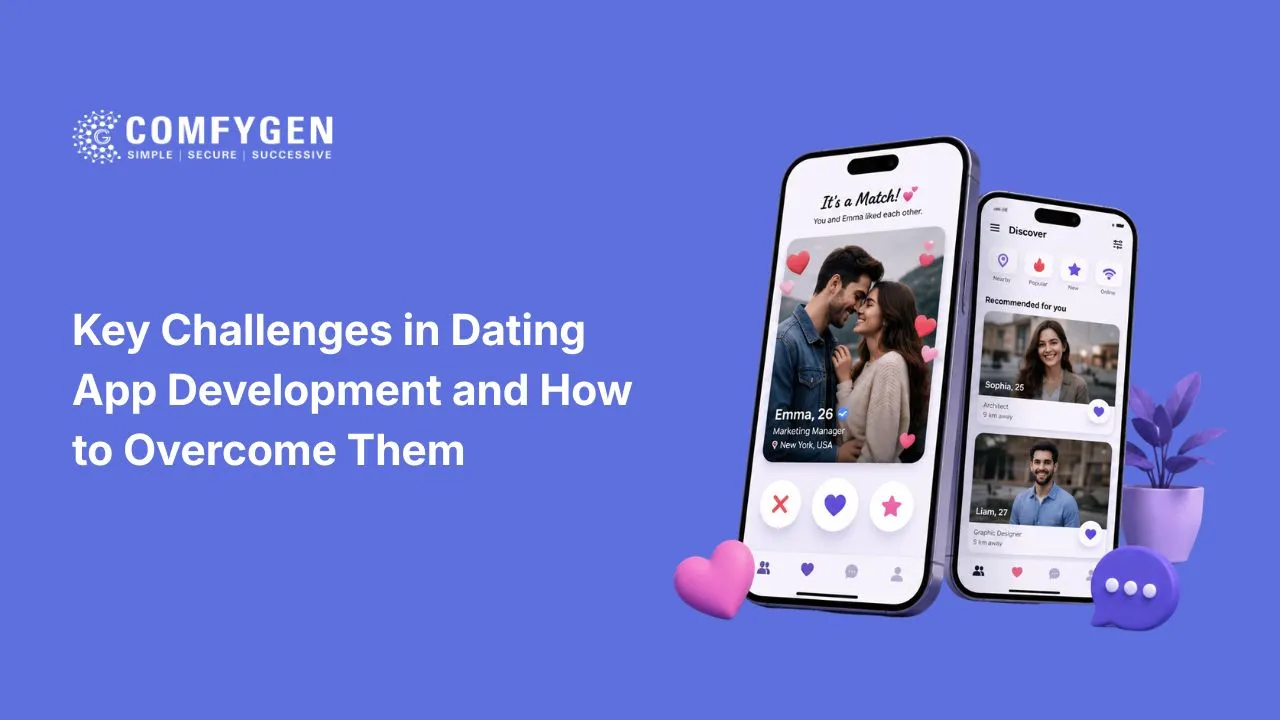





Building a dating app is not just about creating user profiles, adding a swipe feature, or connecting people through chat. It is about creating a platform where people feel safe, comfortable, and confident while connecting with others.
Some key challenges are gaining user trust, Meaningful matches, preventing fake profiles and scams, protecting personal data, moderate user behavior, ensuring the app can scale as its user base grows, and keep users engaged over time.
Understanding these dating app development challenges help your businesses avoid costly mistakes and make better decisions about technology, features, security, and user experience. More importantly, it can help build a dating platform that is reliable, secure, and genuinely focused on its users.
So, what are the biggest challenges developers and businesses need to consider when building a dating app? Let’s explore them.
1. Creating Meaningful and Accurate Matches
Matching is at the heart of every dating app. Users don’t want a long list of profiles, they prefer to discover people who are relevant to their preferences, interests, location, and relationship goals.
Developing an effective matching system can be challenging because compatibility involves multiple factors. A basic system might rely on age, gender, location, and preferences, while a more advanced solution may analyze user behavior, interests, profile activity, and previous interactions.
The challenge is finding the right balance between personalization and simplicity. If recommendations are too broad, users may see irrelevant profiles. If they are too restrictive, users may run out of potential matches quickly.
How to overcome it: Start with clear matching rules based on user preferences and gradually introduce behavioral data and AI-driven personalization as the platform gathers enough data to improve recommendations.
2. Preventing Fake Profiles, Bots, and Dating Scams
Trust is one of the most important factors in a dating app. Unfortunately, fake accounts, bots, catfishing, spam, and romance scams can quickly damage that user’s trust.
A platform with too many suspicious profiles can cause genuine users to leave, regardless of how attractive its interface or features are.
Dating apps may need multiple layers of protection, including:
- Email and phone verification
- Profile and photo verification
- Bot detection
- Suspicious-activity monitoring
- Spam prevention
- User reporting and blocking
- Manual review for high-risk accounts
How to overcome it: Use a combination of automated detection and human moderation makes Verification strong to discourage abuse without creating unnecessary friction for legitimate users.
3. Protecting Sensitive User Data
Dating apps collect highly personal profile information such as photographs, names, locations, relationship preferences, conversations, and other information that users expect to remain private.
A data breach or privacy failure can have serious consequences for both users and the business.
Therefore developers need to consider:
- Secure authentication
- Encryption
- Access controls
- Secure API design
- Safe data storage
- Regular security testing
- Data minimization
- Account and data deletion controls
How to overcome it: Build privacy and security into the product from the beginning rather than treating them as features to add before launch. Businesses should also understand the privacy and data-protection requirements applicable to their target markets.
4. Ensuring User Safety
Dating involves interactions between people who may have never met before. This makes user safety a critical product consideration.
Users should have easy access to tools that allow them to control unwanted interactions and report suspicious behavior.
Useful safety features can include:
- Block and report options
- Profile verification
- Unmatch functionality
- Suspicious-account detection
- Content moderation
- Privacy controls
- Safety guidance
- Emergency or location-sharing features where appropriate
How to overcome it: Make safety controls visible and easy to use. Don’t bury important reporting or blocking features inside complicated menus.
Planning to Build a Dating App?
Avoid costly development mistakes and get a clear understanding of your app’s features, technology, security requirements, development timeline, and budget before development begins.
Get Your Free Project Quote
5. Moderating User-Generated Content
Dating apps rely heavily on user-generated content. Users upload photographs, write bios, send messages, and share other content.
As the number of users grows, manually reviewing everything becomes impractical. At the same time, relying entirely on automated systems can result in a problem because they may remove content that is actually legitimate.
How to overcome it: Build a moderation framework that combines automated detection, user reports, predefined community guidelines, escalation processes, and human review for complex cases.
Moderation should be considered part of the core product architecture, not an afterthought.
6. Handling Location-Based Matching
Location can be an important part for many dating platforms because users typically want to connect with people within a reasonable distance.
However, location data creates an important privacy challenge. Revealing too much location information could expose sensitive details about a person’s life, works, or spends time.
How to overcome it: Avoid displaying precise locations to other users. Use approximate distance or broader geographic areas when appropriate, minimize unnecessary location collection, and provide users with control over location permissions.
7. Building a Scalable Dating App
An application that performs well with a few thousand users may struggle when its audience grows significantly.
Dating apps can generate considerable amounts of traffic through profile discovery, matching, messaging, notifications, image uploads, and real-time interactions.
Poorly designed infrastructure can result in:
- Slow loading times
- Failed messages
- Delayed notifications
- Server downtime
- Database bottlenecks
- Poor overall user experience
How to overcome it: Choose an architecture that can scale with the business. Cloud infrastructure, caching, efficient database design, load balancing, monitoring, and scalable real-time technologies can help support growth.
The objective isn’t necessarily to over-engineer the first version. Instead, the architecture should provide a practical path from MVP to larger-scale deployment.
8. Designing a Simple but Engaging User Experience
Dating apps operate in a highly competitive market. Users can quickly abandon an application if onboarding is confusing, profiles are difficult to navigate, or discovering potential matches feels frustrating.
A good dating experience makes important actions feel natural:
- Creating a profile
- Discovering people
- Expressing interest
- Understanding a match
- Starting conversations
- Managing notifications
- Reporting or blocking users
How to overcome it: Conduct usability testing and analyze where users drop out of the experience. Keep onboarding simple while collecting enough information to improve matching quality.
9. Solving the User Acquisition and Network-Effect Challenge
One of the biggest challenges in dating app development isn’t technical—it is building a sufficiently active user community.
A user may install an app, create an attractive profile, and still have a poor experience if there aren’t enough relevant people in their area.
This creates a classic network-effect problem, users need other active users to receive value from the platform.
How to overcome it: Instead of launching everywhere at once, businesses should focus on a specific geographic area, audience, or dating niche. Building sufficient user density in one market can create a stronger experience before expanding into new locations.
Want to Build a Successful Dating App Despite the Challenges?
Start with the right technology, secure architecture, smart matchmaking, and an experienced development team to create a safe, scalable, and engaging dating experience.
Get Your Free Project Quote
10. Choosing the Right Monetization Strategy
Dating apps commonly use freemium models, subscriptions, boosts, premium discovery features, and in-app purchases.
The challenge is monetizing the platform without damaging the core dating experience.
If too many useful features are locked behind a paywall, users may become frustrated. On the other hand, if premium features offer little additional value, users have little reason to pay.
How to overcome it: Identify features that provide genuine value to paying users and test different subscription structures, feature limits, and pricing strategies based on actual user behavior.
11. Meeting Legal, Privacy, and App-Store Requirements
Dating platforms may need to address a range of legal and platform requirements depending on where they operate and what features they provide.
These may involve:
- Data protection and privacy
- Age restrictions
- User consent
- Content moderation
- User-generated content
- Payment requirements
- Data deletion
- App-store policies
How to overcome it: Consider compliance during the planning and design stages. Businesses should assess the requirements of each target market instead of assuming that one approach will work globally.
12. Keeping Users Engaged and Retained
Dating platforms may need to address a range of legal and platform requirements depending on where they operate and what features they provide.
Acquiring users is part of the challenge. The platform also needs to give them a reason to return.
Users may leave because they encounter irrelevant matches, fake profiles, poor conversations, excessive notifications, or a lack of active users.
Dating apps also have a unique retention challenge: if users successfully find a partner, they may stop using the platform.
How to overcome it: Focus on the quality of the dating experience rather than simply maximizing time spent in the application. Better recommendations, meaningful conversations, safety, personalization, and a healthy user community can contribute to stronger long-term satisfaction.
How Can Businesses Overcome Dating App Development Challenges?
The best way to manage these challenges is to address them during the planning stage rather than after the application has been launched.
A practical approach is to:
- Define the target audience before selecting features.
- Research competitors to identify gaps in the market.
- Prioritize an MVP around the core dating experience.
- Plan security and privacy from the beginning.
- Design moderation and safety systems before user growth.
- Build a scalable technical foundation without unnecessarily over-engineering the MVP.
- Test matching and UX with real users.
- Monitor analytics and feedback after launch.
- Improve the product continuously based on user behavior.
- Expand features and markets gradually once the core experience is validated.
Final Thoughts
Developing a dating app comes with challenges that go far beyond coding and UI design. The real difficulty lies in creating an environment where users can discover relevant people, communicate safely, protect their personal information, and build genuine connections.
From matching algorithms and fraud prevention to data security, moderation, scalability, monetization, and retention, every part of the product can influence whether users trust and continue using the platform.
Businesses that understand these dating app development challenges early can make smarter product decisions, reduce development risks, and create a platform that is not only technically strong but also valuable to the people using it.
FAQs
1. What are the biggest challenges in dating app development?
The biggest challenges in dating app development include creating accurate matching algorithms, preventing fake profiles and scams, protecting sensitive user data, ensuring user safety, moderating content, handling location privacy, building scalable infrastructure, attracting users, choosing the right monetization strategy, and complying with legal and app-store requirements.
2. How much does it cost to develop a dating app?
The cost of developing a dating app depends on its features, design complexity, technology stack, platform, development team, and third-party integrations. A basic MVP will generally cost less than an advanced dating platform with AI-powered matching, video calling, verification, real-time chat, and sophisticated moderation systems. The best approach is to define the MVP requirements first and then estimate development costs based on those specifications.
3. How does a dating app matching algorithm work?
A dating app matching algorithm typically analyzes factors such as age, location, gender preferences, interests, relationship goals, profile information, and user behavior. More advanced systems can use machine learning and behavioral data to personalize recommendations over time. The goal is to show users relevant profiles without making the selection process too restrictive.
4. How do dating apps prevent fake profiles and scams?
Dating apps can use multiple security measures to identify and prevent fake accounts and scams. These may include phone and email verification, photo or identity verification, bot detection, suspicious-activity monitoring, spam detection, reporting and blocking tools, and manual moderation. Combining automated systems with human review can provide stronger protection.
5. How can I make a dating app safe for users?
User safety should be considered from the beginning of the development process. Important features include profile verification, block and report options, unmatching, privacy controls, content moderation, suspicious-account detection, and clear community guidelines. Depending on the target market and use case, additional safety tools such as safety reminders or location-sharing features may also be appropriate.
6. How can dating apps protect user data and privacy?
Dating apps can protect user data through secure authentication, encryption, access controls, secure APIs, protected data storage, regular security testing, and data minimization. Users should also have control over their privacy settings and access to account and data deletion options. Privacy and security should be incorporated into the architecture rather than added shortly before launch.
7. How do you build a scalable dating app?
A scalable dating app requires an architecture that can handle increasing numbers of users, profiles, messages, images, notifications, and real-time interactions. Cloud infrastructure, caching, efficient databases, load balancing, monitoring, and scalable real-time communication technologies can help. Businesses should start with a practical MVP architecture while maintaining a clear path for future growth.
8. What are the essential features of a dating app?
Common dating app features include user registration, profile creation, photo uploads, search and discovery, matching, likes, messaging, push notifications, blocking and reporting, profile verification, privacy settings, and subscription or payment functionality. Advanced apps may also include AI-powered recommendations, video calling, voice features, location-based discovery, and enhanced safety tools.
9. How do dating apps make money?
Dating apps commonly generate revenue through freemium models, premium subscriptions, in-app purchases, profile boosts, paid discovery features, and other premium services. A successful monetization strategy should provide meaningful benefits to paying users without making the free experience frustrating or preventing users from engaging with the core dating experience.
10. How can I attract users to a new dating app?
User acquisition is one of the biggest challenges for a new dating platform because users need enough active and relevant people in their area to get value from the app. Instead of launching everywhere at once, businesses can focus on a specific location, niche, or target audience. Digital marketing, referrals, partnerships, social media campaigns, and community-building initiatives can then help increase user density and engagement
11. How can I improve user retention in a dating app?
User retention improves when people consistently receive relevant matches, meaningful conversations, and a safe and enjoyable experience. Personalized recommendations, better matching, useful notifications, strong moderation, an active user base, and a simple interface can encourage users to return. The focus should be on improving the quality of connections rather than simply maximizing app usage time.
12. What legal requirements should be considered when developing a dating app?
Legal requirements vary depending on the countries and regions where the dating app operates. Businesses may need to consider privacy and data-protection laws, age restrictions, user consent, content moderation, payment rules, data deletion requirements, intellectual property, and app-store policies. Legal and compliance requirements should be evaluated during the planning stage rather than after development is complete.
13. How can AI be used in dating app development?
AI can be used to improve profile recommendations, matchmaking, fraud detection, spam prevention, content moderation, personalization, and user engagement. Machine-learning models can analyze user preferences and behavior to improve recommendations over time. However, AI systems should be designed with privacy, transparency, fairness, and human oversight in mind.
14. How long does it take to develop a dating app?
The development timeline depends on the complexity of the app and the number of platforms and features involved. A basic MVP with core registration, profiles, matching, and messaging can be developed faster than a full-featured platform with AI matching, verification, video calling, advanced moderation, subscriptions, and analytics. Defining the MVP clearly can help reduce development time and control costs
15. How can businesses successfully launch a dating app?
A successful launch starts with clearly defining the target audience, validating the concept, researching competitors, and developing an MVP around the core dating experience. Security, privacy, moderation, and user safety should be built into the product from the beginning. After launch, businesses should monitor user behavior, collect feedback, improve matching and UX, and expand into new markets gradually.
Building a dating app is not just about creating user profiles, adding a swipe feature, or connecting people through chat. It is about creating a platform where people feel safe, comfortable, and confident while connecting with others.
Some key challenges are gaining user trust, Meaningful matches, preventing fake profiles and scams, protecting personal data, moderate user behavior, ensuring the app can scale as its user base grows, and keep users engaged over time.
Understanding these dating app development challenges help your businesses avoid costly mistakes and make better decisions about technology, features, security, and user experience. More importantly, it can help build a dating platform that is reliable, secure, and genuinely focused on its users.
So, what are the biggest challenges developers and businesses need to consider when building a dating app? Let’s explore them.
1. Creating Meaningful and Accurate Matches
Matching is at the heart of every dating app. Users don’t want a long list of profiles, they prefer to discover people who are relevant to their preferences, interests, location, and relationship goals.
Developing an effective matching system can be challenging because compatibility involves multiple factors. A basic system might rely on age, gender, location, and preferences, while a more advanced solution may analyze user behavior, interests, profile activity, and previous interactions.
The challenge is finding the right balance between personalization and simplicity. If recommendations are too broad, users may see irrelevant profiles. If they are too restrictive, users may run out of potential matches quickly.
How to overcome it: Start with clear matching rules based on user preferences and gradually introduce behavioral data and AI-driven personalization as the platform gathers enough data to improve recommendations.
2. Preventing Fake Profiles, Bots, and Dating Scams
Trust is one of the most important factors in a dating app. Unfortunately, fake accounts, bots, catfishing, spam, and romance scams can quickly damage that user’s trust.
A platform with too many suspicious profiles can cause genuine users to leave, regardless of how attractive its interface or features are.
Dating apps may need multiple layers of protection, including:
- Email and phone verification
- Profile and photo verification
- Bot detection
- Suspicious-activity monitoring
- Spam prevention
- User reporting and blocking
- Manual review for high-risk accounts
How to overcome it: Use a combination of automated detection and human moderation makes Verification strong to discourage abuse without creating unnecessary friction for legitimate users.
3. Protecting Sensitive User Data
Dating apps collect highly personal profile information such as photographs, names, locations, relationship preferences, conversations, and other information that users expect to remain private.
A data breach or privacy failure can have serious consequences for both users and the business.
Therefore developers need to consider:
- Secure authentication
- Encryption
- Access controls
- Secure API design
- Safe data storage
- Regular security testing
- Data minimization
- Account and data deletion controls
How to overcome it: Build privacy and security into the product from the beginning rather than treating them as features to add before launch. Businesses should also understand the privacy and data-protection requirements applicable to their target markets.
4. Ensuring User Safety
Dating involves interactions between people who may have never met before. This makes user safety a critical product consideration.
Users should have easy access to tools that allow them to control unwanted interactions and report suspicious behavior.
Useful safety features can include:
- Block and report options
- Profile verification
- Unmatch functionality
- Suspicious-account detection
- Content moderation
- Privacy controls
- Safety guidance
- Emergency or location-sharing features where appropriate
How to overcome it: Make safety controls visible and easy to use. Don’t bury important reporting or blocking features inside complicated menus.
Planning to Build a Dating App?
Avoid costly development mistakes and get a clear understanding of your app’s features, technology, security requirements, development timeline, and budget before development begins.
Get Your Free Project Quote
5. Moderating User-Generated Content
Dating apps rely heavily on user-generated content. Users upload photographs, write bios, send messages, and share other content.
As the number of users grows, manually reviewing everything becomes impractical. At the same time, relying entirely on automated systems can result in a problem because they may remove content that is actually legitimate.
How to overcome it: Build a moderation framework that combines automated detection, user reports, predefined community guidelines, escalation processes, and human review for complex cases.
Moderation should be considered part of the core product architecture, not an afterthought.
6. Handling Location-Based Matching
Location can be an important part for many dating platforms because users typically want to connect with people within a reasonable distance.
However, location data creates an important privacy challenge. Revealing too much location information could expose sensitive details about a person’s life, works, or spends time.
How to overcome it: Avoid displaying precise locations to other users. Use approximate distance or broader geographic areas when appropriate, minimize unnecessary location collection, and provide users with control over location permissions.
7. Building a Scalable Dating App
An application that performs well with a few thousand users may struggle when its audience grows significantly.
Dating apps can generate considerable amounts of traffic through profile discovery, matching, messaging, notifications, image uploads, and real-time interactions.
Poorly designed infrastructure can result in:
- Slow loading times
- Failed messages
- Delayed notifications
- Server downtime
- Database bottlenecks
- Poor overall user experience
How to overcome it: Choose an architecture that can scale with the business. Cloud infrastructure, caching, efficient database design, load balancing, monitoring, and scalable real-time technologies can help support growth.
The objective isn’t necessarily to over-engineer the first version. Instead, the architecture should provide a practical path from MVP to larger-scale deployment.
8. Designing a Simple but Engaging User Experience
Dating apps operate in a highly competitive market. Users can quickly abandon an application if onboarding is confusing, profiles are difficult to navigate, or discovering potential matches feels frustrating.
A good dating experience makes important actions feel natural:
- Creating a profile
- Discovering people
- Expressing interest
- Understanding a match
- Starting conversations
- Managing notifications
- Reporting or blocking users
How to overcome it: Conduct usability testing and analyze where users drop out of the experience. Keep onboarding simple while collecting enough information to improve matching quality.
9. Solving the User Acquisition and Network-Effect Challenge
One of the biggest challenges in dating app development isn’t technical—it is building a sufficiently active user community.
A user may install an app, create an attractive profile, and still have a poor experience if there aren’t enough relevant people in their area.
This creates a classic network-effect problem, users need other active users to receive value from the platform.
How to overcome it: Instead of launching everywhere at once, businesses should focus on a specific geographic area, audience, or dating niche. Building sufficient user density in one market can create a stronger experience before expanding into new locations.
Want to Build a Successful Dating App Despite the Challenges?
Start with the right technology, secure architecture, smart matchmaking, and an experienced development team to create a safe, scalable, and engaging dating experience.
Get Your Free Project Quote
10. Choosing the Right Monetization Strategy
Dating apps commonly use freemium models, subscriptions, boosts, premium discovery features, and in-app purchases.
The challenge is monetizing the platform without damaging the core dating experience.
If too many useful features are locked behind a paywall, users may become frustrated. On the other hand, if premium features offer little additional value, users have little reason to pay.
How to overcome it: Identify features that provide genuine value to paying users and test different subscription structures, feature limits, and pricing strategies based on actual user behavior.
11. Meeting Legal, Privacy, and App-Store Requirements
Dating platforms may need to address a range of legal and platform requirements depending on where they operate and what features they provide.
These may involve:
- Data protection and privacy
- Age restrictions
- User consent
- Content moderation
- User-generated content
- Payment requirements
- Data deletion
- App-store policies
How to overcome it: Consider compliance during the planning and design stages. Businesses should assess the requirements of each target market instead of assuming that one approach will work globally.
12. Keeping Users Engaged and Retained
Dating platforms may need to address a range of legal and platform requirements depending on where they operate and what features they provide.
Acquiring users is part of the challenge. The platform also needs to give them a reason to return.
Users may leave because they encounter irrelevant matches, fake profiles, poor conversations, excessive notifications, or a lack of active users.
Dating apps also have a unique retention challenge: if users successfully find a partner, they may stop using the platform.
How to overcome it: Focus on the quality of the dating experience rather than simply maximizing time spent in the application. Better recommendations, meaningful conversations, safety, personalization, and a healthy user community can contribute to stronger long-term satisfaction.
How Can Businesses Overcome Dating App Development Challenges?
The best way to manage these challenges is to address them during the planning stage rather than after the application has been launched.
A practical approach is to:
- Define the target audience before selecting features.
- Research competitors to identify gaps in the market.
- Prioritize an MVP around the core dating experience.
- Plan security and privacy from the beginning.
- Design moderation and safety systems before user growth.
- Build a scalable technical foundation without unnecessarily over-engineering the MVP.
- Test matching and UX with real users.
- Monitor analytics and feedback after launch.
- Improve the product continuously based on user behavior.
- Expand features and markets gradually once the core experience is validated.
Final Thoughts
Developing a dating app comes with challenges that go far beyond coding and UI design. The real difficulty lies in creating an environment where users can discover relevant people, communicate safely, protect their personal information, and build genuine connections.
From matching algorithms and fraud prevention to data security, moderation, scalability, monetization, and retention, every part of the product can influence whether users trust and continue using the platform.
Businesses that understand these dating app development challenges early can make smarter product decisions, reduce development risks, and create a platform that is not only technically strong but also valuable to the people using it.
FAQs
1. What are the biggest challenges in dating app development?
The biggest challenges in dating app development include creating accurate matching algorithms, preventing fake profiles and scams, protecting sensitive user data, ensuring user safety, moderating content, handling location privacy, building scalable infrastructure, attracting users, choosing the right monetization strategy, and complying with legal and app-store requirements.
2. How much does it cost to develop a dating app?
The cost of developing a dating app depends on its features, design complexity, technology stack, platform, development team, and third-party integrations. A basic MVP will generally cost less than an advanced dating platform with AI-powered matching, video calling, verification, real-time chat, and sophisticated moderation systems. The best approach is to define the MVP requirements first and then estimate development costs based on those specifications.
3. How does a dating app matching algorithm work?
A dating app matching algorithm typically analyzes factors such as age, location, gender preferences, interests, relationship goals, profile information, and user behavior. More advanced systems can use machine learning and behavioral data to personalize recommendations over time. The goal is to show users relevant profiles without making the selection process too restrictive.
4. How do dating apps prevent fake profiles and scams?
Dating apps can use multiple security measures to identify and prevent fake accounts and scams. These may include phone and email verification, photo or identity verification, bot detection, suspicious-activity monitoring, spam detection, reporting and blocking tools, and manual moderation. Combining automated systems with human review can provide stronger protection.
5. How can I make a dating app safe for users?
User safety should be considered from the beginning of the development process. Important features include profile verification, block and report options, unmatching, privacy controls, content moderation, suspicious-account detection, and clear community guidelines. Depending on the target market and use case, additional safety tools such as safety reminders or location-sharing features may also be appropriate.
6. How can dating apps protect user data and privacy?
Dating apps can protect user data through secure authentication, encryption, access controls, secure APIs, protected data storage, regular security testing, and data minimization. Users should also have control over their privacy settings and access to account and data deletion options. Privacy and security should be incorporated into the architecture rather than added shortly before launch.
7. How do you build a scalable dating app?
A scalable dating app requires an architecture that can handle increasing numbers of users, profiles, messages, images, notifications, and real-time interactions. Cloud infrastructure, caching, efficient databases, load balancing, monitoring, and scalable real-time communication technologies can help. Businesses should start with a practical MVP architecture while maintaining a clear path for future growth.
8. What are the essential features of a dating app?
Common dating app features include user registration, profile creation, photo uploads, search and discovery, matching, likes, messaging, push notifications, blocking and reporting, profile verification, privacy settings, and subscription or payment functionality. Advanced apps may also include AI-powered recommendations, video calling, voice features, location-based discovery, and enhanced safety tools.
9. How do dating apps make money?
Dating apps commonly generate revenue through freemium models, premium subscriptions, in-app purchases, profile boosts, paid discovery features, and other premium services. A successful monetization strategy should provide meaningful benefits to paying users without making the free experience frustrating or preventing users from engaging with the core dating experience.
10. How can I attract users to a new dating app?
User acquisition is one of the biggest challenges for a new dating platform because users need enough active and relevant people in their area to get value from the app. Instead of launching everywhere at once, businesses can focus on a specific location, niche, or target audience. Digital marketing, referrals, partnerships, social media campaigns, and community-building initiatives can then help increase user density and engagement
11. How can I improve user retention in a dating app?
User retention improves when people consistently receive relevant matches, meaningful conversations, and a safe and enjoyable experience. Personalized recommendations, better matching, useful notifications, strong moderation, an active user base, and a simple interface can encourage users to return. The focus should be on improving the quality of connections rather than simply maximizing app usage time.
12. What legal requirements should be considered when developing a dating app?
Legal requirements vary depending on the countries and regions where the dating app operates. Businesses may need to consider privacy and data-protection laws, age restrictions, user consent, content moderation, payment rules, data deletion requirements, intellectual property, and app-store policies. Legal and compliance requirements should be evaluated during the planning stage rather than after development is complete.
13. How can AI be used in dating app development?
AI can be used to improve profile recommendations, matchmaking, fraud detection, spam prevention, content moderation, personalization, and user engagement. Machine-learning models can analyze user preferences and behavior to improve recommendations over time. However, AI systems should be designed with privacy, transparency, fairness, and human oversight in mind.
14. How long does it take to develop a dating app?
The development timeline depends on the complexity of the app and the number of platforms and features involved. A basic MVP with core registration, profiles, matching, and messaging can be developed faster than a full-featured platform with AI matching, verification, video calling, advanced moderation, subscriptions, and analytics. Defining the MVP clearly can help reduce development time and control costs
15. How can businesses successfully launch a dating app?
A successful launch starts with clearly defining the target audience, validating the concept, researching competitors, and developing an MVP around the core dating experience. Security, privacy, moderation, and user safety should be built into the product from the beginning. After launch, businesses should monitor user behavior, collect feedback, improve matching and UX, and expand into new markets gradually.

Mr. Saddam Husen, (CTO)
Mr. Saddam Husen, CTO at Comfygen, is a renowned Blockchain expert and IT consultant with extensive experience in blockchain development, crypto wallets, DeFi, ICOs, and smart contracts. Passionate about digital transformation, he helps businesses harness blockchain technology’s potential, driving innovation and enhancing IT infrastructure for global success.