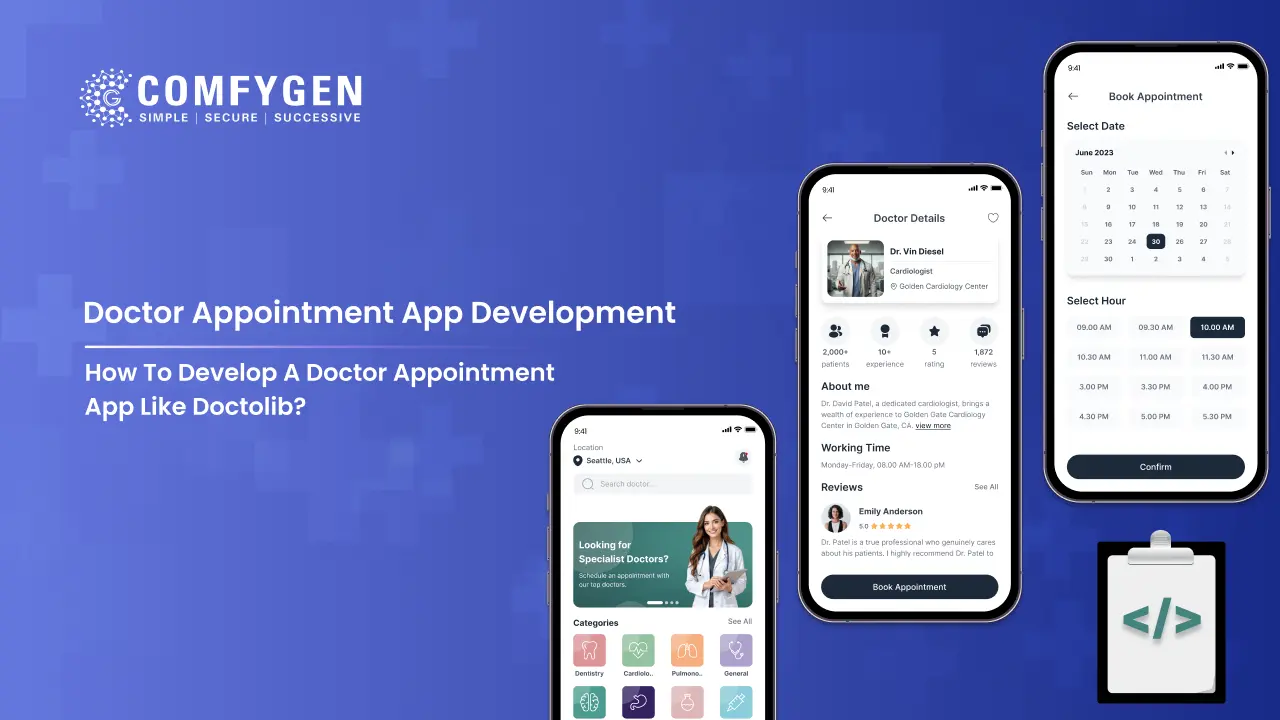





Digital appointment and telehealth platforms continue to evolve as patients and healthcare providers look for more convenient ways to manage appointments, consultations, and follow-up care. A platform inspired by Doctolib can combine doctor discovery, appointment scheduling, practice management, and online consultations depending on the needs of its target users and market.
Globally, the online doctor consultation market — which includes doctor appointment and telemedicine apps — is on pace to grow from around $10–$11 billion in 2025 to potentially nearly $300 billion by 2034 as more patients and providers embrace virtual care models.
Mobile Dr. Appointment apps lead this shift. In 2025, about 70% of online doctor consults happened through mobile applications, with video chat appointments making up roughly 60% of interactions.
Here’s where the growth is breaking out geographically:
- North America accounts for the largest share of the doctor appointment app market, thanks to advanced healthcare systems, high mobile adoption, and strong telehealth reimbursement policies.
- Europe follows closely, with countries like Germany, France, and the UK increasingly integrating apps into patient care.
- Asia-Pacific is the fastest-growing region, driven by rising internet penetration, expanding digital infrastructure in India, and government initiatives to bring healthcare access to underserved areas.
Why develop a Doctor Appointment App like Doctolib is a successful business idea?
Dr. Appointment App Similler to Doctolib succeed because they didn’t just digitize appointments — they created a digital workflow for the modern healthcare industry.
In France alone, around 50 million patients use Doctolib’s services, and the platform facilitates about 15 million appointments every month, half of which are booked outside traditional office hours.
That’s not a niche tool — it’s now embedded deeply in how people manage their healthcare.
Here’s what this success looks like in practice:
- Patients get transparency — they can find doctors by specialty, read reviews, and book instantly without calling.
- Doctors and clinics free up hours previously lost to phone scheduling and reduce no-shows with automated reminders.
- Adoption spreads beyond big cities — in France, 86% of users are outside the five largest cities, proving this convenience appeals everywhere, not just in urban centers.
How the Doctolib Dr. Appointment App Works
Doctolib operates as a healthcare marketplace connecting patients with doctors and clinics. Patients search by specialty, location, or availability and book appointments instantly through the app or website. They receive confirmations and reminders, and in many cases, can opt for video consultations.
Doctors use a digital scheduling system to manage availability, reduce no-shows, and streamline patient flow. The platform becomes part of their daily workflow, not just a booking tool.
Revenue Model and Monetization Strategy in Dr. Appointment App
Doctolib doesn’t rely on patients for revenue. The core monetization comes from healthcare professionals.
The primary model is subscription-based. Doctors and clinics pay a monthly fee to use the platform’s scheduling and patient management tools. This creates predictable, recurring revenue and long-term client relationships.
Beyond subscriptions, revenue streams can include:
- Premium visibility for clinics or featured listings
- Advanced analytics and practice management tools
- Teleconsultation features as part of higher-tier plans
- Software integrations for larger healthcare institutions
Have a vision for a doctor appointment app? Share your ideas with Comfygen
and let’s turn your concept into a scalable and secure healthcare solution.
Contact USKey Features of a Doctor Appointment App Like Doctolib
If you’re looking to build a doctor appointment app like Doctolib, features are everything. The app must serve three main users: patients, doctors, and admins. Each panel needs to solve real problems, not just look good on screen.
Patient Panel Features
This is where experience matters most. If booking feels complicated, users won’t return.
- Easy Registration & Profile Setup – Sign up via email, phone, or social login.
- Advanced Doctor Search – Filter by specialty, location, language, ratings, and availability.
- Real-Time Appointment Booking – Live calendar with instant confirmation.
- Video Consultation – Secure in-app telemedicine support.
- Online Payments – Multiple payment options with secure gateways.
- Push Notifications & Reminders – Reduce missed appointments.
- E-Prescriptions & Medical Records – Access prescriptions and consultation history.
- Ratings & Reviews – Build trust and transparency.
Doctor Panel Features
Doctors need control, clarity, and efficiency.
- Profile & Availability Management – Set working hours and manage time slots.
- Appointment Dashboard – View, accept, cancel, or reschedule bookings.
- Patient History Access – Quick access to consultation records.
- Digital Prescription Management – Issue and manage e-prescriptions.
- Earnings & Reports – Track revenue and appointment analytics.
- Teleconsultation Tools – Secure video and chat features.
Admin Panel Features
The admin panel keeps the entire system running smoothly.
- User & Doctor Management – Approve, verify, or manage accounts.
- Appointment Monitoring – Track booking activity in real time.
- Payment & Commission Management – Monitor transactions and platform revenue.
- Analytics & Reports – Performance insights and usage data.
- Content & Support Management – Handle complaints and manage FAQs.
Benefits of Doctor Appointment Apps like Doctolib
Mobile applications for doctor appointments have become a game-changer in the healthcare sector as the following advantages will show. Develop an App Like Doctolib to help schedule medical appointments, making it easier for people to access health services.
Here are some key benefits of doctor appointment apps:
- Convenience for Patients
In doctor appointment apps, patients can make appointments at any time in the comfort of their homes. This does away with the need to call the clinic when the office is in session or spending time on hold.
The patients can also view the available time that the doctors are free to attend to patients and fix an appointment with the doctor simply by touching their phone screens.
- Reduced Waiting Times
The conventional system of scheduling makes people book their appointments only to wait for a long time, and sometimes their appointments may be cancelled to other patients.
Most appointment apps, for instance, have live scheduling that implies that the available times are as current as possible.
This is also in that patients can schedule appointments that are open and are not just left waiting around for a doctor who is occupied with other patients.
- Improved Access to Healthcare
In the case of patients who reside in rural areas or remote regions, they might find it very difficult to access the various healthcare services.
Doctor appointment apps like Doctolib help to fill this gap in that patients can get an appointment with the doctor, without necessarily having to travel long distances.
Some of the doctor booking apps also provide telehealth services that provide consultation services and reduce the costs of traveling.
- Enhanced Patient Engagement
Such apps usually have features such as appointment and medication reminders as well as follow-up visits. These constitute a way of reminding the patients to adhere to their treatment regimes, which in turn enhances their overall health.
Moreover, using the app, patients can view their medical records and test results, as well as prescription details, which makes them more engaged in the process of their treatment.
- Efficient Practice Management
For healthcare providers, doctor appointment apps are the best way of managing appointments, records, and communication. This cuts costs and effectively frees a lot of manpower for more vital patient care activities.
The absence of missed appointments also reduces the time spent rescheduling clients, hence improving the clinic’s efficiency.
- Data Security and Privacy
All the reliable applications for doctor appointments focus on the protection and confidentiality of the patient’s information.
They apply sophisticated privacy and security standards to guarantee the privacy and confidentiality of all the patient data, including the medical history and other details.
This makes patients more confident in engaging with healthcare providers via these digital solutions, and as such, more people engage in them.
- Cost-Effective Solution
As they do not require so much investment in physical structures and employees, doctor appointment apps can cut down on the expenses of medical practices.
They assist in reducing operating expenses even as the quality of service delivery is enhanced. To the patients, these apps help them to avoid frequent clinic visits, which they incur costs in the process.
Step-by-Step Process to develop an app like Doctolib
Building a doctor appointment app like Doctolib isn’t just about coding. It’s about solving workflow problems in healthcare. Here’s how the process typically unfolds.
1. Market Research & Requirement Analysis
Identify your target users. Are you focusing on independent clinics, multi-specialty hospitals, or a specific region? Study competitors, pricing models, and feature gaps. Define your revenue model early, whether subscription-based, commission-based, or hybrid.
2. UI/UX Design
Design separate flows for patients and doctors. Booking should take minimal steps. Navigation must be clear. Avoid clutter. Include accessible fonts and clean layouts since users may include elderly patients.
3. Choosing the Right Technology Stack
- Frontend: Flutter, React Native, or Swift/Kotlin for native apps
- Backend: Node.js, Python, or .NET
- Database: PostgreSQL or MongoDB
- Cloud: AWS, Azure, or Google Cloud
4. App Development (Frontend & Backend)
Frontend handles user experience. Backend manages authentication, appointment logic, notifications, payments, and data storage. Real-time scheduling systems need accurate time-slot management to avoid double bookings.
5. API & EHR Integration
- Payment gateways
- SMS and push notification services
- Video consultation APIs
- Electronic Health Records (EHR) systems
6. Security & Compliance (HIPAA/GDPR)
Implement end-to-end encryption, secure authentication, role-based access control, and secure cloud storage. Ensure compliance with regulations like HIPAA (US) or GDPR (Europe), depending on your target market.
7. Testing & QA
Check appointment booking flows, payment processing, video calls, and notification delivery. Perform performance testing to ensure the system handles peak loads. Security testing is critical to prevent data breaches.
8. Deployment & Launch
Once testing is complete, deploy to the App Store and Google Play. Set up backend servers and monitoring tools.
Post-launch, monitor user behavior, fix bugs quickly, and release regular updates. Growth comes from continuous improvement, not a one-time launch.
Looking to build a powerful doctor appointment app like Doctolib?
Partner with Comfygen and start developing your healthcare platform today.
Hire Experts
Compliance and Security Requirements in Dr. Appointment App development
When you develop a doctor appointment app like Doctolib, compliance and security are not optional features. They are the foundation. You are dealing with sensitive medical data, and even a small breach can damage trust and lead to legal penalties.
Here’s what you need to focus on.
HIPAA Compliance
If your target market includes the United States, HIPAA compliance is mandatory. This law protects patient health information and defines how it can be stored, accessed, and shared.
To meet HIPAA standards, your app should include:
- Secure storage of medical records
- Encrypted data transmission
- Role-based access control
- Audit logs to track data access
- Business Associate Agreements with third-party vendors
GDPR Regulations
If you plan to operate in Europe, GDPR compliance is mandatory. GDPR focuses on data privacy and user consent.
Your app must:
- Clearly inform users how their data is used
- Collect explicit consent before storing medical information
- Allow users to access, modify, or delete their data
- Ensure secure cross-border data transfers
Data Encryption & Secure Authentication
Strong technical security is the backbone of compliance.
Your doctor appointment app should implement:
- End-to-end encryption for chats and video calls
- SSL certificates for secure communication
- Two-factor authentication (2FA)
- Biometric login options
- Secure cloud infrastructure
- Regular vulnerability testing and security audits
Cost to Develop a Doctor Appointment App Like Doctolib
Building a doctor appointment app like Doctolib can vary widely in cost. The final budget depends on features, integrations, compliance needs, and the development team you choose. Let’s break it down clearly.
Basic MVP
Includes a single-platform app with appointment booking, doctor profiles, in-app chat, and notifications.
Estimated cost: $10,000 – $18,000
Standard Clinic App
Includes apps for both platforms, payment integration, video consultation, and staff scheduling.
Estimated cost: $18,000 – $30,000
Hospital Platform
Includes EHR/EMR integration, multi-department scheduling, analytics, and advanced admin controls.
Marketplace / Enterprise Platform
Includes an AI symptom checker, generative AI notes, billing and revenue cycle management (RCM), wearable device integration, and support for multiple locations.
Factors Affecting Development Cost
Several elements influence the final price:
- Number and complexity of features
- Android, iOS, or both platforms
- Custom UI/UX design
- Third-party integrations (payment, video APIs, EHR systems)
- Compliance requirements (HIPAA, GDPR)
- Development team location and expertise
- Cloud infrastructure and scalability needs
Ongoing Dr. Appointment App Maintenance Costs
Post-launch maintenance requirements vary based on the platform’s complexity, infrastructure, integrations, security needs, and frequency of updates. Businesses should plan for ongoing maintenance as part of the long-term product budget.
- Server and cloud hosting
- Security updates and monitoring
- Bug fixes and performance optimization
- Feature upgrades
- Compliance updates
Also Read: Estimate The Cost Of Building A Doctor Appointment App Like ZocDoc
Monetization Strategies in Dr. Appointment Clone App Development
Building the app is one part. Making it profitable is the real game. A doctor appointment app like Doctolib needs a revenue model that feels fair to providers while keeping access simple for patients.
- Subscription Model
Doctors and clinics pay a monthly or yearly fee to use scheduling, patient management, and teleconsultation features. This provides stable recurring revenue and is the most common model in healthcare platforms. - Commission Per Appointment
The platform charges a fixed fee or small percentage for each confirmed booking. This works well for new providers who prefer paying based on usage. - Premium or Featured Listings
Doctors can pay for higher visibility in search results, helping them attract more patients. - Value-Added Services
Advanced analytics, marketing tools, or integration with hospital systems can be offered as paid upgrades.
Challenges in Developing a Doctor Appointment App like Doctolib
Building a doctor appointment app sounds straightforward. In reality, healthcare adds layers of complexity that most industries don’t face. Here are the key challenges you need to plan for.
Data Privacy Issues
Medical data is highly sensitive. Any breach can damage trust and lead to legal consequences. You must implement strong encryption, secure cloud storage, strict access controls, and regular security audits. Security cannot be an afterthought.
User Adoption
Not all doctors are comfortable switching from manual scheduling to digital systems. Training, onboarding support, and a simple interface are critical. If the platform feels complicated, adoption slows down quickly.
System Scalability
As user numbers grow, the app must handle high traffic, real-time bookings, and video consultations without crashing. Poor infrastructure planning can lead to slow performance and double-booking issues.
Regulatory Compliance
Healthcare laws differ by country. Whether it’s HIPAA in the US or GDPR in Europe, compliance requires both technical and legal planning. Expanding into new regions often means adapting the system to new regulations.
How Comfygen Can Help You in Doctolib Clone App Development?
Comfygen can significantly aid in building doctor appointment apps by leveraging its extensive expertise and industry experience. With a team of skilled mobile app developers and designers, Comfygen can create a user-friendly, secure, and feature-rich app tailored to your specific needs.
They offer end-to-end solutions, from initial concept and design to doctor appointment app development, testing, and deployment.
This is one of the best mobile app development company ensure the integration of essential features like appointment scheduling, real-time availability updates, telemedicine, secure messaging, and payment processing.
They also prioritize data security and compliance with healthcare regulations, ensuring patient information is protected.
Additionally, it’s the best healthcare app development company that provides ongoing support and maintenance to keep the app updated and functioning smoothly. Their agile development approach ensures timely delivery and adaptability to changing requirements.
By choosing Comfygen, you benefit from a reliable partner dedicated to delivering a high-quality doctor appointment app development that enhances patient engagement and streamlines healthcare services.
Final Verdict
Developing a doctor appointment app like Doctolib is more than building a booking platform. It’s about creating a secure, scalable healthcare ecosystem that benefits patients, doctors, and clinics alike.
From defining the right features and technology stack to ensuring compliance with healthcare regulations, every step requires strategic planning. The success of your platform depends on usability, data security, performance, and a clear monetization model.
If you’re planning to enter the digital healthcare space, partnering with an experienced development team makes all the difference. Comfygen specializes in healthcare app development, delivering secure, compliant, and scalable doctor appointment solutions tailored to your business goals.
With the right approach and expert support, you can build a powerful healthcare platform that drives growth, improves patient access, and transforms appointment management.
Frequently Asked Questions (FAQs)
What are the essential features of a doctor appointment app?
How much does it cost to build a doctor appointment app?
Building a doctor appointment app can cost between $10,000 to $100,000+. The cost varies based on features, platform (iOS app development, Android app development, or both), design complexity, development team location, and ongoing maintenance needs.
How can Comfygen help in developing a doctor appointment app?
What monetization strategies can be used for a doctor appointment app?
How long does it take to develop a doctor appointment app?
The development timeline for a doctor appointment app typically ranges from 8 to 48 weeks. The duration depends on the app's complexity, the number of features, the chosen technology stack, and the efficiency of the development team.

Mr. Saddam Husen, (CTO)
Mr. Saddam Husen, CTO at Comfygen, is a renowned Blockchain expert and IT consultant with extensive experience in blockchain development, crypto wallets, DeFi, ICOs, and smart contracts. Passionate about digital transformation, he helps businesses harness blockchain technology’s potential, driving innovation and enhancing IT infrastructure for global success.