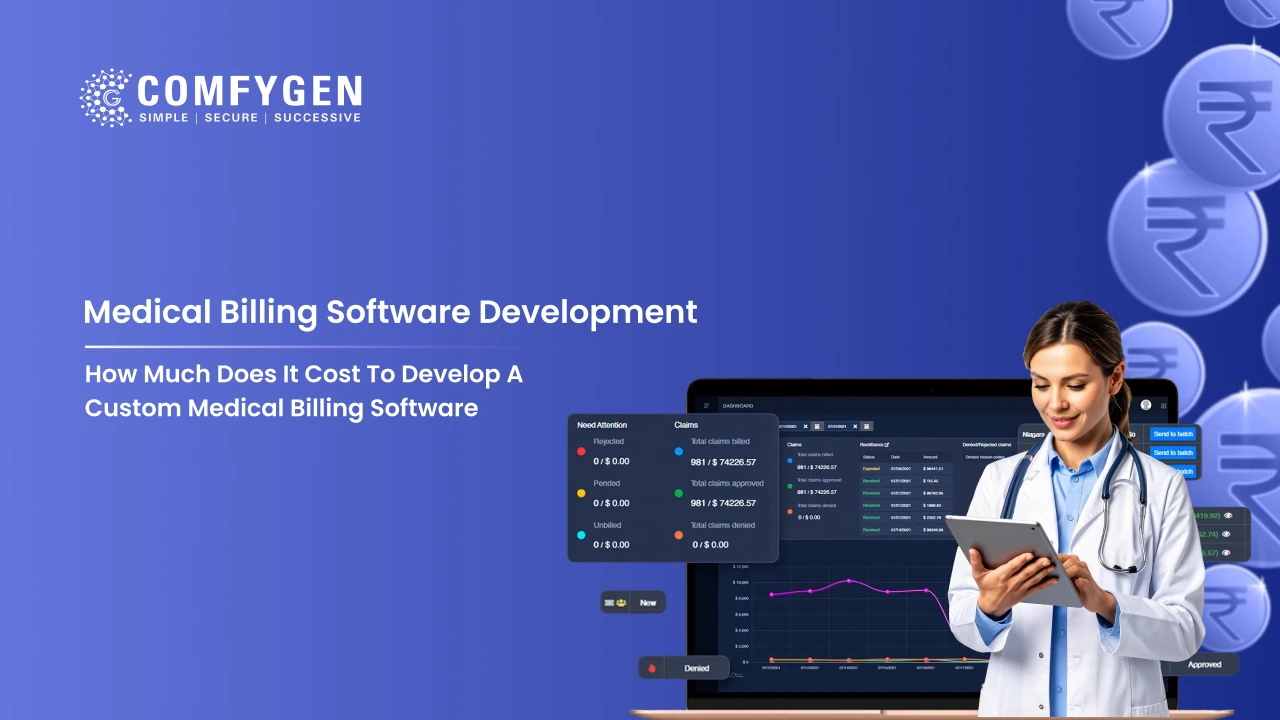





The healthcare sector is digitally changing at an alarming rate, and medical billing is among the most sensitive fields that need to be accurate and automated. The need to reduce human mistakes, lessen administrative burden and better the management of revenues in the healthcare system has seen the need to acquire tailor made medical billing software increasing.
As a matter of fact, almost 80 percent of healthcare providers have embraced digital billing systems in the past few years which has demonstrated that manual billing is no longer efficient or scalable. Due to the rise of telehealth, the use of cloud-based systems, and automated workflows, the development of custom medical billing software has become a strategic investment and not an added feature.
This shift is also supported by global trends. Research indicates that by 2035, the market size of medical billing software in the world will be at 52.57 billion with a CAGR of more than 10. The market is now dominated by North America because of the greater levels of digital adoption and high compliance requirements.
The question is, However, How much would it cost to develop custom medical billing software? Let’s break it down.
What is Custom Medical Billing Software?
Every healthcare organization handles billing differently. A small dermatology clinic doesn’t follow the same workflow as a multi-location hospital. Off-the-shelf software often forces teams to “adjust their process” to fit the software. Custom software does the opposite—it adapts to you.
Organizations choose custom billing systems because they get:
-
A platform built around their workflow
-
Better automation (fewer human errors)
-
Seamless integration with EHR/EMR systems
-
Faster claims and improved reimbursement cycle
-
Complete control over security and compliance
-
The ability to scale at their own pace
In a sector where margins are tight and administrative work is huge, custom billing software can make a measurable impact on revenue cycle efficiency.
Average Cost to Develop a Custom Medical Billing Software
The average cost to develop a custom medical billing software generally ranges between $30,000 and $300,000, depending on the project’s scope, feature set, and compliance requirements. A basic custom medical billing system with core functionalities such as patient management, insurance verification, claim submission, and standard reporting usually starts from $30,000 to $50,000 and can be developed within 3 to 5 months. These entry-level solutions are ideal for small clinics and healthcare startups seeking cost-effective automation.
For more advanced medical billing software development, costs increase significantly due to added complexity. Systems that include EHR/EMR integrations, AI-powered coding, denial management, advanced analytics, multi-platform access, and strict HIPAA compliance typically fall in the $100,000 to $300,000+ range, with development timelines extending from 6 to 12+ months. Key cost drivers include feature depth, data security standards, third-party integrations, and the expertise and location of the development team. Choosing an experienced healthcare software partner ensures accurate cost estimation, regulatory compliance, and long-term scalability.
Get a Free Consultation for Your Custom Medical Billing Software Today!
Factors Affecting the Cost of Medical Billing Software Development
The cost of medical billing software development is not fixed and varies widely depending on multiple technical, regulatory, and business requirements. From feature complexity to compliance standards, each factor directly impacts development time, resources, and overall budget. Understanding these cost-influencing factors helps healthcare providers plan investments wisely and avoid unexpected expenses while building a scalable and compliant medical billing system.
1. Feature Complexity
The number and type of features play a major role in determining cost. Basic systems include patient registration, claim submission, and payment tracking, while advanced solutions support AI-based coding, denial management, analytics, and reporting dashboards.
2. HIPAA & Regulatory Compliance
Healthcare billing software must comply with regulations such as HIPAA, ICD-10, and CPT standards. Implementing data encryption, access controls, audit logs, and secure authentication increases development effort and cost but is essential for legal compliance.
3. Third-Party Integrations
Integrating EHR/EMR systems, insurance payer APIs, clearinghouses, payment gateways, and accounting tools significantly impacts development cost due to additional customization and testing requirements.
4. UI/UX Design
A user-friendly interface for billing staff and administrators improves efficiency but requires extra design effort. Custom dashboards and role-based interfaces add to the overall cost.
5. Platform Selection
Whether the software is web-based, mobile-based (Android/iOS), or cross-platform affects both development time and pricing. Multi-platform solutions naturally require higher investment.
6. Development Team Location & Expertise
Hourly rates vary by region. Hiring an experienced healthcare billing software development company ensures quality and compliance but may affect the overall budget depending on team location and skill level.
7. Maintenance & Scalability
Post-launch maintenance, feature upgrades, security updates, and scalability planning add recurring costs, typically calculated annually.
Estimated Cost Impact Table
| Cost Factor | Description | Estimated Cost Impact |
| Feature Set | Basic vs advanced billing features | $10,000 – $80,000+ |
| HIPAA Compliance & Security | Encryption, audit logs, access control | $8,000 – $40,000 |
| Third-Party Integrations | EHR/EMR, insurance, payment gateways | $5,000 – $50,000+ |
| UI/UX Design | Custom dashboards & user workflows | $5,000 – $20,000 |
| Platform (Web / Mobile) | Single or multi-platform development | $10,000 – $60,000 |
| Development Team | Location & expertise level | $30 – $120/hour |
| Maintenance & Support | Annual updates & monitoring | 15–20% of total cost |
Overall Cost Insight
When all factors are combined, the total cost of medical billing software development typically falls between $30,000 and $300,000+, depending on customization level, compliance needs, and long-term scalability goals. Partnering with an experienced provider like Comfygen Technologies helps optimize these factors while ensuring performance, security, and regulatory adherence.
Cost Breakdown by Medical Billing Software Development Phase
Understanding the cost breakdown by development phase helps healthcare providers plan budgets more accurately for medical billing software development. Each phase of development requires different resources, expertise, and time, which collectively determine the final project cost. Below is a clear, phase-wise explanation along with an estimated cost table.
1. Requirement Analysis & Planning
This initial phase focuses on understanding business needs, billing workflows, compliance requirements (HIPAA, ICD-10, CPT), and third-party integrations. Proper planning reduces rework and unexpected expenses later.
- Estimated Cost: $3,000 – $10,000
- Timeline: 1–3 weeks
2. UI/UX Design
Designing an intuitive interface ensures ease of use for billing staff and administrators. This phase includes wireframes, prototypes, and user journey mapping for a smooth billing workflow.
- Estimated Cost: $5,000 – $20,000
- Timeline: 2–4 weeks
3. Core Development
This is the most resource-intensive phase, covering front-end and back-end development, database setup, billing logic, claims processing, and reporting modules.
- Estimated Cost: $15,000 – $120,000+
- Timeline: 3–6 months
4. Third-Party Integrations
Integration with EHR/EMR systems, insurance payer APIs, clearinghouses, and payment gateways is handled in this phase to ensure seamless data exchange.
- Estimated Cost: $5,000 – $50,000+
- Timeline: 3–6 weeks
5. Security & Compliance Implementation
This phase ensures HIPAA compliance through encryption, access control, audit logs, secure authentication, and data protection mechanisms.
- Estimated Cost: $8,000 – $40,000
- Timeline: 2–4 weeks
6. Testing & Quality Assurance
Comprehensive testing ensures system stability, security, performance, and compliance. It includes functional testing, security testing, and user acceptance testing.
- Estimated Cost: $3,000 – $15,000
- Timeline: 2–4 weeks
7. Deployment & Go-Live
Final deployment includes cloud/server setup, configuration, and production launch. Training and documentation may also be provided.
- Estimated Cost: $2,000 – $8,000
- Timeline: 1–2 weeks
8. Maintenance & Support
Post-launch maintenance covers bug fixes, feature updates, compliance upgrades, and performance monitoring. This is typically an ongoing cost.
- Estimated Cost: 15%–20% of total development cost annually
Estimated Cost Breakdown Table
| Development Phase | Estimated Cost Range |
| Requirement Analysis & Planning | $3,000 – $10,000 |
| UI/UX Design | $5,000 – $20,000 |
| Core Development | $15,000 – $120,000+ |
| Integrations | $5,000 – $50,000+ |
| Security & Compliance | $8,000 – $40,000 |
| Testing & QA | $3,000 – $15,000 |
| Deployment | $2,000 – $8,000 |
| Maintenance (Annual) | 15%–20% of total cost |
Final Insight
The total medical billing software development cost typically ranges between $30,000 and $300,000+, depending on features, integrations, compliance, and scalability requirements. Partnering with an experienced development company like Comfygen Technologies ensures cost transparency, regulatory compliance, and long-term system reliability.
How Comfygen Technologies Can Help
Comfygen Technologies helps healthcare providers streamline their operations through reliable and scalable medical billing software development services. With strong expertise in building custom medical billing software, Comfygen creates solutions that align perfectly with your billing workflows, payer requirements, and compliance standards. This approach ensures accurate claim processing, faster reimbursements, reduced billing errors, and improved revenue cycle management for clinics, hospitals, and healthcare startups.
From requirement gathering and intuitive UI/UX design to development, EHR/EMR integration, and HIPAA-compliant security implementation, Comfygen Technologies handles the complete development lifecycle. By leveraging modern technologies, cloud-based infrastructure, and intelligent automation, the team delivers high-performance medical billing systems that integrate seamlessly with existing healthcare platforms. With transparent pricing, ongoing support, and maintenance services, Comfygen enables healthcare organizations to achieve long-term efficiency, regulatory compliance, and a strong return on investment.
Conclusion
Developing a custom medical billing software is a smart investment for healthcare providers, clinics, hospitals, and startups aiming to streamline revenue cycle management and maintain regulatory compliance. Costs typically range from $30,000 to $300,000+, depending on features, integrations, security requirements, and scalability. Careful planning and a phased development approach can help organizations manage budgets efficiently while ensuring a solution that meets their specific operational needs.
Partnering with a trusted medical billing software development company in india like Comfygen Technologies ensures a secure, scalable, and fully compliant medical billing system. With expertise in custom healthcare billing software development, Comfygen delivers end-to-end solutions, including UI/UX design, EHR/EMR integration, security implementation, and ongoing support, helping healthcare organizations reduce errors, accelerate reimbursements, and improve long-term efficiency.
Frequently Asked Questions
What factors cause medical billing software costs to increase?
Can I develop a HIPAA-compliant billing system under a limited budget?
How long does it take to build custom medical billing software?
Is outsourcing development cheaper than in-house teams?
What ongoing costs should I expect after launch?

Mr. Saddam Husen, (CTO)
Mr. Saddam Husen, CTO at Comfygen, is a renowned Blockchain expert and IT consultant with extensive experience in blockchain development, crypto wallets, DeFi, ICOs, and smart contracts. Passionate about digital transformation, he helps businesses harness blockchain technology’s potential, driving innovation and enhancing IT infrastructure for global success.