




Decentralized finance has fundamentally reshaped how people think about money. Among the most significant innovations to emerge from this shift is the peer-to-peer (P2P) crypto exchange — a trading model that cuts out the middleman and puts buyers and sellers in direct control of their transactions.
Whether you are a seasoned trader looking for more flexibility, a developer exploring blockchain-based commerce, or an entrepreneur eyeing a gap in the market, understanding P2P crypto exchanges is essential. This guide covers everything: what they are, how they work under the hood, their advantages and limitations, the features that define great platforms, and why building one has become an exciting business opportunity in 2026.
What is a P2P Crypto Exchange?
A peer-to-peer (P2P) crypto exchange is a decentralized marketplace where individuals trade digital assets directly with one another, without routing orders through a central authority or institutional broker. Buyers and sellers negotiate terms, agree on payment methods, and complete transactions on their own schedule — the platform exists primarily to connect them and protect both sides.
The key distinction from a centralized exchange (CEX) like Binance or Coinbase is custody. On a CEX, the platform holds your funds. On a P2P exchange, assets move from the seller’s wallet to an escrow mechanism and then to the buyer’s wallet. The platform never takes ownership of your funds.
How Peer-to-Peer Trading Works
Understanding the mechanics of a P2P trade helps both users and builders appreciate why the model is secure and why certain design choices matter.
Step 1 — Account Creation
Users register on the platform, typically completing identity verification (KYC/AML) in accordance with local regulations. Some privacy-focused platforms offer trading with minimal verification.
Step 2 — Browse or Post Offers
Sellers create listings that specify the cryptocurrency they want to sell, the price (often expressed as a percentage above or below the spot rate), accepted payment methods, and any trading limits. Buyers browse these listings or post their own buy requests.
Step 3 — Initiate a Trade
A buyer selects a suitable offer and initiates a trade request. Both parties confirm the terms: amount, price, and payment method.
Step 4 — Escrow Locks the Crypto
This is the critical safety mechanism. The platform’s escrow system automatically moves the seller’s cryptocurrency into a secure, time-limited lockbox. Neither party can access those funds — the seller cannot back out and the buyer cannot claim the coins without completing payment.
Step 5 — Buyer Sends Fiat Payment
The buyer transfers the agreed amount using the chosen payment method — bank transfer, mobile money, PayPal, cash deposit, gift card, or any of dozens of other options. The buyer uploads proof of payment and notifies the seller within the platform’s chat system.
Step 6 — Seller Confirms and Escrow Releases
The seller verifies the received payment and confirms completion. The escrow system automatically releases the cryptocurrency to the buyer’s wallet. The trade is complete.
Step 7 — Ratings and Reputation
Both parties leave feedback. Over time, traders build reputation scores that signal trustworthiness to future counterparties — a crucial element of the P2P trust ecosystem.
Types of P2P Crypto Exchanges
Not all P2P platforms are built the same way. They differ in architecture, custody model, and the degree of decentralization they offer.
1. Custodial P2P Exchanges
The platform manages the escrow and sometimes holds user funds in hot wallets. Examples include Binance P2P and Paxful. These platforms benefit from higher liquidity and professional dispute resolution, but users rely on the platform’s security practices.
2. Non-Custodial P2P Exchanges
Smart contracts handle escrow autonomously, with no platform wallet involved. The seller’s crypto is locked in a contract and released automatically when conditions are met. Examples include LocalCryptos and HODL HODL. Users retain full self-custody throughout the trade.
3. Decentralized P2P Exchanges (DEX-P2P Hybrids)
Platforms like Bisq operate without any central server. Order books are distributed across a network of nodes. There is no company to shut down, no single point of failure, and no mandatory identity verification. The trade-off is lower liquidity and a steeper learning curve.
4. Hybrid Platforms
Many modern exchanges embed a P2P module alongside centralized spot and futures trading. Bybit, OKX, and KuCoin all offer this model, letting users switch between P2P and order-book trading within the same account.
Key Features of a Modern P2P Crypto Exchange Platform
When hiring a p2p crypto exchange development company, you must look for these essential features that ensure platform success and user safety:
- Smart Escrow System: Holds assets securely during trades.
- Reputation System: Allows users to rate and review each other.
- KYC/AML Compliance (Optional): Builds trust, especially in regulated countries.
- Multi-Crypto Wallet Integration: Supports storage and exchange of different crypto assets.
- Two-Factor Authentication (2FA): Adds a layer of user account protection.
- Real-Time Chat System: Helps users coordinate trades smoothly.
- Dispute Resolution Center: Moderators can intervene in cases of fraud or miscommunication.
- Mobile & Web Apps: Seamless experience across devices.
These components are core to every successful p2p cryptocurrency exchange development solution and should be discussed clearly with your development partner.
Advantages of Using a P2P Crypto Exchange Platform
Why are so many crypto users shifting to peer-to-peer trading? The benefits go beyond decentralization:
- Lower Trading Fees: P2P platforms usually charge minimal platform fees, often just for escrow or dispute resolution.
- Accessibility: Users from regions without access to centralized exchanges can still trade globally.
- Payment Flexibility: Accept payments in local currencies, gift cards, PayPal, and even cash.
- Anonymity: No need to give up sensitive info unless required by local laws.
- Borderless Trading: Anyone can trade with anyone, anywhere — a key factor behind the rising demand for p2p crypto exchange development services.
These platforms are empowering the unbanked and underbanked worldwide, becoming a key pillar of the next phase of crypto adoption.
Why Businesses are Investing in P2P Crypto Exchange Development
Entrepreneurs, startups, and even traditional fintech companies are now exploring p2p crypto exchange development to build niche platforms or serve specific geographic regions. Here’s why:
- High-Growth Market: The number of P2P users is increasing due to distrust in centralized exchanges and a desire for financial independence.
- Multiple Revenue Channels: Platform fees, ads, premium features, token listings, and affiliate programs.
- Fewer Regulatory Hurdles (in some regions): Because no fiat is held on the platform, compliance is simpler.
- Custom Brand Positioning: You can build a brand that speaks to local culture, trust, and preferences.
By hiring a p2p cryptocurrency exchange development company, founders get access to technical expertise, ready-made modules, and quicker go-to-market timelines.
P2P Crypto Exchange Development Cost in 2026: What to Expect
The development cost varies greatly depending on:
- Project Complexity
- Feature Requirements
- Region of Development Company
- UI/UX Design Needs
- Security Implementation
- Mobile App Requirements
Here’s a rough breakdown:
| Region | Basic P2P Exchange | Advanced Custom P2P Exchange |
|---|---|---|
| India | $10,000 – $25,000 | $30,000 – $50,000 |
| UAE | $20,000 – $40,000 | $50,000 – $80,000 |
| USA / Europe | $40,000 – $60,000 | $80,000 – $120,000+ |
Note: These are average estimates. Custom blockchain features, AI bots, or DeFi integrations can further increase the cost of p2p cryptocurrency exchange development.
Want to Develop a
P2P Crypto Exchange?
Contact Now
How to Choose the Right P2P Cryptocurrency Exchange Development Company
Your exchange’s success depends on your development partner. Here’s how to pick the right one:
- Proven Experience: Do they have a portfolio of blockchain projects?
- Customizable Tech Stack: Are they flexible with frameworks and blockchain networks?
- Security Protocols: End-to-end encryption, smart contract audits, anti-DDoS systems.
- Post-Launch Support: Will they assist with maintenance, upgrades, and bug fixes?
- Cost Transparency: Avoid hidden costs and vague pricing.
If you’re looking for quality and affordability, consider a p2p cryptocurrency exchange development company in India or the UAE, known for cost-effective and high-quality blockchain services.
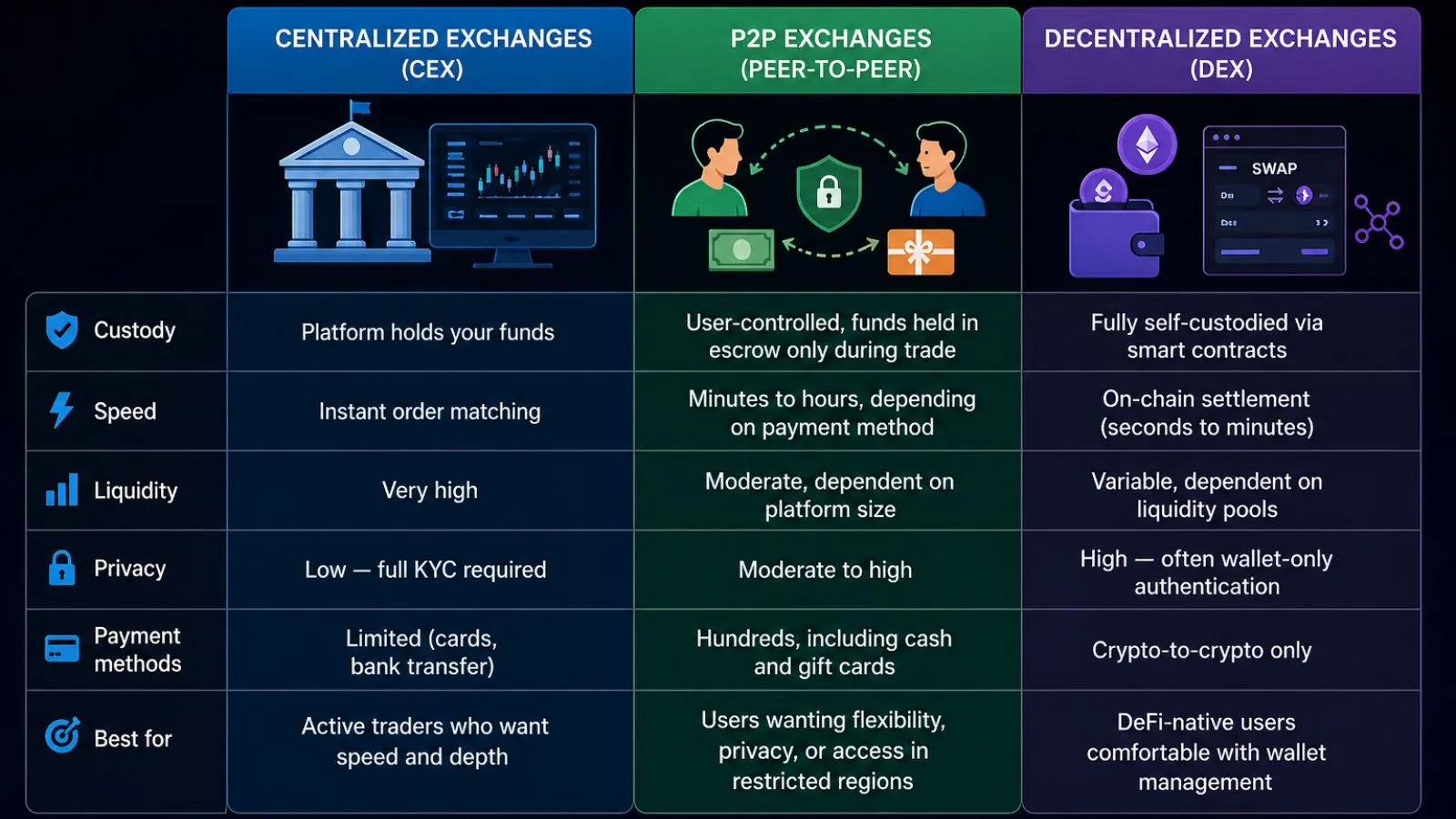
P2P Exchanges vs CEX vs DEX: A Comparison
Understanding where P2P exchanges sit in the broader ecosystem helps users and builders make informed choices.
Top Services Offered by P2P Exchange Development Companies
Most companies offering p2p crypto exchange development services provide a mix of the following:
- White-Label P2P Exchange Platforms
- Custom Exchange Development
- Escrow Smart Contract Development
- Mobile App for iOS & Android
- Crypto Wallet Integration
- Multi-language & Multi-currency Support
- DeFi and NFT Features (Add-ons)
Trends Shaping the Future of Peer-to-Peer Crypto Exchanges
In 2025, the following trends are defining how P2P crypto platforms are built and used:
- Layer-2 Blockchain Integration: Faster and cheaper transactions using Polygon, Arbitrum, and Optimism.
- Cross-Chain P2P Trading: Interoperability across Ethereum, BNB Chain, Solana, etc.
- AI Chatbots for Support: Reduce human involvement while improving user experience.
- Zero-Knowledge Proofs (ZKPs): Enhanced privacy and compliance.
- DeFi + P2P Hybrids: Lending, staking, and liquidity features within P2P platforms.
Startups working with an experienced p2p crypto exchange development company can implement these trends early for a future-proof business.
Conclusion
The shift toward decentralized and user-first trading is undeniable. P2P crypto exchanges empower users across borders, enable financial inclusion, and foster trustless ecosystems.
Whether you’re a blockchain startup, a crypto entrepreneur, or an investor, now is the time to explore cryptocurrency exchange development. By choosing the right p2p cryptocurrency exchange development company, you can ensure your platform is scalable, secure, and tailored for your target market.
FAQ
What is a P2P crypto exchange?
How does a P2P crypto exchange work?
What is the difference between a P2P exchange and a centralized exchange (CEX)?
What payment methods do P2P exchanges support?
How much does it cost to build a P2P crypto exchange?

Mr. Saddam Husen, (CTO)
Mr. Saddam Husen, CTO at Comfygen, is a renowned Blockchain expert and IT consultant with extensive experience in blockchain development, crypto wallets, DeFi, ICOs, and smart contracts. Passionate about digital transformation, he helps businesses harness blockchain technology’s potential, driving innovation and enhancing IT infrastructure for global success.