




The way people refuel their vehicles is changing fast. Instead of driving to a gas station, waiting in line, and dealing with bad weather, customers now expect fuel to come directly to them, right at their doorstep, office parking, or job site. This shift has turned fuel delivery app development into one of the most profitable opportunities in the on-demand economy.
The numbers tell the story clearly. According to market research, the global mobile fuel delivery market is projected to grow from USD 5.8 billion in 2026 to over USD 10 billion by 2035, expanding at a CAGR of more than 7%. In emerging markets like India, the on-demand fuel delivery sector is growing at over 23% annually. Whether you run a fuel distribution business, a logistics company, or you are a startup founder looking for a fresh idea, building a fuel delivery app can put your brand at the center of this booming industry.
In this complete guide, we will walk you through the top 10 benefits of building a fuel delivery app for your business in 2026, the features that drive success, and how to get started with the right mobile app development company.
What Is a Fuel Delivery App?
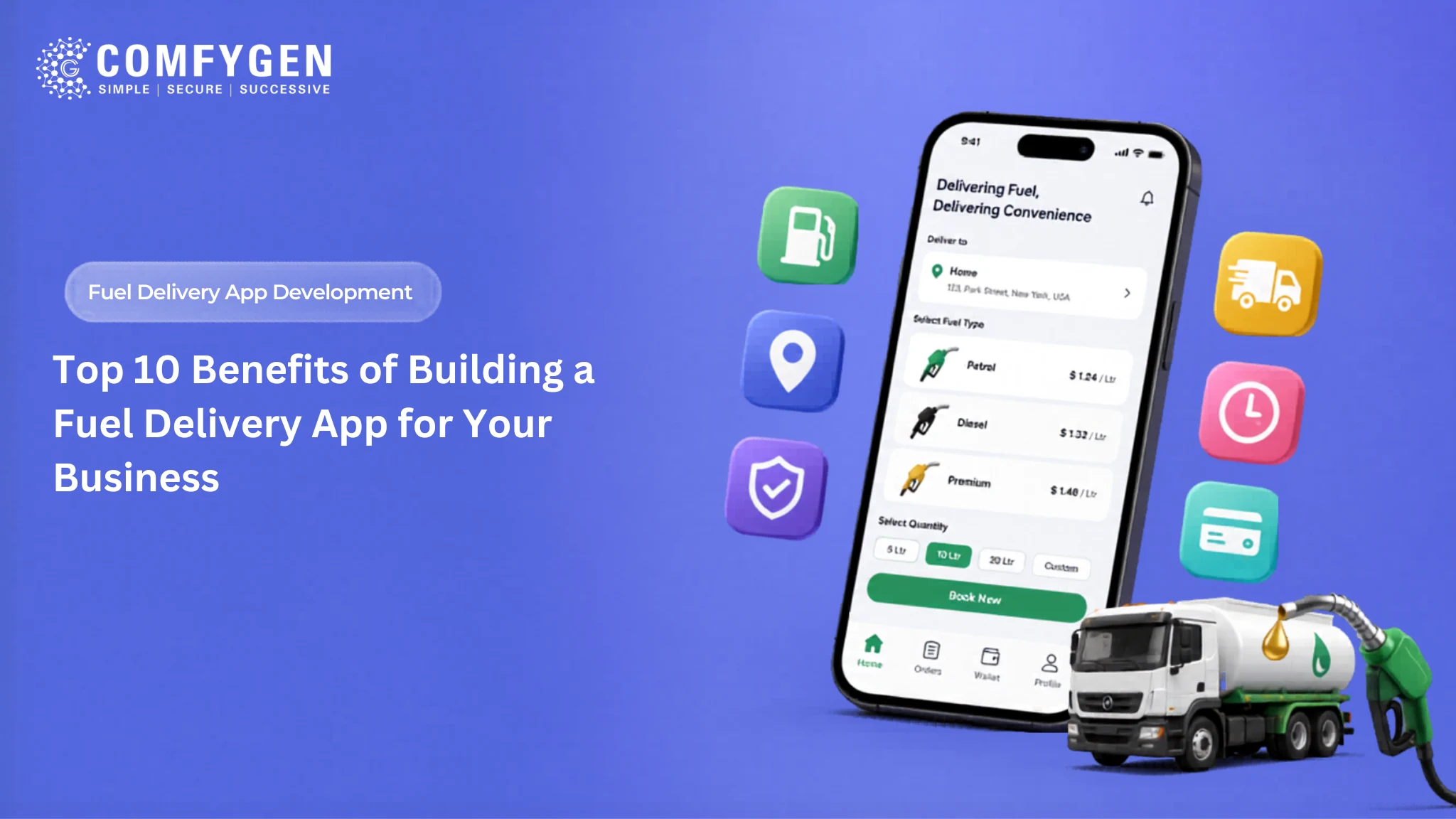
A fuel delivery app is an on-demand mobile application that lets customers order gasoline, diesel, CNG, or even alternative fuels directly to their location. Think of it as the “Uber for fuel.” Instead of driving to a gas station, the customer opens the app, selects fuel type and quantity, picks a delivery location, and a certified driver brings the fuel right to them.
The platform typically has three connected parts:
- Customer app – for placing orders, tracking deliveries, and paying.
- Driver app – for managing routes, deliveries, and dispatches.
- Admin dashboard – for the business to monitor orders, drivers, payments, and analytics.
Modern fuel delivery apps use GPS tracking, IoT-enabled tanks, real-time payments, and AI-driven route optimization to make every delivery safe, fast, and profitable. If you are exploring how on-demand models work across industries, you can compare it to similar models like grocery delivery app development, courier delivery app development, and logistics app development, all of which share the same core architecture of real-time order management, GPS dispatch, and digital payments.
Why Fuel Delivery Apps Are the Future
The on-demand economy reshaped food, groceries, transport, and now it is reshaping fuel. Three forces are driving this change:
- Customer expectations have shifted. Today’s consumers want everything delivered. According to industry research, around 74% of users prefer services that save them time, even at a slightly higher cost.
- Urban congestion is getting worse. People want to avoid traffic, queues, and the time wasted at gas stations.
- Businesses with large fleets need efficiency. Logistics, construction, and agriculture companies lose money every minute their vehicles sit idle at a fuel station. Data from the U.S. Energy Information Administration shows that U.S. motor gasoline consumption averaged nearly 8.9 million barrels per day in 2025, a massive market where any efficiency gain creates real value.
Top 10 Benefits of Building a Fuel Delivery App for Your Business
Let us look at the real, measurable benefits a fuel delivery app brings to your business.
1. Unmatched Convenience for Customers
Convenience is the number one reason on-demand apps exist. A fuel delivery app removes the entire friction of refueling. Customers do not need to leave their home, office, or work site. They simply place an order, and fuel comes to them.
For busy professionals, fleet managers, and people in remote locations, this is a game-changer. The app saves time, removes the stress of finding open stations late at night, and eliminates the discomfort of refueling in bad weather. For your business, that convenience translates directly into higher repeat usage and more orders per customer.
2. Strong Revenue Growth and New Income Streams
A fuel delivery app opens up multiple ways to make money. Unlike a traditional gas station that depends only on per-litre sales, your app can earn revenue through several models at once:
- Delivery fees are charged per order.
- Subscription plans for unlimited or priority deliveries (similar to the models popularized by industry leaders like Yoshi and Booster).
- B2B contracts with logistics companies, construction sites, and corporate fleets for bulk recurring orders.
- Commission models with partner fuel stations and oil distributors.
- In-app advertising for vehicle services, insurance, or maintenance products.
- Premium services like emergency refueling or after-hours delivery.
Many fuel delivery startups generate predictable, scalable income by combining two or three of these revenue streams. If you are building a long-term business, this diversification protects you from price fluctuations and seasonal dips. To see how revenue strategies vary by app complexity, check out our detailed guide on the cost to develop a fuel delivery app like CAFU.
3. Real-Time Tracking and Operational Transparency
GPS-based real-time tracking is one of the most loved features of any on-demand app. Customers can see exactly where their driver is, get an accurate ETA, and receive automatic notifications at every stage: order confirmed, dispatched, arriving, and completed.
For your business, real-time tracking is just as valuable. The admin dashboard gives you a live view of every delivery, every driver, and every vehicle. You can spot bottlenecks, reroute drivers, and respond to issues before customers even notice. This level of transparency builds trust with users and gives operations managers complete control over fleet performance.
If you want to see how real-time tracking transforms operations across delivery models, this is something we apply across all our delivery app development solutions at Comfygen, including quick commerce app development, where minute-level tracking is mission-critical.
4. Lower Operational and Infrastructure Costs
Running a traditional gas station is expensive. You need land, fuel storage tanks, dispensers, building maintenance, multiple employees per shift, and large utility bills. A fuel delivery app cuts most of those costs.
Instead of a fixed location, you operate with a fleet of certified fuel trucks. Digital order management replaces paperwork. Automated dispatch reduces manual coordination. Route optimization saves on fuel and labor costs. Some companies report up to a 40% reduction in admin and operational expenses after going digital.
This lower cost base means a much better margin per litre, which is why fuel delivery apps are becoming a preferred model for both startups and existing fuel businesses. For cost-conscious startups, our white-label mobile app development services let you launch with proven, ready-to-customize architecture and a much lower upfront investment.
5. Stronger Customer Loyalty and Retention
Once a customer experiences doorstep fuel delivery, going back to a gas station feels like a step backward. That stickiness is gold for your business.
Loyalty becomes even stronger when you add:
- Subscription plans that lock in repeat usage.
- Reward points and cashback for every order.
- Referral bonuses to grow through word of mouth.
- Personalized offers based on order history.
- Push notifications for fuel price drops and seasonal deals.
These engagement tools turn one-time users into long-term subscribers. The result is predictable monthly revenue and a strong customer base that competitors find hard to take away. To handle secure recurring payments, we typically integrate gateways like Stripe, Razorpay, and PayPal, covered in detail on our mobile banking app development page.
6. Wider Market Reach Beyond Gas Stations
A physical gas station can only serve customers within a few kilometers. A fuel delivery app removes that limit. You can serve any location your delivery vehicles can reach urban neighborhoods, remote villages, industrial zones, construction sites, large parking lots, event venues, and even agricultural fields.
This expanded reach is particularly powerful for emerging markets. In India, China, and Southeast Asia, millions of people live or work outside the convenient range of a modern fuel station. A fuel delivery app lets you tap that demand without building new physical infrastructure.
For businesses that already operate fuel stations, the app becomes a complementary channel that grows total sales without cannibalizing existing locations. The International Energy Agency reports that on-demand refueling continues to expand global energy access, especially in densely populated and underserved regions.
7. Data-Driven Business Decisions
Every order on a fuel delivery app generates valuable data customer location, fuel type, order size, delivery time, payment method, frequency, and seasonal patterns. Over time, this creates a clear picture of how your business actually performs.
Using analytics and AI, you can:
- Forecast demand by area and time of day.
- Plan driver schedules and inventory more accurately.
- Identify your most valuable customer segments.
- Detect underperforming routes or drivers.
- Run targeted marketing campaigns instead of guessing.
- Set dynamic pricing based on demand patterns.
8. Improved Safety and Compliance
Fuel is a hazardous product, and safety is non-negotiable. A modern fuel delivery app actually improves safety compared to traditional refueling because every step is monitored, logged, and certified.
Key safety advantages include:
- IoT-sealed tanks that prevent tampering and adulteration.
- Geofencing that restricts dispensing to authorized zones.
- Digital invoices for every drop delivered.
- Driver verification and background checks are built into the platform.
- Automatic compliance logs for regulators and authorities.
9. Eco-Friendly and Sustainable Operations
Sustainability is no longer optional; customers and regulators expect it. A fuel delivery app is greener than it might first appear, because it reduces unnecessary travel by thousands of individual vehicles driving to gas stations.
With AI-powered route optimization, one delivery truck can refuel dozens of vehicles on a single trip, cutting overall fuel consumption and emissions per litre delivered. Smart inventory management reduces wastage at the source. And as the industry moves forward, many fuel delivery platforms are now adding biodiesel, renewable diesel, and even EV charging to their offerings, supporting global goals laid out under the UN Sustainable Development Goals and the European Green Deal.
This positions your brand as forward-thinking and environmentally responsible, an important advantage when corporate clients are looking for ESG-aligned partners.
10. Strong Competitive Edge in an Emerging Market
Most industries are saturated. Fuel delivery is not. In many regions, there are still very few established players. Building a fuel delivery app now gives you a chance to capture market share before the space gets crowded.
Early movers in on-demand industries, Uber in transport, Zomato in food, Urban Company in home services, built brand recognition that competitors are still struggling to overcome years later. The same first-mover advantage is available right now in fuel delivery.
With the right technology partner, a smart MVP strategy, and a clear go-to-market plan, your business can become a recognized name in the fuel delivery space within a single growth cycle. If you do not have an in-house tech team, you can hire dedicated mobile app developers from Comfygen and get a full delivery team without the overhead.
The tools and resources invested in the project, as well as the time required to complete it, also determine the final cost of telemedicine app development. Above are the pricing models that affect client companies’ telemedicine app development costs.
Ready to Build Your Fuel Delivery App?
Turn your fuel delivery business into a smart, on-demand platform with real-time tracking, secure payments, and seamless fuel management solutions.
Get a Consultation Today
How Much Does It Cost to Build a Fuel Delivery App?
The cost of building a fuel delivery app depends on several factors, such as features, platforms, design, technology stack, team size, and region.
Here is a rough range for 2026:
- White-label fuel delivery app: USD 5,000 – USD 40,000. Fastest to launch, with proven features and customizable branding. Best for startups and MVPs.
- Custom fuel delivery app (basic to mid-level): USD 20,000 – USD 60,000. Tailored UI/UX, custom features, and full ownership of the codebase.
- Custom fuel delivery app (advanced and enterprise-grade): USD 60,000 – USD 1,50,000+. Includes AI, IoT integration, blockchain, multi-region support, and enterprise security.
What to Consider Before Building Your Fuel Delivery App
Realizing these benefits depends on building the right product. Several factors deserve careful planning. First, regulatory compliance is non-negotiable. Transporting and dispensing fuel requires permits, certified drivers, and trucks engineered for hazardous materials. Your technology platform must support documentation, audit trails, and safety workflows from day one.
Second, the technology stack must be robust. Real-time tracking, route optimization, dispatch automation, payment integration, IoT-enabled meters, and analytics all need to work together seamlessly. Cutting corners in any layer creates operational headaches that compound at scale. Third, the user experience matters as much as the backend. Customers compare your app to Uber and DoorDash, not other fuel companies, so polish, speed, and reliability are baseline expectations.
Finally, choose a development partner with proven expertise in on-demand logistics platforms. The complexity of fuel delivery, combining mobile apps, geospatial systems, payment processing, regulatory compliance, and real-time operations, is significant. Building it right the first time saves years of rework later.
Why Choose Comfygen for Fuel Delivery App Development
Comfygen Technologies is a trusted mobile app development company, with more than a decade of experience building secure, scalable, and high-performing on-demand applications. Our team has delivered successful apps across logistics, fintech, healthcare, e-commerce, and on-demand industries, and fuel delivery app development is one of our specialty areas.
When you build your fuel delivery app with Comfygen, you get:
- A fully customized solution built around your business model, not a one-size-fits-all template.
- Powerful AI, IoT, and analytics integrations that future-proof your platform.
- Real-time GPS tracking, automated dispatch, and secure payment gateways.
- White-label and custom development options to match your timeline and budget.
- A skilled team of dedicated mobile app developers covering Android, iOS, and cross-platform builds.
- Strong UI/UX design that drives conversions and retention.
- Cross-domain experience across delivery app development, logistics, quick commerce, courier, healthcare, and fintech.
- End-to-end support from idea validation to launch, scaling, and maintenance.
- 300+ global clients served with a 95% satisfaction rate.
Conclusion
Building a fuel delivery app offers a rare combination of strong market demand, multiple revenue streams, operational leverage, and long-term strategic positioning. From tapping a fast-growing on-demand category and solving real customer pain points to building a technology moat, capturing the fleet management opportunity, and future-proofing your business for the energy transition, the benefits stretch across every dimension that matters to a modern business.
The fuel delivery revolution is no longer a question of if; it’s a question of who. The brands that move now, with the right strategy and the right technology partner, will define how the world refuels in the decade ahead. Whether you’re exploring the opportunity for the first time or planning to scale an existing platform, the path forward starts with building a product that customers love and that operations can sustain. Partner with Comfygen Technologies to bring your fuel delivery app to life and position your business at the front of one of the most exciting categories in the on-demand economy.
Frequently Asked Questions
Is building a fuel delivery app a good business in 2026?
How long does it take to build a fuel delivery app?
What is the best revenue model for a fuel delivery app?
Do I need physical fuel infrastructure to launch?
Is fuel delivery legal in my country?
Which technology stack is best for a fuel delivery app?

Mr. Saddam Husen, (CTO)
Mr. Saddam Husen, CTO at Comfygen, is a renowned Blockchain expert and IT consultant with extensive experience in blockchain development, crypto wallets, DeFi, ICOs, and smart contracts. Passionate about digital transformation, he helps businesses harness blockchain technology’s potential, driving innovation and enhancing IT infrastructure for global success.