




Logistics app development cost ranges from $18,000 to $350,000+ in 2026. A single-workflow MVP such as a driver app with proof of delivery runs $18,000 to $35,000. A working platform with customer, driver and admin panels costs $35,000 to $70,000. Add route optimization, multi-carrier APIs and analytics and you’re at $70,000 to $150,000. Enterprise builds with AI routing, ERP integration and fleet management start at $150,000.
The number moves on five things: how many user panels you launch with, how many outside systems you connect to, whether routing is rule-based or AI-driven, which platforms you ship on, and where your team sits.
This guide breaks each one down with real numbers.
How Much Does Logistics App Development Cost by Complexity?
Most quotes fall into four bands. Pick the row that matches what you actually need on day one, not what you want in year three.
| Build level | What it includes | Cost (USD) | Timeline |
| Single-workflow MVP | One panel only. A driver app with proof of delivery, or a dispatcher console for one depot | $18,000 – $35,000 | 2 – 3 months |
| Basic logistics app | Customer tracking, driver app, admin panel, live GPS, scheduling, payments | $35,000 – $70,000 | 3 – 5 months |
| Mid-level platform | Route optimization, multi-carrier APIs, analytics dashboard, multi-depot support | $70,000 – $150,000 | 5 – 8 months |
| Enterprise / TMS-grade | AI routing, predictive analytics, ERP and WMS integration, fleet telematics, compliance | $150,000 – $350,000+ | 9 – 18 months |
These are planning ranges for scoping a budget, not fixed quotes. Two apps with identical screens can differ by $40,000 once you count the integrations behind them.
What Does Each User Panel Cost to Build?
A logistics product is rarely one app. Every panel you launch with is a separate build, and this is where budgets quietly double. If you’re comparing vendors, ask which panels their quote actually covers.
| Panel | Who uses it | Cost (USD) |
| Customer tracking link (web) | End recipients | $2,000 – $5,000 |
| Customer mobile app | B2C senders, repeat shippers | $8,000 – $18,000 |
| Driver app | Drivers and delivery staff | $10,000 – $22,000 |
| Dispatcher console | Operations and dispatch teams | $14,000 – $35,000 |
| Fleet manager dashboard | Fleet and maintenance leads | $10,000 – $25,000 |
| Backend and API layer | Everything above | $15,000 – $45,000 |
One thing most businesses get wrong here: most of your customers don’t want an app. They want a tracking link. Shipping a web tracking page instead of a customer app saves $6,000 to $13,000 and usually gets used more. The same logic applies when you’re scoping a courier delivery app, where recipients rarely install anything.
Which Features Increase Logistics App Development Cost the Most?
Feature scope drives the biggest swings. Here’s what each one adds on top of the base build.
| Feature | Cost to build (USD) | Notes |
| Real-time GPS tracking | $6,000 – $14,000 | Ongoing map API cost sits on top |
| Proof of delivery (photo, signature, OTP) | $3,000 – $6,000 | Cheapest high-value feature in logistics |
| Offline mode for drivers | $5,000 – $11,000 | Needed for rural and basement deliveries |
| Rule-based route optimization | $8,000 – $15,000 | Fixed rules, no learning |
| AI route optimization | $20,000 – $45,000 | Needs historical data and tuning cycles |
| Automated dispatch and assignment | $12,000 – $28,000 | Replaces manual allocation calls |
| Multi-carrier API aggregation | $10,000 – $25,000 | Price scales with carrier count, not screens |
| Warehouse and inventory module | $12,000 – $30,000 | Pushes you toward WMS territory |
| Fleet management with telematics | $15,000 – $35,000 | Hardware and device licensing are separate |
| Predictive analytics dashboard | $18,000 – $45,000 | Demand forecasting, delay prediction |
| Payments with COD reconciliation | $5,000 – $12,000 | Reconciliation is the expensive half |
Integrations cost more than screens, and they’re invisible in a wireframe. A dispatch screen looks simple in a mockup. Wiring it to three carrier APIs, an ERP and a payment gateway is where the hours go. Adding AI-driven routing and forecasting typically lifts a build budget by 25% to 40%.
How Much Do Different Types of Logistics Apps Cost?
Product type matters as much as complexity. These ranges overlap because the same label covers very different scopes.
| App type | What it does | Cost (USD) |
| Last-mile delivery app | Assigns, tracks and proves local deliveries | $30,000 – $80,000 |
| Courier and parcel app | Booking, pickup, hub scanning, delivery | $35,000 – $90,000 |
| Fleet management app | Vehicle health, driver behaviour, fuel, maintenance | $45,000 – $120,000 |
| Freight matching platform | Connects shippers with carriers, bidding, contracts | $70,000 – $180,000 |
| Warehouse management system | Inbound, picking, putaway, stock, barcode and RFID | $60,000 – $200,000 |
| Transportation management system | Multi-mode planning, rating, settlement, compliance | $100,000 – $350,000+ |
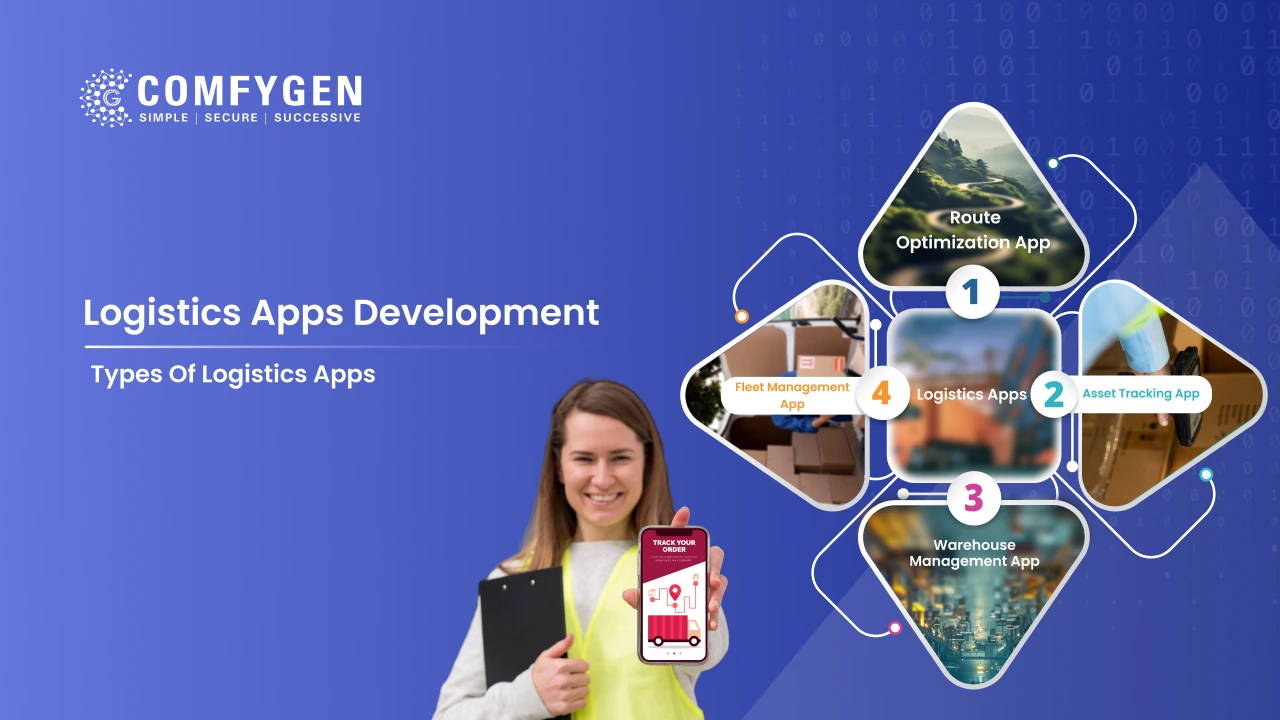
Each of these is a different build, which is why types of logistics apps are worth settling before you ask anyone for a number. Businesses running fast local drops often find their requirement sits closer to quick commerce than to freight.
What Does Logistics App Development Cost at Each Stage?
Budgets get approved stage by stage, so it helps to see where the money and the months actually go.
| Stage | Cost (USD) | Time | What happens |
| Discovery and scoping | $3,000 – $8,000 | 2 – 3 weeks | Workflow mapping, requirement freeze, prototype |
| UI/UX design | $6,000 – $18,000 | 3 – 5 weeks | Wireframes, dispatcher and driver screens, testing |
| Development | $25,000 – $200,000 | 3 – 7 months | Frontend, backend, database, API integrations |
| QA and testing | $5,000 – $20,000 | Runs parallel + 2 – 4 weeks | Load testing, GPS accuracy, offline behaviour |
| Deployment and launch | $3,000 – $8,000 | 1 – 2 weeks | Store submission, server setup, monitoring |
| Maintenance | 15% – 20% of build per year | Ongoing | Fixes, OS updates, security patches |
Skipping discovery is the most expensive saving in this table. Requirements that surface in month four cost three to five times what they’d cost in week two, because the architecture is already built around the old assumption.
Quick estimate formula:
Total = (hourly rate × hours per stage) + annual maintenance + third-party running costs
At $40 an hour with a 900-hour development stage, that phase alone is $36,000.
Planning a Logistics App? Know the Cost Before You Start
Get a realistic estimate for your logistics app based on features, platform, integrations, and business requirements before investing your money.
Get a Cost Estimate
How Much Does a Logistics App Cost in India?
India is the lowest-cost mature market for this work, at $25 to $50 an hour against $120 to $250 in North America. Same scope, 60% to 75% less.
| Build level | USD | INR (approx.) |
| Single-workflow MVP | $18,000 – $35,000 | ₹15 lakh – ₹31 lakh |
| Basic logistics app | $35,000 – $70,000 | ₹31 lakh – ₹62 lakh |
| Mid-level platform | $70,000 – $150,000 | ₹62 lakh – ₹1.3 crore |
| Enterprise / TMS-grade | $150,000 – $350,000+ | ₹1.3 crore – ₹3.1 crore+ |
Logistics App Development Cost by Region
| Region | Hourly rate | What you’re paying for |
| North America | $120 – $250 | Same timezone, highest rates |
| Western Europe | $90 – $180 | Strong compliance and GDPR depth |
| Eastern Europe | $45 – $95 | Good balance of cost and seniority |
| India | $25 – $50 | Deepest pool of logistics and delivery engineers |
Rate isn’t the real variable. A cheaper team that hasn’t built dispatch logic before will burn the savings on rework. Ask any vendor for a live tracking system they’ve shipped and the fleet size it handles.
What Does It Cost to Run a Logistics App After Launch?
This is the part most budgets miss. Running costs are recurring, and for a logistics app they’re higher than for most product categories because every shipment generates billable API events.
| Running cost | Annual cost (USD) |
| Maintenance and updates | 15% – 20% of build cost |
| Cloud hosting | $3,000 – $18,000 |
| Maps, routing and geocoding APIs | $2,000 – $15,000 |
| SMS and push notifications | $1,200 – $6,000 |
| Compliance and security audits | $8,000 – $30,000 |
| App Store and Play Store | $124 (first year) |
| Telematics or ELD device licensing | $15 – $40 per vehicle per month |
Map and routing costs deserve a closer look because they scale with delivery volume, not with users. Google’s published rates put Routes Compute Routes Essentials at $5.00 per 1,000 requests on the first tier, with the Enterprise tier at $15.00 per 1,000. A fleet doing 2,000 optimized route calls a day crosses the free allowance in the first week of every month. Teams that cut this bill usually do it by batching route calculations, caching geocoded addresses, and handing drivers off to the Google Maps app rather than building in-app navigation.
Payment gateway fees are separate again, typically 1.5% to 3% per transaction.
How Can You Reduce Logistics App Development Cost?
Budget overruns don’t come from one bad decision. They come from a feature added in a meeting, then a timeline that slips a week, then another.
| Strategy | Typical saving |
| Launch a single-workflow MVP first | 30% – 50% |
| Cut features that don’t change daily operations | 20% – 40% |
| Build cross-platform instead of two native apps | 25% – 40% |
| Use pre-built integrations over custom API work | 15% – 30% |
| Cloud infrastructure that scales with volume | 15% – 30% |
| Hire in a lower-rate region with logistics experience | 50% – 70% |
Cross-platform is usually the right call here. React Native and Flutter both handle GPS, background location and offline sync well enough for driver apps, and one codebase means one update cycle instead of two. Native still wins if you’re running continuous high-frequency location tracking across a large fleet, where battery behaviour matters more than build cost.
The sharpest saving is sequencing. Ship the driver app first, run it for six weeks with real drivers, then build the dispatcher console around what actually broke. Teams that build all three panels before anyone uses one usually rebuild two of them.
Is Custom Logistics Software Cheaper Than Off-the-Shelf?
Not at first. Off-the-shelf tools start at $20 to $80 per user per month with no build cost. Custom starts at $18,000.
The crossover usually arrives in year two or three. Fifty users on a $50 per-user platform is $30,000 a year, every year, with licence increases and no control over the roadmap. A $60,000 custom build with $10,000 annual maintenance passes that total around month 30, and after that the gap widens every year.
Custom wins earlier when your workflow doesn’t fit a template. Cold chain rules, multi-leg transfers, cash-on-delivery reconciliation, and carrier contracts with per-lane pricing are the usual reasons teams give up on off-the-shelf. If your operation runs on spreadsheet workarounds beside the software you already pay for, that’s the signal. You can see where that logic lands for other delivery categories in the broader picture of general delivery app costs.
What Hidden Costs Should You Plan For?
Six that catch most first-time buyers:
- Carrier API onboarding. Each carrier has its own certification process. Budget two to six weeks per carrier, not two days.
- Driver training and rollout. Software that drivers don’t use is a total loss. Budget $2,000 to $8,000 for rollout support.
- Data migration. Moving shipment history out of an old system runs $3,000 to $15,000 depending on how clean the data is.
- Peak-season load testing. Festive and end-of-quarter spikes break systems that passed normal testing. Another $4,000 to $12,000.
- Store rejection cycles. Background location permissions are a common rejection trigger. Build in two weeks.
- Second-year licence renewals. Telematics, mapping tiers and SMS rates all step up once volume grows.
How Long Does It Take to Build a Logistics App?
Two to three months for a single-workflow MVP. Three to five months for a working platform with three panels. Nine to eighteen months for an enterprise TMS.
Integration count drives the schedule more than feature count. An app with twelve screens and one API ships faster than one with six screens and five APIs. If a vendor quotes you an enterprise platform in four months, ask which integrations they’ve excluded.
Let’s Talk About Your Logistics App
Whether you need a delivery app or a complete logistics platform, let’s discuss your requirements and work out the development cost.
Start a Conversation
How Should You Estimate Your Budget Before Hiring a Vendor?
Work through five questions before you ask for a quote, and the quotes you get back will be comparable:
- Which panels do you need in version one, and which can wait?
- How many outside systems must it talk to on day one?
- Is routing rule-based or does it need to learn from history?
- How many vehicles and shipments a day at peak, not average?
- What’s your running budget for year two, separate from the build?
Take those answers to three vendors. If the quotes come back more than 40% apart, the scope wasn’t clear enough, not the pricing.
Building Your Logistics App with Comfygen
Comfygen has been building delivery and logistics software since 2019, with 550+ projects delivered for 400+ clients across 30+ countries and a 97% client retention rate. The team ships dispatch consoles, driver apps and live tracking systems that run under real fleet load, not just in demos.
Work ranges from a focused driver app for a single depot through to a custom logistics platform build with AI routing and ERP integration. Related delivery work covers delivery app development and delivery management software for teams managing their own fleets.
Every engagement starts with a scoping session that produces a fixed feature list and a cost band before anyone writes code. That’s the step that keeps the final invoice close to the first estimate.
Frequently Asked Questions
How much does logistics app development cost in 2026?
What is the average cost to develop a logistics app in India?
What factors affect logistics app development cost?
How much does it cost to build a logistics app with GPS tracking?
How much does a fleet management app cost to develop?
How much does a logistics app cost with customer, driver and admin panels?
How much does it cost to maintain a logistics app after launch?
How long does it take to develop a logistics management app?
What's the cost difference between a logistics MVP and a full platform?
How much does AI route optimization add to logistics app development cost?
How can businesses reduce logistics app development costs?

Mr. Saddam Husen, (CTO)
Mr. Saddam Husen, CTO at Comfygen, is a renowned Blockchain expert and IT consultant with extensive experience in blockchain development, crypto wallets, DeFi, ICOs, and smart contracts. Passionate about digital transformation, he helps businesses harness blockchain technology’s potential, driving innovation and enhancing IT infrastructure for global success.