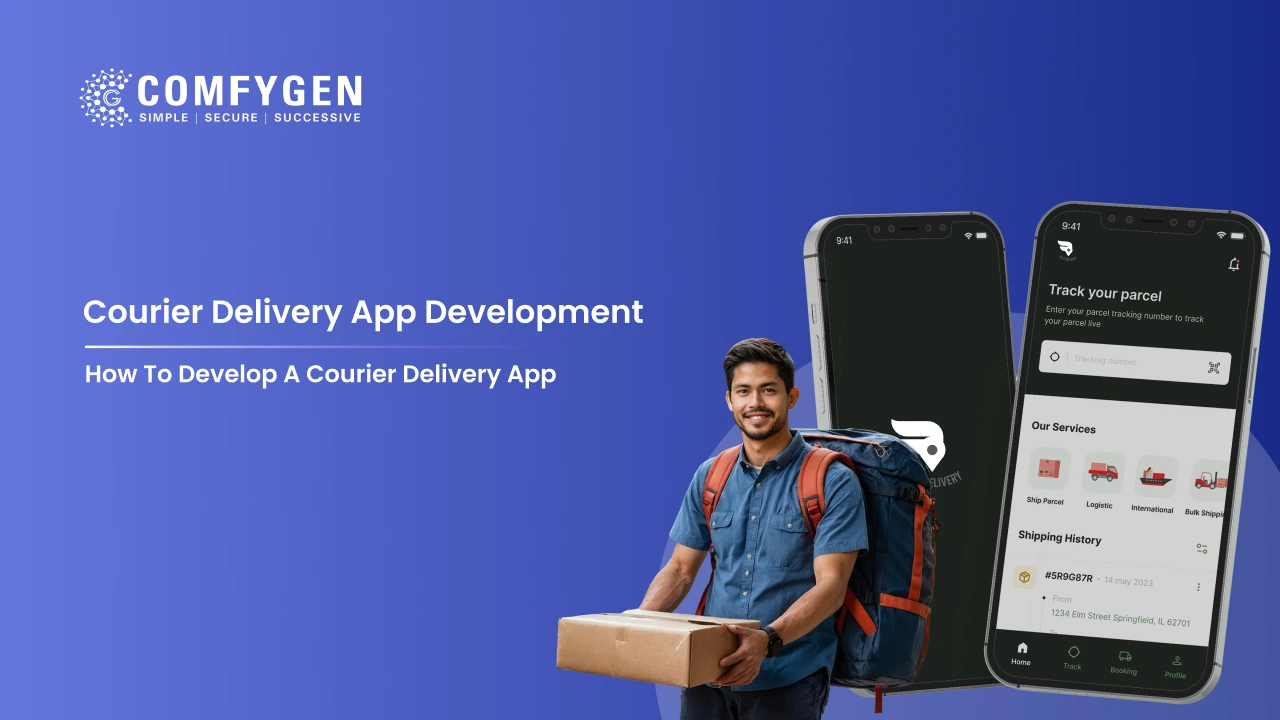





The rapid growth of e-commerce, rising same-day delivery expectations, and digital transformation in logistics have significantly increased the demand to develop a courier delivery app for modern businesses. Companies looking to streamline parcel booking, real-time tracking, automated dispatching, and last-mile delivery management are investing in advanced logistics solutions to stay competitive. When you develop a courier delivery app, you create a centralized digital platform that connects customers, delivery agents, and administrators, improving operational efficiency and customer satisfaction. In today’s on-demand economy, businesses that develop a courier delivery app with features like GPS tracking, route optimization, and secure payment integration gain a strong competitive advantage in the fast-growing logistics and parcel delivery market.
In this guide, we explain how to develop a courier delivery app step by step. You’ll learn what a courier delivery app is, the development process, top courier apps and their features, estimated development costs, the technology stack, and common challenges to plan for before building your app.
What Is a Courier Delivery App?
A courier delivery app is a mobile or web-based platform that allows users to send and receive packages digitally. Customers can book a pickup, track parcels in real time, make payments, and receive delivery updates without phone calls or manual coordination.
The app connects three key users: customers who place delivery requests, delivery partners who complete orders, and admins who manage operations. When a customer creates an order, the system calculates distance and cost, assigns the nearest available driver, and tracks the delivery using GPS. Status updates, notifications, and payments happen automatically.
Instant Courier Delivery Apps in India, USA, and UAE
| Country | App Name | Delivery Speed |
|---|---|---|
| India | Porter | Instant / Same-day |
| USA | Uber Parcel Delivery | Same-day / Instant |
| USA | Roadie Delivery Network | Same-day |
| UAE | Careem Parcel Service | Same-day |
| UAE | Quiqup Express | Same-day |
| UAE | Jeebly Express | Same-day |
Most courier delivery apps include three core components.
- The customer app is used for booking deliveries, tracking shipments, and making payments.
- The delivery partner app helps drivers manage orders, routes, and delivery status.
- The admin dashboard allows businesses to monitor deliveries, manage drivers, handle payments, and view reports.
Market Overview & Industry Statistics
The courier and logistics industry is expanding rapidly due to the rise of e-commerce and increasing demand for faster delivery services. Key market insights include:
-
The global courier delivery market was valued at USD 584.1 billion in 2023 and is expected to reach USD 817.3 billion by 2028, showing strong industry growth.
-
The growth of online shopping and direct-to-consumer (D2C) brands is increasing parcel shipment volumes and driving demand for advanced courier solutions.
-
The same-day delivery market reached USD 8.3 billion in 2024 and is projected to grow to USD 27.9 billion by 2033, driven by rising consumer expectations for faster delivery.
-
The last-mile delivery market was valued at USD 145.59 billion in 2023 and is expected to reach USD 318.83 billion by 2032, as businesses focus on improving delivery speed and customer experience.
-
Increasing smartphone adoption and mobile app usage are accelerating the demand for digital logistics and courier delivery app development solutions.
-
The Asia-Pacific region is one of the fastest-growing courier markets due to expanding e-commerce platforms and urbanization trends.
Types of Courier Delivery Apps
When businesses plan to develop a courier delivery app, understanding the different types of courier applications is essential. The type of courier delivery apps you choose depends on your target audience, delivery model, and business goals. Below are the major types of courier delivery apps in the logistics industry:
1. B2B Courier Delivery Apps
B2B (Business-to-Business) courier apps are designed for companies that handle bulk shipments, supply chain logistics, and intercity or international deliveries. These apps include features like fleet management, warehouse integration, automated invoicing, and shipment tracking dashboards. Businesses that want to develop a courier delivery app for manufacturers, wholesalers, or distributors often choose the B2B model.
2. B2C Parcel Delivery Apps
B2C (Business-to-Consumer) courier apps focus on delivering parcels directly to customers. These apps are commonly used by e-commerce companies and retail brands. Key features include real-time tracking, secure payment gateways, delivery scheduling, and instant notifications. If your goal is to serve online shoppers, you should develop a courier delivery app tailored for B2C operations.
3. On-Demand Courier Apps
On-demand courier apps allow users to book instant deliveries similar to ride-hailing services. Customers can request pickup and delivery anytime, making this model ideal for urgent shipments. Startups looking to enter the hyper-competitive logistics market often develop a courier delivery app with on-demand functionality to meet fast delivery expectations.
4. Hyperlocal Delivery Apps
Hyperlocal courier apps focus on short-distance deliveries within a specific city or area. These are widely used for grocery, pharmacy, food, and local store deliveries. Businesses that want to capture the last-mile market often develop a courier delivery app with hyperlocal delivery features such as GPS tracking and route optimization.
5. Enterprise Logistics Management Apps
Enterprise-level courier apps are built for large logistics companies that manage extensive fleets, warehouses, and global shipments. These solutions include advanced analytics, AI-powered route optimization, inventory management, and multi-branch control systems. Large enterprises typically develop a courier delivery app to streamline operations and improve efficiency at scale.
Step-by-Step Process to Develop a Courier Delivery App
The courier delivery app development process is not just about design and code. It’s about creating a system that runs fast, scales smoothly, and stays reliable under pressure. Let’s break the process down step by step.
Step 1: Define Business Goals and App Requirements
First, decide which type of delivery service you will provide before developing a courier delivery app: on-demand, scheduled, or hyperlocal. Identify your target users, service area, pricing logic, and core features. This step sets the foundation for everything that follows.
Step 2: Choose the Right Business Model
Finalize how the app will generate revenue. This could include delivery fees, subscription plans, commissions from partners, or enterprise contracts. Your business model directly impacts features, user flow, and development cost.
Step 3: Plan App Features and User Flow
List essential features for the customer app, delivery partner app, and admin panel. Map the complete user journey from order placement to delivery confirmation. Clean user flow reduces drop-offs and operational errors.
Step 4: Design UI and UX
Design simple, fast, and intuitive interfaces. Customers should book a delivery in seconds. Drivers should access routes and orders without confusion. Good UX improves adoption and retention on both sides.
Step 5: Select the Technology Stack
Choose scalable technologies for mobile apps, backend, databases, APIs, and cloud hosting. The right tech stack ensures performance, security, and easy future upgrades.
Step 6: App Development and Integration
Develop the customer app, delivery partner app, and admin dashboard in parallel. Integrate key services like GPS tracking, payment gateways, push notifications, maps, and route optimization.
Step 7: Testing and Quality Assurance
Test the app for performance, security, usability, and real-world delivery scenarios. Fix bugs, optimize speed, and ensure the app performs well during peak usage.
Step 8: Deployment and Launch
Deploy the app on Android, iOS, and web platforms. Set up servers, monitoring tools, and backup systems. Launch with a controlled rollout to catch issues early.
Step 9: Maintenance and Scaling
After launch, track performance, user feedback, and delivery metrics. Add new features, improve automation, and scale infrastructure as demand grows.
Ready to build a courier delivery app??
Talk to our app development experts and get a clear cost estimate today.
Best Courier Delivery Apps and Their Development Cost
If you want to understand what a successful courier delivery app looks like and how much it costs to build one, the fastest way is to study the market leaders. These apps set user expectations for speed, tracking accuracy, pricing transparency, and overall experience. Below are some of the best courier delivery apps, their core features, and the estimated cost to develop a courier delivery app similar to others with comparable functionality.
1. Uber Freight
Uber Freight is a technology-driven logistics platform focused on freight and large-scale courier operations. It connects shippers with carriers through real-time matching and automation.
Key Features:
- Real-time shipment tracking with GPS
- Smart route optimization and load matching
- Digital documentation and automated invoicing
- Transparent pricing and instant booking
Estimated Cost to Build a Similar App:
- ₹1.5 Cr – ₹3 Cr
- $180,000 – $350,000
2. DHL Express App
The DHL Express app is designed for international courier and logistics operations, offering end-to-end shipment visibility and documentation support.
Key Features:
- Live shipment tracking across regions
- Customs documentation and duty calculation
- Delivery status alerts and notifications
- Shipment history and proof of delivery
Estimated Cost to Build a Similar App:
- ₹1 Cr – ₹2.5 Cr
- $120,000 – $300,000
3. Delhivery App
Delhivery is one of the most popular courier delivery apps in India, known for hyperlocal, regional, and nationwide delivery services.
Key Features:
- Hyperlocal and pan-India delivery management
- Cash on delivery and prepaid payment options
- Real-time order tracking and notifications
- Admin analytics dashboard for performance insights
Estimated Cost to Build a Similar App:
- ₹80 Lakh – ₹1.8 Cr
- $100,000 – $220,000
4 FedEx Mobile App
The FedEx mobile app focuses on enterprise-grade logistics, shipment control, and operational reliability.
Key Features:
- Barcode and package scanning
- Digital proof of delivery
- Multi-language and multi-region support
- Advanced shipment management tools
Estimated Cost to Build a Similar App:
- ₹1.2 Cr – ₹2.8 Cr
- $150,000 – $320,000
5. Porter App
Porter is a leading on-demand courier and intracity delivery app, especially popular for last-mile and same-day deliveries.
Key Features:
- Instant vehicle and driver booking
- Live driver and order tracking
- Transparent pricing based on distance and load
- In-app communication between the customer and the driver
Estimated Cost to develop a courier delivery app like Peter:
- ₹60 Lakh – ₹1.5 Cr
- $80,000 – $180,000
Tech Stack Used in Courier Delivery App Development
Choosing the right technology stack is not a technical decision alone. It directly impacts app performance, scalability, security, and long-term maintenance cost. A courier delivery app handles real-time tracking, live data sync, payments, and high user traffic. That means the tech stack must be fast, stable, and flexible enough to grow with the business.
Tech Stack for Courier Delivery App Development
| App Layer | Technologies Used | Purpose |
| Frontend | React Native, Flutter | Cross-platform mobile app development for Android and iOS |
| Backend | Node.js, Python, Laravel | Business logic, real-time order management, driver assignment |
| Database | MongoDB, PostgreSQL | Store orders, users, payments, and live tracking data |
| Maps & Navigation | Google Maps, Mapbox | Route optimization and real-time location tracking |
| Payments | Stripe, Razorpay, PayPal | Secure online payments and transactions |
| Notifications | Firebase, Twilio | Push notifications, SMS alerts, OTP verification |
| Cloud Hosting | AWS, Google Cloud | Scalable infrastructure and server management |
| DevOps | CI/CD Pipelines | Automated deployment, testing, and app updates |
Key Features Every Courier Delivery App Must Have
When building a courier delivery app, success doesn’t come from packing in every possible feature. It comes from getting the essentials right—features that directly impact user experience, operational efficiency, and business growth. Here’s a breakdown of the key features every courier delivery app must include:
1. Customer App Features
When businesses develop a courier delivery app, the customer interface must be simple, fast, and reliable.
-
User Registration & Profile Management
Allows customers to sign up via email, phone number, or social login and manage personal details, addresses, and preferences. -
Real-Time Shipment Tracking
Enables users to track parcels live using GPS integration, increasing transparency and trust. -
Multiple Payment Integration
Supports various payment methods such as credit/debit cards, UPI, net banking, digital wallets, and cash on delivery. -
Delivery Scheduling
Let customers choose preferred pickup and delivery time slots for convenience. -
Push Notifications
Sends instant updates about order confirmation, dispatch status, estimated arrival time, and successful delivery. -
Order History
Provides access to past shipments, invoices, and delivery details for easy reference and repeat bookings.
2. Delivery Agent App Features
A delivery partner app is crucial when you develop a courier delivery app focused on efficient last-mile operations.
-
Easy Login & Verification
Secure login with OTP or biometric authentication ensures verified driver access. -
Route Optimization & Navigation
Integrated GPS and AI-based route planning reduce delivery time and fuel costs. -
Order Management Dashboard
Allows drivers to accept, reject, and manage assigned deliveries efficiently. -
Earnings & Incentives Tracking
Displays completed deliveries, daily earnings, bonuses, and performance incentives. -
Availability Toggle
Drivers can switch between online/offline modes based on availability.
3. Admin Panel Features
The admin panel acts as the control center when businesses develop a courier delivery app.
-
User & Driver Management
Manage customer accounts, approve drivers, and monitor performance. -
Order & Shipment Monitoring
Track all deliveries in real time with centralized dashboards. -
Analytics & Reports
Generate reports on revenue, delivery performance, peak hours, and operational efficiency. -
Commission Management
Set commission structures, pricing rules, and driver payouts. -
Customer Support Management
Handle complaints, refunds, disputes, and support tickets efficiently.
Challenges in Courier Delivery App Development
Developing a Courier Delivery App looks straightforward on the surface. Book a delivery, assign a driver, track the parcel. In reality, this is where most products struggle. The challenges are operational, technical, and scale-related. Ignoring them early leads to delays, poor user experience, and rising costs later.
- Real-Time Tracking Accuracy
Live tracking is essential but tricky. GPS drift, poor connectivity, and delayed updates can reduce accuracy and trust. Optimized GPS polling, background location handling, and smart sync intervals keep tracking reliable without draining devices. - Driver Availability and Smart Allocation
Assigning the nearest driver isn’t enough. Offline drivers, rejected orders, and peak-hour overloads cause delays. Automated allocation based on availability, distance, workload, and priority ensures faster, balanced deliveries. - High Traffic During Peak Hours
Sales, festivals, and busy hours spike app traffic. Without a scalable backend and load balancing, apps slow down or crash. Cloud infrastructure and optimized APIs handle high concurrency smoothly. - Payment Failures and Refund Handling
Failed transactions, delayed refunds, and COD issues frustrate users. Secure gateways, automated refunds, real-time logs, and multi-payment support reduce errors and improve trust. - Data Security and User Privacy
Courier apps handle sensitive info like addresses, payments, and locations. Strong encryption, secure APIs, role-based access, and regulatory compliance protect data and user trust. - Scaling Operations Across Regions
Expanding to multiple cities requires adaptable pricing, delivery rules, taxes, and driver management. Configurable settings and modular features allow growth without rebuilding the app.
Conclusion
Creating a courier delivery app requires expertise in logistics, real-time tracking, and user experience. From a smooth customer app to efficient driver management and a reliable admin dashboard, every part must work flawlessly.
With Comfygen Technologies, you get end-to-end courier app development—UI/UX design, backend, API integration, and post-launch support. Our scalable apps improve operational efficiency, enhance customer satisfaction, and help your delivery business grow smoothly.

Mr. Saddam Husen, (CTO)
Mr. Saddam Husen, CTO at Comfygen, is a renowned Blockchain expert and IT consultant with extensive experience in blockchain development, crypto wallets, DeFi, ICOs, and smart contracts. Passionate about digital transformation, he helps businesses harness blockchain technology’s potential, driving innovation and enhancing IT infrastructure for global success.