




The cryptocurrency industry is no longer a speculative sideshow. As of March 2026, the global cryptocurrency exchange platform market is valued at approximately $68.85 billion — up from $54.8 billion in 2025 — and is on track to reach $173.92 billion by 2030 at a CAGR of 26.1%. With over 600 million crypto users worldwide, 260+ active exchanges globally, and institutional investors now driving 63% of trading volume, the business opportunity for building a cryptocurrency exchange has never been more compelling.
But before you launch, there is one question every entrepreneur, startup, and enterprise asks first:
What is the actual cryptocurrency exchange development cost in 2026?
The straightforward answer is this — the cryptocurrency exchange development cost ranges from as little as $10,000 for a white-label solution to well over $500,000 for a fully custom, enterprise-level platform. Where you land on that spectrum depends on the type of cryptocurrency exchange, the features you need, your compliance requirements, and your development partner.
In this in-depth guide, Comfygen Technologies, a leading cryptocurrency exchange development company, breaks down every exchange development cost factor so you can plan your budget with clarity, build with confidence, and launch with a competitive product in 2026’s maturing crypto market.
What Is Cryptocurrency Exchange Development?
Cryptocurrency exchange development is the end-to-end process of designing, engineering, securing, and deploying a digital trading platform where users can buy, sell, and exchange cryptocurrencies and digital assets. It is far more complex than a standard web application.
A production-ready exchange requires:
- A high-throughput order-matching engine capable of processing thousands of transactions per second
- Multi-currency hot and cold wallet infrastructure with secure key management
- KYC/AML compliance modules meeting local and international regulatory standards
- A real-time trading interface with live charts, order books, and portfolio management
- A robust admin dashboard for user management, fee control, and compliance reporting
- Multi-layered security architecture to protect against hacks, DDoS attacks, and internal fraud
- API infrastructure for third-party integrations, liquidity providers, and market data feeds
At Comfygen, we build all categories of crypto exchange platforms — centralised (CEX), decentralised (DEX), hybrid, P2P, OTC, white-label, and AI-powered exchanges — each with its own technical architecture, regulatory footprint, and cost structure. Understanding which type you need is the first and most important step in estimating your budget.
Types of Cryptocurrency Exchanges and Their Development Costs
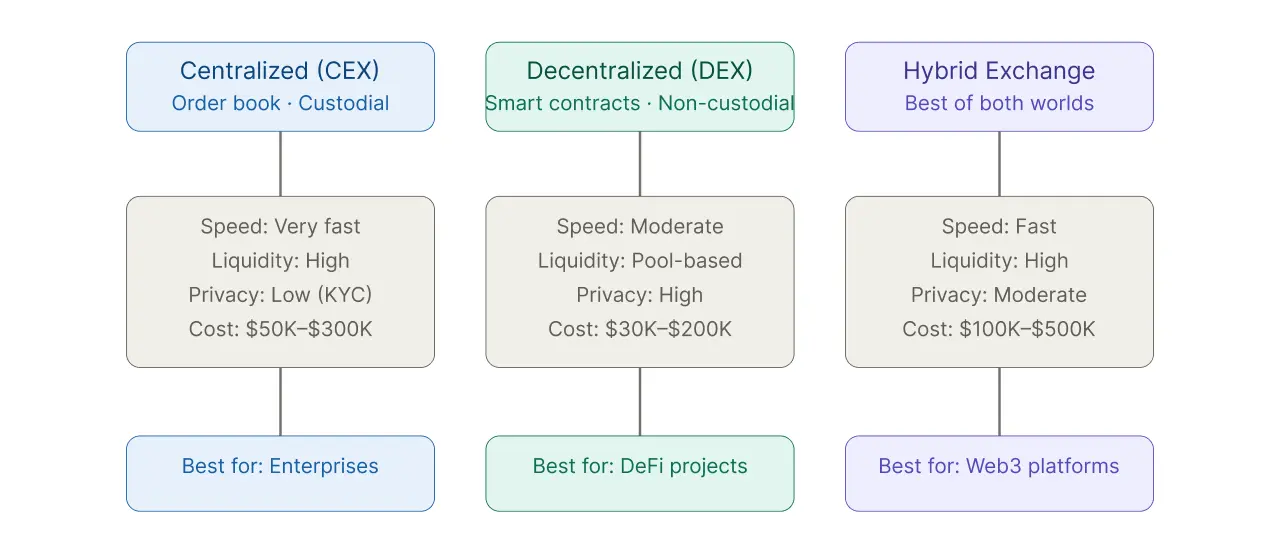
Centralised Exchange (CEX)
A Centralised Exchange operates under a central authority — your company — acting as the intermediary between all buyers and sellers. It uses an order book model, holds user funds in custodial wallets, and runs a high-speed matching engine to execute trades. Global leaders like Binance (which held 38.3% CEX market share in December 2025), Coinbase, and MEXC all operate on this model.
CEX platforms dominate the market. In 2025, the CEX segment held 87.4% of total exchange market share, driven by superior liquidity, faster transaction speeds, and a more intuitive user experience for retail traders. They are also the most feature-rich platforms to build, placing them at the higher end of the cost range.
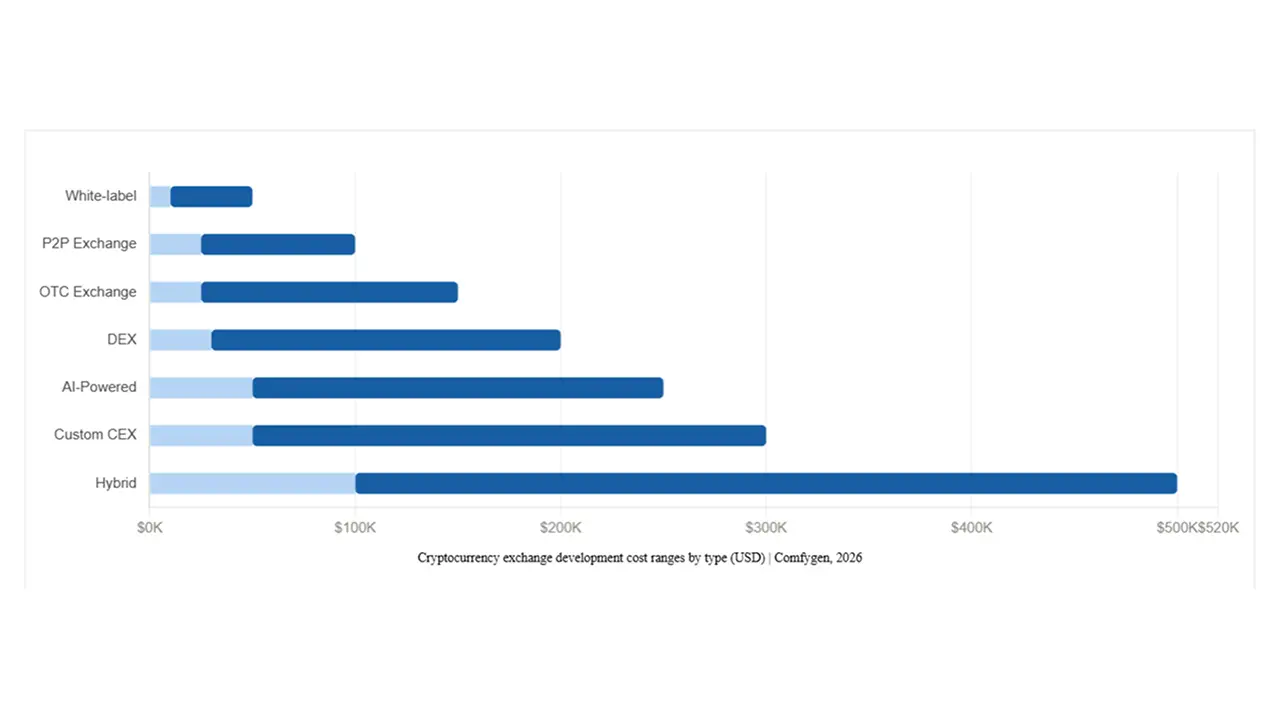
Estimated CEX development cost: $50,000 – $300,000+
Decentralised Exchange (DEX)
A Decentralised Exchange eliminates the central authority. Trades execute automatically through smart contracts deployed on a blockchain — no custodial wallets, no central order book, no single point of failure. Platforms like Uniswap, PancakeSwap, and dYdX operate on this model.
DEX adoption surged in 2025, with decentralised perpetual DEX trading growing 346% to approximately $6.7 trillion in annual volume. If you are targeting the DeFi space, a DEX is a compelling opportunity. Smart contract development and security auditing are the primary cost drivers here.
Estimated DEX development cost: $30,000 – $200,000+
Hybrid Exchange
A Hybrid Crypto Exchange merges the speed and liquidity of a CEX with the self-custody and privacy of a DEX. Users retain control of their private keys while the platform provides centralized matching speeds and a smoother trading experience. This is the most technically sophisticated exchange model — and the most expensive to build.
Estimated Hybrid Exchange development cost: $100,000 – $500,000+
White-Label Crypto Exchange
A white-label exchange is a pre-built, fully tested, and ready-to-deploy platform that you brand as your own. The core infrastructure — trading engine, wallet system, KYC module, admin panel — is already built. You configure it, brand it, and launch it in weeks rather than months.
Comfygen’s white-label crypto exchange solutions are among the fastest routes to market in 2026. This model is ideal for startups, entrepreneurs entering new regional markets, and businesses that need a working product before committing to full custom development.
Estimated White-Label Exchange cost: $10,000 – $50,000+
P2P Exchange (Peer-to-Peer)
A P2P exchange facilitates direct trades between users, protected by escrow-based smart contracts. The platform acts as a facilitator rather than an intermediary, offering buyers and sellers the ability to negotiate prices and payment methods directly. P2P cryptocurrency exchanges are particularly popular in markets with limited fiat-to-crypto ramp access.
Estimated P2P Exchange development cost: $25,000 – $100,000+
OTC (Over-the-Counter) Exchange
OTC platforms facilitate large, private trades executed off the public order book. They serve institutional investors, hedge funds, and high-net-worth individuals who need to move significant volumes without market impact. OTC cryptocurrency exchanges require strong liquidity relationships, advanced settlement workflows, and strict compliance infrastructure.
Estimated OTC Exchange development cost: $25,000 – $150,000+
AI-Powered Crypto Exchange
The newest category is gaining traction in 2026. AI-powered exchanges integrate machine learning models directly into the trading experience — predictive market analytics, intelligent trading bots, AI-driven fraud detection, automated AML monitoring, and personalised dashboards that adapt to each user’s trading behaviour. These platforms represent the cutting edge of exchange technology and command a premium development cost.
Estimated AI-Powered Exchange development cost: $50,000 – $250,000+
Cryptocurrency Exchange Development Cost: Full Breakdown by Stage
Your total cryptocurrency exchange development cost is the cumulative sum of several distinct development phases. Here is exactly where your investment goes:
Stage 1: Discovery, Planning, and Architecture — $5,000 to $15,000
A well-built exchange starts with a well-defined blueprint. This stage covers technology stack selection, regulatory mapping by jurisdiction, competitor analysis, API architecture design, blockchain network selection, database design, and the complete project roadmap. Skipping or rushing this stage is one of the most expensive mistakes a founder can make — unclear requirements cause expensive rework mid-development.
At Comfygen, our blockchain development architects and compliance consultants work alongside you during this phase to define your exchange model, feature scope, scalability requirements, and regulatory obligations before a single line of code is written.
Stage 2: UI/UX Design — 10% to 15% of Total Budget
Your exchange’s interface is the first thing every user judges. A clean, intuitive, and responsive design reduces friction, increases onboarding conversion, and directly drives user retention. This stage covers:
- Information architecture and user flow mapping
- Wireframes and clickable prototypes
- Responsive web trading interface design
- Mobile app UI/UX for iOS and Android
- Dark mode, accessibility standards, and multi-language layout support
For a $100,000 project, expect to allocate $10,000 – $15,000 to design. Underinvesting here is a false economy — poor UX is one of the leading reasons crypto users abandon exchanges.
Stage 3: Core Backend Development — 30% to 40% of Total Budget
This is the most technically complex and time-consuming phase. Core backend development encompasses:
Trading Engine: The heart of any exchange. A low-latency order-matching engine handles thousands of simultaneous buy and sell orders in real time, with FIFO or pro-rata matching logic and microsecond execution speeds.
Wallet Infrastructure: Multi-currency hot wallets for day-to-day transactions and cold wallets for the majority of user funds kept offline. Secure key generation, storage, and management are critical — this is where most exchange hacks originate.
Liquidity Management: For CEX platforms, this means integrating with external liquidity providers via APIs. For DEX platforms, this means automated market maker (AMM) logic and liquidity pool smart contracts.
Admin Dashboard: Real-time exchange monitoring, user management, fee configuration, compliance reporting, trade surveillance, and system health dashboards.
API Layer: REST APIs and WebSocket connections for real-time market data, order management, account management, and third-party integrations (payment gateways, price oracles, data providers).
For a mid-range CEX, backend development runs approximately $30,000 – $120,000.
Stage 4: KYC/AML and Compliance Integration — $10,000 to $40,000
In 2026, regulatory compliance is not optional. Any exchange handling fiat currencies or operating in regulated markets — including the UAE, EU (under MiCA), US, UK, or Singapore — must implement identity verification and anti-money laundering controls from day one.
This stage integrates KYC verification providers (Jumio, Onfido, or Sumsub), AML transaction screening tools, politically exposed persons (PEP) checks, GDPR-compliant data handling, and jurisdiction-specific reporting workflows.
The compliance cost scales with the number of jurisdictions you target. A single-market exchange in one country costs significantly less to make compliant than a global platform operating across 10+ jurisdictions.
Stage 5: Security Development and Penetration Testing — $10,000 to $50,000
Security is the one area where cutting costs can be catastrophic. An exchange breach does not just cost money — it destroys user trust permanently. In 2025, the Bybit hack alone demonstrated how even well-resourced platforms remain targets. Comfygen’s security-first development approach includes:
- Two-factor authentication (2FA) and biometric login options
- Cold storage architecture for the majority of exchange funds
- DDoS mitigation and rate limiting
- SSL/TLS encryption across all data transmission
- Role-based access control and internal audit logs
- Smart contract auditing for DEX and hybrid platforms ($5,000 – $20,000 for audits alone)
- Third-party penetration testing and vulnerability assessments
Budget a minimum of 15% – 20% of your total development cost for security. This is non-negotiable.
Stage 6: QA Testing and Performance Optimisation — $8,000 to $25,000
Before launch, your platform undergoes comprehensive quality assurance — load testing under simulated peak trading conditions, functional testing of every user flow, mobile app testing across device types, API stress testing, and user acceptance testing (UAT) with a controlled group of beta users.
Performance optimisation ensures your exchange handles 100 users on launch day and 100,000 users six months later without degraded performance or system failures.
Stage 7: Deployment, Infrastructure, and Launch — $5,000 to $15,000
This covers scalable cloud infrastructure setup on AWS, Google Cloud, or Azure; containerization with Docker and Kubernetes for horizontal scaling; CI/CD pipeline configuration; domain, DNS, and SSL configuration; and the initial production deployment.
Your infrastructure must be designed to scale automatically with trading volume. A fixed-capacity server that performs well in testing will buckle under real market conditions.
Cryptocurrency Exchange Development Cost Summary Table
| Exchange Type | Development Cost | Timeline | Best For |
| White-Label CEX | $10,000 – $50,000 | 1 – 3 months | Startups, fast market entry |
| Custom CEX | $50,000 – $300,000 | 6 – 12 months | Enterprises, full control |
| DEX (Smart Contract) | $30,000 – $200,000 | 3 – 9 months | DeFi-focused businesses |
| Hybrid Exchange | $100,000 – $500,000 | 9 – 18 months | Advanced Web3 platforms |
| P2P Exchange | $25,000 – $100,000 | 3 – 8 months | Community-driven trading |
| OTC Exchange | $25,000 – $150,000 | 3 – 9 months | Institutional/high-volume trading |
| AI-Powered Exchange | $50,000 – $250,000+ | 6 – 14 months | Next-gen intelligent platforms |
Key Factors That Determine Your Cryptocurrency Exchange Development Cost
Beyond the exchange type, these variables move your final cost up or down significantly.
1. Feature Set and Complexity
Every feature you add increases development time and, therefore, cost. Non-negotiable core features include the trading engine, wallets, KYC, and admin panel. Advanced features scale your budget:
- Mobile apps (iOS and Android): $20,000 – $60,000
- Futures and derivatives trading: $30,000 – $80,000
- Margin trading and leverage tools: $20,000 – $50,000
- Staking and yield farming modules: $15,000 – $40,000
- Copy trading and social features: $15,000 – $35,000
- AI trading bots and predictive analytics: $20,000 – $60,000
- NFT marketplace integration: $15,000 – $40,000
- Multi-language and multi-currency support: $5,000 – $20,000
- Referral and affiliate system: $5,000 – $15,000
The smartest approach is to launch with core features, validate with real users, and add advanced capabilities iteratively.
2. Development Approach: Custom vs. White-Label vs. Open-Source
| Approach | Cost | Speed to Market | Flexibility |
| Custom Development | Highest | Slowest (6–18 months) | Maximum |
| White-Label Solution | Lowest | Fastest (1–3 months) | Moderate |
| Open-Source Framework | Medium | Medium (3–9 months) | High (with expertise) |
White-label crypto exchange software development solutions from Comfygen reduce total project costs by 40% – 70% and dramatically accelerate time-to-market. Custom development gives you full architectural control, proprietary features, and a differentiated product. Open-source frameworks require a highly skilled team to customize securely and are best suited for experienced blockchain developers.
3. Development Team Location
Where your development team is based has a direct impact on your hourly rates and total budget:
- North America / Western Europe: $100 – $200 per hour
- Eastern Europe (Poland, Ukraine, Romania): $50 – $100 per hour
- South Asia (Comfygen Technologies): $20 – $50 per hour
Comfygen’s development team is based in India, enabling us to deliver enterprise-grade cryptocurrency exchange platforms at highly competitive rates — without compromising on code quality, security standards, or delivery timelines.
4. Blockchain Network Selection
The blockchain your exchange operates on determines smart contract complexity, gas fee economics for users, and multi-chain integration costs. Common choices in 2026 include Ethereum, BNB Chain, Solana, Polygon, Tron, and Avalanche. Supporting multiple chains simultaneously adds significant development complexity and cost but dramatically widens your user base and asset selection.
5. Regulatory Jurisdiction and Compliance Depth
A lightly regulated P2P exchange serving a single emerging market has much lower compliance costs than a full-featured CEX targeting the US, EU (MiCA), UAE, and Singapore simultaneously. Legal consultation fees, licensing costs, ongoing AML monitoring subscriptions, and compliance reporting infrastructure all scale with the number and complexity of your target jurisdictions.
Hidden Costs of Running a Cryptocurrency Exchange in 2026
Many entrepreneurs budget carefully for the development phase but are caught off guard by operational costs. Here is what to plan for beyond the build:
Cloud hosting and infrastructure: A scalable AWS or Google Cloud setup runs $2,000 – $20,000 per month at meaningful scale, depending on trading volume and concurrent users. This cost grows with your success.
Third-party API subscriptions: KYC providers (Jumio, Onfido, Sumsub), real-time market data feeds (CoinGecko, CoinMarketCap), SMS/email notification services, payment gateway integrations — these carry recurring monthly costs ranging from a few hundred to several thousand dollars.
Ongoing maintenance and development: Budget approximately 20% of your initial build cost per year for security patches, platform updates, new feature development, and performance optimisation. Your exchange is never truly “finished.”
Customer support infrastructure: 24/7 multi-channel support (live chat, email, ticketing), dispute resolution workflows, and multilingual support capabilities are essential for user trust and retention — and they have real operational costs.
Marketing, SEO, and community building: In a market with 260+ active exchanges competing for users and liquidity, marketing is not optional. Content marketing, paid advertising, influencer campaigns, exchange listing fees, and community management often cost as much as the initial development. Plan for sustained marketing investment from day one.
Legal, licensing, and compliance: Depending on your target markets, licensing fees range from $5,000 to $50,000+ upfront, with ongoing annual renewal fees, legal counsel costs, and compliance audit expenses.
Liquidity bootstrapping: A new exchange with no liquidity attracts no traders. Budget for initial liquidity provision, market maker partnerships, or liquidity provider API costs to ensure your order book has enough depth to offer a competitive trading experience from launch.
How to Reduce Cryptocurrency Exchange Development Cost Without Compromising Quality
You do not need a half-million-dollar budget to build a competitive exchange in 2026. Here are the most effective strategies to optimise your investment:
Start with a focused MVP. Launch with core trading features — order matching, basic wallet support, KYC, and a clean trading interface — and collect real user feedback before investing in advanced functionality. A well-built MVP can go live in 3 – 4 months for $30,000 – $80,000 and will teach you more about your users than any amount of pre-launch planning.
Use a white-label exchange as your foundation. Comfygen’s white-label crypto exchange platforms include a pre-built, tested trading engine, wallet infrastructure, compliance modules, and admin dashboard. You brand it, configure supported assets and fee structures, and launch — without the cost and time of building from scratch. This single decision can reduce your budget by 40% – 70%.
Built with a modular microservices architecture. Structure your exchange so that individual components — a stacking module, derivatives engine, referral system, or AI analytics layer — can be added independently without rebuilding the core platform. This allows you to scale features with revenue rather than front-loading your investment.
Choose a proven, experienced development partner. Working with a team that has already built and launched multiple exchange platforms eliminates the costly trial-and-error that comes with inexperienced developers. At Comfygen, we have delivered CEX, DEX, hybrid, P2P, OTC, and AI-powered exchange platforms for clients across multiple continents. We know the technical pitfalls, the regulatory considerations, and the architectural decisions that separate successful exchanges from failed launches.
Leverage security-audited open-source components. For wallet cryptography, certain DEX smart contract functions, and standard protocol integrations, vetted open-source tools reduce both development time and cost while maintaining high security standards. The key is knowing which components are safe to use off the shelf and which require custom engineering.
Why Launch a Cryptocurrency Exchange in 2026?
If you are weighing whether the cryptocurrency exchange development cost is worth the investment, consider the revenue potential and market momentum:
The market is growing fast. The cryptocurrency exchange platform market is valued at $68.85 billion in 2026, growing at 26.1% CAGR toward $173.92 billion by 2030. Spot plus derivatives trading volume exceeded $79 trillion in 2025, and DEX volume grew 346% in a single year.
Revenue streams are diverse and scalable:
- Trading fees: Typically 0.1% – 0.5% per trade. An exchange with $10 million in daily trading volume generates $10,000 – $50,000 daily in fee revenue.
- Token listing fees: Charging blockchain projects to list on your exchange.
- Withdrawal fees: Small flat or percentage-based fees on every user withdrawal.
- Premium membership tiers: VIP accounts with reduced fees, higher withdrawal limits, and advanced features.
- Staking and DeFi yields: Earning a percentage of the staking rewards your platform facilitates.
- Margin trading interest: Interest earned on leveraged trading positions.
- API access fees: Charging institutional traders and bots for high-frequency API access.
Institutional interest is accelerating. In 2025, Coinbase generated approximately $1.9 billion in revenue in Q3 alone — up 54% year-over-year. OKX received a major investment from the parent company of the New York Stock Exchange in 2026, achieving a $25 billion valuation. The institutional endorsement of crypto exchanges as legitimate financial infrastructure is now undeniable.
Regulatory clarity is improving globally. The EU’s MiCA framework, evolving US crypto regulation, and progressive policies in the UAE and Singapore are all reducing the regulatory uncertainty that previously deterred serious businesses from entering the market. Exchanges that build for compliance from day one are best positioned to capture this institutional and retail growth.
Comfygen’s Expertise in Cryptocurrency Exchange Development
At Comfygen, cryptocurrency exchange development is not a side service — it is a core specialisation backed by years of hands-on delivery experience.
Our portfolio spans centralised, decentralised, hybrid, P2P, OTC, white-label, and AI-powered exchange platforms built for startups, fintech companies, and enterprises across India, UAE, Nigeria, the US, and beyond. Our work includes high-volume CEX platforms supporting spot, margin, and futures trading; hybrid OTC exchanges with P2P functionality and fiat on-ramp integrations across multiple jurisdictions; and multiple white-label deployments customised for competitive regional markets.
Our CTO, Saddam Husen, is a recognised blockchain architect and Blockchain consultant with deep expertise in blockchain development, crypto wallet engineering, DeFi protocols, ICO platforms, and smart contract development. Every project at Comfygen benefits from his technical leadership and our team’s unwavering commitment to security-first architecture, regulatory compliance, and performance at scale.
When you work with Comfygen, you receive a true end-to-end partnership — from initial strategy and architecture through design, development, security hardening, compliance integration, launch, and ongoing post-launch support. We provide transparent pricing, realistic timelines, and full accountability at every project stage.
Conclusion
The cryptocurrency exchange development cost in 2026 is not a one-size-fits-all number. A white-label launch can get your platform to market for $10,000 – $50,000 in weeks. A fully custom, AI-powered, multi-chain CEX built for institutional and retail users globally may require $300,000 – $500,000+ investment over 12 – 18 months. Both are viable paths — the right one depends on your market, your timeline, your budget, and your long-term competitive vision.
What is consistent across every exchange that succeeds is this: the platforms that win are built on secure, scalable architecture, deliver an intuitive user experience, meet regulatory requirements from day one, and are backed by a development team with the expertise to navigate the full journey from concept to launch.
At Comfygen Technologies, we have helped startups and enterprises across the globe build, launch, and scale their cryptocurrency exchange platforms — from lean MVPs to enterprise-grade, multi-chain trading ecosystems. Whether you need a rapid white-label deployment, a custom CEX, a smart contract-powered DEX, or an AI-driven exchange platform for 2026 and beyond — our team is ready to bring your vision to life.
FAQs
How much does it cost to develop a cryptocurrency exchange in 2026?
How long does it take to build a cryptocurrency exchange?
What is the cheapest way to build a crypto exchange in 2026?
What are the hidden costs of running a cryptocurrency exchange?
Is building a cryptocurrency exchange profitable in 2026?

Mr. Saddam Husen, (CTO)
Mr. Saddam Husen, CTO at Comfygen, is a renowned Blockchain expert and IT consultant with extensive experience in blockchain development, crypto wallets, DeFi, ICOs, and smart contracts. Passionate about digital transformation, he helps businesses harness blockchain technology’s potential, driving innovation and enhancing IT infrastructure for global success.