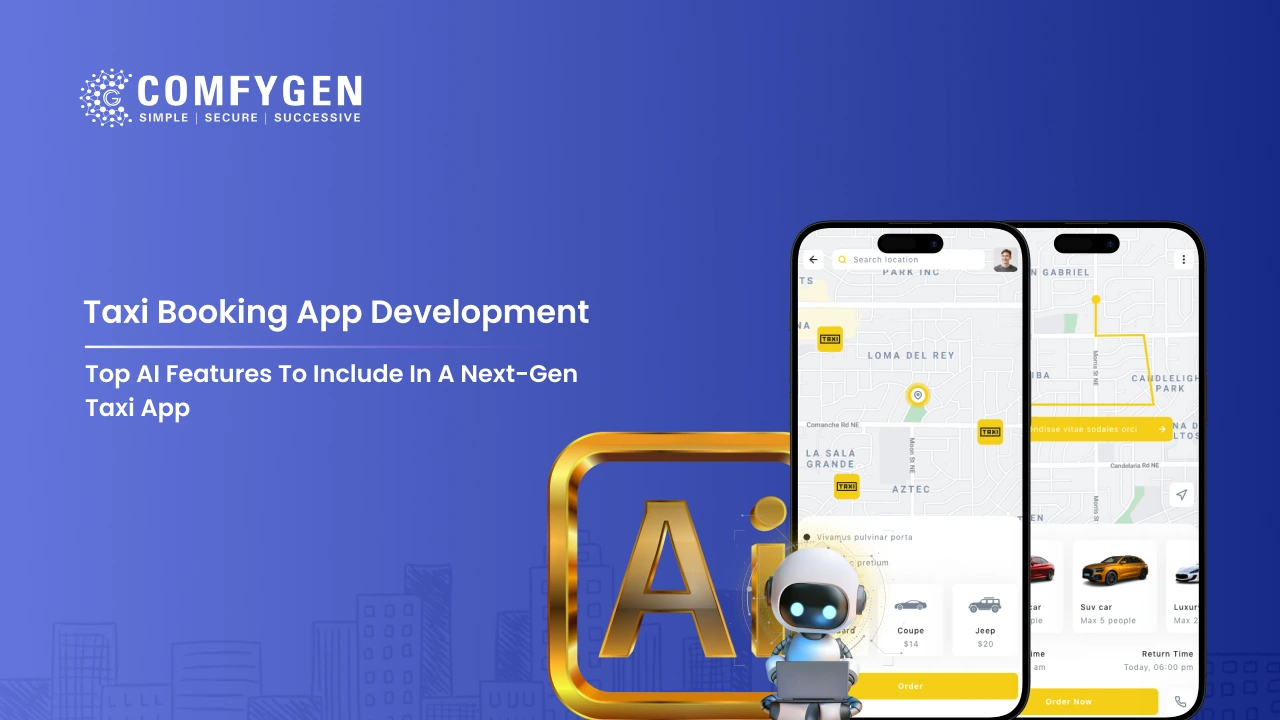





AI features for taxi apps are no longer optional add-ons—they have become the competitive baseline for serious ride-hailing businesses in 2026. The ride-hailing market is projected to grow from USD 154.8 billion in 2025 to USD 184.49 billion in 2026 and reach USD 392.27 billion by 2031, growing at a CAGR of 16.29% from 2026 to 2031., growing at a CAGR of 16.29% from 2026 to 2031, and the engine powering this explosive growth is Artificial Intelligence.
Traditional taxi booking apps were built around three pillars: GPS tracking, cab booking, and payment gateways. In 2025, these capabilities were becoming standard expectations for taxi and ride-hailing apps. Over 75% of ride-hailing companies are already integrating AI and machine learning into their platforms for dynamic pricing, route optimization, and demand forecasting — and the remaining 25% risk irrelevance.
What separates the next-gen taxi apps from legacy platforms isn’t just better code. It’s intelligence. The ability to predict demand before it happens, match drivers with remarkable precision, detect fraud in milliseconds, and personalize every ride for every passenger — these capabilities are what define market leaders like Uber, Lyft, and Ola in 2026.
In this guide, Comfygen’s development team breaks down the top 15 AI features for next-gen taxi apps — how each one works, the real business ROI it delivers, and exactly how to build them into your platform. Whether you’re launching a new ride-hailing startup or upgrading an existing taxi app, this is your complete technical and strategic roadmap.
What Is an AI-Powered Taxi App? (And How It Differs from Traditional Apps)
An AI-powered taxi app is a ride-hailing platform that uses machine learning (ML), natural language processing (NLP), computer vision, and predictive analytics to automate decisions, optimize operations, and deliver personalized experiences for both riders and drivers — rather than simply connecting passengers to the nearest available vehicle.
Where traditional taxi booking apps execute fixed rules (“assign the closest driver”), AI-powered taxi apps make contextual, data-driven decisions (“assign the driver most likely to accept, arrive on time, and satisfy this specific passenger based on 40+ variables”).
Traditional vs. AI-Powered Taxi App: A Clear Comparison
| Feature | Traditional Taxi App | AI-Powered Taxi App |
|---|---|---|
| Driver matching | Nearest available | Multi-variable ML matching |
| Pricing | Fixed or basic surge | Predictive dynamic pricing |
| Route planning | Single GPS route | Real-time multi-data routing |
| Customer support | Human agents | NLP chatbots + voice AI |
| Fraud detection | Manual review | Real-time anomaly detection |
| Driver monitoring | None | Computer vision + sensor AI |
| Demand prediction | None | 15–30 min predictive forecasting |
| Personalization | None | Preference learning engine |
The 5 Core AI Technologies Powering Next-Gen Taxi Apps
- Machine Learning (ML) handles pattern recognition across millions of ride events — identifying demand surges, matching accuracy, and dynamic pricing adjustments. Uber’s AI infrastructure processes over 20 million ride matches per day using ML algorithms.
- Natural Language Processing (NLP) enables chatbots, voice assistants, and sentiment analysis. Riders can say “Book me a ride to Connaught Place,” and the system understands intent, context, and urgency.
- Computer Vision powers driver identity verification, real-time safety monitoring, drowsiness detection, and document processing — all through a standard smartphone camera.
- Predictive Analytics forecasts demand by neighborhood, hour, weather, and event schedule — enabling proactive driver positioning that reduces wait times by 30–40%.
- Generative AI handles complex support queries with human-like understanding, auto-generates trip summaries, and creates contextual push notifications that improve engagement.
Market Snapshot: AI in Ride-Hailing (2025–2030)
Before investing in AI taxi app development, understanding the market trajectory confirms the ROI case.
2.5 billion people use ride-hailing services globally as of 2024, generating over 65 billion rides annually across 320+ platforms worldwide. Daily ride requests average 120 million, creating massive data pipelines that AI systems need to function at their best.
67% of ride-hailing companies have already integrated AI into their core systems, with adoption projected to reach 85% by 2026. Among these, 75% are using ML models specifically for predictive analytics, dynamic pricing, and route optimization.
Why is 2026 the inflection year? Three forces converge simultaneously: large language models (LLMs) have matured enough for real-time mobile deployment, generative AI APIs are cost-effective at scale, and autonomous vehicle pilot programs are creating demand for AI-ready fleet management infrastructure. Companies building AI-powered taxi booking apps today are not just competing for current riders — they are laying the technical foundation for the autonomous mobility era.
Top 15 AI Features for Next-Gen Taxi Apps in 2026
Here are the core AI features every next-generation taxi app should consider, ranked by implementation priority and business impact.
1. Intelligent Driver-Passenger Matching
Traditional taxi booking apps assign the nearest available driver. Intelligent matching does something far more sophisticated: it evaluates 40+ variables simultaneously to predict the optimal driver-passenger pairing before either party notices a delay.
How it works: The ML matching engine scores every available driver against a ride request using real-time inputs — driver proximity, predicted acceptance probability, current traffic between driver and pickup point, vehicle type preference, driver rating, trip history with similar destinations, and estimated arrival time under current road conditions.
Business impact: AI-powered matching delivers 30–40% improvement in match accuracy and an 18–25% increase in completed trips versus proximity-only algorithms. Driver idle time drops because accepted rides are more predictable, and passengers experience shorter, more reliable pickup windows.
Real-world benchmark: Uber’s deep learning matching model, which processes millions of potential pairings per second, has been cited as one of the primary drivers behind their 70%+ trip completion rate in dense markets.
At Comfygen, our taxi app development team builds multi-variable matching engines tailored to your market’s unique supply-demand dynamics.
2. AI-Powered Dynamic and Surge Pricing
Dynamic pricing — the ability to adjust fares in real-time based on supply and demand — is one of the highest-ROI AI features in ride-hailing. But in 2026, the most competitive platforms have moved beyond reactive surge pricing to predictive demand-based pricing.
How it works: ML models analyze historical demand patterns, current booking velocity, weather forecasts, local event calendars, time-of-day trends, and competitor pricing to forecast demand surges 15–30 minutes before they occur. The pricing engine adjusts fares proactively to balance supply and demand while maximizing revenue per available driver-hour.
Ethical pricing design: A critical differentiator for 2026 is transparent surge communication. AI-generated fare breakdown explanations (“Your fare is 1.4x because a concert nearby just ended”) improve rider acceptance of dynamic pricing by 35–45% and reduce booking abandonment during surges.
Business impact: Platforms using predictive dynamic pricing report 15–25% revenue uplift during peak windows compared to static or reactive surge models. Driver earnings increase because high-demand periods are monetized more efficiently.
3. Real-Time AI Route Optimization
Basic GPS navigation chooses the shortest path. AI route optimization chooses the smartest path — the route that minimizes trip time, fuel consumption, and driver stress while maximizing passenger satisfaction.
How it works: The route optimization engine fuses multiple real-time data streams: live traffic conditions from mapping APIs (Google Maps Platform, HERE), historical speed data by road segment, weather impact on road conditions, construction and closure alerts, and learned driver preferences for specific route types. The system recalculates the optimal route every 30–60 seconds during the trip.
Business impact: AI-optimized routing reduces average trip times by 15–20%, translating directly into more trips per driver per shift, lower fuel costs, and higher passenger ratings. At fleet scale, a 15% trip time reduction across 10,000 daily rides represents enormous operational savings.
2026 enhancement: Multi-stop optimization AI now enables drivers to sequence pickups and drop-offs across carpooling and shared-ride scenarios with near-optimal efficiency — a feature critical for any platform exploring shared mobility models.
4. Predictive Demand Forecasting and Driver Positioning
One of the most powerful AI features for taxi app development is the ability to predict where and when rides will be needed — and position drivers accordingly before demand materializes.
How it works: Demand forecasting models are trained on years of historical ride data segmented by geolocation, time of day, day of week, weather conditions, local events (concerts, sports matches, festivals), public holiday patterns, and school schedules. The model outputs a demand probability heat map updated every 5–15 minutes, which the dispatch system uses to nudge idle drivers toward high-probability pickup zones through in-app notifications and bonuses.
Business impact: Predictive positioning reduces average passenger wait times by 30–40% and cuts driver idle time by 20–30%. For passengers, sub-3-minute ETAs are a powerful retention driver — studies consistently show that wait time is the number-one factor in ride-hailing app switching behavior.
Integration point: Demand forecasting feeds directly into dynamic pricing (Feature 2) — when the model predicts a surge, pricing adjusts preemptively to attract more driver supply into the area, smoothing the supply-demand gap before riders experience it.
5. NLP Chatbots and AI Voice Assistants
Modern riders expect instant, intelligent support without waiting in a phone queue. AI-powered chatbots and voice assistants in next-gen taxi apps handle the full spectrum of customer interactions — from booking and payment queries to real-time ride modifications and complaint resolution.
How it works: NLP models trained on ride-hailing-specific conversation data understand intent, context, and urgency across text and voice inputs. A rider can say “I’m running late, can you ask the driver to wait?” and the AI understands the request, contacts the driver through an automated message, and updates both parties with a status notification — without human agent involvement.
Voice assistants integrate with Alexa, Google Assistant, and in-app voice commands for completely hands-free booking. Multi-language support across Hindi, Arabic, Spanish, French, and regional dialects is now standard in competitive markets.
Business impact: AI chatbots handle 60–75% of all customer support queries without escalation, reducing support operational costs by 40–60%. Response time drops from minutes to milliseconds, and 24/7 availability removes friction at every hour of the day.
At Comfygen, our AI development team builds NLP-powered support systems that integrate seamlessly with your existing CRM and operations stack.
6. AI-Based Fraud Detection and Prevention
Fraudulent activity — fake bookings, GPS spoofing, payment fraud, multi-account abuse, and driver-passenger collusion — costs the ride-hailing industry an estimated $1.2 billion annually. AI-powered fraud detection is the most cost-effective defense available.
How it works: Machine learning models build behavioral profiles for every driver and rider on the platform. Real-time anomaly detection flags deviations: a driver whose GPS trajectory matches known spoofing patterns, a user creating multiple accounts from the same device fingerprint, a payment method with velocity indicators consistent with stolen card use, or a booking pattern matching a known “cancel after pickup” scam.
The system operates in three modes: passive monitoring (flag for review), friction injection (add verification step for suspicious sessions), and automatic block (for high-confidence fraud signals).
Business impact: Companies that implement AI fraud detection reduce fraudulent activities by 30–45% within the first 90 days of deployment. Beyond direct financial savings, fraud reduction improves platform trust ratings and reduces driver churn caused by dishonest passenger behavior.
2026 addition: AI models now detect collusion between specific driver-passenger pairs — a growing fraud vector where both parties split fare payments while reporting longer trips. Pattern analysis across trip history and payment flows identifies these rings with high precision.
7. Computer Vision Driver Behavior and Safety Monitoring
Passenger safety is the single most important trust factor in ride-hailing. AI-powered driver monitoring uses computer vision and sensor fusion to protect both passengers and drivers in real time — without requiring manual reporting.
How it works: Using the vehicle’s forward-facing camera, in-cabin camera (optional, with consent), and smartphone accelerometer/gyroscope data, the AI system monitors:
- Fatigue indicators: Eye closure frequency, head position, microsleep detection
- Distraction detection: Phone use while driving, eyes-off-road duration
- Driving behavior: Harsh braking events, rapid acceleration, lane swerving
- Crash detection: Sudden deceleration above threshold triggers automatic SOS
8. Hyper-Personalized Rider Experience
Discounts do not retain the most loyal ride-hailing users — they are retained by experiences that feel designed for them. AI personalization engines learn rider preferences over time and apply them automatically to every interaction.
How it works: The personalization model tracks and learns: preferred vehicle categories (sedan, SUV, premium), usual pickup locations by time of day, common destinations, preferred payment methods, in-ride music genre, preferred temperature settings (in integrated vehicles), and communication style (minimal contact vs. conversational drivers).
Over time, the app pre-fills likely destinations during commute hours, suggests departure times based on real-time traffic predictions to meet the rider’s usual schedule, and surfaces relevant offers (airport transfers, subscription plans) based on usage patterns.
Business impact: AI personalization increases repeat booking rates by 25–30% and app engagement scores by 20–35%. The compounding effect of personalization on lifetime value (LTV) is significant — a rider who feels the app “knows them” is dramatically less likely to try a competitor.
9. Predictive Vehicle Maintenance Using IoT and AI
For fleet operators and platform partners managing vehicle assets, unplanned breakdowns are both a financial and reputational disaster — a broken-down taxi strands a passenger and removes an earning asset from the road simultaneously. AI-powered predictive maintenance eliminates both outcomes.
How it works: IoT sensors installed in partner vehicles (or integrated with the vehicle’s OBD-II port) continuously stream data: engine temperature and RPM patterns, brake pad wear indicators, tire pressure and tread depth, battery charge cycles, transmission behavior, and mileage accumulation rates. AI analytics models compare live sensor readings against failure pattern libraries built from thousands of vehicles to predict component failures days or weeks before they occur.
Business impact: Platforms implementing predictive maintenance report 30–35% reduction in unplanned vehicle downtime, which directly translates to higher driver earning hours and better platform supply reliability for passengers.
Our IoT development team at Comfygen has extensive experience integrating vehicle telematics with AI analytics platforms for fleet-scale predictive maintenance.
10. Generative AI for Support Automation and Personalized Communication
Generative AI represents the frontier of AI features for taxi app development in 2026. Unlike rule-based chatbots, generative AI systems (built on LLMs like GPT-4, Gemini, or custom fine-tuned models) understand nuance, handle multi-turn conversations, and generate contextually appropriate responses indistinguishable from human support agents.
How it works: The generative AI support layer handles complex queries that rule-based bots cannot resolve: billing disputes involving multiple ride legs, requests for exceptions to cancellation policies, driver incident reports that require empathetic handling, and account recovery scenarios with unusual circumstances. The system has full access to ride history, payment records, and account data — allowing it to respond with specific, accurate information rather than generic scripts.
Beyond reactive support, generative AI creates proactive personalized communication: post-ride summaries with route highlights and time saved, contextual push notifications (“Your usual morning commute will take 12 minutes longer today — consider leaving at 8:15”), and fare forecasts for planned trips.
Business impact: Platforms integrating generative AI support handle 75–85% of all tier-1 support interactions without human escalation, while achieving 20–30% higher customer satisfaction scores than rule-based chatbot predecessors.
Explore our Generative AI development services to understand how Comfygen builds production-ready LLM integrations for mobile platforms.
Build Your AI-Powered Taxi App Today
11. Emotional AI and Sentiment Analysis
Understanding how riders and drivers feel about their experience — not just what they explicitly say — enables platforms to resolve issues before they escalate into churn.
How it works: Sentiment analysis models process in-app chat messages, post-ride reviews, support ticket language, and driver feedback to identify emotional signals: frustration, satisfaction, anxiety, or confusion. Real-time sentiment scoring during active support conversations allows the system to escalate to a human agent when a conversation is trending toward high frustration — before the rider hangs up or posts a negative review.
Driver sentiment monitoring identifies early signs of burnout, dissatisfaction with earnings, or safety concerns by analyzing the tone of their platform interactions. Proactive outreach to drivers showing burnout signals reduces attrition by 15–20%.
12. AI-Powered Accessibility Features
A truly competitive next-gen taxi app serves 100% of potential riders — including the estimated 1.3 billion people worldwide living with some form of disability (WHO). AI accessibility features are both a commercial opportunity and a regulatory imperative in many markets.
How it works: Voice-first UI design powered by NLP enables fully app-free booking for visually impaired users. The booking AI automatically matches passengers with accessibility requirements to vehicles equipped with wheelchair ramps, wide doors, or other adaptations. Sign language recognition via computer vision is an emerging feature enabling deaf and hard-of-hearing users to communicate booking requests through the phone camera.
Why this matters for ranking: This is a differentiation angle that almost no competitor blog addresses — which creates a topical authority opportunity and reaches an underserved but commercially significant user segment.
13. AI-Driven Carbon Footprint Tracking and Green Routing
Environmental consciousness is increasingly influencing ride-hailing choices, particularly among urban millennial and Gen-Z riders. AI-powered sustainability features are emerging as genuine competitive differentiators in ESG-aware markets.
How it works: The carbon AI layer calculates the real-time CO₂ emissions of each trip based on vehicle type, route distance, speed profile, and fuel type. It offers riders a “green route” option (marginally longer but significantly lower emissions) and matches eco-conscious passengers with EV or hybrid drivers first. A cumulative carbon offset tracker in the rider profile gamifies sustainable travel choices.
Business impact: Platforms offering sustainability features in European and North American markets report 8–15% higher booking rates among 18–35 demographic segments specifically driven by the feature. It also creates B2B corporate travel contract opportunities with ESG-mandated enterprise accounts.
14. AI-Driven Loyalty Engine and Gamification
Static loyalty points programs have low engagement. AI-driven loyalty systems use behavioral data to create dynamic reward structures that adapt to each user’s patterns, making rewards feel personally valuable rather than generic.
How it works: The AI loyalty engine analyzes individual rider behavior to determine which reward types drive maximum engagement for each user segment: some riders respond to cash discounts, others to priority booking access, others to partner perks (restaurant vouchers, hotel credits). The engine serves each rider the reward type most likely to increase their booking frequency.
Driver gamification works similarly — AI-powered leaderboards, streak bonuses, and performance insights drive healthy competition while surfacing actionable improvement guidance. Drivers with AI-coached performance improvements show 12–18% higher customer ratings within 60 days.
15. Autonomous Vehicle and Fleet Readiness Layer
The most forward-looking AI feature on this list is not a feature that delivers value today — it is the infrastructure investment that protects your platform’s competitive position for the next decade.
How it works: Building an AV readiness layer means designing your platform’s dispatch engine, driver management systems, and vehicle communication APIs to support a hybrid fleet: human-driven vehicles today, remotely monitored autonomous vehicles tomorrow. This requires AI-ready fleet management APIs, real-time vehicle telemetry infrastructure, remote monitoring dashboards, and regulatory compliance modules for AV-specific requirements.
Why build it now: Waymo, Cruise, and several Chinese AV operators are actively approaching ride-hailing platforms for fleet integration partnerships. Platforms with AV-ready infrastructure are already receiving preferential partnership terms. The incremental cost of building AV-readiness into your architecture today is a fraction of the cost of retrofitting it later.
Hire AI Taxi App Developers
Partner with experienced developers to build next-gen taxi apps with smart AI features and future-ready technology.
How to Integrate AI Features Into Your Taxi App: Step-by-Step
Building AI into a ride-hailing platform is not a single project — it is a phased capability roadmap that grows with your data.
Phase 1 — Discovery and AI Audit (Weeks 1–3): Assess your current data infrastructure, identify the 3–5 AI features with the highest ROI for your specific market (matching and dynamic pricing almost always rank first), and define success metrics for each.
Phase 2 — Data Infrastructure Setup (Weeks 3–8): Build or upgrade data pipelines to capture the events your AI models will need: ride requests, completions, cancellations, driver locations, traffic timestamps, payment events, and support interactions. Set up real-time streaming infrastructure (Apache Kafka or AWS Kinesis) and a data warehouse for historical training data.
Phase 3 — Model Selection and Training (Weeks 6–16): Make the build vs. buy decision for each feature. Matching, routing, and demand forecasting typically benefit from custom ML model development trained on your proprietary data. NLP chatbots and sentiment analysis often start with pre-built APIs (Dialogflow, OpenAI) and are fine-tuned on your domain data. Computer vision features for driver monitoring can be built on pre-trained vision models with domain-specific fine-tuning.
Phase 4 — Integration, Testing, and Bias Auditing (Weeks 12–20): A/B test each AI feature against the existing system before full rollout. Shadow-mode deployment (where the AI makes decisions in parallel with the existing system, but its decisions are logged rather than acted upon) is essential for validating matching and pricing models before live deployment. Conduct algorithmic bias audits to ensure AI models don’t systematically disadvantage any driver or rider demographic.
Phase 5 — Launch, Monitor, and Retrain (Ongoing): Deploy with real-time model performance monitoring. Set thresholds for model drift detection (when model performance degrades as the real world diverges from training data). Establish a quarterly retraining cadence for demand forecasting and matching models, with continuous retraining pipelines for fraud detection.
Technology Stack for AI-Powered Taxi Apps in 2026
Building production-grade AI taxi app features requires a carefully selected technology stack across five layers:
| Layer | Technology Options | Primary Use Case |
|---|---|---|
| ML/AI Frameworks | TensorFlow, PyTorch, Scikit-learn | Model training and inference |
| NLP / Conversational AI | Google Dialogflow, Amazon Lex, Rasa, OpenAI API | Chatbots, voice assistants |
| Generative AI | OpenAI GPT-4, Google Gemini, Custom LLM | Support automation, content gen |
| Cloud AI Platform | AWS SageMaker, Google Cloud AI, Azure ML | Scalable model deployment |
| Real-Time Streaming | Apache Kafka, Redis, AWS Kinesis | Live data processing |
| Mapping and Routing | Google Maps Platform, HERE API, Mapbox | Route optimization |
| Mobile Development | Flutter, React Native | Cross-platform app deployment |
| IoT Integration | AWS IoT Core, MQTT Protocol | Vehicle telematics |
| Database | PostgreSQL, MongoDB, ClickHouse | Operational + analytics data |
Business ROI: What AI Delivers for Passengers, Drivers, and Operators
The financial case for investing in AI features for taxi apps is compelling across every stakeholder group:
| Metric | Impact | AI Feature Driving It |
|---|---|---|
| Passenger wait time | ↓ 30–40% | Matching + Demand Forecasting |
| Trip completion rate | ↑ 18–25% | Intelligent Matching |
| Support cost per ticket | ↓ 40–60% | NLP Chatbots + Generative AI |
| Driver earnings per shift | ↑ 18–25% | Route Optimization + Positioning |
| Fraudulent transactions | ↓ 30–45% | AI Fraud Detection |
| Unplanned vehicle downtime | ↓ 30–35% | Predictive Maintenance |
| Repeat booking rate | ↑ 25–30% | Personalization Engine |
| Operational cost (platform) | ↓ 20–35% | Process Automation across features |
AI Taxi App Development Cost in 2026
The cost of building an AI-powered taxi app depends on the sophistication of AI features, the data infrastructure required, and your development partner’s location and expertise.
| Investment Tier | Estimated Cost Range | Timeline | Ideal For |
| MVP / Validation Build | $10,000 – $20,000 | 3–5 months | First-time operators, single-city pilot, market validation |
| Growth-Stage Platform | $20,000 – $30,000 | 5–8 months | Funded operators, city-scale commercial launch |
| Investor-Ready AI Platform | $30,000 – $60,000 | 8–14 months | Multi-city operators, VC-backed ventures |
| Enterprise AI Suite | $60,000 – $120,000+ | 12–18 months | National platforms, white-label licensing, PE targets |
The cost of AI capabilities depends on the models, data requirements, integrations, and level of customization. Businesses can introduce features such as intelligent matching, demand forecasting, dynamic pricing, and ETA prediction according to the scope of the overall platform.
Cost per specific AI feature (rough estimates):
- Intelligent matching engine: $8,000–$18,000
- Dynamic pricing model: $10,000–$22,000
- NLP chatbot integration: $5,000–$15,000
- Fraud detection system: $12,000–$25,000
- Computer vision driver monitoring: $15,000–$35,000
Conclusion: Future-Proof Your Taxi App with AI
AI features are becoming increasingly important for ride-hailing businesses in 2026, particularly for improving operational efficiency, passenger experience, and decision-making. Choosing the right AI capabilities can help taxi apps adapt to changing user expectations while supporting more efficient and reliable operations.
Key takeaways for your AI taxi app strategy:
- Start with intelligent matching, dynamic pricing, and NLP chatbots — these three features deliver the fastest, most measurable ROI across all platform sizes
- Invest in data infrastructure before AI models — the quality of your training data determines the quality of every AI feature on top of it
- Build fraud detection and safety monitoring early — they protect your brand and your platform economics
- Plan your AV readiness layer now, even if autonomous vehicles are years from your market — the cost of retrofitting is far higher than building it in from the start
- Partner with a development team that has both AI expertise and mobile platform experience — the intersection is where next-gen taxi apps are actually built
Comfygen Technologies has delivered AI-powered ride-hailing solutions across multiple global markets. Our team combines deep expertise in machine learning, NLP, computer vision, and mobile development — giving you a single partner for the full stack of AI taxi app features described in this guide.
FAQs
What AI features are most important in a taxi app?
How does AI dynamic pricing work in ride-hailing apps?
How long does it take to build an AI-powered taxi app?
Can small taxi businesses afford AI taxi app development?
What is the difference between Uber's AI system and a custom-built taxi app?

Mr. Saddam Husen, (CTO)
Mr. Saddam Husen, CTO at Comfygen, is a renowned Blockchain expert and IT consultant with extensive experience in blockchain development, crypto wallets, DeFi, ICOs, and smart contracts. Passionate about digital transformation, he helps businesses harness blockchain technology’s potential, driving innovation and enhancing IT infrastructure for global success.