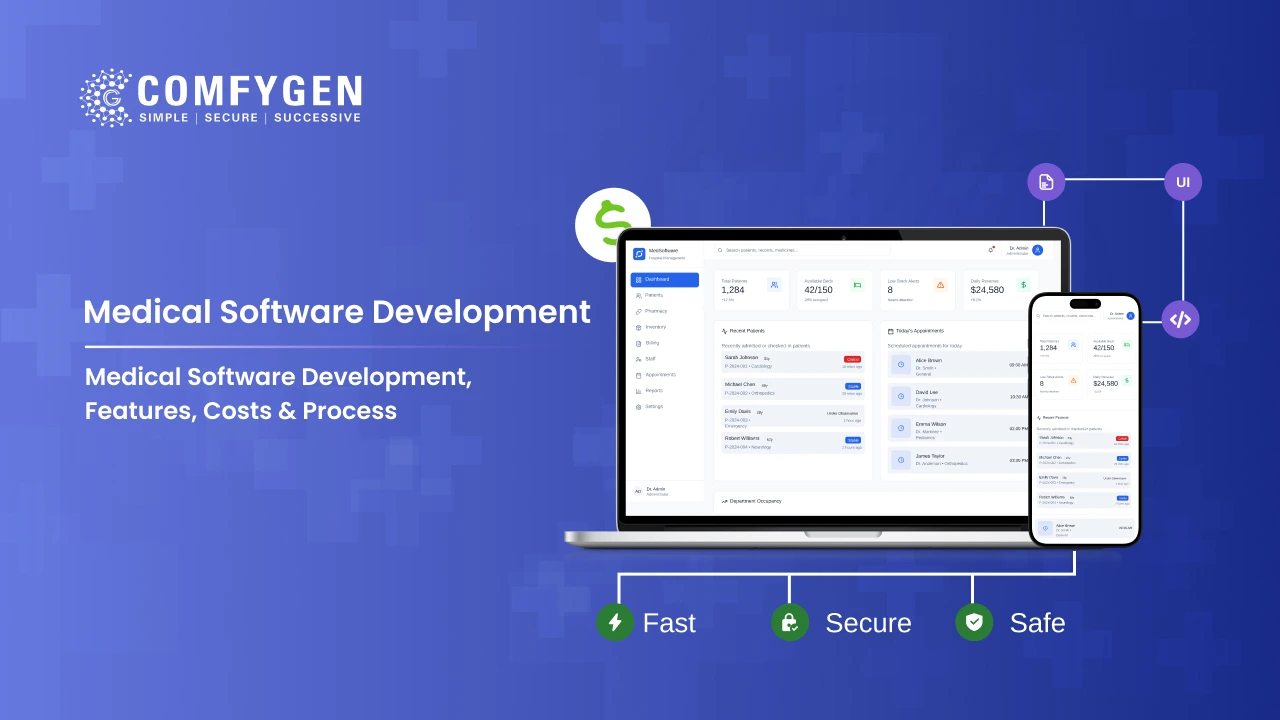





The healthcare industry is rapidly transforming through digital innovation. From hospitals and clinics to pharmacies and medical wholesalers, businesses are increasingly relying on medical software development to improve efficiency, accuracy, compliance, and patient outcomes. As regulatory demands grow and data security becomes critical, investing in custom medical software solutions is no longer optional—it’s essential.
This in-depth guide covers everything you need to know about medical software development, including key features, development process, cost breakdown, technologies used, and industry-specific use cases. Whether you are a healthcare startup, medical wholesaler, or enterprise organization, this guide by Comfygen Technologies will help you make informed decisions.
Market Status of Medical Software
The global medical software development market is witnessing rapid growth, driven by the increasing adoption of software development for healthcare, AI-powered medical solutions, and cloud-native healthcare software platforms. The broader healthcare information software market continues to expand as healthcare providers invest heavily in digital transformation. Among key segments, Software as a Service (SaaS) medical software solutions were valued at USD 25.13 billion in 2024 and are projected to reach USD 74.74 billion by 2030, registering a strong 20.0% CAGR. North America dominates the market, accounting for over 45% share in 2024, supported by advanced digital health infrastructure, high healthcare IT spending, and growing demand for secure, scalable medical software development solutions.
What Is Medical Software Development?
Medical software development is a specialized process of designing, building, testing, and maintaining secure digital solutions that improve healthcare delivery, diagnostic accuracy, and administrative efficiency. It focuses on creating custom healthcare software applications—including web, mobile, cloud-based, and embedded systems—tailored specifically for healthcare providers, medical organizations, and patients.
This form of software development for healthcare enables the secure management of patient data, supports telehealth and remote care services, and facilitates the operation of medical devices while ensuring compliance with industry regulations such as HIPAA and GDPR. Modern medical software solutions play a critical role in reducing manual errors, streamlining clinical workflows, and enhancing overall patient care outcomes.
Key Aspects of Medical Software Development
Medical software systems are designed with both functionality and compliance in mind. The core objectives include:
- Streamlining hospital and clinical workflows
- Improving patient care quality and operational efficiency
- Reducing human and administrative errors
- Ensuring data privacy, security, and regulatory compliance
- Enabling scalable and cloud-based healthcare software solutions
Common Examples of Medical Software Solutions
Medical software development covers a wide range of healthcare applications, including:
- Electronic Health Records (EHR/EMR) systems
- Telemedicine and virtual care platforms
- Remote patient monitoring software
- Medical imaging and diagnostic software
- Mobile health (mHealth) applications
Looking to estimate your medical software development cost? Get a free consultation.
Talk to Experts
Types of Medical Software Development
Medical software can be categorized based on its functional use within the healthcare ecosystem:
1. Clinical Software
Includes diagnostic tools, medical imaging systems, and treatment management software used by healthcare professionals for patient care.
2. Administrative Software
Covers medical billing software development, appointment scheduling systems, and healthcare resource management solutions to streamline administrative tasks.
3. Patient-Facing Software
Comprises patient portals and mobile healthcare apps that enable communication, symptom tracking, health monitoring, and appointment management.
Why Medical Software Development Is Crucial for Healthcare Businesses
Healthcare organizations handle massive volumes of sensitive data daily. Manual processes lead to inefficiencies, billing errors, and compliance risks. Custom healthcare software development services address these challenges by enabling automation, accuracy, and secure data handling.
Key Benefits of medical software
- Streamlined medical billing and invoicing
- Reduced human errors
- Centralized medical data management
- Improved regulatory compliance
- Enhanced operational efficiency
- Scalability for growing healthcare businesses
Key Features of Medical Software Development
Medical software development features focus on secure data management, workflow automation, and regulatory compliance. Software development for healthcare enables scalable, cloud-based solutions that improve clinical efficiency, medical billing accuracy, and patient care delivery.
Core Features
- Medical Data Management: Secure storage and management of patient records, prescriptions, invoices, and transaction history.
- Medical Billing & Invoicing: Automated billing workflows, insurance claims processing, tax handling, and accurate invoicing.
- Inventory & Stock Management: Real-time tracking of medicines, batches, expiry dates, and supplier data—especially important for medical wholesale software development.
- User & Role-Based Access Control: Restricted access for doctors, pharmacists, accountants, and administrators to ensure data security.
- Reporting & Analytics: Custom dashboards, financial reports, inventory insights, and performance metrics.
Advanced Features
- HIPAA-Compliant Security & Encryption
- Cloud-Based Medical Software Solutions
- AI-Powered Analytics & Forecasting
- ERP & Accounting Software Integration
- E-Prescription & Order Management
- Multi-Location & Multi-Branch Support
- API & Third-Party Integration
- Audit Logs & Compliance Tracking
Medical Software Development Process at Comfygen Technologies
At Comfygen Technologies, we follow a structured, compliance-first approach to deliver secure, scalable, and high-performance medical software development solutions. Our expertise in software development for healthcare ensures regulatory compliance, data security, and long-term business scalability.
Step 1: Requirement Analysis & Compliance Planning
We analyze business workflows, user roles, and compliance requirements such as HIPAA, HL7, and FHIR.
Step 2: UI/UX Design
User-friendly interfaces tailored for healthcare professionals, ensuring efficiency and ease of use ui/ux design.
Step 3: Backend & Frontend Development
Secure backend systems combined with responsive frontend interfaces for seamless performance.
Step 4: Medical Billing & Module Integration
Integration of billing engines, inventory modules, ERP systems, and third-party APIs.
Step 5: Quality Assurance & Security Testing
Rigorous testing for functionality, security, performance, and compliance.
Step 6: Deployment & Cloud Integration
Deployment on secure cloud infrastructure or on-premise environments.
Step 7: Maintenance & Ongoing Support
Continuous updates, monitoring, and feature enhancements.
Industry-Specific Medical Software Solutions
Different sectors within healthcare require tailored digital solutions. Industry-specific medical software development enables hospitals, pharmacies, medical wholesalers, and healthcare startups to streamline operations, ensure regulatory compliance, improve data security, and deliver efficient, scalable, and technology-driven healthcare services.
Medical Wholesale Software Development
- Drug distribution management
- Batch & expiry tracking
- Supplier & distributor management
- GST-compliant billing
- Real-time inventory tracking
Pharmacy Management Software
- Prescription handling
- POS billing systems
- Medicine stock alerts
- Insurance & reimbursement processing
Hospital & Clinic Software
- Patient records (EHR/EMR)
- Appointment scheduling
- Diagnostic & lab integration
- Doctor & staff management
Healthcare Startups
- SaaS medical platforms
- Mobile healthcare apps
- Telemedicine solutions
- Scalable cloud-based systems
Technology Stack Used in Medical Software Development
Choosing the right technology stack is critical for performance, scalability, and security in medical software development. A robust stack supports software development for healthcare by enabling seamless integrations, regulatory compliance, data protection, and scalable digital healthcare solutions for long-term growth.
Frontend Technologies
- React.js
- Angular
- Vue.js
Backend Technologies
- Node.js
- Java
- .NET
- Python
Database & Storage
- PostgreSQL
- MySQL
- MongoDB
- Cloud Storage Solutions
Cloud & DevOps
- AWS
- Microsoft Azure
- Google Cloud
- Docker & Kubernetes
Security & Compliance
- Data encryption
- Secure APIs
- HIPAA-compliant architecture
- HL7 & FHIR integration
Cost of Developing Medical Software
One of the most common questions businesses ask is: What is the cost to build medical software?
The medical software development cost depends on multiple factors including features, complexity, compliance requirements, and development location.
Average Cost to Build Medical Software
|
Software Type |
Estimated Cost |
|
Basic Medical Software |
$10,000 – $25,000 |
|
Medical Billing Software |
$25,000 – $60,000 |
|
Medical Wholesale Software |
$40,000 – $90,000 |
|
Advanced Healthcare Systems |
$90,000 – $150,000+ |
Factors Affecting Medical Software Development Cost
Understanding these factors helps estimate the cost of developing medical software accurately.
- Software complexity & custom features
- Medical billing & wholesale modules
- Compliance requirements (HIPAA, HL7, FHIR)
- Cloud infrastructure & security
- Third-party integrations
- Development team expertise & location
Cost Breakdown of Medical Software Development
This structured breakdown ensures transparency in medical software pricing.
- UI/UX Design: 10–15%
- Frontend & Backend Development: 40–50%
- Medical Billing & Inventory Modules: 15–20%
- Security & Compliance: 10–15%
- Testing & Deployment: 10%
Why Choose Comfygen Technologies for Medical Software Development?
Comfygen Technologies is a trusted medical software development company with strong expertise in software development for healthcare and medical wholesale solutions. We build secure, scalable, and compliance-ready medical software that helps healthcare businesses streamline operations and achieve sustainable digital growth.
Our Strengths
- Expertise in software development for healthcare
- HIPAA-compliant and secure architectures
- Custom medical billing & wholesale solutions
- Scalable, cloud-based platforms
- Transparent pricing models
- Dedicated support & maintenance
Conclusion
Investing in medical software development is a strategic move for healthcare providers, pharmacies, and medical wholesalers aiming for efficiency, compliance, and growth. From advanced features and secure technologies to transparent costs and structured processes, custom solutions deliver long-term value.
If you are looking for a reliable partner in software development for healthcare, Comfygen Technologies offers end-to-end medical software development services tailored to your business needs.

Mr. Saddam Husen, (CTO)
Mr. Saddam Husen, CTO at Comfygen, is a renowned Blockchain expert and IT consultant with extensive experience in blockchain development, crypto wallets, DeFi, ICOs, and smart contracts. Passionate about digital transformation, he helps businesses harness blockchain technology’s potential, driving innovation and enhancing IT infrastructure for global success.