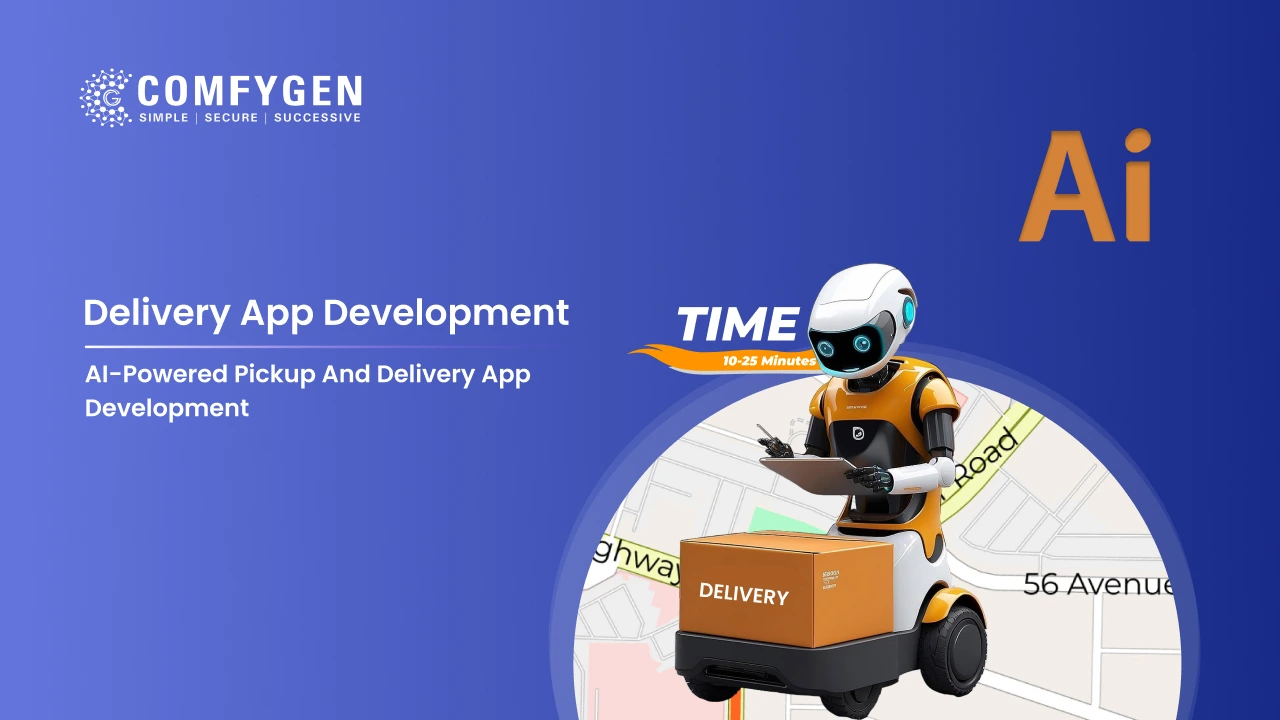





Pickup and delivery apps are the backbone of modern logistics. Whether it’s food, groceries, couriers, pharmacies, or eCommerce, customers expect fast delivery, live tracking, flexible time slots, and zero friction from checkout to doorstep.
AI-powered pickup and delivery app development helps in this. AI automates driver assignment, optimizes routes, predicts delivery times, and balances demand in real time. The result is faster deliveries, lower operational costs, and a smoother experience for customers and drivers alike.
In this blog, we’ll know how AI-powered pickup and delivery apps work, the key features, benefits, pickup and delivery app development cost, real-world use cases for every sector, and what it takes to build a scalable, intelligent delivery platform.
What Is AI-Powered Pickup and Delivery App Development?
AI-powered pickup and delivery app development means building delivery apps that use artificial intelligence to make smarter decisions. Unlike standard pickup and delivery apps, AI apps use machine learning, automation, and data analytics to optimize routes, predict demand, assign drivers, and improve delivery speed and accuracy in real time.
Why Businesses Are Investing in AI-Driven Pickup and Delivery Solutions
Pickup and delivery is no longer a back-office operation. It’s a core part of the customer experience, and businesses that depend on manual or rule-based systems are already feeling the pressure. AI-driven delivery app development solutions solve traditional logistics and transportation problems.
1. Rising customer expectations for faster delivery
Customers now expect same-day, and often same-hour, delivery as the standard. AI helps businesses forecast demand, optimize routes in real time, and assign pickups instantly. What this really means is fewer delays, smoother operations, and happier customers without overloading drivers.
2. High operational costs in manual dispatch systems
Manual dispatch drives up operational costs. It depends on human judgment, spreadsheets, and constant coordination, which leads to delays, errors, and wasted fuel as operations scale. AI automates dispatching, reduces driver idle time, and selects the most efficient routes, cutting costs while maintaining service quality.
3. Need for real-time decision making
Delivery operations change minute by minute. Traffic, cancellations, and sudden demand spikes can disrupt schedules instantly. AI-powered systems analyze live data and make real-time adjustments, rerouting drivers or reallocating deliveries before problems escalate.
4. Scalability challenges in on-demand logistics
As order volumes grow, traditional logistics systems break down. Adding more dispatchers or manual checks doesn’t scale. AI-powered systems are built for growth, learning from data, adapting to higher demand, and keeping operations stable, whether you manage 100 orders a day or 10,000.
Key Technologies used in AI-Powered Pickup and Delivery App
AI is no longer an optional feature in food and grocery delivery app development. It powers the core operations behind modern logistics, enabling faster deliveries, fewer errors, and consistent performance at scale. In an AI-powered pickup and delivery app, intelligent technologies drive real-time decisions across dispatching, routing, and demand management. Here’s how these core AI technologies work in real-world delivery operations.
| Business Need | How AI Solves It | Real Business Impact |
| Faster deliveries | AI predicts traffic, weather, and demand to optimize routes in real time | Shorter delivery times and fewer late orders |
| High operational costs | Smart dispatching reduces fuel usage, idle time, and manual coordination | Lower delivery costs and higher profit margins |
| Growing customer expectations | AI enables real-time tracking, accurate ETAs, and proactive notifications | Better customer satisfaction and repeat usage |
| Inefficient order allocation | AI automatically matches orders with the best nearby driver | Faster pickups and balanced driver workloads |
| Unpredictable demand | Machine learning forecasts peak hours and order volume | Smarter resource planning and fewer bottlenecks |
| Delivery errors and failures | AI detects anomalies and flags potential issues before they escalate | Reduced failed deliveries and refunds |
| Scaling challenges | AI systems adapt as order volume and service areas grow | Easy expansion without operational chaos |
| Data overload | AI turns delivery data into actionable insights | Better decisions backed by real numbers |
Core Features of an AI-Powered Pickup and Delivery App
An AI-driven pickup and delivery app isn’t just about moving a parcel from point A to point B. The real value comes from how intelligently the system makes decisions in real time. Here’s what that looks like in practice.
1. Smart Order Allocation
Smart order allocation uses AI to automatically assign delivery orders to the most suitable driver in real time. Instead of manual dispatching or basic rule-based systems, AI-powered food delivery apps evaluate key factors like driver location, availability, vehicle type, and current workload. This ensures faster pickups, balanced workloads, and more efficient delivery operations.
2. Real-Time GPS Tracking
Real-time GPS tracking brings full transparency to pickup and delivery apps. AI-powered tracking shows live order status, driver location, and delivery progress at every step. For businesses, it enables better monitoring, faster issue resolution, and consistent service quality. For customers, it builds trust and cuts down “Where is my order?” inquiries.
3. Dynamic Pricing Engine
Static pricing falls apart in real-world delivery operations. An AI-driven dynamic pricing engine automatically adjusts delivery fees based on demand, distance, traffic conditions, time of day, and peak hours. This allows businesses to protect margins during high-demand periods while staying competitive when demand is lower.
4. Intelligent Delivery Time Prediction
Accurate delivery time estimates are critical but complex. AI-powered ETA prediction analyzes historical delivery data, live traffic, weather conditions, and rider performance to forecast delivery times more accurately. This leads to fewer missed expectations and better planning for both customers and operations teams.
5. Fraud Detection and Risk Analysis
Fraud can quietly erode profits in pickup and delivery platforms. AI-powered fraud detection systems analyze behavior patterns to identify fake orders, failed payments, and promo code misuse in real time. This helps prevent losses early while keeping the experience smooth for genuine users.
6. AI-Powered Customer Support
AI-powered customer support reduces pressure on human teams by handling routine queries such as order status, delays, refunds, and notifications. Intelligent chatbots resolve common issues instantly, while complex cases are smoothly routed to human agents with full context, saving time and reducing frustration for everyone involved.
Feature Summary Table
| Feature | What AI Does | Business Impact |
| Smart Order Allocation | Matches orders with the best delivery partner in real time | Faster deliveries, optimized resources |
| Real-Time GPS Tracking | Tracks riders and orders live | Higher customer trust, fewer support queries |
| Dynamic Pricing Engine | Adjusts prices based on demand and distance | Better margins and fair pricing |
| Intelligent ETA Prediction | Uses live and historical data to predict delivery times | Fewer delays and better customer satisfaction |
| Fraud Detection & Risk Analysis | Identifies fake orders and suspicious behavior | Reduced revenue leakage |
| AI-Powered Customer Support | Automates queries and notifications | Lower support costs, faster resolutions |
Boost Your Delivery Business with AI
Get Your Custom Pickup & Delivery App Developed Today!
Benefits of AI-Powered Pickup and Delivery App Development
AI-powered pickup and delivery apps close these gaps, optimizing operations, improving speed, and enhancing customer experience. With intelligence built in, your app starts working for your business, not against it.
Faster deliveries with fewer delays
AI monitors traffic, weather, delivery density, and driver availability in real time to create adaptive, smart routes. This reduces late deliveries, minimizes idle time, and increases the number of orders completed each day.
Lower fuel and operational costs
AI optimizes routes, load planning, and driver assignments to reduce unnecessary mileage. By matching the right driver to the right delivery, businesses save on fuel, overtime, and overall operational expenses.
Higher customer satisfaction and repeat usage
Reliability drives customer loyalty. AI ensures accurate delivery times, proactive delay notifications, and faster issue resolution. When deliveries arrive as promised, trust grows, leading to repeat orders and long-term customer satisfaction.
Smarter decisions backed by real data
AI-powered pickup and delivery app go beyond completing orders—they learn from them. By analyzing peak hours, high-demand areas, driver performance, and customer behavior, businesses gain actionable insights for pricing, staffing, expansion, and marketing strategies.
Easy scalability as your business grows
Manual systems struggle when order volumes spike. AI-powered delivery platforms scale effortlessly, adapting to new cities, additional drivers, or seasonal surges without disrupting operations.
Key Players Leveraging AI in Pickup and Delivery
The pickup and delivery industry has seen some of its biggest innovations driven by AI, and several major players are setting the benchmark for efficiency, speed, and customer satisfaction.
Global Leaders Using AI
Companies like Amazon, Uber Eats, DoorDash, DHL, and FedEx are at the forefront of integrating AI into their delivery operations. Amazon, for example, leverages AI for route optimization, predictive inventory management, and automated warehouse operations, reducing delivery times and costs. Uber Eats and DoorDash use AI to match orders with delivery partners dynamically, predict delivery times based on real-time traffic data, and adjust pricing during peak demand. DHL and FedEx apply AI for predictive maintenance, automated sorting, and fraud detection, ensuring parcels reach customers faster and securely.
AI Innovation by Startups
Startups are also bringing fresh approaches to the table. Companies focusing on niche deliveries, such as medicines, groceries, or fragile goods, use AI for predictive delivery scheduling, temperature monitoring, and even optimizing multi-stop routes for small fleets. These innovations often allow startups to compete with larger players by offering highly personalized and efficient services.
Lessons for Small and Medium Businesses
Even if you’re running a small or medium delivery operation, the practices of these leaders offer valuable insights. Implementing AI-powered route optimization can cut fuel and labor costs. Predictive delivery estimates enhance customer trust, while automated dispatch systems streamline operations without adding headcount. Essentially, AI enables businesses of all sizes to operate smarter, faster, and more reliably.
AI-Powered Pickup and Delivery App Development Process
Developing an AI-powered pickup and delivery app involves a structured process that leverages machine learning for features like route optimization and personalized recommendations, aligning with agile methodologies and tech stacks like React Native, Node.js, and TensorFlow. This approach suits on-demand services such as grocery or food delivery, focusing on efficiency and user experience in markets.
1. Requirement Analysis and Research
Start by defining your business goals, target users, and the type of delivery service—food, groceries, parcels, or specialized items. Analyze competitors, market trends, and customer pain points to identify AI features that will make your app stand out.
2. Conceptualization and Feature Planning
Outline the core features your app needs. For AI-powered apps, this often includes:
-
Smart route optimization
-
Predictive delivery times
-
Automated order assignment to drivers
-
Real-time traffic and weather analysis
-
AI-powered customer support
Decide on additional modules like payment gateways, notifications, and analytics dashboards.
3. UI/UX Design
Design a user-friendly interface for customers, drivers, and admins. Focus on simplicity, clear navigation, and real-time visibility. AI can be integrated into the interface for dynamic suggestions, like predicting preferred delivery times or offering smart notifications.
4. AI & Backend Development
-
AI Models: Develop machine learning algorithms for route optimization, demand forecasting, and predictive analytics.
-
Backend: Build a scalable backend to handle user requests, orders, and real-time updates. Integrate APIs for maps, payment processing, and notifications.
-
Database: Store delivery data securely while enabling analytics and reporting.
5. Mobile App Development
Develop native or cross-platform apps for iOS and Android. Integrate AI features into both apps so that drivers get optimized routes, customers receive accurate ETAs, and admins can monitor performance with AI-powered insights.
6. Testing and QA
Test every component: AI predictions, real-time tracking, payments, notifications, and UI. Conduct load testing to ensure the app performs under high demand. Refine AI models based on initial test results to improve accuracy.
7. Deployment
Launch the app on app stores and web platforms. Ensure smooth server scaling and monitoring for user activity and AI performance.
8. Post-Launch Optimization
-
Continuously analyze user behavior and delivery performance.
-
Update AI models for better predictions and route optimization.
-
Roll out new features based on analytics and user feedback.
9. Maintenance and Support
Provide ongoing updates, bug fixes, and enhancements. AI models need periodic retraining as new data comes in to maintain efficiency and accuracy.
Cost of AI-Powered Pickup and Delivery App Development
Understanding the cost of building an AI-driven pickup and delivery app helps businesses plan effectively. The total investment depends on several factors:
Factors Affecting Development Cost
- App complexity: More features like real-time tracking, predictive delivery, or AI-powered recommendations increase development effort.
- Platform choice: iOS, Android, or cross-platform apps affect cost differently.
- AI model integration: Custom AI models for route optimization, demand prediction, or automated dispatch add to the budget.
- Third-party integrations: Payment gateways, maps, and messaging services can influence cost.
Basic vs Advanced AI Features
- Basic AI features:
- Simple route suggestions
- Automated notifications
- Basic predictive delivery times
- Simple route suggestions
- Advanced AI features:
- Dynamic route optimization using traffic and weather data
- Demand forecasting and resource allocation
- AI-powered customer support and chatbot assistance
- Dynamic route optimization using traffic and weather data
Estimated Cost Range
- Basic AI-powered app: $25,000 – $50,000
- Advanced AI-powered app: $50,000 – $120,000+
Costs vary based on features, AI complexity, and customization.+
Conclusion
At Comfygen Technologies, we believe AI is the future of pickup and delivery solutions. Our AI-powered apps help businesses predict demand, optimize routes, and enhance customer experience, making every delivery smarter and faster.
Investing in an AI-driven delivery solution with Comfygen Technologies means gaining efficiency, reducing operational costs, and staying ahead in a competitive market. Our expertise ensures your app is not just functional but intelligent—turning data into actionable insights and delivering a seamless experience for users and drivers alike.

Mr. Saddam Husen, (CTO)
Mr. Saddam Husen, CTO at Comfygen, is a renowned Blockchain expert and IT consultant with extensive experience in blockchain development, crypto wallets, DeFi, ICOs, and smart contracts. Passionate about digital transformation, he helps businesses harness blockchain technology’s potential, driving innovation and enhancing IT infrastructure for global success.