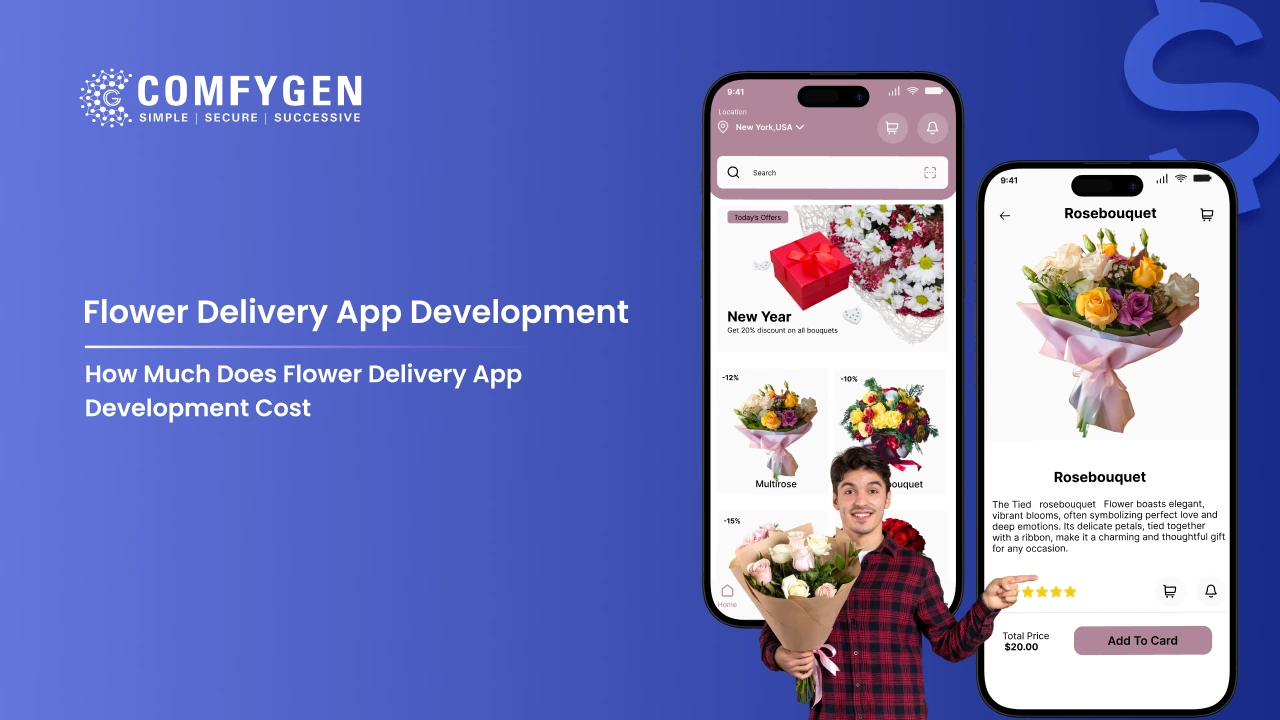





Flower delivery app development cost ranges from $8,000 to $60,000+ in 2026. A white-label app starts near $8,000 and launches in 3 to 5 weeks. A custom single-florist app runs $8,000 to $15,000. A multi-vendor flower marketplace runs $20,000 to $40,000. A full gifting platform with partner florists and midnight slots starts at $25,000. On top of that, plan for $4,000 to $14,000 in year-one running costs.
Key Takeaways
- Features drive price more than anything else. Live tracking, subscriptions and vendor payouts are the three that move the number most.
- Flowers carry costs other delivery apps don’t, such as stock that expires, product photography and servers that must survive Valentine’s Day.
- Running costs are usually missed. App store fees, maps, SMS, payment processing and hosting add up every month after launch.
- Starting with an MVP in one city cuts the first bill by roughly 30% to 50%, and you can add the rest once orders are steady.
- Most single-shop apps pay back in 9 to 18 months, mainly through orders placed outside shop hours.
How Much Does It Cost to Build a Flower Delivery App?
The honest answer is that there isn’t one price, because “flower delivery app” covers everything from a one-shop ordering app to a platform that routes orders between florists in different countries. Still, the market clusters into five fairly predictable tiers.
| App type | Typical cost | Timeline | Best for |
| White-label flower app | From $8,000 | 3 to 5 weeks | Shops that need to launch before a season |
| Custom single-florist app | $8,000 to $15,000 | 2 to 3 months | One shop or one city, own stock |
| Subscription flower app | $18,000 to $35,000 | 3 to 5 months | Weekly or monthly bouquet plans |
| Multi-vendor flower marketplace | $20,000 to $40,000 | 3 to 5 months | Aggregators listing many florists |
| Flower and gift platform like FNP | $25,000 to $60,000+ | 5 to 7 months | Combos, midnight slots, many cities |
Each tier includes a customer app, a florist panel, a driver app and an admin dashboard. Drop a panel and the price falls, though you usually pay for it later in manual work.
These figures sit above what a courier or laundry build costs, mainly because flowers need stock rules for items that expire within days. Across the wider category, delivery app development costs start closer to $6,000 for the same four panels with simpler inventory.
What Affects the Cost to Develop a Flower Delivery App?
Six decisions account for most of the difference between a $10,000 quote and a $45,000 one.
| Factor | Low cost | Higher cost | Why it matters |
| Feature depth | Catalog, cart, checkout | Live tracking, subscriptions, AI suggestions | Each feature adds design, build, test and support time |
| Panels | Customer app only | Customer, florist, driver and admin | A marketplace needs all four |
| Platform | Cross-platform | Separate native iOS and Android | Two codebases means roughly 1.6 times the build effort |
| Design | Template screens | Custom visuals and animation | Flowers sell on looks, so design pays for itself |
| Backend | Single shop, simple orders | Multi-vendor, real-time stock, payouts | Vendor payouts are the single costliest backend piece |
| Team location | Asia | North America, Western Europe | Hourly rates differ by 4 to 6 times |
Flower Delivery App Cost Breakdown by Development Stage
Here’s where the money actually goes on a mid-sized build.
| Stage | Cost range | Share of budget |
| Discovery and planning | $500 to $2,000 | 5% |
| UI/UX design | $1,500 to $4,000 | 12% |
| Frontend development | $3,000 to $8,000 | 22% |
| Backend development | $4,000 to $12,000 | 30% |
| Third-party integrations | $1,000 to $4,000 | 12% |
| Testing and deployment | $1,000 to $3,000 | 10% |
| Project management | $800 to $2,500 | 9% |
Backend work takes the largest share because order routing, stock sync and payment handling all live there. Skimping at this stage tends to show up as crashes on your busiest day.
Feature-Wise Flower App Development Cost
Below are the figures most clients ask for. Prices assume cross-platform development at mid-range offshore rates.
Customer App Features and Cost
| Feature | What it does | Cost |
| Registration and login | Email, phone or social sign-in | $300 to $700 |
| Flower catalog | Photos, prices, occasion categories | $600 to $1,200 |
| Search and filters | Find by occasion, colour, budget | $500 to $1,000 |
| Cart and checkout | Order review and address entry | $700 to $1,500 |
| Payment integration | Cards, wallets, UPI | $800 to $2,000 |
| Live order tracking | Map view of the driver | $1,000 to $2,500 |
| Bouquet builder | Pick stems and wrap, see a preview | $2,000 to $4,500 |
| Message cards and gift notes | Personal note printed or attached | $400 to $1,000 |
Florist Panel Features and Cost
| Feature | What it does | Cost |
| Product management | Add and edit listings | $700 to $1,500 |
| Stock control | Track stems and arrangements | $600 to $1,200 |
| Accept or reject orders | Decline when stock runs out | $500 to $1,100 |
| Seasonal pricing | Raise prices on peak dates | $500 to $1,000 |
| Bouquet photo approval | Upload the finished arrangement | $700 to $1,600 |
| Sales dashboard | Earnings and order reports | $700 to $1,500 |
Driver App Features and Cost
| Feature | What it does | Cost |
| Order assignment | Send jobs to the nearest driver | $600 to $1,200 |
| GPS navigation | Route planning via maps | $1,000 to $2,500 |
| Status updates | Picked up, on the way, delivered | $700 to $1,500 |
| Proof of delivery | Photo or signature at the door | $600 to $1,200 |
Admin Panel Features and Cost
| Feature | What it does | Cost |
| User and vendor management | Approve and manage accounts | $800 to $1,800 |
| Commission and payouts | Split money between vendors | $1,000 to $2,500 |
| Offers and coupons | Run promotions | $700 to $1,500 |
| Analytics and reports | Sales and delivery performance | $1,200 to $3,000 |
| Slot capacity control | Cap orders per zone per day | $900 to $2,000 |
Advanced Features That Raise the Cost
| Feature | Cost |
| AI occasion recommendations | $2,000 to $5,000 |
| Subscription management | $1,200 to $3,000 |
| Partner florist relay routing | $2,500 to $6,000 |
| In-app chat support | $1,500 to $3,500 |
| Loyalty and referral program | $1,000 to $2,500 |
| Multi-currency checkout | $1,200 to $3,000 |
Flower-Specific Costs Most Estimates Leave Out
This is where a flower app stops behaving like a food app, and where generic quotes go wrong.
Stock That Expires
Cut roses last a few days. Your app needs stock rules that hide sold-out stems automatically and offer the customer a close swap to approve. Building that logic properly costs $1,500 to $4,000, and skipping it means refunds and bad reviews instead.
Peak-day Infrastructure
Valentine’s Day and Mother’s Day can bring several times your normal order volume into a few hours. Auto-scaling servers, queue handling and load testing before the season add $1,000 to $3,500 to the first build, plus a higher hosting bill for those two months.
Product Photography
Customers buy what they can see, and stock images rarely match what your florist actually makes. Professional photography runs $40 to $200 per product, and a catalog of 80 items is a real line in your budget.
Surprise Delivery Handling
The buyer often doesn’t know the recipient’s full address, and the price must stay off the delivery note. Address-request messaging and hidden-price packing slips add $800 to $2,000.
Partner Florist Relay
Sending an order from Dubai to Jaipur means handing it to a local shop, with agreed quality standards and a payout split. That routing layer is $2,500 to $6,000 and only makes sense once you serve more than one city.
Bouquet Photo Approval
Having the florist photograph the finished arrangement before dispatch cuts complaints sharply. Budget $700 to $1,600 for the upload and approval flow.
Together, these flower-specific pieces usually add $6,000 to $18,000 to a serious build. Leaving them out is how a cheap quote turns expensive later.
Flower Delivery App Development Cost by Platform
| Platform | Cost | Notes |
| Android only | $10,000 to $25,000 | Widest reach in India, Southeast Asia and Latin America |
| iOS only | $12,000 to $28,000 | Higher average order values in the US, UK and Gulf |
| Cross-platform | $15,000 to $35,000 | One codebase for both, usually the best value |
| Native both | $22,000 to $50,000 | Worth it only for heavy animation or deep device features |
For most florists, Flutter or React Native covers both stores at roughly 60% of the native price. iOS still makes sense for premium gifting brands where polish drives conversion.
Cost to Develop a Flower Delivery App by Region
Developer rates vary more than any other single factor.
| Region | Hourly rate | Typical project cost |
| India | $25 to $50 | $8,000 to $25,000 |
| Eastern Europe | $40 to $70 | $18,000 to $40,000 |
| Western Europe | $70 to $120 | $25,000 to $50,000 |
| USA and Canada | $100 to $180 | $30,000 to $60,000+ |
| UAE and Gulf | $60 to $100 | $22,000 to $45,000 |
The same app can therefore cost three times more depending on where it’s built. Many US and UK florists hire offshore teams while keeping product decisions in-house, which is why our Jaipur team works with clients across the USA, UK, UAE and Canada.
What a Flower Delivery App Costs to Run in Year One
Development is a one-time bill. Running the app is not, and this is the part most guides skip entirely.
| Running cost | Typical year-one amount |
| Apple Developer Program | $99 per year (Apple’s current fee) |
| Google Play registration | $25, one time |
| Cloud hosting | $100 to $600 per month, higher during peak months |
| Maps and routing APIs | $50 to $400 per month after the free allowance |
| SMS and push notifications | $30 to $250 per month |
| Payment processing | Roughly 2% to 3% of every transaction |
| App maintenance and updates | 15% to 20% of build cost per year |
| Customer support tools | $20 to $150 per month |
For a mid-sized app, that works out to roughly $4,000 to $14,000 in the first year, before marketing. Budget for it from day one rather than discovering it in month three.
How Long Does It Take to Build a Flower Delivery App?
| App type | Timeline |
| White-label | 3 to 5 weeks |
| Custom single-florist | 2 to 3 months |
| Subscription app | 3 to 5 months |
| Multi-vendor marketplace | 3 to 5 months |
| Gifting platform | 5 to 7 months |
Seasons matter here. If you want to be live for Valentine’s Day, start a custom build by early November. Leaving it to January usually means a white-label launch instead.
How to Reduce Flower Delivery App Development Cost
You can cut the first invoice substantially without shipping a weak product.
Launch an MVP in one city: Catalog, checkout, slot booking and tracking will carry you. Add subscriptions and multi-vendor later. Saves 30% to 50%.
Go cross-platform: One codebase for iOS and Android instead of two teams. Saves 25% to 40%.
Use proven APIs: Stripe or Razorpay for payments, Google Maps for routing, Twilio for messaging. Building these from scratch adds months and almost no advantage. Saves 20% to 35%.
Start white-label, customize later: A white-label app gets you trading while the custom build runs in parallel, so revenue starts earlier and funds part of the bigger version.
Phase the features: Ship, watch what customers actually use, then build. Plenty of teams pay for features nobody opens. Pairing phased releases with a tight first scope is the most reliable way to reduce app development cost without shipping something half-finished.
How Flower Delivery Apps Earn the Investment Back
Cost only means something next to return. Flower apps make money in five ways.
| Revenue stream | Typical range |
| Commission from florists | 10% to 25% per order |
| Delivery fees | $2 to $10 per order |
| Vendor subscription plans | $20 to $200 per vendor per month |
| Featured listings | $50 to $500 per campaign |
| Peak-season pricing | 20% to 40% higher margins |
Here’s a simple payback example for a single-shop app built at $12,000. Suppose the shop takes 250 app orders a month at an average of $55, with a 30% margin. That’s about $4,125 in monthly gross profit from app orders. Even if only a third of those orders are genuinely new business that the shop wouldn’t have taken by phone, payback lands around 9 months. Shops that promote the app properly usually beat that, because most app orders arrive in the evenings and on Sundays, when the shop is closed.
Demand supports the maths too. Grand View Research expects the global flower delivery service market to reach USD 11.28 billion by 2030, growing about 6.8% a year, with online channels taking a rising share.
Comparing Your Quotes
When three agencies send three very different numbers, check these five things before deciding:
- Does the quote include all four panels, or only the customer app?
- Is stock logic for perishable items included, or treated as a change request?
- Who pays for product photography?
- What’s covered by support after launch, and for how long?
- Does the price include load testing before peak season?
A cheap quote that excludes three of these usually ends up costing more than the higher one, because each omission comes back as a change request at full rate. As a flower delivery app development company working with florists and gifting brands across the USA, UK, UAE and Canada, our team prices all five into the first estimate rather than the third invoice.
Conclusion
Flower delivery app development cost in 2026 lands between $8,000 and $60,000+, and where you sit depends mostly on how many panels you need and whether your app has to handle perishable stock, peak-day traffic and partner florists. Add year-one running costs of roughly $4,000 to $14,000 on top of the build.
The smartest route for most florists is simple. Launch lean in one city, get real order data, then invest in the features your customers keep asking for. A phased build almost always beats a big-bang launch, both for budget and for the quality of what ends up shipping.
Frequently Asked Questions
How much does it cost to develop a flower delivery app?
What is the cheapest way to build a flower delivery app?
How much does it cost to build an app like Ferns N Petals or Floward?
What are the hidden costs of a flower delivery app?
How much does flower delivery app maintenance cost per year?
How long does it take to build a flower delivery app?
Is a flower delivery app profitable for a small florist?

Mr. Saddam Husen, (CTO)
Mr. Saddam Husen, CTO at Comfygen, is a renowned Blockchain expert and IT consultant with extensive experience in blockchain development, crypto wallets, DeFi, ICOs, and smart contracts. Passionate about digital transformation, he helps businesses harness blockchain technology’s potential, driving innovation and enhancing IT infrastructure for global success.