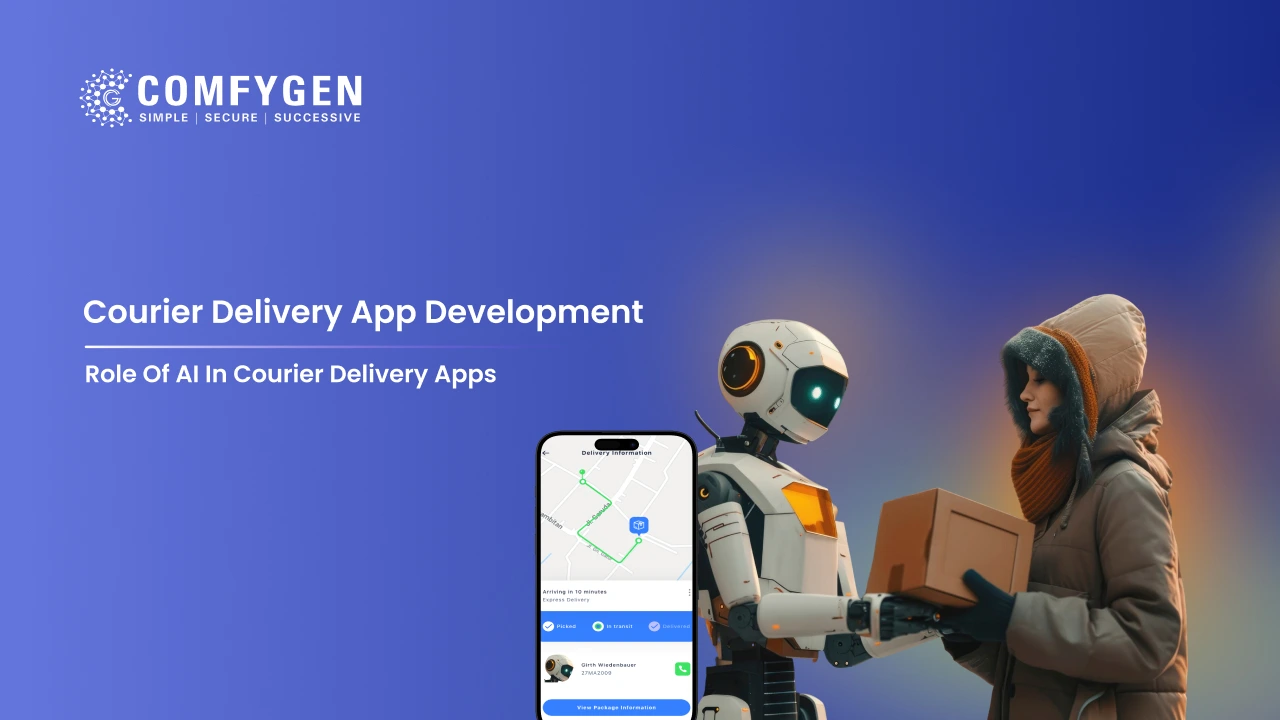





AI in courier delivery apps handles four jobs: choosing the best courier partner for each shipment, assigning the right driver to each pickup, planning multi-stop routes, and predicting delivery times. The biggest gains come from courier allocation, where picking the right partner per pincode can lower shipping cost and cut failed deliveries. Each of these needs 3 to 6 months of your own delivery history before it works better than a simple rule.
Key takeaways
- Courier allocation and driver dispatch are two different problems. Most articles mix them up.
- AI needs your delivery history. Without data, a rule-based system performs just as well.
- Start with one use case, measure it, then add the next.
- Vendor-reported savings figures are marketing numbers. Test against your own baseline.
- AI agents that handle failed deliveries are the newest practical use case.
AI Courier Allocation vs. AI Dispatch: What’s the Difference?
This trips up a lot of people planning a courier app, so it’s worth separating early.
| Factor | AI Courier Allocation | AI Driver Dispatch |
| The question it answers | Which courier company should carry this parcel? | Which of my drivers should pick this up? |
| Who needs it | Businesses shipping through multiple courier partners | Businesses running their own delivery fleet |
| Decides based on | Cost per pincode, delivery success rate, partner SLA | Driver location, current load, vehicle type |
| Typical user | Ecommerce brands, aggregators, marketplaces | Courier companies, hyperlocal delivery apps |
Some platforms need both. A marketplace might dispatch its own riders inside the city and hand longer shipments to partner couriers.
How Does AI Courier Allocation Work?
When an order comes in, the system scores every available courier partner for that specific shipment and picks the best one. The scoring usually looks at:
- Pincode-level performance: A courier that performs well in Mumbai may fail often in a Tier 3 town.
- Delivery success rate: How often that partner actually completes delivery on the first attempt.
- RTO risk: RTO means Return to Origin, when a parcel comes back undelivered. This is the most expensive failure in ecommerce shipping.
- Cost for that weight and distance band.
- Promised delivery time versus actual history.
- Current capacity: A partner already at full load will slow down.
Should You Use Rules or Machine Learning?
Many platforms call a simple rule engine “AI.” Here’s the honest difference:
| Factor | Rule-Based Allocation | Machine Learning Allocation |
| How it decides | Fixed rules you set once, like “cheapest courier for this pincode” | Learns from outcomes and updates its own weighting |
| Data needed | None | 3 to 6 months of delivery outcomes |
| Handles new situations | Poorly, rules go stale | Adapts as patterns shift |
| Build effort | Low | Moderate to high |
| Worth it when | Under a few hundred orders a day, few partners | High volume, many partners, high cash-on-delivery share |
If your order volume is low, a rule engine is the right starting point. Machine learning only beats it once you have enough history for patterns to appear. Building an ML model on two months of thin data produces confident guesses, not useful ones.
Platform vendors publish figures like 12 to 18% lower shipping cost or 20 to 30% lower RTO from AI allocation. Treat those as vendor marketing. Measure your own baseline for 30 days first, then compare.
How Does AI Driver Dispatch Work?
Dispatch assigns a pickup to one of your own drivers. A good engine weighs distance to pickup, current load, vehicle capacity, driver shift time left, and the direction of their existing route.
The part teams underestimate is re-assignment. Orders get cancelled, drivers run late, traffic changes. A dispatch engine that assigns once and never reconsiders falls apart during busy hours. Plan for continuous re-evaluation from the start, because adding it later means rebuilding the core logic.
AI Route Planning for Multi-Stop Deliveries
One driver with fifteen stops has more possible route combinations than anyone can work out by hand. AI route planning solves for distance, time windows, traffic, and vehicle limits together, then updates mid-route when conditions change.
Two things matter in practice. First, the route must recalculate when a stop fails or a new pickup is added. Second, drivers need to see why the order changed, or they start ignoring the app and following their own instincts.
How AI Predicts Delivery Times
Customers judge a courier on whether the promised time was accurate, not whether it was fast. A prediction model uses past delivery times on similar routes, time of day, day of week, weather, and the specific pickup and drop-off area.
Set expectations honestly here. A good model narrows a delivery window, it does not produce a guaranteed minute. Showing a 30-minute window you hit consistently builds more trust than a precise time you miss.
Multi-Courier Shipping Automation
Allocation is one step. Full automation means these run without anyone logging into a courier portal:
| Task | What automation does |
| Courier selection | Picks the partner per shipment automatically |
| Label generation | Creates and prints labels in bulk |
| Tracking | Pulls status from every partner into one view |
| NDR handling | NDR means Non-Delivery Report. The system contacts the customer, confirms details, and reschedules |
| Reconciliation | Matches courier invoices against actual shipments |
| Returns | Books reverse pickup automatically |
Most teams automate selection and tracking, then stop. NDR handling is usually where the bigger saving sits, because every failed delivery you rescue avoids a full return journey.
AI Agents for Same-Day Courier Platforms
This is the newest practical use case. An AI agent handles a complete task on its own instead of just making one prediction.
- Failed delivery agent: Calls or messages the customer, confirms the address, and rebooks the slot.
- Capacity agent: Watches incoming demand against available drivers and flags a shortfall before it becomes a delay.
- Dispute agent: Collects the delivery photo, GPS record, and timestamp, then resolves or escalates the claim.
- Support agent: Answers tracking questions from live order data rather than a static FAQ.
Keep a human in the loop for anything involving refunds or compensation. Agents are good at gathering and acting on facts, less good at judgment calls that cost money.
Fraud Detection and Payment Checks
AI flags unusual patterns that manual review misses: repeated cash-on-delivery refusals from one address, deliveries marked complete far from the drop-off GPS point, or sudden spikes in claims from one driver. These checks run in the background and only surface the cases worth a human look.
What Data You Need Before Any of This Works
This is the section most articles skip, and it decides whether an AI project succeeds.
| AI feature | Data needed | Rough minimum |
| Courier allocation | Delivery outcomes by partner and pincode | 3 to 6 months |
| Driver dispatch | Trip logs with timestamps and locations | 2 to 3 months |
| Predictive ETA | Completed deliveries with actual durations | 6 months, ideally across seasons |
| Fraud detection | Confirmed fraud and dispute cases | 100+ labelled examples |
| Route planning | Address and map data | Works from day one |
Route planning is the exception. It works immediately because it solves a maths problem rather than learning from your history. That’s why it’s usually the first AI feature to add.
If you’re launching a new app with no history at all, start with rules, log everything properly from day one, and revisit AI after six months of real orders.
The Order to Build These In
| Stage | Add | Why here |
| 1 | Route planning | Works without historical data |
| 2 | Rule-based allocation or dispatch | Gives a baseline and starts collecting outcomes |
| 3 | Predictive delivery times | Needs a few months of completed trips |
| 4 | ML-based allocation | Needs enough history for patterns |
| 5 | NDR and fraud automation | Needs labelled failure cases |
| 6 | AI agents | Needs the layers above working reliably |
Teams that try to build stages 4 to 6 first usually end up rebuilding them. The models need the data that stages 1 to 3 produce.
Adding AI to a Courier App That Already Exists
You don’t need to rebuild. In most cases, AI features are added as a separate service that sits alongside the existing app, reads from the same database, and returns decisions through an API.
What usually needs attention first:
- Event logging: Many older apps record only the final delivery status, not the steps in between. Models need the steps.
- Clean location data: Inconsistent address formats break pincode-level scoring.
- A feedback loop: The system has to learn whether its decision turned out well, which means recording outcomes against predictions.
Comfygen handles this kind of work as part of its AI-powered courier delivery app development, whether the AI layer goes into a new build or an existing platform.
Mistakes to Avoid With AI Courier Apps
1. Calling a rule engine AI: It isn’t wrong to use rules, but naming them AI leads teams to expect learning that isn’t there.
2. Starting with the hardest model: Allocation models need history. Route planning doesn’t. Start where you can succeed.
3. No baseline measurement: Without 30 days of “before” numbers, you can’t prove the AI helped.
4. Ignoring driver trust: If the app’s assignments look wrong to experienced drivers, they override it and the data stops reflecting reality.
5. Skipping the feedback loop: A model that never learns whether its choices worked stops improving the day it ships.
Why Work With Comfygen
Comfygen has built delivery and logistics platforms since 2019, including a custom logistics app with real-time tracking for a courier client. That work covers 550+ projects for 400+ clients across 30+ countries, with a 97% client retention rate, under ISO 9001, ISO/IEC 20000-1, and ISO 27001 certified processes.
The practical advantage on AI projects is knowing which features actually need machine learning and which ones a well-designed rule will handle for a fraction of the cost. That judgement call is part of every build, which is why the team settles the AI layer during planning rather than after launch, alongside the model, features, and budget decisions that shape how to develop a courier delivery app.
Frequently Asked Questions
What is AI courier allocation?
What’s the difference between AI courier allocation and AI dispatch?
How much data do I need before AI allocation works?
Does AI courier allocation actually reduce costs?
Which AI feature should I add first?
Can AI be added to an existing courier app?
What are AI agents in courier delivery?

Mr. Saddam Husen, (CTO)
Mr. Saddam Husen, CTO at Comfygen, is a renowned Blockchain expert and IT consultant with extensive experience in blockchain development, crypto wallets, DeFi, ICOs, and smart contracts. Passionate about digital transformation, he helps businesses harness blockchain technology’s potential, driving innovation and enhancing IT infrastructure for global success.