

Most blockchain budgets go wrong in the first conversation, not the last one. A founder asks what an app costs, gets a number, and builds a plan around it — then discovers the security audit, the integrations, and the legal review were never inside that figure.
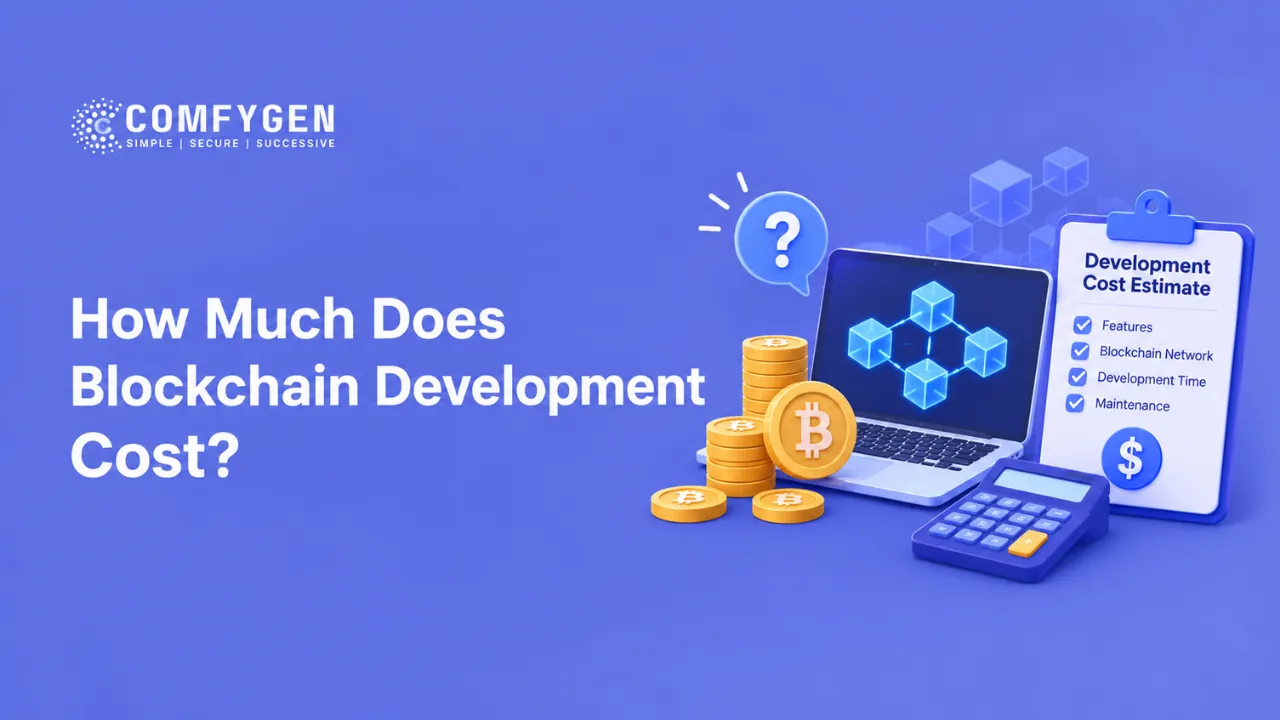
In 2026, a basic blockchain application costs $25,000 to $50,000. Medium-complexity work sits at $50,000 to $120,000. Advanced and enterprise platforms start at $120,000 and run past $300,000. Building a new blockchain from scratch starts at $120,000 and can exceed $500,000.
The range is that wide because the real cost driver is not feature count , it is whether your system holds value. An application that records business events and an application that custodies user funds can look identical on a feature list and differ by $100,000 in build cost, almost entirely in security and testing.
This guide breaks the cost down by project type, by feature, and by region, and covers the expenses that sit outside most development quotes.
Blockchain Development Cost at a Glance
| Project complexity | Development cost | Timeline |
| Basic blockchain application | $25,000 – $50,000 | 3–6 months |
| Medium-complexity blockchain application | $50,000 – $120,000 | 6–9 months |
| Advanced or enterprise blockchain solution | $120,000 – $300,000+ | 9–18 months |
Basic blockchain application: $25,000 – $50,000
Essential functionality with straightforward blockchain integration:
- User registration and authentication
- Basic wallet integration
- Simple smart contract functionality
- Transaction tracking and user dashboard
- Standard UI/UX
- Single-network integration
Typical fit: a startup building a simple decentralised application, a token-based platform, or a proof of concept moving to production.
Typical fit: a startup building a simple decentralised application, a token-based platform, or a proof of concept moving to production.
Medium-complexity application: $50,000 – $120,000
More advanced business logic, integrations, and user-facing functionality:
- Multiple interacting smart contracts
- Advanced wallet functionality
- API and third-party integrations
- Admin dashboard and reporting
- KYC/AML integration where required
- Token management
- Expanded security testing
Typical fit: a decentralised marketplace, a tokenisation platform, or a business application with several external integrations.
Advanced or enterprise solution: $120,000 – $300,000+
Complex architecture, large-scale integration, and customised workflows:
- Private or permissioned networks
- Multi-chain architecture
- Complex smart contract systems
- Enterprise software integration
- Identity and access management
- Compliance and reporting infrastructure
- Independent security audit
- Scalability and performance work
Typical fit: a financial institution building an asset management platform, or a manufacturer implementing a multi-party supply chain network. Our guide to enterprise blockchain solutions covers the architecture decisions behind these builds.
The tier is not set by feature count. An application handling customer funds or valuable digital assets requires materially more security investment than one that records business events, even with an identical feature list.
Cost by Project Type
| Project type | Cost | Timeline |
| Smart contract development | $5,000 – $70,000+ | 1–14 weeks |
| Token development | $5,000 – $25,000 | 2–6 weeks |
| Cryptocurrency wallet | $15,000 – $60,000 | 2–4 months |
| Basic dApp | $25,000 – $50,000 | 3–6 months |
| NFT marketplace | $50,000 – $150,000 | 3–7 months |
| DeFi platform | $80,000 – $250,000 | 6–12 months |
| Cryptocurrency exchange | $60,000 – $300,000+ | 4–9 months |
| Supply chain blockchain | $70,000 – $250,000 | 4–8 months |
| Enterprise blockchain platform | $120,000 – $300,000+ | 9–18 months |
| Custom blockchain from scratch | $120,000 – $500,000+ | 9–18 months |
These categories overlap with the complexity tiers above. They are alternative ways of scoping the same project, not separate line items to add together.
Smart contract development cost
Smart contracts are self-executing programs stored on a blockchain. They execute predefined instructions when their conditions are met — transferring tokens, distributing rewards, managing staking, or executing a digital agreement.
| Contract type | Cost |
| Basic token contract | $5,000 – $15,000 |
| Medium-complexity contract | $15,000 – $35,000 |
| Advanced business logic | $35,000 – $70,000+ |
A simple token transfer contract requires far less effort than one managing staking rewards, governance, vesting schedules, and complex financial logic.
Security matters most here, because vulnerabilities in deployed contracts can expose funds with no way to patch in place. Independent audits are budgeted separately unless explicitly included in the development agreement. Protocols handling pooled funds need the deeper review that DeFi smart contract development requires.
Cryptocurrency wallet development cost
| Wallet type | Cost |
| Basic crypto wallet | $15,000 – $25,000 |
| Multi-currency wallet | $25,000 – $40,000 |
| Advanced crypto wallet | $40,000 – $60,000+ |
Common features: wallet creation and recovery, private key management, multi-currency support, transaction history, QR scanning, token transfers, biometric and multi-factor authentication, hardware wallet integration.
A custodial wallet requires additional infrastructure and operational controls, because the provider manages users’ keys or assets. Our multicurrency wallet development page covers the custodial and non-custodial trade-off in detail, and crypto wallet development covers single-chain builds.
dApp development cost
A decentralised application interacts with blockchain networks and smart contracts to execute transactions and manage on-chain data.
Basic dApp development runs $25,000 to $50,000. Applications with staking, lending, governance, and multiple interacting contracts move into the $50,000 to $120,000 band.
Common components: Web3 wallet connectivity, smart contract integration, user authentication, transaction management, real-time data synchronisation, admin dashboard, API integrations, responsive interface.
NFT marketplace development cost
$50,000 to $150,000, depending on functionality, supported networks, payment methods, and trading mechanisms.
Common features: NFT minting, user profiles, asset listings, buying and selling, auctions, royalty management, wallet integration, collection management, admin dashboard.
A basic marketplace with fixed-price listings sits at the lower end. Auctions, multiple collections, royalty distribution, and cross-chain transactions push toward the upper end.
DeFi platform development cost
$80,000 to $250,000 or more. This covers decentralised exchanges, lending and borrowing platforms, staking platforms, and yield protocols.
Requirements: smart contract architecture, liquidity pool management, token swaps, staking and rewards, lending and borrowing logic, price oracle integration, risk management, and independent security audit.
DeFi needs the most careful security planning of any category, because vulnerabilities directly affect user funds. Complex lending protocols, bridges, and applications managing substantial assets exceed these estimates.
Crypto exchange development cost
$60,000 to $300,000 or more, depending on whether you build a centralised or decentralised exchange.
Components: user registration and verification, trading interface, order management, liquidity integration, wallet infrastructure, transaction processing, security architecture, admin dashboard, monitoring.
Centralised exchanges add custody, operational security, compliance, and financial infrastructure. Decentralised exchanges need contract development, liquidity mechanisms, and extensive security testing. A P2P crypto exchange sits between the two, with escrow contracts replacing the order book.
Licensing and regulatory requirements are separate and must be assessed per target market.
Supply chain blockchain cost
$70,000 to $250,000.
Features: product tracking, digital product identification, supplier management, transaction records, inventory tracking, QR or RFID integration, logistics monitoring, permission-based access, reporting dashboards.
The main cost driver here is usually integration with existing ERP, logistics platforms, and physical tracking hardware — not the blockchain work itself.
Enterprise blockchain platform cost
$120,000 to $300,000 or more.
Components: private blockchain infrastructure, network architecture, permission and identity management, smart contract development, enterprise API integration, data privacy mechanisms, compliance reporting, network monitoring, security testing.
Hyperledger Fabric and Besu suit organisations needing controlled participation and enterprise infrastructure.
Cost to Build a Blockchain From Scratch
Building a blockchain from scratch means developing a new network, not an application on an existing one. It requires specialised engineering for consensus, node architecture, transaction validation, network communication, and infrastructure.
| Development component | Cost |
| Consensus mechanism development | $40,000 – $100,000 |
| Node software and network architecture | $30,000 – $80,000 |
| Block explorer development | $15,000 – $40,000 |
| Native wallet development | $20,000 – $50,000 |
| Validator and staking infrastructure | $25,000 – $60,000 |
| Testing, security and mainnet deployment | $20,000 – $70,000 |
Not every component is required in every build. A chain without a native wallet or a public block explorer starts below the sum of these ranges, which is why the overall floor sits at $120,000 rather than the component total.
Why custom blockchain costs more
- Consensus mechanism — determines how nodes agree on transaction and block validity
- Node development — nodes communicate, validate, and maintain chain data
- Network architecture — reliable communication, processing, and synchronisation
- Validator infrastructure — validator management, staking, and governance
- Security and testing — extensive testing against network failures, consensus issues, and attacks
The cost teams consistently miss is everything after launch. A chain with no explorer, no wallet support, no indexer, and no auditors familiar with its virtual machine is a chain nobody can build on. Budget ecosystem tooling as its own line item.
Build from scratch, or use an existing network?
Not every business needs its own chain. If your application needs smart contracts, tokenisation, or decentralised transactions, an existing network delivers that at a fraction of the cost.
| Network | Best for |
| Ethereum | Smart contracts and dApps, deepest tooling and liquidity |
| Polygon | EVM-compatible, with far lower transaction fees than Ethereum mainnet |
| Solana | High-throughput applications with frequent on-chain activity |
| Hyperledger Fabric | Permissioned enterprise networks with private data channels |
| Hyperledger Besu | An Ethereum client supporting both public and permissioned deployments |
A custom blockchain build makes sense when you need specialised consensus rules, network governance, or transaction functionality that no existing platform supports. Otherwise an established network reduces development time, security surface, and infrastructure burden.
What Drives the Cost
1. Project complexity
A basic application with wallet connectivity and simple contracts needs fewer engineering hours than a financial platform with multiple contracts, governance, and external integrations. Complexity multiplies development hours, testing requirements, architectural work, and security considerations together — not one at a time.
2. Smart contract complexity
Cost rises with the number of contracts, transaction condition complexity, role-based permissions, upgradeability requirements, governance mechanisms, and oracle integrations.
3. Platform selection
| Blockchain platform | Development consideration | Transaction model |
| Ethereum | Mature EVM ecosystem and tooling | Gas fees |
| Polygon | EVM-compatible, low fees | Network fees |
| BNB Chain | EVM-compatible | Gas fees |
| Solana | Rust and Solana-specific architecture | Network fees |
| Hyperledger Fabric | Permissioned, Go/Java chaincode | No public gas model |
The cheapest network is not automatically the right one. Weigh ecosystem maturity, developer availability, security, scalability, and long-term maintenance. Our blockchain development process guide covers platform selection as a distinct project phase.
4. Security and audits
Audits, code reviews, penetration testing, vulnerability assessment, infrastructure testing, key management, and post-audit remediation all sit here. Independent audit is a separate service unless written into the development agreement. See the audit table below for current pricing.
5. Third-party integrations
Payment gateways, banking systems, ERP and CRM platforms, KYC/AML providers, wallet providers, identity verification, external APIs, oracle services. Integration becomes a significant share of budget when existing systems have thin documentation or need custom middleware.
6. UI/UX design
Budget scales with screen count, user journeys, dashboards, and interaction complexity. A basic wallet interface is far simpler than a DeFi dashboard showing liquidity pools, transaction activity, balances, and portfolio analytics.
7. Team location and experience
| Development region | Hourly rate |
| India | $25 – $60 |
| Eastern Europe | $40 – $80 |
| UAE | $60 – $120 |
| UK | $70 – $150 |
| USA | $80 – $180 |
The cheapest team is rarely the most cost-effective. Demonstrated experience in contract security, architecture, and production deployment prevents rework that costs multiples of the rate difference. Our breakdown of what it costs to hire Ethereum developers from India covers the rate comparison in detail, and teams scaling for a fixed engagement can hire blockchain developers on a dedicated basis.
Cost by Feature
Useful when scoping an MVP and deciding what goes in the first release.
| Development feature | Cost |
| User registration and authentication | $5,000 – $10,000 |
| Smart contract development | $5,000 – $50,000 |
| Wallet integration | $8,000 – $15,000 |
| API and third-party integrations | $5,000 – $20,000 |
| Admin dashboard | $5,000 – $12,000 |
| Basic UI/UX design | $3,000 – $8,000 |
| Advanced UI/UX design | $10,000 – $25,000 |
| KYC/AML integration | $8,000 – $25,000 |
These are components within an application build, not standalone projects. The smart contract line covers contract work inside an app; for a standalone contract engagement, use the $5,000 to $70,000+ range in the project-type section above. Wallet integration means connecting to existing wallets — building a wallet product is the $15,000 to $60,000 range above.
The Costs That Sit Outside the Quote
The most common budgeting mistake is treating the development quote as the project cost.
| Additional expense | Cost | When required |
| Independent security audit | $5,000 – $100,000+ | Before production launch |
| Post-audit remediation | Reserve 10–20% of build budget | After security review |
| Gas and deployment fees | $500 – $10,000 allowance | Deployment and operation |
| RPC and node infrastructure | $200 – $2,000 / month | Development and production |
| Indexing and monitoring | $100 – $1,000 / month | Production |
| Legal and compliance review | $5,000 – $50,000+ | Where applicable |
| Maintenance and support | $2,000 – $10,000 / month | After launch |
Security audit cost in detail
Audit price scales with logic complexity, not line count. A 20,000-line repository with a 600-line core is a small engagement if scoped correctly. Novel mathematics, cross-contract interactions, upgradeability, and oracle dependencies are what drive the number.
| Contract scope | Audit cost | Duration |
| Simple token (ERC-20, ERC-721) | $5,000 – $15,000 | 2–5 days |
| Standard DeFi protocol | $50,000 – $100,000 | 3–6 weeks |
| Cross-chain bridge, L1, ZK rollup | $150,000 – $500,000+ | 2–6 months |
Sources: Sherlock — Smart Contract Audit Pricing: A Market Reference for 2026; Zealynx — Audit Pricing 2026
Audits on Solana typically run 20 to 30 percent above an equivalent Ethereum audit, reflecting the smaller pool of auditors fluent in Rust.
Book the audit slot during development, not after. Reputable firms carry multi-week waiting lists, and finishing development with no audit booked means either delaying launch or settling for a weaker reviewer.
Gas and network fees
Public networks charge transaction fees for processing. Ethereum uses gas to measure the computational resources a transaction or contract execution consumes, and cost varies with network conditions and transaction complexity (Ethereum Foundation — gas and fees).
Budget for deployment fees, user transactions, and any gas sponsorship you plan to provide.
Infrastructure
RPC services, nodes, database hosting, backend servers, transaction indexing, monitoring, storage, analytics. Costs scale with usage, data volume, and availability expectations.
Legal and compliance
Applications involving financial services, digital assets, custody, token offerings, or identity verification need specialised regulatory assessment. Compliance planning belongs in the architecture stage, not after development.
Maintenance
$2,000 to $10,000 per month, scaling with application complexity and service-level requirements. A basic application sits at the lower end; an enterprise platform with multiple integrations and 24/7 monitoring sits at the upper end.
Covers contract monitoring, security updates, backend maintenance, dependency upgrades, infrastructure monitoring, performance work, bug fixes, and wallet and API compatibility updates.
Calculate total cost of ownership across three years, not just the initial build.
How Long Development Takes
| Project type | Timeline |
| Basic blockchain application | 3–6 months |
| Medium-complexity application | 6–9 months |
| Enterprise blockchain solution | 9–18 months |
| Custom blockchain network | 9–18 months or more |
| Development phase | Share of timeline |
| Discovery and architecture | 10–15% |
| UI/UX design | 10–15% |
| Smart contract development | 20–30% |
| Backend and integrations | 25–35% |
| Testing, audit and remediation | 15–25% |
| Deployment | 5% |
Phases overlap, so total project time is shorter than the sum of these shares. Schedule the independent audit early — waiting until development finishes creates delays when remediation and a second review are needed.
Startup vs Enterprise Budgets
| Budget consideration | Startups | Enterprises |
| Typical budget | $25,000 – $120,000 | $120,000 – $300,000+ |
| Development approach | MVP-first | Comprehensive implementation |
| Features | Core functionality | Advanced functionality |
| Integrations | Limited | Multiple enterprise systems |
| Security | Scaled to application risk | Extensive security programme |
| Compliance | Depends on business model | Usually extensive |
| Maintenance | Lean support | Long-term support with SLAs |
Startups should build a minimum viable product validating one core idea: one use case, one network, essential contract functionality, basic wallet integration, core interface, required security testing. Add features after validating demand.
Enterprises should prioritise architecture, integration, data governance, security, scalability, and regulatory requirements. A thorough discovery phase surfaces technical dependencies before implementation and prevents mid-build surprises.
How to Reduce Cost Without Cutting Security
- Start with an MVP. Build only what validates the business idea. This controls initial investment and lets real user feedback direct the next release.
- Choose the right platform. Evaluate Ethereum, Polygon, Solana, and enterprise platforms against your actual requirements — not against popularity or headline transaction fees. A blockchain consulting engagement is cheaper than rebuilding on the wrong chain.
- Use established contract libraries. OpenZeppelin Contracts covers tokens, access control, and upgrade patterns, and is the most reviewed code in the ecosystem. Library use does not replace application-specific audit.
- Avoid unnecessary custom blockchain work. Confirm no existing public or permissioned network meets your requirements first. Custom infrastructure adds development, security, and maintenance obligations permanently.
- Plan integrations before development. Identify every third-party system, API, wallet, identity provider, and enterprise platform during discovery. Integration discovered mid-build is one of the most common causes of overrun.
- Keep personal data off-chain. On-chain data cannot practically be deleted, which conflicts with erasure rights under GDPR and India’s DPDP Act 2023. The standard pattern stores a cryptographic hash on-chain and the underlying data in a controlled off-chain system. Hashing alone does not make data anonymous or compliant — privacy architecture needs legal review.
- Budget security and maintenance from day one. Removing these lowers the initial quotation and raises the total cost. The average loss per smart contract exploit over the past four years has been roughly $1.9 million — multiples of any audit fee.
What to Check in a Blockchain Development Quote
Two quotes for the same project can differ by 60 percent and both be honest, because they include different things. These are the items to confirm before comparing numbers.
| Check | What to ask |
| Audit | Is an independent third-party audit included, or is the quote development-only? Which firm, and at what scope? |
| Remediation | If the audit returns findings, who pays to fix them and for the re-review? |
| Scope boundary | Which contracts, screens, and integrations are named in the quote — and which are “phase two”? |
| Infrastructure | Are RPC, node, indexing, and hosting costs inside the figure or billed separately? |
| Gas | Who funds deployment gas and any user-transaction sponsorship? |
| Compliance | Is legal and regulatory review included, excluded, or assumed to be your responsibility? |
| Maintenance | What does post-launch support cost per month, and what response time does it commit to? |
| Handover | Do you receive the repository, deployment documentation, the audited commit hash, and the audit report? |
| Upgrade path | If business logic changes after launch, is an upgrade pattern built in or is redeployment required? |
A quote that separates development cost from external audit fees, infrastructure, legal services, and operating expenses is easier to compare and far less likely to produce a mid-project budget conversation.
For engagement models, team composition, and the technologies we work across, see our blockchain development services page.
Planning a Blockchain Budget
Accurate budgeting needs more than an hourly rate. It needs the architecture decided, the platform chosen, the security scope defined, the integrations mapped, and the maintenance model agreed — before the first line of code.
Comfygen builds blockchain applications across Ethereum and EVM chains, Solana, Polygon, and Hyperledger Fabric, covering smart contracts, dApps, wallets, NFT marketplaces, DeFi platforms, enterprise networks, and custom chains. We coordinate independent third-party audits as part of every mainnet build.
FAQ’s

Mr. Saddam Husen, (CTO)
Mr. Saddam Husen, CTO at Comfygen, is a renowned Blockchain expert and IT consultant with extensive experience in blockchain development, crypto wallets, DeFi, ICOs, and smart contracts. Passionate about digital transformation, he helps businesses harness blockchain technology’s potential, driving innovation and enhancing IT infrastructure for global success.