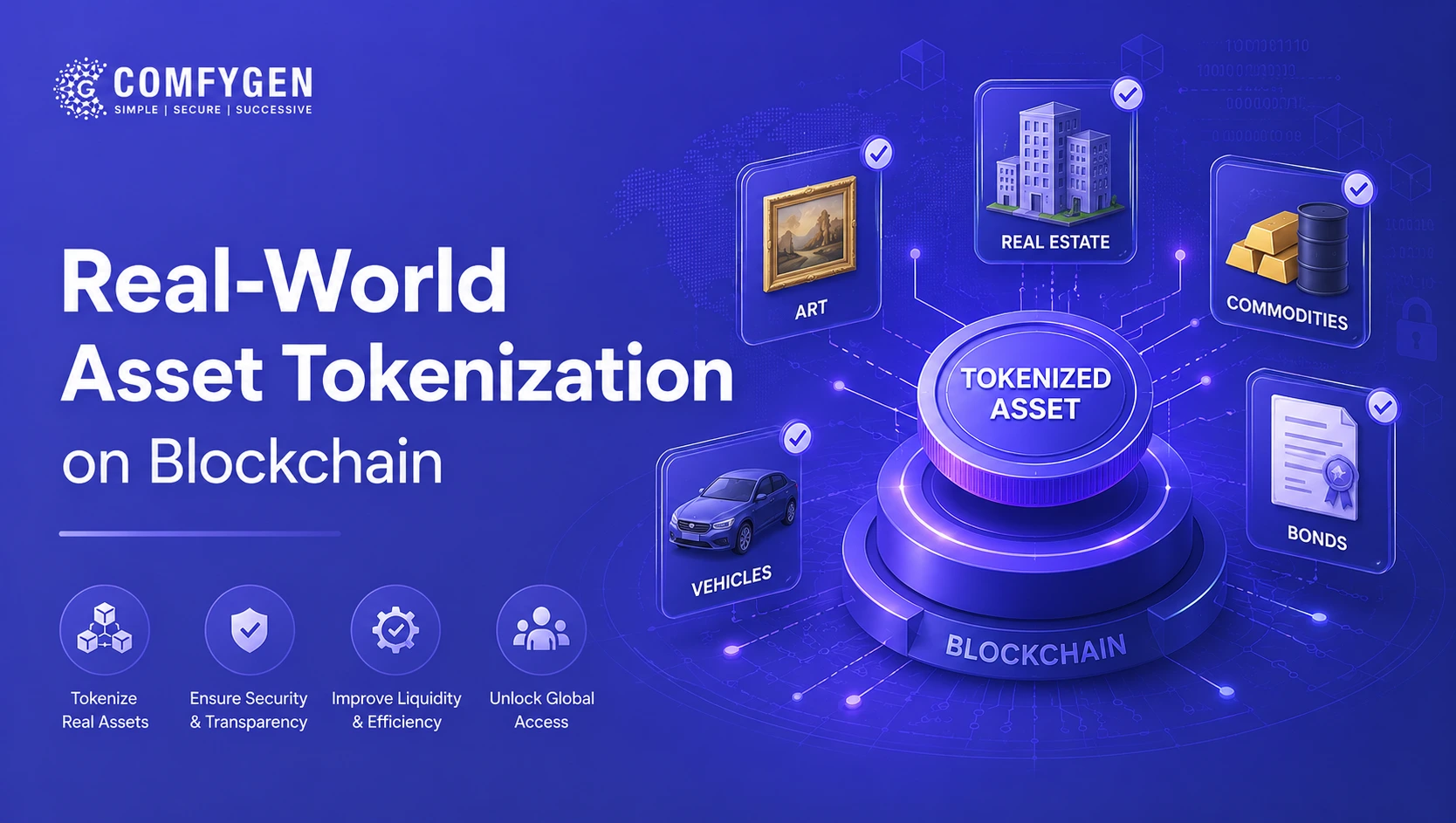





Real-world asset tokenization is changing how ownership, investment, and liquidity work across industries. By converting physical and financial assets into blockchain-based digital tokens, businesses can unlock markets that have historically been restricted, illiquid, or inaccessible to most investors.
This guide covers how asset tokenization works, what the development process looks like, which asset classes are being tokenized right now, and what you need to consider if you are planning a project in this space.
What Is Real-World Asset Tokenization?
Real-world asset (RWA) tokenization is the process of representing ownership rights in a physical or financial asset as a digital token on a blockchain. The token holds the same legal and economic rights as owning the underlying asset — but it can be transferred, subdivided, and traded digitally without paperwork-heavy processes or geographic restrictions.
A practical example: a commercial property worth $5 million can be tokenized into 5 million tokens, each worth $1. An investor in Singapore can buy 500 tokens, gaining fractional ownership of that property with near-instant settlement, complete transaction history on-chain, and the ability to sell tokens on a secondary market at any time.
This is different from traditional securitization, which converts low-liquidity assets into marketable securities through legal structures. Tokenization does the same but uses blockchain smart contracts to automate the ownership logic, reduce intermediaries, and make the asset globally accessible.
How Big Is the RWA Tokenization Market?
The numbers tell a clear story. The RWA tokenization market reached $24 billion in 2025, growing 380% in just three years, according to a report by RedStone, Gauntlet, and RWA.xyz. Standard Chartered projects this market could reach $30 trillion by 2034.
The Global Tokenized Assets Market was valued at $25.8 billion in 2024 and is expected to reach $2,832.3 billion by 2034, growing at a CAGR of 60%.
Private credit currently leads tokenized asset classes, accounting for 61% of the market as of early 2025. Tokenized US Treasuries make up around 30%, while real estate and commodities are growing rapidly. Institutional investors drove approximately 70% of deployed capital in tokenized assets in 2024, a sign that large financial institutions have moved well past the exploratory phase.
Real-world milestones back this up:
- JPMorgan launched a tokenized money market fund on Ethereum in December 2025, open to qualified investors with a $1 million minimum.
- Franklin Templeton and BlackRock both have tokenized fund products running on public blockchains.
- The SEC approved Nasdaq to test blockchain-based trade settlement in March 2026.
This is no longer a future-state conversation. Tokenization of real-world assets is happening now, at institutional scale.
How Asset Tokenization Works on Blockchain
At a technical level, asset tokenization involves several interdependent components working together:
Smart Contracts
Smart Contracts handle the core logic — token issuance, ownership transfers, compliance enforcement, and revenue distribution (like rental income or dividends). The smart contract is the agreement made permanent in code.
Token Standards
Token Standards define how the token behaves on-chain. For fungible assets like shares or debt instruments, ERC-20 is common. For unique assets, ERC-721 (NFT standard) is used. For regulated securities requiring investor whitelisting and compliance controls, ERC-1400 and ERC-3643 are more appropriate standards.
Oracles
Oracles bring off-chain data on-chain — things like asset valuations, interest rates, or legal status updates. Without reliable oracles, the token cannot reflect the real-world value of the underlying asset accurately.
Legal Wrappers
Legal Wrappers connect the digital token to enforceable legal rights. Most tokenization structures use a Special Purpose Vehicle (SPV) or trust to hold the underlying asset, with tokens representing shares in that entity.
KYC/AML Modules
KYC/AML Modules handle investor verification. Most tokenized assets are regulated securities, so only verified, compliant investors can hold them.
Custody Infrastructure
Custody Infrastructure protects both the digital tokens (through secure wallets) and the underlying physical assets.
These components form the foundation of any serious asset tokenization platform development.
How to Tokenize Real-World Assets: Step-by-Step
If you are planning a tokenization project, here is the development and launch process from start to finish:
Step 1: Asset Selection and Feasibility Assessment
Identify the asset and evaluate whether tokenization makes financial and legal sense. Consider the asset’s value, existing ownership structure, and whether fractional ownership would attract investor demand. Real estate, private credit, commodities, and intellectual property are the most tokenization-ready asset classes.
Step 2: Legal Structuring
Set up a legal wrapper — typically a Special Purpose Vehicle — to hold the asset. Tokens then represent shares in the SPV, giving holders enforceable legal rights. This step requires legal counsel familiar with both securities law and blockchain.
Step 3: Independent Valuation and Due Diligence
Commission an independent appraisal of the asset. This valuation feeds into the token price and must be verifiable by investors. Ongoing valuation updates are typically delivered through oracle integrations.
Step 4: Determine Token Type and Tokenomics
Decide whether the token is a security token, utility token, or NFT. Define supply, divisibility, investor rights (voting, income distribution, redemption), and any lockup periods. This framework is called the tokenomics model.
Step 5: Choose the Blockchain Platform
Ethereum is the most common choice for regulated asset tokenization due to its maturity, tooling, and liquidity. Polygon is used for lower transaction cost applications. Hyperledger and private blockchain networks are used for enterprise deployments that require permissioned access. Your blockchain development partner should help you evaluate this based on your specific requirements.
Step 6: Smart Contract Development
Develop and audit smart contracts that handle token issuance, ownership transfers, compliance checks (investor whitelisting, transfer restrictions), and automated income distribution. Every smart contract must undergo a third-party security audit before deployment.
Step 7: Platform and Wallet Infrastructure
Build or integrate the investor-facing platform the interface where investors onboard, complete KYC, purchase tokens, and manage their holdings. Integrate with a compatible blockchain wallet for secure token custody.
Step 8: Token Issuance
Issue tokens through a Security Token Offering (STO), private placement, or other regulated mechanism depending on your jurisdiction. This is where investors first purchase tokens.
Step 9: Secondary Market Listing
List the tokens on a regulated secondary market so investors can trade their holdings. This is what gives the asset genuine liquidity — the ability to exit a position without waiting for the asset itself to be sold.
Step 10: Ongoing Compliance and Asset Management
Post-launch, the platform must maintain investor records, distribute income, handle redemptions, report to regulators, and update asset valuations. Smart contracts automate much of this, but legal and operational oversight remains necessary.
Planning a tokenization project?
Comfygen Technologies has delivered blockchain solutions for clients across fintech, real estate, and financial services. Our team handles the full stack — from smart contract development and blockchain selection to investor platform design and compliance integration.
Get a free project consultation
Types of Assets Suitable for Tokenization
Nearly any asset with measurable value and a definable ownership structure can be tokenized. The most active categories in 2025 are:
Real Estate
Tokenized real estate allows fractional ownership of residential, commercial, or industrial properties. Deloitte projects $1 trillion in tokenized private real estate funds by 2035, with BCG forecasting the sector could reach $3.2 trillion by 2030. Platforms like RealT and Lofty already let investors buy fractional property tokens for as little as $50.
Private Credit and Debt
Private credit is the largest tokenized asset class today, making up 61% of tokenized RWAs. Companies tokenize loan portfolios and bonds to access capital markets more efficiently and give investors exposure to yield-generating debt instruments.
Commodities
Gold, silver, oil, and agricultural commodities are being tokenized to simplify trading and settlement. Tokenized gold surged 227% in 2025 alone, driven by high physical gold prices and institutional demand for digital exposure.
Government Securities and Treasuries
Tokenized US Treasuries currently account for about 30% of the RWA market. Franklin Templeton’s BENJI token and BlackRock’s BUIDL fund are leading examples.
Art and Collectibles
High-value art, vintage cars, and rare collectibles can be tokenized into NFTs or fractional tokens, giving multiple investors ownership stakes in assets that previously required millions to access.
Intellectual Property
Patents, royalties, music rights, and licensing agreements can be tokenized to let creators access upfront capital while investors receive ongoing revenue shares.
Private Equity and Venture Funds
Tokenized fund shares give accredited investors earlier access to private markets with lower minimums and faster settlement compared to traditional fund structures.
Carbon Credits
Environmental assets like carbon credits are increasingly tokenized to improve tracking, prevent double-counting, and enable broader market participation.
Key Benefits of Asset Tokenization
Increased Liquidity
Illiquid assets — real estate, private equity, collectibles — become tradeable through tokenization. Instead of waiting months to sell a property, a token holder can sell their position on a secondary market within minutes.
Fractional Ownership
Tokenization divides high-value assets into affordable units. A $10 million commercial building can be accessible to an investor with $500 through fractional tokens. This lowers the minimum investment barrier significantly.
Global Accessibility
Blockchain platforms operate 24/7 and are accessible globally. A token issued in Dubai can be purchased by a verified investor in Brazil without intermediaries, currency conversion delays, or geographic restrictions.
Transparency and Immutability
Every ownership transfer, income distribution, and compliance check is recorded on-chain and visible to authorized parties. This eliminates disputes over ownership history and reduces the risk of fraud.
Reduced Transaction Costs
Smart contracts replace brokers, lawyers, custodians, and clearinghouses for routine processes. Settlement that traditionally takes T+2 days can occur in seconds, with a fraction of the fees.
Programmable Compliance
Regulatory requirements can be coded directly into the smart contract. Transfer restrictions, investor accreditation checks, and KYC/AML rules execute automatically — reducing compliance overhead for issuers.
Automated Income Distribution
Rental income, dividends, or interest payments can be distributed automatically to token holders by the smart contract on a schedule, without manual processing or third-party administrators.
Portfolio Diversification
Investors can now hold fractional stakes in real estate, gold, private credit, and art within a single digital wallet, creating diversification that was previously logistically impossible for smaller investors.
Token Types Used in Blockchain Asset Tokenization
Understanding token types is essential when planning a tokenization project.
Security Tokens
Security tokens represent regulated financial instruments — shares, bonds, fund units, or revenue rights. They must comply with securities laws in the relevant jurisdiction. ERC-1400 and ERC-3643 are the dominant standards.
Utility Tokens
Utility tokens provide access to a product, service, or platform. They are less regulated but cannot represent investment rights in most jurisdictions.
NFTs (Non-Fungible Tokens)
NFTs represent unique, non-interchangeable assets — a specific painting, a specific property deed, or a specific patent. Each NFT is distinct. ERC-721 is the standard.
Stablecoins
Stablecoins are tokenized representations of fiat currency, used to facilitate payments and settlements within tokenization platforms without exposure to cryptocurrency volatility.
Governance Tokens
These give holders voting rights over platform or protocol decisions. They are often combined with security or utility tokens in more complex tokenization structures.
What Goes Into an Asset Tokenization Platform
Building an asset tokenization platform is a multi-layer development project. The core components include:
- Token issuance engine — handles the creation of tokens on the chosen blockchain, including supply caps and compliance parameters
- Smart contract layer — encodes all asset rules: transfer restrictions, income distribution, investor rights, redemption conditions
- KYC/AML integration — onboards investors through verified identity checks (can integrate with Sumsub, Onfido, or similar providers)
- Investor dashboard — the interface where token holders view their holdings, track income, and manage their portfolio
- Admin panel — allows the issuer to manage the offering, update valuations, and oversee compliance
- Oracle integration — connects the platform to off-chain asset data like valuations, interest rates, and legal status
- Wallet integration — supports custody through software or hardware wallet connections
- Secondary market module — enables peer-to-peer token trading with built-in compliance checks on each transfer
The development cost for an asset tokenization platform varies based on complexity. A basic platform with core token issuance and investor dashboard functionality typically starts around $50,000–$80,000. Platforms with full compliance automation, multi-asset support, and secondary market capabilities can range from $150,000–$300,000 or more.
If you are planning a project, contact our blockchain development team for a scoped estimate based on your specific requirements.
Blockchain Networks Used for Asset Tokenization
Different projects use different chains based on requirements:
- Ethereum remains the dominant choice for regulated asset tokenization. Its mature developer ecosystem, wide institutional adoption, and EVM compatibility make it the default for security token projects.
- Polygon reduces transaction costs significantly while maintaining EVM compatibility. It is commonly used for platforms expecting high transaction volumes or smaller ticket sizes.
- Hyperledger Fabric is used for private, permissioned deployments — particularly in enterprise and banking contexts where public blockchain transparency is not desirable.
- Stellar is designed for payment and asset issuance use cases, with faster settlement and lower fees than Ethereum mainnet.
- Solana offers high throughput and low latency, making it suitable for tokenization platforms that require fast, frequent transactions.
Comfygen has hands-on experience across Ethereum, Polygon, Solana, Stellar, and Hyperledger blockchain development, and can help you select and build on the right network.
Real-World Asset Tokenization Use Cases by Industry
Financial Services
Banks and investment firms tokenize bonds, money market funds, and loan portfolios. JPMorgan’s tokenized MMF and BlackRock’s BUIDL fund are two of the most prominent examples. Tokenized treasury products have grown to over $7.4 billion in 2025.
Real Estate
Property developers and funds use tokenization to raise capital faster, reach a global investor base, and enable fractional participation. Secondary market trading of real estate tokens gives investors an exit path that did not exist before.
Healthcare
Healthcare data and patient records can be tokenized to give patients control over their data while enabling secure sharing with providers. Tokenization replaces sensitive data with non-sensitive identifiers, reducing breach exposure.
Supply Chain and Commodities
Commodity tokenization enables real-time ownership transfer and transparent provenance tracking. Gold, oil, and agricultural products are being tokenized to simplify cross-border trading and settlement.
Intellectual Property and Royalties
Music artists, inventors, and content creators can tokenize future royalty streams to access upfront capital. Investors receive an income share tied to the asset’s commercial performance.
Sports and Entertainment
Fan tokens, athlete contract tokenization, and tokenized sports memorabilia create new revenue streams for clubs and new forms of engagement for fans. Manchester City’s partnership with Superbloke for fan tokenization is one real example.
Regulatory and Legal Considerations
Regulatory clarity is improving but still varies significantly by jurisdiction. Key considerations for any tokenization project:
Securities Classification
In most jurisdictions, security tokens are treated as regulated securities. In the US, this means SEC registration or an applicable exemption (Regulation D, Regulation A+, or Regulation S for offshore offerings). In the EU, MiCA regulation applies. In the UAE, VARA governs digital asset activities.
KYC and AML Compliance
All regulated token offerings require investor identity verification and anti-money laundering screening. This must be embedded in the onboarding process and enforced at the smart contract level on each transfer.
Data Privacy
Depending on where investors and issuers are located, GDPR (EU), PDPB (India), or other data protection laws govern how personal information is handled during onboarding and compliance.
Cross-Border Considerations
A tokenization platform serving investors in multiple countries must navigate the regulatory requirements of each jurisdiction. This typically requires legal counsel in each target market.
Smart Contract Legal Enforceability
In most jurisdictions, smart contracts are not yet fully recognized as legally binding contracts in their own right. The legal wrapper (SPV, trust, or fund structure) provides the enforceable legal framework, with the smart contract automating execution within that framework.
Challenges in Asset Tokenization Development
Despite the market momentum, tokenization projects face real technical and operational challenges:
Smart Contract Security
Smart contract vulnerabilities are the most common failure point. A single coding error can result in significant financial loss. Every smart contract must be audited by an independent third party before deployment.
Oracle Reliability
The accuracy of on-chain asset data depends entirely on the quality of the oracle feeding it. Manipulated or delayed oracle data can trigger incorrect contract execution.
Regulatory Uncertainty
While frameworks are improving, regulatory guidance changes frequently. A platform built today must be designed to adapt to evolving compliance requirements without full redevelopment.
Liquidity in Secondary Markets
Issuing tokens is step one. Building a secondary market with enough participants to give tokens real liquidity is far harder and often requires significant market-making effort post-launch.
Bridging Legal and Technical Ownership
The hardest problem in RWA tokenization is ensuring the token is actually linked to enforceable legal ownership of the asset. Without that link, the token has no real value. Getting this structure right requires both legal and technical expertise working in close coordination.
Future of Real-World Asset Tokenization
Several trends will define how this market develops through 2030:
DeFi Integration
Tokenized real-world assets are increasingly being integrated into DeFi protocols as collateral for lending and borrowing. This creates new yield opportunities for token holders and new capital sources for DeFi platforms.
Institutional-Grade Infrastructure
Regulated custodians, compliant exchanges, and institutional-grade oracle networks are being built specifically for tokenized securities. This infrastructure will reduce the friction currently holding back larger capital deployments.
Central Bank Digital Currency (CBDC) Interaction
As CBDCs come online, they are expected to interact directly with tokenized asset platforms for settlement, replacing stablecoin intermediaries in regulated markets.
Cross-Chain Interoperability
Tokenized assets currently locked on one blockchain will increasingly be tradeable across chains through interoperability protocols, deepening liquidity without forcing issuers to choose a single network.
Tokenization of New Asset Classes
Carbon credits, infrastructure assets, insurance contracts, and litigation funding are among the newer categories seeing tokenization pilots. As legal frameworks catch up, these will become mainstream.
Why Work with a Specialized Asset Tokenization Development Company
Asset tokenization is not a standard software project. It requires expertise across blockchain architecture, smart contract development, legal integration, compliance engineering, and financial product design. A team that handles only one of these areas will produce an incomplete solution.
At Comfygen, we have built blockchain infrastructure for clients across industries, with hands-on experience in smart contract development, token development, and DApp development. We work with clients at every stage — from pre-development consulting to post-launch platform management.
If you are considering an asset tokenization platform project, the right first step is a discovery conversation to scope your requirements and evaluate your options. Contact our team here.
FAQs
How much does it cost to build an asset tokenization platform?
Development costs depend on complexity and features. Basic platforms start around $50,000–$80,000. Full-featured platforms with compliance automation, multi-asset support, and secondary market functionality range from $150,000 to $300,000 or more. Contact Comfygen for a project-specific estimate.
Is asset tokenization legal?
Yes, in most jurisdictions, though the regulatory framework varies. Security tokens are treated as regulated financial instruments in the US, EU, UAE, and most other major markets. Compliance with local securities law, KYC/AML requirements, and data protection regulations is essential.
Which blockchain is best for asset tokenization?
Ethereum is the most widely used for regulated asset tokenization due to its maturity and institutional adoption. Polygon is common for cost-sensitive applications. The right choice depends on your asset type, investor base, transaction volume, and compliance requirements.
What assets can be tokenized?
Any asset with measurable value and a definable ownership structure can be tokenized. The most active categories include real estate, private credit, government bonds, commodities, intellectual property, and private equity.
What is an asset tokenization platform?
An asset tokenization platform is a blockchain-based system that handles the full lifecycle of a tokenized asset — from token issuance and investor onboarding to compliance management, income distribution, and secondary market trading.

Mr. Saddam Husen, (CTO)
Mr. Saddam Husen, CTO at Comfygen, is a renowned Blockchain expert and IT consultant with extensive experience in blockchain development, crypto wallets, DeFi, ICOs, and smart contracts. Passionate about digital transformation, he helps businesses harness blockchain technology’s potential, driving innovation and enhancing IT infrastructure for global success.