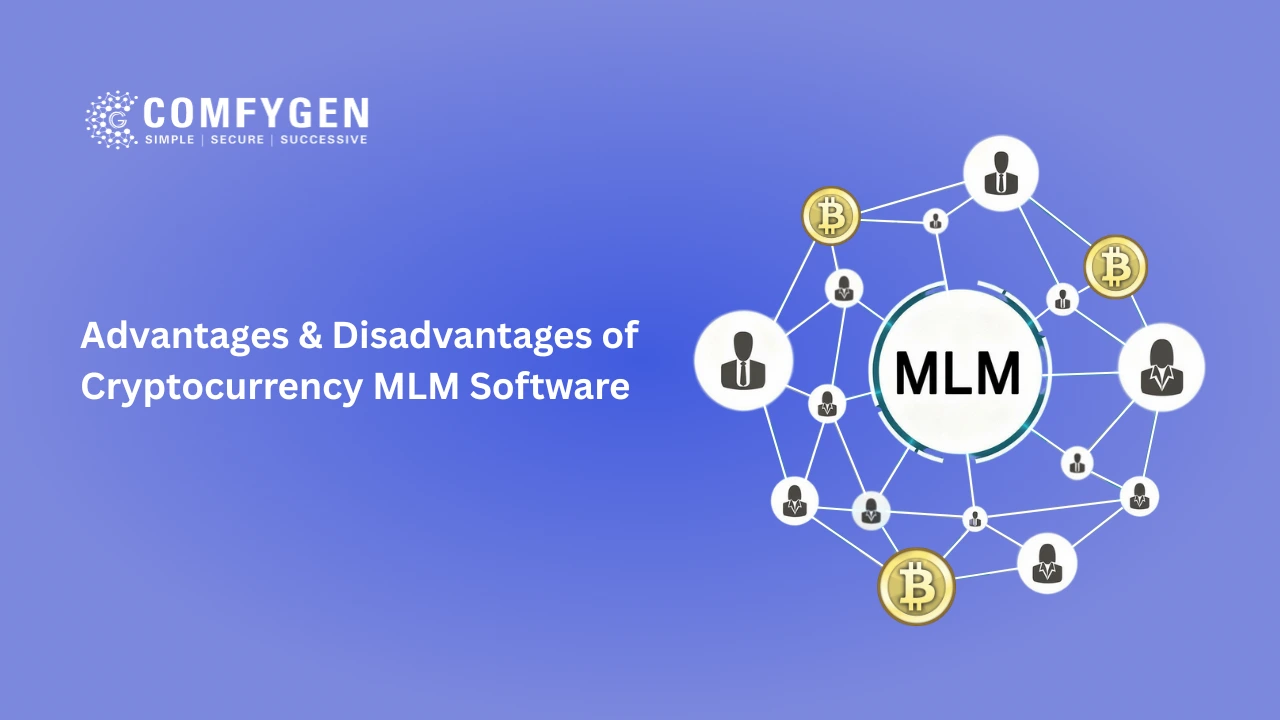





The global cryptocurrency MLM software market was valued at USD 284 million in 2024 and is projected to reach USD 549 million by 2031, growing at a CAGR of 9.6%. This explosive growth is not a coincidence — it reflects a fundamental shift in how network marketing businesses are embracing blockchain technology to solve long-standing problems: slow payments, opaque commission structures, and cross-border friction.
But cryptocurrency MLM software is not a silver bullet. For every business that scales globally using smart contracts and decentralized payments, another stumbles on regulatory hurdles, market volatility, or technical complexity.
This guide gives you the complete, honest picture — the real advantages, the genuine disadvantages, how different MLM plan types interact with crypto, and the key considerations before you commit to building a cryptocurrency MLM software platform.
What Is Cryptocurrency MLM Software?
Cryptocurrency MLM software is a blockchain-based platform that automates the operations of a multi-level marketing business — commission tracking, payout distribution, referral hierarchy management, and participant onboarding — using cryptocurrency instead of traditional fiat payment rails.
At its core, the platform fuses two powerful technologies:
- Blockchain: A distributed, immutable ledger that records every transaction transparently and tamper-proof.
- Smart Contracts: Self-executing code that automatically enforces commission rules, payout conditions, and rank qualifications without human intervention.
Together, these technologies remove the need for a central administrator to manually calculate and distribute earnings. Payments go directly from the platform’s smart contract to each participant’s crypto wallet — instantly, transparently, and verifiably.
Comfygen’s crypto MLM software development service builds these platforms end-to-end, from smart contract architecture to mobile-responsive dashboards.
How It Differs From Traditional MLM Software
| Feature | Traditional MLM Software | Cryptocurrency MLM Software |
|---|---|---|
| Payment processing | Banks, payment gateways | Blockchain, smart contracts |
| Transaction speed | 1–5 business days | Near-instant (seconds to minutes) |
| International transfers | High fees, currency conversion | Borderless, low fees |
| Commission transparency | Admin-controlled | Publicly verifiable on-chain |
| Fraud risk | Moderate (centralized control) | Lower (immutable records) |
| Setup complexity | Low–moderate | Moderate–high |
| Regulatory clarity | Established | Still evolving |
The core distinction is trust by design. Traditional systems ask participants to trust a central party — the company, its bank, its software. Crypto MLM systems encode trust into the protocol itself.
Key Features of Modern Crypto MLM Platforms
Modern cryptocurrency MLM software has evolved significantly beyond basic blockchain payments. Here are the features that define a production-ready platform in 2025:
Blockchain Integration
All transactions are recorded on a decentralized ledger — typically Ethereum, BNB Chain, TRON, or Solana ensuring immutability and full auditability.
Smart Contract Automation
Commission calculation, payout triggering, rank upgrades, and referral tracking are handled entirely by smart contract development no manual processing, no delays, no human error.
Multi-Currency Crypto Wallet
Integrated crypto wallets support Bitcoin, Ethereum, USDT, BNB, TRON, and more. Members can deposit, withdraw, and track balances in real time.
Compensation Plan Engine
Supports Binary, Unilevel, Matrix, Generation, Board, and Hybrid plan structures, each configurable to custom commission percentages and depth limits.
KYC/AML Compliance Module
Automated identity verification (KYC) and anti-money laundering (AML) checks are increasingly standard, especially for platforms targeting US and EU markets. Over 65% of new crypto MLM platforms launched in 2024 incorporated automated compliance checks.
DeFi Integration (Advanced)
Some platforms now offer staking, yield farming, or liquidity pool rewards as supplementary incentives layering DeFi mechanics on top of traditional MLM compensation.
Admin Dashboard & Analytics
Real-time genealogy trees, commission reports, transaction histories, and network growth analytics give administrators full operational visibility.
MLM Compensation Plan Types and Crypto Compatibility
One of the most overlooked topics in this niche is how different MLM plan structures interact with cryptocurrency payment mechanics. This matters because smart contract logic must be written differently for each plan.
Binary Plan
Each distributor sponsors exactly two members (left leg, right leg). Commissions are paid when both legs generate matched volume. Smart contracts can calculate pair volumes and trigger stablecoin payouts instantly when matching thresholds are reached. Spillover mechanics are straightforward to encode on-chain.
Unilevel Plan
No width limitation a distributor can sponsor unlimited frontline members. Commissions are paid across a fixed number of levels. Simple depth-based commission logic is efficient to encode in smart contracts, and instant payouts are well-suited to high-frequency, lower-value unilevel structures.
Matrix Plan (Forced Matrix)
Fixed width and depth — for example, a 3×7 matrix allows 3 members per level across 7 levels. Smart contracts can enforce matrix placement rules and calculate commissions based on filled positions, though more complex position-management logic requires careful contract auditing.
Generation Plan
Commissions are paid based on distributor “generations” rather than levels. Generation tracking requires more sophisticated on-chain genealogy logic but is achievable with proper Smart Contract MLM Software architecture.
Hybrid Plan
Combines elements of two or more plans. Variable depends on complexity. Hybrid plans benefit most from experienced developers who understand both MLM business logic and blockchain architecture.
Advantages of Cryptocurrency MLM Software
1. Decentralization Eliminates Single Points of Failure
Traditional MLM platforms store all data member records, commission calculations, payment history on centralized servers. A single breach, system outage, or administrative error can compromise the entire network.
Cryptocurrency MLM software distributes data across a blockchain network. There is no single server to attack, no single administrator who can manipulate records, and no central authority that can freeze or redirect funds arbitrarily. This decentralization is particularly valuable for global MLM networks operating across jurisdictions with varying levels of institutional trust.
2. Radical Transparency Builds Participant Trust
Every transaction on a blockchain is publicly verifiable. Every commission paid, every rank qualification, every referral link — all permanently recorded on an immutable ledger that any participant can audit at any time.
This level of transparency directly addresses one of the most common criticisms of traditional MLM: opaque compensation structures where participants struggle to verify whether they’re being paid correctly. With on-chain commission logic, the smart contract is the source of truth — and it’s open to anyone to inspect.
3. Instant, Borderless Payments
Traditional MLM companies processing international commissions deal with bank transfer delays (1–5 business days), currency conversion fees, wire transfer costs, and payment rejection risks. For a global downline spanning dozens of countries, this friction is enormous.
Cryptocurrency payments are borderless by design. A distributor in India receives the same near-instant payout as one in the United States or Nigeria, with minimal fees, no currency conversion, and no bank intermediary. This dramatically expands the addressable market for MLM businesses.
4. Dramatically Lower Operational Costs
By eliminating payment processors, banks, and intermediaries, cryptocurrency MLM platforms reduce transaction costs substantially. Traditional payment processors typically charge 2–3% per transaction plus fixed fees. Crypto transactions on efficient networks like BNB Chain or TRON cost fractions of a cent.
For an MLM network processing thousands of micro-commissions daily, these savings compound into significant operational cost reductions — which can be reinvested into higher participant commissions or platform development.
5. Smart Contract Automation Removes Human Error
Commission calculation in complex MLM structures — particularly with multiple tiers, rank bonuses, matching bonuses, and infinity bonuses — is prone to human error when done manually. A miscalculation can generate disputes that damage trust and require costly remediation.
Smart Contract development encodes the exact compensation plan logic into executable code. Once deployed, the contract executes identically every time — no errors, no delays, no manipulation. Participants can verify the contract code before joining, providing a level of assurance no traditional MLM company can match.
6. Tokenized Incentives Create New Engagement Models
Crypto MLM platforms can issue their own utility tokens as supplementary incentives. These tokens can be earned through network activity, redeemed for products or services, traded on secondary markets, or staked for additional yields.
This tokenization layer creates incentive mechanisms that traditional MLM software cannot replicate. Early-stage token appreciation can significantly amplify participant earnings (though this comes with corresponding volatility risks — see disadvantages below).
Comfygen’s Crypto Token Development team builds ERC-20, BEP-20, and TRC-20 tokens tailored to specific MLM incentive architectures.
7. Enhanced Security Through Cryptography
All blockchain transactions are secured by cryptographic signatures. Without the private key associated with a wallet address, no third party — not even the platform developer — can authorize a transaction on a participant’s behalf.
This cryptographic security model, combined with Blockchain Wallet Development best practices, provides robust protection against unauthorized fund access — a meaningful security upgrade over traditional payment systems where chargebacks, reversals, and unauthorized access remain persistent risks.
8. Immutable Audit Trail for Compliance and Dispute Resolution
Every transaction recorded on a blockchain creates a permanent, timestamped audit trail. For MLM businesses subject to regulatory scrutiny, this immutable record is a significant compliance asset providing regulators with complete transaction histories that cannot be retroactively altered.
This same audit trail simplifies dispute resolution between participants. Rather than relying on internal company records (which can be questioned), both parties can reference the same public blockchain data.
9. Global Accessibility, Including Underbanked Markets
An estimated 1.4 billion adults worldwide remain unbanked but have access to smartphones. Traditional MLM payment systems exclude these individuals entirely. Cryptocurrency wallets require only a smartphone and internet connection — no bank account, no credit history, no government-issued payment infrastructure.
For MLM businesses targeting emerging markets in Southeast Asia, Africa, and Latin America, crypto payments represent a genuine competitive advantage in participant accessibility.
Disadvantages of Cryptocurrency MLM Software
1. Cryptocurrency Market Volatility
This is the most significant operational risk. Cryptocurrency prices can swing 20–30% within days or hours. A participant who earns 100 USDT in commissions today may find that reward has lost 25% of its purchasing power by the time they convert to fiat — if they’re being paid in volatile assets rather than stablecoins.
The business impact is real: High volatility erodes participant trust, complicates financial planning, and can cause network attrition when markets turn bearish. Many operators now address this by denominating all commissions in stablecoins (USDT, USDC) pegged 1:1 to USD, effectively preserving payout value while maintaining crypto-native payment infrastructure.
2. Regulatory and Legal Uncertainty
The regulatory landscape for cryptocurrency MLM platforms remains fragmented and rapidly evolving. Key challenges include:
- Securities law: Native tokens issued by MLM platforms may be classified as securities in certain jurisdictions, triggering registration requirements with the SEC (US), FCA (UK), or equivalent bodies.
- MLM legality: Many jurisdictions distinguish legitimate MLM from pyramid schemes based on the ratio of product sales revenue to recruitment revenue. Crypto-native compensation designs can blur these lines.
- AML/KYC requirements: Regulators including FinCEN (US) and FATF-aligned jurisdictions require Money Services Business registration and robust Know Your Customer and Anti-Money Laundering programs for platforms handling crypto transactions.
- Geographic restrictions: Several countries restrict or prohibit cryptocurrency transactions entirely, limiting platform reach.
Navigating these requirements demands ongoing legal counsel, not just software compliance modules.
3. Technical Complexity and Development Cost
Building a production-grade cryptocurrency MLM platform requires expertise across multiple disciplines: blockchain development, smart contract architecture and security, front-end and back-end web development, cryptographic key management, and MLM business logic implementation. This intersection of skills is rare and expensive.
Smart contract bugs are particularly costly — unlike traditional software bugs, smart contract errors can result in permanent, irreversible fund losses. A notorious example is the 2016 DAO hack, where a smart contract vulnerability led to $60 million in losses. Thorough contract auditing by third-party security firms is non-negotiable for any platform handling real user funds.
Development timelines and costs for enterprise-grade crypto MLM platforms significantly exceed those for traditional MLM software. Partnering with an experienced cryptocurrency MLM software development company mitigates these risks.
4. User Experience and Onboarding Friction
Cryptocurrency remains technically complex for mainstream audiences. New MLM participants may need to:
- Create and secure a non-custodial crypto wallet
- Understand private keys, seed phrases, and transaction signing
- Navigate blockchain explorers to verify transactions
- Manage gas fees on transaction-heavy networks
- Complete KYC verification processes
Each of these steps represents friction that can prevent adoption, particularly in markets where cryptocurrency literacy is limited. Addressing this requires significant investment in UI/UX design, in-app educational content, and custodial wallet options for onboarding.
5. Potential for Fraud and Pyramid Scheme Misuse
The pseudonymous nature of cryptocurrency transactions, combined with the network effect dynamics of MLM, creates conditions that bad actors have historically exploited. Ponzi and pyramid schemes have used crypto MLM structures to obscure fund flows and delay the inevitable collapse.
This history creates reputational risk for legitimate crypto MLM businesses regulatory scrutiny is heightened, potential participants are skeptical, and payment processors or exchanges may restrict services. Operators must invest in transparent communication, verifiable smart contracts, and clear documentation of product/service value independent of recruitment.
6. Liquidity Management Challenges
Unlike a traditional MLM company that processes payouts through a bank account, a crypto MLM platform requires active liquidity management. The smart contract must hold sufficient cryptocurrency reserves to fund all pending commissions. If the platform issues its own token, it must maintain sufficient liquidity to enable participants to convert tokens to stablecoins or fiat.
Poor liquidity planning is a common failure mode for crypto MLM platforms particularly when token prices decline and many participants attempt to convert simultaneously, creating a bank-run dynamic.
7. Resistance From Traditional Financial Infrastructure
Banks and traditional payment processors remain cautious about businesses in the crypto space, particularly MLM-adjacent businesses. Platforms may encounter difficulties opening corporate bank accounts, accessing fiat on/off-ramp services, or partnering with traditional payment providers. This resistance limits the flexibility to offer hybrid fiat/crypto payment options and complicates participant withdrawals to local bank accounts.
8. Irreversibility of Transactions
A fundamental property of blockchain transactions is their irreversibility. Unlike a bank transfer that can be reversed, a crypto payment sent to the wrong address, or in the wrong amount, is generally unrecoverable. For MLM platforms processing high volumes of automated commission payouts, this means smart contract code must be flawless before deployment there is no “undo” for funds sent in error.
How to Mitigate the Risks
Understanding the disadvantages is only valuable if you pair that knowledge with risk mitigation strategies. Here is a practical framework:
On Volatility:
- Denominate all commissions and payout calculations in stablecoins (USDT, USDC) rather than volatile assets
- If issuing a native token, implement vesting schedules and lock-up periods to prevent immediate mass selling
- Maintain a treasury reserve in stablecoins to cover 90–180 days of projected commission payouts
On Regulatory Risk:
- Engage specialized crypto and MLM legal counsel before launch, not after
- Implement KYC and AML verification from day one — retrofitting compliance is far harder than building it in
- Restrict platform access from high-risk jurisdictions proactively
- Ensure the platform’s compensation structure rewards genuine product/service sales, not purely recruitment
On Technical Risk:
- Commission third-party smart contract audits from reputable security firms before mainnet deployment
- Build on established, battle-tested blockchain infrastructure
- Implement multi-signature wallet controls for platform treasury funds
- Work with a development partner like Comfygen with demonstrated blockchain MLM experience
On UX Friction:
- Offer custodial wallet options for new participants while preserving non-custodial options for experienced users
- Build comprehensive in-app onboarding flows and educational resources
- Design for mobile-first, given the demographics of many high-growth MLM markets
Regulatory Landscape
The regulatory environment for cryptocurrency MLM software has matured significantly since 2023. Key developments operators must understand:
United States
The regulatory framework remains fragmented across SEC, CFTC, and FinCEN. Crypto MLM platforms handling tokens that may qualify as securities face potential SEC jurisdiction. All platforms processing crypto transactions as a business must register as Money Services Businesses (MSBs) with FinCEN and implement full AML/KYC programs. Suspicious Activity Reports (SARs) are required for transactions involving suspected illicit activity above $5,000.
European Union
MiCA (Markets in Crypto-Assets Regulation) has established a comprehensive regulatory framework for crypto assets and crypto-asset service providers. Platforms operating in the EU must assess whether they qualify as Crypto-Asset Service Providers (CASPs) and comply with licensing, disclosure, and consumer protection requirements.
India
India has implemented a 30% tax on cryptocurrency income and 1% TDS on crypto transactions. MLM businesses operating in India must factor these tax obligations into their commission structure design.
Global
The Financial Action Task Force (FATF) Travel Rule now applies in many jurisdictions, requiring Virtual Asset Service Providers (VASPs) to share sender/recipient information on transactions above threshold amounts.
Future Trends in Crypto MLM Software Development
The landscape is moving fast. Here are the developments shaping the next generation of crypto MLM platforms:
DeFi-MLM Convergence
Platforms are beginning to integrate DeFi mechanisms — staking, yield farming, liquidity pools — as supplementary income streams layered on top of traditional MLM compensation. Comfygen’s DeFi Development Company capabilities enable these advanced integrations.
AI-Powered Commission Optimization
Artificial intelligence is being applied to analyze network performance, detect anomalous patterns consistent with fraud, and optimize commission structure parameters to maximize sustainable network growth.
Cross-Chain Interoperability
Next-generation platforms will operate across multiple blockchains simultaneously, giving participants the ability to receive commissions on their preferred chain whether Ethereum, BNB Chain, TRON, or Solana. Comfygen’s Multichain Blockchain Development addresses this need.
Stablecoin-First Architecture
As the volatility risk of volatile crypto assets becomes better understood, more platforms are shifting to stablecoin-denominated commission structures by default retaining the operational benefits of blockchain while eliminating earnings volatility.
Enhanced Compliance Tooling
Regulatory compliance modules automated KYC, real-time AML monitoring, Travel Rule compliance are becoming standard features rather than add-ons, particularly as regulators increase enforcement scrutiny.
Web3 Wallet Integration
Native integration with MetaMask, Trust Wallet, and WalletConnect enables seamless participant onboarding without custodial risk, improving both security and participant autonomy.
Conclusion
Cryptocurrency MLM software represents a genuine technological advance for network marketing businesses willing to navigate its real complexities. The advantages, transparency through blockchain, instant global payments, smart contract automation, reduced operational costs, and novel tokenized incentives — are substantive and achievable.
But the disadvantages demand equal respect. Market volatility, regulatory fragmentation, technical complexity, onboarding friction, and liquidity management are not minor inconveniences, they are business-defining challenges that require dedicated planning, expert development partners, and ongoing legal counsel.
The most successful crypto MLM operations in 2025 are those that treat blockchain as an operational infrastructure choice not a marketing gimmick and invest proportionally in the compliance, security, and UX foundations required to make it work at scale.
Comfygen’s Cryptocurrency MLM Software Development team brings together blockchain engineers, MLM business logic specialists, and compliance-aware architects to build platforms that capture the advantages while proactively addressing the risks. If you’re evaluating whether crypto MLM is right for your business, connect with our team for an honest, detailed assessment.
Frequently Asked Questions
Is cryptocurrency MLM software legal?
The legality depends on your jurisdiction and the specific structure of your MLM program. The software itself is a neutral technology tool. What regulators scrutinize is whether the MLM compensation structure is primarily based on genuine product/service sales (generally legal) or primarily on recruitment (typically classified as a pyramid scheme, illegal in most jurisdictions). Crypto components add an additional layer of regulatory consideration around securities law and AML/KYC compliance. Always consult qualified legal counsel before launching.
Which blockchain is best for MLM software development?
For most use cases, BNB Chain (low fees, high throughput), TRON (very low fees, popular for USDT transactions), and Ethereum (maximum smart contract ecosystem maturity) are the most common choices. The right choice depends on your target market, anticipated transaction volume, and specific feature requirements. Comfygen's team can advise on chain selection based on your specific needs.
How much does cryptocurrency MLM software development cost?
Development costs vary significantly based on the compensation plan complexity, blockchain choice, number of supported cryptocurrencies, compliance requirements, and UI/UX scope. Contact Comfygen's development team for a detailed quote tailored to your requirements.
Can I use stablecoins instead of volatile cryptocurrencies?
Yes and for most business use cases, stablecoin-denominated payouts are recommended. USDT and USDC are the most widely used, providing USD-pegged stability while retaining the operational advantages of blockchain payment infrastructure.
How do I distinguish a legitimate crypto MLM from a scam?
Indicators of legitimacy include: audited smart contracts published on-chain, identifiable and accountable company leadership, genuine products or services with real market value, a compensation structure where product sales revenue exceeds recruitment fee revenue, and transparent documentation of commission calculation logic. Red flags include anonymous founders, promises of guaranteed returns, heavy recruitment-fee dependency, and unaudited smart contracts.

Mr. Saddam Husen, (CTO)
Mr. Saddam Husen, CTO at Comfygen, is a renowned Blockchain expert and IT consultant with extensive experience in blockchain development, crypto wallets, DeFi, ICOs, and smart contracts. Passionate about digital transformation, he helps businesses harness blockchain technology’s potential, driving innovation and enhancing IT infrastructure for global success.
Based on Interest

Cloud Kitchen Management Software Development: Features, Process, Cost & Compliance Guide
Quick Summary: Cloud kitchen management software development brings order aggregation, kitchen display systems, inventory tracking, and analytics into one dashboard, replacing the…