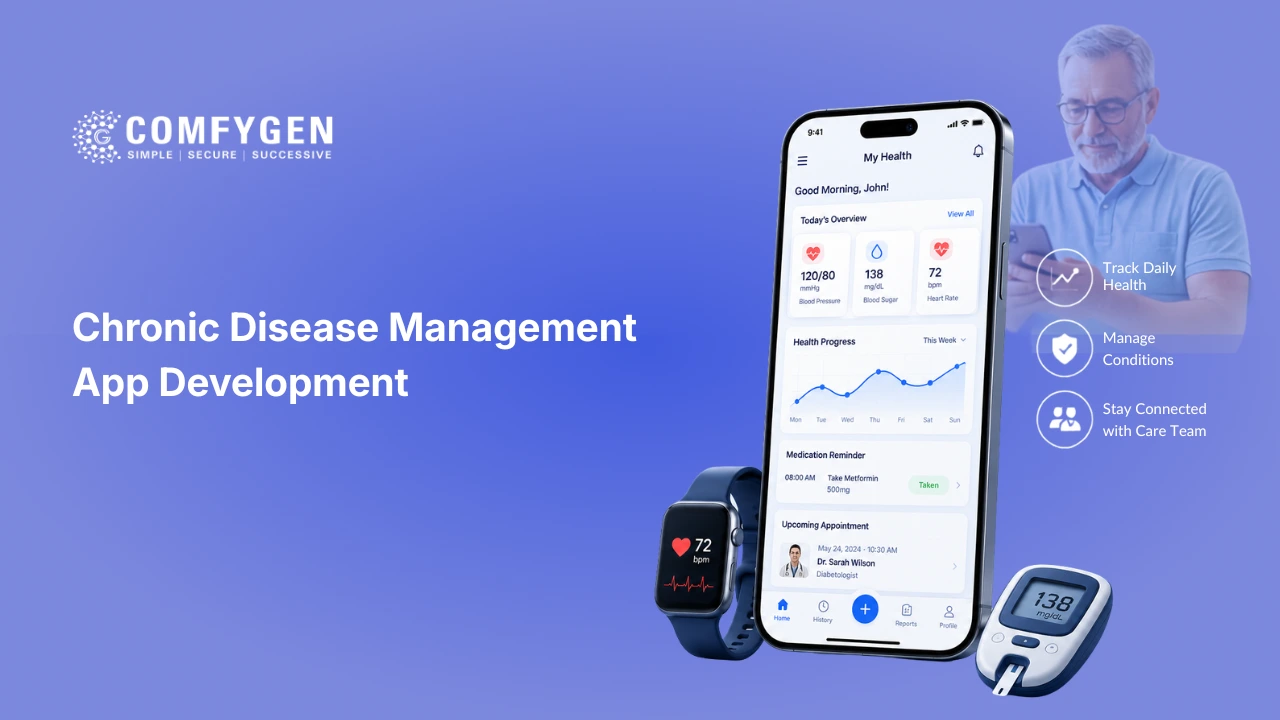





A chronic disease management app is a mobile or web application that helps patients track symptoms, medications, and vital signs while giving doctors remote access to that data. These apps support long-term conditions such as diabetes, hypertension, COPD, chronic kidney disease, and heart disease. Building one in 2026 typically costs between $40,000 and $250,000 depending on features, compliance requirements, and whether the app connects to wearables or remote monitoring devices. A working MVP takes about 4 to 6 months.
That summary answers the core question fast. The rest of this guide breaks down features, compliance, tech stack, cost, and the full build process so you can plan a real product.
What is a chronic disease management app?
A chronic disease management app is software that supports people living with long-term health conditions. Instead of one-off treatment, chronic care runs for years, so the app focuses on daily tracking, medication reminders, and steady communication between patients and care teams.
Three groups use these apps:
- Patients log symptoms, blood glucose, blood pressure, weight, mood, and medication doses.
- Doctors and nurses review that data remotely, flag risk, and adjust treatment without waiting for an in-person visit.
- Care coordinators track a whole panel of patients and prioritize the ones who need attention first.
Some products call themselves a chronic care management app, others a chronic illness tracker, and enterprise buyers often use the term disease management software. The core job stays the same: keep long-term conditions under control between clinic visits and catch problems early.
Why chronic disease management apps matter in 2026
Chronic conditions drive most healthcare spending, and the numbers keep climbing.
- The World Health Organization reports that noncommunicable diseases, most of them chronic, account for roughly 74% of deaths worldwide.
- The U.S. Centers for Disease Control and Prevention estimates that 6 in 10 American adults live with a chronic disease, and 4 in 10 have two or more.
- The global mHealth apps market was valued in the tens of billions of dollars and is projected to keep growing at a double-digit annual rate through the early 2030s, according to market research from firms like Grand View Research and Statista.
The reason apps gained ground is simple. A patient with diabetes sees an endocrinologist a few times a year but manages the condition every single day. An app fills the gap between those visits with daily data, reminders, and alerts. For providers, remote patient monitoring also unlocks reimbursement under CMS programs like Chronic Care Management (CCM) and Remote Patient Monitoring (RPM), which pay clinics for time spent managing patients outside the office.
Which chronic conditions do these apps serve?
Different conditions need different tracking. Building app development for chronic illness starts with picking the condition and its clinical workflow. Here is how the top categories differ.
Diabetes
Patients track blood glucose, carbohydrate intake, insulin doses, and A1C trends. Apps often sync with continuous glucose monitors (CGMs) like Dexcom or Abbott Libre and calculate insulin dosing suggestions. Diabetes is the most common target because daily data has a direct effect on outcomes.
Hypertension and heart disease
The app logs blood pressure readings from a connected cuff, tracks medication adherence, and flags dangerous spikes. Cardiac apps may also pull ECG data from wearables and detect atrial fibrillation.
COPD and asthma
Patients record symptoms, peak flow readings, inhaler use, and air quality. Predictive features warn of a likely flare-up before it lands the patient in the emergency room.
Chronic kidney disease (CKD)
Tracking covers fluid intake, blood pressure, lab values, and diet. Dialysis patients need scheduling and symptom logs tied to their treatment cycle.
Mental health conditions
Depression, anxiety, and bipolar disorder benefit from mood tracking, journaling, therapy scheduling, and crisis support. These apps carry extra privacy weight because of the data involved.
Multi-condition management
Many older patients carry several conditions at once. A strong chronic care management app handles combined tracking in one dashboard rather than forcing the patient to juggle five separate apps.
Core features every chronic disease management app needs
Skip these and the app fails its basic job. Start with the essentials, then add advanced capability.
- Symptom and vitals tracking: Manual entry plus device sync for glucose, blood pressure, weight, oxygen saturation, and heart rate. Data should display as trends, not just single numbers.
- Medication management: Dose schedules, refill reminders, and adherence tracking. Missed-dose alerts matter because non-adherence is one of the biggest drivers of hospital readmission.
- Appointment scheduling: In-app booking, reminders, and calendar sync with the clinic.
- Secure messaging: HIPAA-compliant chat between patient and care team, separate from regular texting.
- Care plans: A personalized plan set by the provider with goals the patient can see and act on.
- Educational content: Condition-specific articles, videos, and diet guidance built into the app.
- Alerts and notifications: Reminders for the patient, and risk alerts routed to the care team when readings cross a threshold.
- Reports and data export: Clean summaries the patient can share and the doctor can review in seconds.
Advanced features that set your app apart
Basic tracking gets you a working product. These features get you a competitive one.
Wearable and device integration
Connect to Apple Watch, Fitbit, CGMs, smart blood pressure cuffs, pulse oximeters, and smart scales through Apple HealthKit, Google Health Connect, and manufacturer SDKs. Automatic data capture beats manual logging every time, because patients stop entering data by hand within a few weeks.
Remote patient monitoring (RPM)
RPM streams device data straight to the care team and supports CMS reimbursement. This turns the app from a self-help tool into a clinical product that clinics will pay for.
AI-driven risk prediction
Machine learning in healthcare models spot patterns that signal a coming problem: a COPD flare, a cardiac event, a diabetic emergency. Predictive alerts let care teams act before a hospital visit. Comfygen builds these models as part of our AI development work, trained on the app’s own longitudinal data. (Swap in your exact service URL.)
Telehealth and video consultation
Built-in video visits, screen sharing, and e-prescription support. Combining tracking data with a live consult gives the doctor full context.
EHR and HL7 FHIR integration
The app should read from and write to hospital electronic health record systems using the HL7 FHIR standard. Without this, clinicians end up copying data between systems, and the app becomes extra work instead of less.
Voice and accessibility support
Voice logging, large-text modes, and screen reader support matter because many chronic-condition patients are older or have vision and dexterity limits.
How a chronic disease management app works
Here is the flow from patient action to clinical response.
1. The patient opens the app and logs a reading, or a connected device sends it automatically.
2. The app stores the data securely and updates the patient’s trend view.
3. Rules and AI models check the reading against safe thresholds.
4. If a value is out of range, the care team gets an alert with the patient’s history attached.
5. A nurse or coordinator reviews the flag, messages the patient, or schedules a call.
6. The provider adjusts the care plan, and the patient sees the update in the app.
That loop, running daily, is what keeps chronic conditions stable and cuts avoidable hospital visits.
Comfygen’s 7-step development process
Comfygen has delivered 550+ projects since 2019, and healthcare apps follow a clear, repeatable path. Here is how the build runs.
Step 1: Discovery and requirement analysis. Define the condition, target users, clinical workflow, and compliance scope. This is where you decide MVP features versus later phases.
Step 2: UX and UI design. Wireframes and prototypes built for patients who may be older or less tech-comfortable. Simplicity beats visual flourish here.
Step 3: Architecture and compliance planning. Choose the tech stack, plan HIPAA and GDPR controls, and map every point where health data moves.
Step 4: Development. Frontend, backend, device integrations, and API work, built in sprints so you see progress every two weeks.
Step 5: Integration. Connect wearables, EHR systems via FHIR, payment and telehealth modules.
Step 6: Testing and QA. Functional testing, security testing, and validation against clinical accuracy requirements. Health apps get tested harder than most because a wrong reading has real consequences.
Step 7: Deployment and support. App store submission, provider onboarding, and ongoing maintenance, monitoring, and updates.
The healthcare app development team handles each step end to end.
Recommended tech stack
Your stack depends on scale and budget, but here is a practical 2026 setup.
- Frontend (mobile): React Native or Flutter for one codebase across iOS and Android, or native Swift and Kotlin when device performance matters most.
- Backend: Node.js or Python (Django) for the API layer.
- Database: PostgreSQL for structured records, plus a time-series store for high-frequency device data.
- Cloud: AWS, Google Cloud, or Azure, all of which offer HIPAA-eligible services and signed BAAs.
- Interoperability: HL7 FHIR APIs for EHR data exchange.
- Device integration: Apple HealthKit, Google Health Connect, and vendor SDKs.
- AI/ML: TensorFlow or PyTorch for prediction models, run on managed cloud ML services.
Cross-platform frameworks like Flutter cut cost by 30 to 40% versus building two native apps, which matters when the budget is tight.
How much does it cost to develop a chronic disease management app?
Cost depends on feature depth, compliance load, and integrations. Here are consistent 2026 ranges.
|
App type |
Feature scope |
Estimated cost |
Timeline |
|---|---|---|---|
|
MVP |
Symptom tracking, medication reminders, basic dashboard |
$40,000 to $70,000 |
4 to 6 months |
|
Mid-level |
MVP plus wearable sync, secure messaging, care plans |
$70,000 to $130,000 |
6 to 9 months |
|
Advanced |
AI risk prediction, RPM, EHR/FHIR integration, telehealth |
$130,000 to $250,000+ |
9 to 14 months |
What pushes cost up:
- Compliance work: HIPAA and GDPR controls add engineering and audit time.
- Device integrations: Each wearable or medical device brings its own SDK and testing.
- AI features: Model development, data pipelines, and validation are their own workstream.
- EHR integration: FHIR work depends on the systems your target clinics run.
- Team location: Development rates vary widely by region, which is why many companies build with teams in India to control cost without cutting quality.
For an accurate quote, price the specific feature list rather than a general tier. A vague estimate at the start is the most common reason projects run over budget.
Compliance and security: the part you cannot skip
Health data is among the most regulated data there is. Get this wrong and the product is a liability, not an asset.
HIPAA (United States): Any app touching protected health information needs encryption in transit and at rest, access controls, audit logs, and a signed Business Associate Agreement with every vendor that handles data, including your cloud provider.
GDPR (Europe): Explicit consent, the right to data deletion, and strict rules on cross-border data transfer.
HITECH, FDA, and local rules: Apps that make treatment decisions may count as medical devices and fall under FDA (U.S.) or MDR (EU) oversight. Check this early, because it changes the whole regulatory path.
Core security controls:
- End-to-end encryption using AES-256 and TLS 1.3
- Multi-factor authentication for patients and staff
- Role-based access so people see only the data they need
- Full audit trails of who accessed what and when
- Regular penetration testing and security review
Comfygen builds these controls into the architecture from day one rather than bolting them on later. Retrofitting security into a finished app costs far more and rarely holds up under audit.
Common challenges and how to solve them
Low patient engagement
Many health apps get abandoned within weeks. Fix it with automatic device sync (less manual work), meaningful reminders, and visible progress toward goals patients actually care about.
Older or less tech-savvy users
Design for large text, simple flows, voice input, and minimal steps to log a reading. Test with real patients in the target age group, not just internal staff.
Data accuracy
A wrong glucose or blood pressure reading has clinical consequences. Validate device data, flag outliers, and never let the app present unverified numbers as clinical fact.
Interoperability headaches
Hospitals run different EHR systems. Standardize on FHIR and budget extra time for integration testing with each target system.
Provider adoption
Clinicians resist tools that add work. The app has to save them time, surface only the patients who need attention, and fit into their existing routine.
Building a chronic illness tracker: a lighter starting point
Not every project needs a full clinical platform. A chronic illness tracker is a patient-facing app focused on self-management, without the RPM and EHR complexity. It suits startups testing an idea or brands building a community product.
A tracker usually includes symptom and mood logging, medication reminders, trend charts, and simple report sharing with a doctor. It skips the heavy compliance load of a clinical RPM system, which brings the cost down to the $40,000 to $70,000 MVP range. Many teams launch a tracker first, prove demand, then add clinical features in later phases.
Why choose Comfygen for chronic disease app development
Comfygen is a mobile app, blockchain, and AI development company founded in 2019, headquartered in Jaipur, India, serving clients across 30+ countries. Here is what backs the healthcare work:
- 7+ years building custom software since 2019
- 550+ projects delivered across mobile, web, AI, and blockchain
- 400+ clients with a 97% repeat rate
- ISO-certified processes and verified reviews on Clutch and GoodFirms
- Dedicated teams for mobile app development, AI, and healthcare integrations
The healthcare team handles the full path from discovery to compliant deployment, including HIPAA Compliance healthcare app architecture, wearable integration, and AI risk models.
Book a free consultation to price your specific feature list and get a realistic timeline.
Whatsapp: +91 9587867258
Email: sales@comfygen.com
Conclusion
A chronic disease management app succeeds when it makes daily tracking easy for the patient and useful for the care team. Get the essentials right first: reliable tracking, medication support, and secure communication. Build compliance into the architecture from the start. Add wearables technology, AI prediction, and EHR integration as the product matures.
If you are planning app development for chronic illness and want a build partner who handles the clinical and compliance side properly, Comfygen can scope your project and give you a fixed feature-based quote. Reach out for a free consultation.
Frequently asked questions
What is a chronic disease management app?
It is software that helps patients with long-term conditions track symptoms, medications, and vital signs, while giving their care team remote access to that data. It supports conditions like diabetes, hypertension, COPD, and heart disease between clinic visits.
How much does it cost to build a chronic disease management app?
A basic MVP costs $40,000 to $70,000. A mid-level app with wearable sync and messaging runs $70,000 to $130,000. An advanced app with AI prediction, remote monitoring, and EHR integration costs $130,000 to $250,000 or more. Final cost depends on the exact feature list.
How long does development take?
An MVP takes 4 to 6 months. A full-featured clinical app takes 9 to 14 months, including compliance work and testing.
Does a chronic disease management app need to be HIPAA compliant?
Yes, if it handles protected health information for U.S. patients. That means encryption, access controls, audit logs, and signed Business Associate Agreements with every data vendor. Apps for European users also need GDPR compliance.
Can the app connect to smartwatches and glucose monitors?
Yes. Apps integrate with Apple Watch, Fitbit, continuous glucose monitors, smart blood pressure cuffs, and pulse oximeters through Apple HealthKit, Google Health Connect, and device SDKs. Automatic sync raises engagement compared to manual entry.
What is the difference between a chronic illness tracker and a chronic care management app?
A chronic illness tracker is a patient-facing self-management tool with lighter compliance needs and lower cost. A chronic care management app is a clinical platform that adds remote monitoring, provider dashboards, and EHR integration, often tied to CMS reimbursement programs.
Can the app integrate with hospital EHR systems?
Yes, using the HL7 FHIR standard. This lets the app read and write patient data to systems like Epic or Cerner, so clinicians work from one record instead of copying data between tools.
How do these apps make money?
Common models include subscription plans for patients, per-provider licensing for clinics, CMS reimbursement for RPM and Chronic Care Management, and enterprise contracts with health systems and insurers.

Mr. Saddam Husen, (CTO)
Mr. Saddam Husen, CTO at Comfygen, is a renowned Blockchain expert and IT consultant with extensive experience in blockchain development, crypto wallets, DeFi, ICOs, and smart contracts. Passionate about digital transformation, he helps businesses harness blockchain technology’s potential, driving innovation and enhancing IT infrastructure for global success.
Based on Interest
Cloud Kitchen Management Software Development: Features, Process, Cost & Compliance Guide
Quick Summary: Cloud kitchen management software development brings order aggregation, kitchen display systems, inventory tracking, and analytics into one dashboard, replacing the…