




The cryptocurrency market is evolving rapidly, and investors are constantly looking for blockchain projects that offer speed, scalability, and real-world usability. Among the top-performing Layer-1 blockchains, Solana (SOL) has gained significant attention. Understanding the features of Solana Token (SOL) is essential before making any investment decision.
This blog provides an in-depth, informational overview of Solana’s blockchain technology, core features, and ecosystem to help investors make informed choices.
Introduction to Solana Token (SOL)
Solana is a high-performance blockchain designed to support decentralized applications (dApps), smart contracts, NFTs, and DeFi platforms. The native cryptocurrency of the network, SOL, is used for transaction fees, staking, and network security.
Due to its innovative architecture and growing adoption, Solana has become a popular choice among developers, enterprises, and investors exploring next-generation blockchain solutions.
What Is The Solana Blockchain?
Solana is a Layer-1 blockchain that focuses on delivering fast transaction speeds without compromising decentralization or security. Unlike many traditional blockchains, Solana does not rely solely on Layer-2 scaling solutions.
The Solana blockchain is designed to handle thousands of transactions per second, making it suitable for applications that require high throughput, such as financial platforms, gaming apps, and AI-powered decentralized applications.
How Solana Blockchain Works
Solana uses a unique combination of Proof of History (PoH) and Proof of Stake (PoS) consensus mechanisms. Proof of History acts as a cryptographic clock that orders transactions before they are added to the blockchain.
This approach reduces validation time, improves network efficiency, and allows Solana to process transactions in parallel rather than sequentially—one of the reasons behind its exceptional performance.
Key Features of Solana Token (SOL)
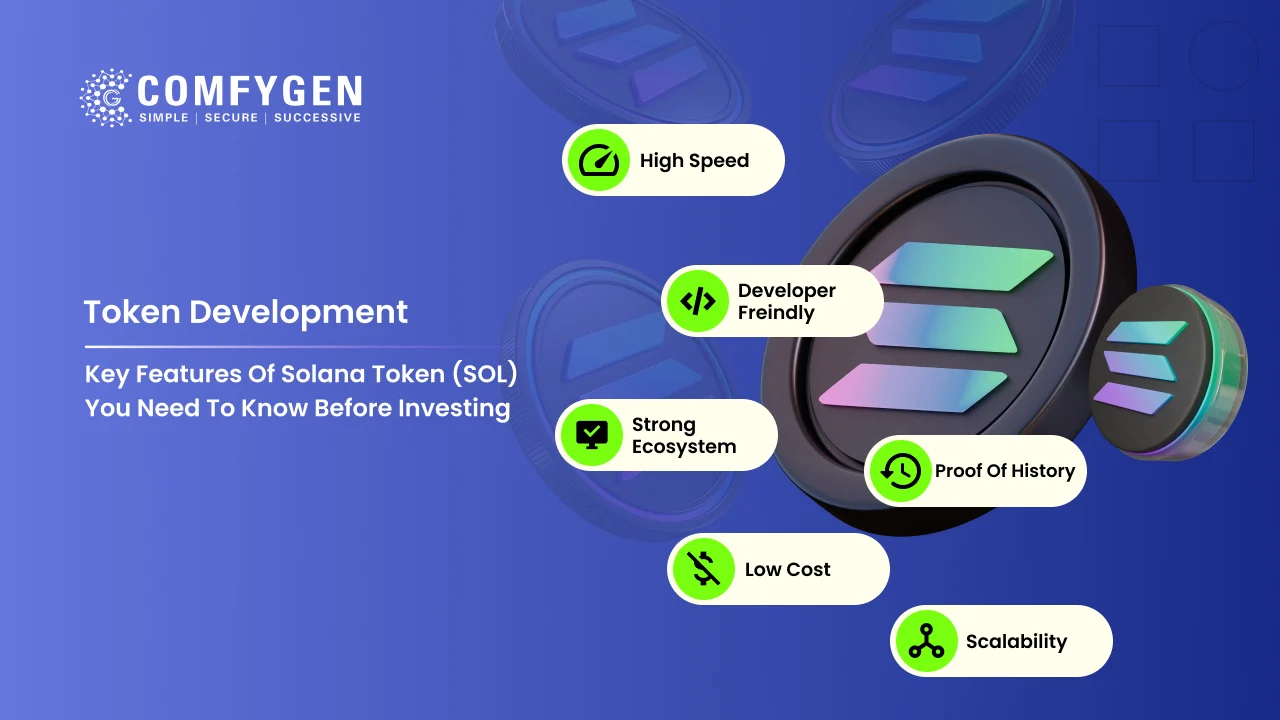
The features of Solana Token (SOL) are designed to support a high-performance blockchain ecosystem that prioritizes speed, scalability, and cost efficiency. These features make Solana one of the most advanced Layer-1 blockchains and a popular choice for developers, enterprises, and investors.
Key Features:
1. High-Speed Transaction Processing
Solana is capable of processing thousands of transactions per second, thanks to its innovative Proof of History mechanism. This high speed ensures near-instant transaction confirmation, making the network suitable for real-time applications such as DeFi platforms, gaming, and NFT marketplaces.
2. Low Transaction Fees
One of the most attractive features of Solana Token Development is its extremely low transaction cost. Users can send and receive SOL or interact with dApps at minimal fees, which improves accessibility and supports mass adoption.
3. Proof of History (PoH) Consensus
Proof of History is one of the most distinctive features of Solana. It creates a verifiable timeline of events, allowing nodes to agree on transaction order without extensive communication. this innovation sets Solana apart from many other blockchain networks.
For investors, PoH enhances:
- Network speed
- Scalability
- Predictable transaction costs
4. Proof of Stake (PoS) Security
Solana’s proof-of-stake mechanism enables SOL holders to stake their tokens and participate in securing the network. Validators are selected based on their stake and performance, ensuring decentralization and security.
Staking SOL also allows token holders to earn passive rewards, making it attractive for long-term investors interested in yield generation.
5. Scalability and Performance of Solana Blockchain
One of the strongest features of Solana Token is its ability to scale efficiently. Solana can handle thousands of transactions per second without significant increases in transaction fees. such scalability supports long-term ecosystem growth, which is a critical factor for investors.
This performance makes Solana ideal for:
- DeFi platforms
- NFT marketplaces
- Web3 applications
- AI-powered Solana dApps
6. Smart Contract and dApp Support
SOL is used to deploy and interact with smart contracts on the Solana blockchain. This enables the development of decentralized applications, including DeFi platforms, NFT projects, and AI-powered Solana DApps.
7. Energy-Efficient Blockchain Design
Compared to traditional proof-of-work blockchains, Solana is more energy-efficient. This makes it an environmentally friendly option for developers and investors focused on sustainable blockchain technology.
Start your Solana development journey today
Contact NowUse Cases of Solana Token (SOL)
The real value of Solana lies in how its technology and token are used across multiple blockchain applications. Backed by the advanced features of Solana Token, SOL supports a wide range of real-world and digital use cases within the Web3 ecosystem.
1. Decentralized Finance (DeFi) Applications
SOL is widely used across DeFi platforms built on the Solana blockchain, including decentralized exchanges, lending protocols, and staking platforms. Its fast transaction speed and low fees make DeFi operations more efficient and cost-effective for users.
2. NFT Marketplaces and Digital Assets
Solana has become a popular blockchain for NFTs due to its scalability and affordability. SOL is used for minting, buying, selling, and transferring NFTs, enabling creators and collectors to interact without high gas fees.
3. Web3 Gaming and Metaverse Projects
The Solana token plays a key role in blockchain-based games and virtual worlds. Developers leverage Solana’s performance to support real-time gameplay, in-game assets, and reward systems powered by SOL.
4. Staking and Network Security
SOL is used for staking on the Solana network, allowing token holders to participate in securing the blockchain. In return, stakers earn rewards, making this use case attractive for long-term holders.
5. Payment and Microtransaction Solutions
Thanks to low transaction costs, SOL can be used for peer-to-peer payments and microtransactions. This makes Solana suitable for digital payments, subscriptions, and cross-border transfers.
6. Smart Contracts and dApp Interactions
SOL is required to deploy and interact with smart contracts on the Solana blockchain. It powers decentralized applications across industries such as finance, healthcare, supply chain, and social platforms.
7. AI-Powered Solana DApps
With growing innovation, SOL is increasingly used in AI-powered Solana DApps, where artificial intelligence integrates with blockchain infrastructure for automation, analytics, and decision-making.
Solana Blockchain Development and Ecosystem
Solana Blockchain Development focuses on creating high-performance decentralized applications using a fast and scalable Layer-1 blockchain. The ecosystem supports modern Web3 use cases, including DeFi, NFTs, gaming, and AI-powered Solana DApps, making it attractive for developers and enterprises.
Key Highlights:
- High-performance blockchain enabling thousands of transactions per second
- Low transaction fees suitable for scalable dApp development
- Robust developer tools and SDKs for efficient Solana development
- Support for smart contracts and decentralized applications
- Growing ecosystem of DeFi, NFT, and Web3 projects
- Compatibility with AI-powered blockchain solutions
- Strong community and enterprise adoption
Conclusion
Understanding the features of Solana Token (SOL) is essential for anyone considering blockchain investment or development opportunities. With its high-speed transactions, low fees, scalable architecture, and innovative Proof of History mechanism, Solana has positioned itself as a powerful Layer-1 blockchain. Its expanding ecosystem, including DeFi, NFTs, and AI-powered Solana DApps, highlights strong long-term potential. Companies like Comfygen Technologies continue to explore Solana Blockchain Development to build secure, scalable, and future-ready decentralized solutions, reinforcing Solana’s relevance in the evolving Web3 landscape.
FAQ’s
Yes! You can create an NFT on Solana blockchain development. You can use the Solana SPL token development standard to create this NFT. Also you can modify an existing NFT smart contract development. Yes! Solana Token development is a wise investment option. Solana consists of minimal transaction costs and quick transaction completion. This is considered as appealing features. It has all the possibility to be a highly profitable investment. Solana token development and Bitcoin are different. They are different by their mechanisms and scalability. Solana uses proof of stake mechanism. It results in faster transaction rates than Bitcoin. In general, Solana token development is faster than other Crypto token development. Also they are more scalable than Bitcoin. Solana is capable of processing thousands of transactions per second. It also provides a better user experience due to its more concentrated structure. It makes it an excellent addition to any portfolio. Solana is a blockchain app development platform. It provides smart contract development capability using a proof of stake mechanism. Also, it permits the building of NFT app development. Its own Crypto is SOL. It is used to pay transaction fees and staking. Also, it can be purchased and sold on exchanges like Coinbase.Is it possible to create NFTs on Solana?
Is it wise to invest in Solana tokens?
How does Solana differ from Bitcoin?
Is Solana Better Than Bitcoin?
What is the use of Solana Crypto?

Mr. Saddam Husen, (CTO)
Mr. Saddam Husen, CTO at Comfygen, is a renowned Blockchain expert and IT consultant with extensive experience in blockchain development, crypto wallets, DeFi, ICOs, and smart contracts. Passionate about digital transformation, he helps businesses harness blockchain technology’s potential, driving innovation and enhancing IT infrastructure for global success.