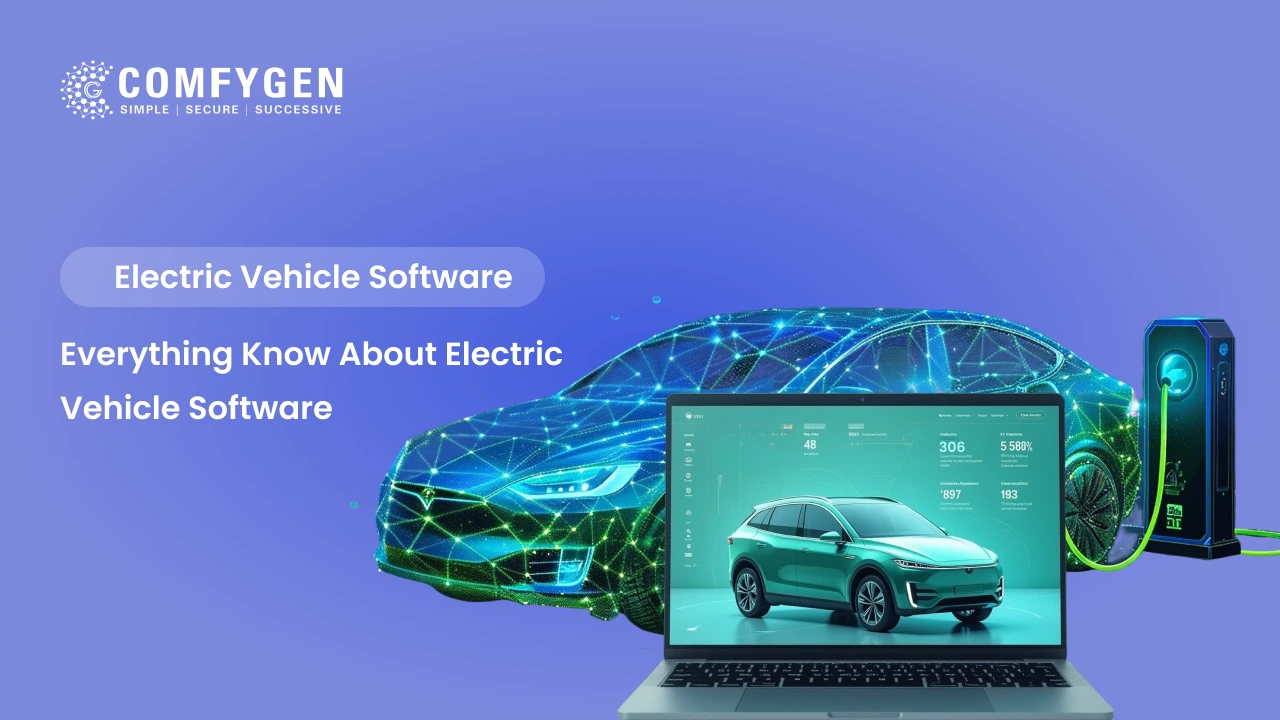





Electric vehicles (EVs) are powered by more than batteries and electric motors. Software plays a central role in how modern EVs manage energy, monitor battery health, support driver-assistance features, deliver connected services, and receive updates over the air.
From battery management and charging infrastructure to connectivity, diagnostics, and advanced driver-assistance systems, electric vehicle software is becoming an increasingly important part of the EV experience. In this blog, we explore the main types of EV software, how it is developed, the role of charging software, and the trends shaping the future of connected electric mobility.
Core Types of Electric Vehicle Software
Electric Vehicle Software depends on a sophisticated network of software systems to function efficiently. In old vehicles, mechanical components are required, but in EVs, they depend on digital intelligence to optimize performance, safety, and user experience. Here’s a look at the key software behind today’s electric cars.
1. Battery Management System (BMS) Software
Purpose: Protects the battery, increases battery life, and efficiency.
Key Functions:
- Monitors battery status including voltage, temp, and charge.
- Stops the battery from overcharging, overheating, or draining too low.
- Balances energy distribution across battery cells.
- Predicts remaining range and battery health.
Example: Modern EV battery-management systems can use data-driven algorithms to monitor battery performance, optimize charging, estimate remaining range, and support battery health.
2. Infotainment & Connectivity Software
Purpose: Enhances user experience.
Key Features:
- Touchscreen dashboards (e.g., Tesla’s Linux-based OS, Volvo’s Android Automotive).
- Voice assistants (Google Assistant, Alexa, or proprietary systems).
- Smartphone integration (Apple CarPlay, Android Auto).
- Real-time overview of traffic, weather, and entertainment apps.
Trend: Automakers are shifting toward custom OS (e.g., Rivian’s in-house system) for better control.
3. Autonomous Driving & ADAS Software
Purpose: Self-driving technologies and driver-assist features.
Key Technologies:
- Tesla Autopilot (vision-based AI).
- LiDAR-based systems (Waymo, Lucid).
- Sensor fusion (combining radar, cameras, and ultrasonic data).
- Machine learning for real-time decision-making.
Future: Fully autonomous EVs (Level 4/5) will rely on edge computing for faster processing.
4. Over-the-Air (OTA) Update Software
Purpose: Allows remote software upgrades without dealership visits.
Benefits:
- Fixes bugs and improves performance.
- Adds new features (e.g., Tesla’s “Dog Mode” or acceleration boosts).
- Enhances cybersecurity.
Example: Ford’s Power-Up updates mimic Tesla’s OTA model.
5. Vehicle-to-Everything (V2X) Communication Software
Purpose: Connects EVs to grids, chargers, and other vehicles.
Applications:
- V2G (Vehicle-to-Grid): EVs supply power back to the grid.
- V2H (Vehicle-to-Home): Powers homes during outages.
- V2V (Vehicle-to-Vehicle): Improves traffic flow and safety.
Example: Nissan Leaf’s bidirectional charging capabilities.
Behind the Scenes: How Electric Vehicle Software is Developed
Electric vehicle software development isn’t an easy task; it combines automotive engineering with advanced computer science. EV software must interact with hardware in real-time, comply with strict safety standards, and adapt as technology advances. Here’s a look at how EV software is designed, built, and maintained.
1. Key Stages of Electric Vehicle Software Development
A. Requirement Analysis & Architecture Design
- Goal: Clarifies the software needs to achieve (e.g., battery optimization, autonomous driving).
- Process:
- Collaboration between automakers, battery experts, and AI engineers.
- Compliance with automotive safety standards (ISO 26262 for functional safety).
- Decision between custom-built vs. third-party solutions.
B. Coding & Integration
- Programming Languages Used:
- C/C++ (for real-time embedded systems like BMS).
- Python/Java (for AI, data analytics, and infotainment).
- MATLAB/Simulink (for modeling battery and motor behavior).
- Integration Challenges:
- Ensuring seamless communication between hardware (sensors, ECUs) and software.
- Testing across different EV models and conditions.
C. Testing & Validation
- Types of Testing:
- Hardware-in-the-Loop (HIL): Simulates real-world conditions in a lab.
- Cybersecurity Testing: Prevents hacking risks in connected EVs.
- OTA Update Testing: Ensures remote updates don’t disrupt vehicle functions.
D. Deployment & Continuous Updates
-
- Over-the-Air (OTA) Deployment: Tesla-style remote updates for bug fixes and feature upgrades.
- Legacy System Support: Older EVs may need backward-compatible updates.
2. Major Challenges in Electric Vehicle Software Development
A. Real-Time Processing Demands
- EVs require millisecond-level decision-making (e.g., battery overheating response).
- High-performance computing (HPC) and edge AI help meet these demands.
B. Cybersecurity Risks
- Connected EVs face threats like:
- Remote hijacking (e.g., through charging ports or infotainment).
- Data theft (location, driving patterns).
- Solutions include blockchain-based authentication and encrypted OTA updates.
C. Fragmented Standards
- Lack of universal protocols for:
- Charging networks (CCS vs. NACS plug wars).
- V2X communication (competing 5G and Wi-Fi-based systems).
D. Balancing Performance vs. Energy Efficiency
- Software must optimize:
- Battery drain (e.g., Tesla’s “camp mode” vs. climate control).
- Computing power (self-driving AI consumes significant energy).
3. Who Builds EV Software?
| Stakeholder | Role |
| Automakers | Develop proprietary OS (Tesla, Rivian) or partner with tech firms (GM + Google). |
| Tier 1 Suppliers | Companies like Bosch and Continental supply middleware and ADAS software. |
| Tech Giants | NVIDIA (AI chips), Qualcomm (infotainment), and Microsoft (cloud integration). |
| Startups | Focus on niche areas like battery AI (SparkCharge) or V2G software. |
Electric Vehicle Charging Station Software: The Backbone of EV Infrastructure
The number of Electric vehicles is growing globally, so charging stations and the charging station software have emerged as a critical component in ensuring seamless, efficient, and smart energy management. This software doesn’t just facilitate charging—it enables grid balancing, user authentication, payment processing, and remote diagnostics.
Here’s a deep dive into how EV charging software works and why it matters.
1. Core Functions of EV Charging Station Software
A. User Authentication & Access Control
- How it works:
- RFID cards, mobile apps (like ChargePoint), or plug-and-charge (ISO 15118 standard).
- Facial recognition and biometrics in next-gen chargers.
Example: Tesla Superchargers automatically bill the connected Tesla account.
B. Dynamic Load Management
- Why it’s needed: Prevents grid overload during peak hours.
- How it works:
- AI algorithms distribute power based on:
- Number of connected EVs.
- Grid demand (smart charging).
- Renewable energy availability (solar/wind-powered stations).
C. Payment Processing & Billing
- Models:
- Pay-per-use (credit card, digital wallets like Apple Pay).
- Subscription-based (EVgo’s membership plans).
- Free charging (promotions by automakers like Porsche).
- Challenges: Cross-border payment standardization (e.g., roaming between networks).
D. Remote Monitoring & Diagnostics
- Features:
- Real-time alerts for malfunctions (e.g., cable overheating).
- Predictive maintenance using IoT sensors.
- Energy usage analytics for fleet operators.
2. Types of Charging Station Software
| Type | Use Case | Example Providers |
| Networked Chargers | Public stations with cloud connectivity | ChargePoint, EVgo, Electrify America |
| Fleet Management | For commercial EVs (delivery vans, buses) | Shell Recharge, Tridens Mobility |
| Home Chargers | Residential smart charging | Wallbox, JuiceBox |
| V2G Software | Bidirectional charging (EV to grid) | Nuvve, OVO Energy |
3. Key Challenges in Charging Software
A. Interoperability Issues
- Different networks use proprietary protocols, forcing drivers to use multiple apps.
- Solution: Open standards like OCPP (Open Charge Point Protocol).
B. Scalability for Mass Adoption
- Charging software needs to scale reliably as the number of connected vehicles, users, and charging sessions grows.
- Cloud-based solutions (AWS, Google Cloud) help scale dynamically.
C. Cybersecurity Risks
- Hackers can exploit:
- Payment systems (credit card skimming).
- Grid connections (demand-response attacks).
- Solution: End-to-end encryption and blockchain-based authentication.
D. Integration with Renewable Energy
- Smart software must align charging with:
- Solar/wind availability.
- Time-of-use electricity pricing.
4. The Future of EV Charging Software
- Automatic Charging: EVs schedule charging during the cheapest/cleanest energy hours.
- Robot Chargers: AI-powered robotic arms plug in cars autonomously (Tesla’s prototype).
- Blockchain Payments: Decentralized, secure transactions without third-party apps.
Top EV Software Companies Leading the Industry
The boom in the EV sector isn’t just driven by automakers, behind this may companies work. These companies develop everything from battery management systems (BMS) to autonomous driving AI, shaping the future of mobility.
Let’s check out the top EV software companies and what makes them stand out.
1. Tesla – The Pioneer in Vertical Integration
Key Software:
- Tesla OS (Linux-based infotainment and vehicle control)
- Autopilot & Full Self-Driving (FSD) (AI-powered autonomy)
- Over-the-Air (OTA) Updates (Remote feature upgrades)
Why They Lead:
- Tight integration between hardware and software.
- Extensive real-world vehicle data and ongoing autonomous-driving development.
2. NVIDIA – The AI Powerhouse for Autonomous EVs
Key Software:
- DRIVE Platform (AI computing for self-driving cars)
- Neural Networks for Sensor Fusion (Combines LiDAR, radar, and cameras)
- Clients: Mercedes-Benz, Jaguar Land Rover, Volvo.
Why They Matter:
- NVIDIA provides widely used AI computing platforms for advanced driver-assistance and autonomous-driving development.
- Enables Level 4 autonomy with simulation training.
3. Bosch – The Middleware & ADAS Expert
Key Software:
- Vehicle Computer Systems (Centralized ECU software)
- Battery Management Solutions (Cloud-connected BMS)
Why They Stand Out:
- Strong expertise in automotive software, vehicle electronics, cybersecurity, and functional safety.
- Focus on cybersecurity and functional safety (ISO 26262).
4. ChargePoint – The Charging Network Leader
Key Software:
- Cloud-Based Charging Management (For fleets and public stations)
- Roaming Integration (Works across multiple networks)
Why They’re Important:
- Largest EV charging network software in North America.
- Smart load-balancing for grid efficiency.
5. Rivian – The Off-Road & Fleet Software Specialist
Key Software:
- Custom Infotainment & Telematics (Built in-house)
- Fleet OS (For Amazon delivery vans and commercial EVs)
Why They’re Unique:
- Focus on adventure EVs and last-mile delivery optimization.
- Proprietary vehicle-to-cloud communication.
6. Emerging Startups to Watch
| Company | Specialization | Innovation |
| Nuvve | V2G (Vehicle-to-Grid) Software | Turns EVs into grid power sources. |
| Twaice | Battery Analytics AI | Predicts battery degradation. |
| Recogni | Autonomous Driving AI | Ultra-low-power vision processing. |
Future Trends in EV Software: What’s Next?
The EV software involved, like AI connectivity and automation, pushes boundaries beyond traditional driving. As electric vehicles become more like “smartphones on wheels,” here are the key trends that will redefine EV software in the coming years.
1. AI-Powered Personalization
How It Works:
- AI-powered personalization can adapt to driver preferences and usage patterns.
- Example: Tesla’s cabin pre-conditioning based on calendar events.
Impact:
- Enhanced user experience, brand loyalty.
2. Blockchain for Secure EV Transactions
Applications:
- Decentralized charging payments (no need for multiple apps/accounts).
- Tamper-proof vehicle history (for used EV sales).
- Smart contracts for V2G energy trading.
Example: Startups like DOVU are testing blockchain-based mileage tracking.
3. Autonomous Driving Breakthroughs
Next-Gen Tech:
- Level 4 autonomy (Driverless operation in geofenced areas, subject to safety and regulatory approval).
- LiDAR cost reduction (new solid-state models).
- Crowdsourced mapping (Tesla’s “Dojo” supercomputer training).
Challenge: Regulatory approval for driverless taxis.
4. Extended Reality (XR) Dashboards
Innovations:
- AR windshields (navigation arrows on the road).
- VR passenger entertainment (Meta partnerships with automakers).
Pioneers: Mercedes’ Hyperscreen, BMW’s Mixed Reality HUD.
5. Standardization of Charging Software
Trends:
- Plug-and-Charge (ISO 15118) adoption is expanding to enable more seamless EV charging and payment.
- Universal roaming (single account for all chargers, like cell networks).
Holdout: Tesla’s proprietary Supercharger network.
6. Cybersecurity as a Priority
New Threats:
- Ransomware attacks on charging stations.
- Data theft from connected infotainment.
Solutions:
- Biometric authentication (fingerprint/face ID for driving).
- Quantum encryption (for government fleets).
7. Edge Computing for Faster Decisions
Why It Matters:
- Reduces latency in autonomous driving (no cloud dependency).
- Enables real-time battery optimization.
Leaders: NVIDIA’s Drive Thor, Qualcomm’s Snapdragon Ride.
8. Sustainability-Focused Software
Innovations:
- Battery recycling tracking via a custom blockchain network.
- Carbon footprint calculators in dashboards.
Conclusion:
Electric vehicle software has become an important part of modern EV development, supporting everything from battery management and charging to connectivity, diagnostics, and advanced driver-assistance features. As EV technology continues to evolve, software will play an increasingly important role in improving efficiency, safety, convenience, and connected vehicle experiences.
For businesses developing EV software, choosing the right architecture, integrations, security practices, and development approach is essential for building solutions that can scale with changing vehicle and charging requirements. At Comfygen Technologies, we help businesses develop software for the next generation of electric mobility, from smart charging and BMS platforms to connected and autonomous-driving solutions.
Frequently Asked Questions (FAQ)
How do software updates work in EVs?
- OTA Updates: Most modern EVs receive wireless updates (like your smartphone)
- Frequency: Ranges from monthly (Tesla) to annually (some legacy automakers)
- Types: Includes bug fixes, new features, and performance improvements
Is EV software different from regular car software?
- More Complex: EV software manages battery systems, charging, and often autonomous features
- More Connected: Typically has constant internet connectivity for updates and features
- More Integrated: Directly controls critical systems like power distribution
What happens if the software crashes while driving?
- Fail-Safes: Multiple redundant systems take over
- Limited Function Mode: Vehicle maintains basic operation
- Emergency Protocols: Safely pulls over in autonomous vehicles
Do all EVs use the same operating system?
- Varied Landscape: Different manufacturers use different systems
- Common Bases: Many build on Linux, Android Automotive, or QNX
- Custom Solutions: Some (like Tesla) developed completely proprietary systems
Can software updates improve my EV's range?
- Yes: Optimizations can improve efficiency by 5-10%
- Examples: Better battery management, improved thermal controls
- Limits: Physical battery capacity remains the ultimate constraint

Mr. Saddam Husen, (CTO)
Mr. Saddam Husen, CTO at Comfygen, is a renowned Blockchain expert and IT consultant with extensive experience in blockchain development, crypto wallets, DeFi, ICOs, and smart contracts. Passionate about digital transformation, he helps businesses harness blockchain technology’s potential, driving innovation and enhancing IT infrastructure for global success.