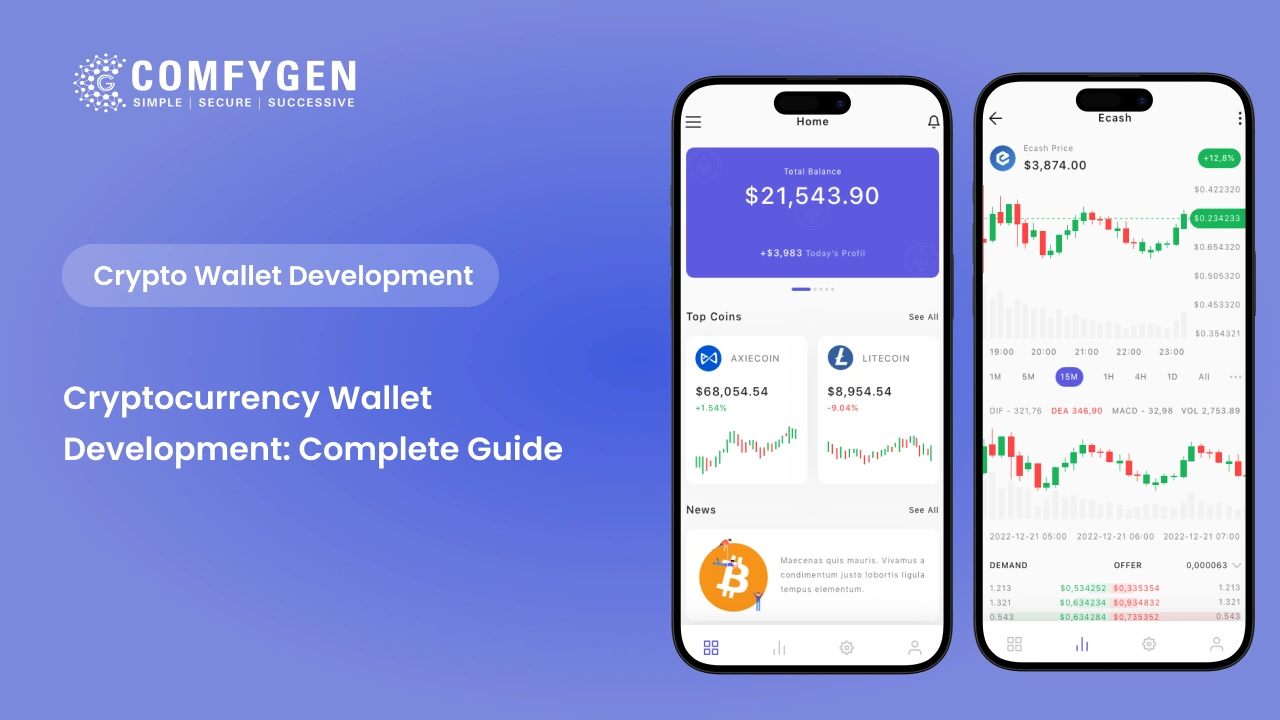





A cryptocurrency wallet is a digital cryptocurrency management tool that is used to store the private keys used to prove ownership of crypto assets and approve blockchain transactions. It plays a central role in how users interact safely with blockchain networks. In the broader crypto system, crypto wallets function as the main interface for managing digital assets, tracking portfolio value, accessing decentralised applications, and enabling secure peer-to-peer transfers without relying on intermediaries.
Today, an AI-powered crypto wallet development service has become essential for businesses entering the Web3 space. A reliable Crypto wallet ensures user security by protecting the cryptographic keys that control digital currencies. Whether it’s a DeFi wallet, multi-currency wallet, Bitcoin wallet, Ethereum wallet, or a fully customised cryptocurrency wallet development solution, the goal is the same: keep assets safe while delivering smooth blockchain interactions. Without a secure wallet, users cannot safely send, receive, or hold crypto, making wallets the backbone of every crypto platform.
This guide explores the core elements of crypto wallet development, including wallet types, blockchain integration, security frameworks, essential APIs, multi-chain compatibility, and the key factors that influence the overall development cost. It’s built to help startups, enterprises, and Web3 projects navigate the rapidly growing digital asset landscape with confidence.
Market Overview: Crypto wallet and cryptocurrency
The cryptocurrency market is experiencing fast growth because of the increasing adoption of cryptocurrencies and the need for secure, user-friendly platforms to manage different digital assets.
Cryptocurrency Market size was valued at USD 6.75 billion in 2019 and USD 8.42 billion in 2023 to USD. Market growth will be 61.87 billion in 2031 and growing at a CAGR of 24.8% in the evaluation period (2024-2031).
Key trends include the integration of advanced security features like biometric authentication and multi-signature support, as well as increased interoperability with decentralised finance applications. Major players like Ledger, Trezor, and come-out fintech startups are continuously innovating to offer cross-platform similarity and perfect user experiences. Also, the growing interest in decentralised exchanges and the proliferation of new cryptocurrencies are further charging the demand for strong multi-currency wallet solutions that support the storage of confidential keys that keep crypto secure and accessible.
Types of Cryptocurrency Wallets
Cryptocurrency wallets come in a variety of forms, each crypto wallet designed and developed for different user needs and security requirements. Understanding these crypto wallet types will help developers select and design optimal Cryptocurrency wallet development solutions according to specific applications.
Software Wallets
-
Mobile wallets: Apps for iOS or Android devices, designed for convenient on-the-go transactions and quick access to DeFi and NFTs.
-
Desktop wallets: Programs installed on Windows, Mac, or Linux computers, often offering advanced features for active traders and developers.
-
Web wallets: Browser-based Wallet Development Solutions, providing instant access from anywhere with an internet connection, but Web crypto wallets are typically less secure than desktop or hardware wallets.
Hardware Wallets (Cold Wallets)
-
Hardware Wallets are offline devices that keep your private keys away from internet risks. Because every transaction requires physical confirmation on the hardware crypto wallets, they’re one of the safest ways to store cryptocurrency. Most hardware crypto wallets come with PIN protection, seed phrase backups, and encrypted chips. They’re ideal for long-term holding, large portfolios, and anyone who wants maximum security without constant online exposure.
Custodial vs Non-Custodial Wallets
-
Custodial wallets: Custodial wallets managed by third parties (such as exchanges), who control the private keys. These are easier for beginners but less private and secure since the user relies on a company for asset protection.
-
Non-custodial wallets: The user holds and manages their own keys, providing full control and privacy but requiring more responsibility for security.
Multi-signature Wallets
- Multi-signature wallets need approval from multiple keys before any transaction can go through. Think of it as a shared lock where no single person has full control. Organisations use them to avoid internal misuse, teams depend on them for treasury management, and investors use them to add an extra safety layer to large holdings.
Specialized Wallets
-
NFT wallets: Built to manage, store, and interact with NFT collections across blockchain platforms.
-
DeFi wallets: Enable users to connect to decentralised finance protocols for lending, borrowing, and staking crypto assets directly.
Security Models while Crypto Wallet Development Service
Security in cryptocurrency wallet development requires both advanced design and continuous vigilance. Blockchain Developers integrate multiple protective strategies, such as account abstraction to enable user-friendly authentication (like passkeys) beyond traditional private keys, reducing risks linked to seed phrase theft or loss. Safeguards against phishing attacks are vital; wallets should warn users before revealing private keys and use databases of trusted sites to prevent redirection to malicious actors.
Private Key Management Best Practices
-
Use secure generation methods and never expose private keys to the user interface; keys should always remain encrypted and protected by hardware or trusted execution environments such as Secure Enclave (iOS) or StrongBox (Android).
-
Implement recovery plans and regular wallet backups, storing them securely to ensure access in case of loss or device failure.
Encryption Techniques
-
Employ strong encryption standards like AES for storing sensitive data, including private keys and user credentials, both at rest and in transit.
-
Always secure communications between the wallet and blockchain nodes using TLS with certificate pinning to prevent interception.
Authentication Mechanisms
-
Two-Factor Authentication (2FA) adds an extra layer of security, using authenticator apps or hardware security keys rather than SMS verification.
-
Biometric authentication methods, such as face ID or fingerprint recognition, reduce reliance on passwords and enhance user experience while maintaining high-security standards.
Hot vs. Cold Wallets
-
Hot wallets are connected to the internet and offer convenience for daily transactions, but are more vulnerable to cyber threats.
-
Cold wallets store keys offline (hardware devices or paper wallets), providing stronger protection for long-term asset storage.
Multi-signature and Multi-factor Authentication
-
Multi-signature wallets, which require signatures from multiple private keys, are ideal for organisations and joint accounts, increasing resilience against unauthorised access.
-
Combining several authentication methods (such as password, biometric, and device-based verification) helps establish multi-factor security.
Security Audits and Penetration Testing
-
Security audits, including static code analysis and black-box/white-box penetration testing, identify vulnerabilities and ensure a compliant, resilient wallet architecture.
-
Continuous monitoring and updates based on audit findings are essential to maintain crypto wallet security and adapt to new threats.
APIs and Integrations for Crypto Wallet Development Solution
APIs are at the core of modern cryptocurrency wallet development, enabling seamless integration with blockchain networks, payment systems, and compliance frameworks. Blockchain node APIs allow crypto wallets to interact directly with blockchain networks like Ethereum and Bitcoin, providing functionalities such as transaction creation, balance checking, and blockchain smart contract interactions.
Third-party APIs simplify integration with payment gateways, enable real-time price tracking (e.g., CoinGecko API), and support regulatory compliance through KYC/AML verification modules. For user convenience, wallets increasingly support token swaps and direct exchange integration, facilitated through APIs provided by platforms such as Binance and Coinbase.
Multi-currency support, wallet connect protocols, and interoperability features are implemented using SDKs and libraries like Web3.js, ethers.js, and MetaMask SDK. These tools allow developers to build cross-platform experiences, mobile deeplinking, and secure multi-chain operations. Adopting robust API integration strategies also improves audit readiness, supports regulatory reporting, and scales feature delivery speed for enterprise wallet solutions.
Cryptocurrency Wallet Development Cost Factors
Crypto Wallet development cost is based on several key factors. The crypto wallet development type matters: hardware wallets and those with non-custodial architecture tend to incur higher costs due to specialised security and firmware requirements, while custodial and simple software-based crypto wallets are less expensive. Adding advanced features like support for multi-currency transactions, staking, DeFi, or NFT management increases engineering time and complexity, driving up expenses.
Security features form a substantial portion of the budget. Advanced encryption, two-factor authentication, multi-signature routines, and compliance frameworks like KYC/AML can greatly increase costs, especially when custom development is required and ongoing audits are needed. Platform support also impacts cost; building for multiple platforms (iOS, Android, Web, hardware) requires separate development and testing, with specialisation for each environment.
Blockchain Development team location and expertise play a crucial role. Teams in North America and Europe typically charge higher hourly rates than those in Asia or Eastern Europe, resulting in broad cost variances for similar work. After launch, ongoing maintenance, updates, and regular security audits are necessary investments to ensure wallets remain strong and compliant, usually billed annually or per update.
Estimated cost ranges:
-
Basic wallets: $5,000 to $25,000 for simple transactional features.
-
Advanced wallets: $30,000 to $100,000+ with rich DeFi, NFT, and multi-layer security.
-
Enterprise-grade wallets: $100,000 and above, reflecting custom integrations, ultra-secure storage, and regulatory adaptation for global use.
Conclusion
Partnering with a top-rated wallet development company, Comfygen Technologie, for cryptocurrency wallet development means leveraging deep expertise in blockchain, AI-driven security, and user-focused innovation. Comfygen designs secure, scalable crypto wallets that support multi-chain assets, DeFi, and NFTs, integrating advanced authentication and compliance features to meet global standards.
Comfygen’s end-to-end Cryptocurrency Wallet Development Process, grounded in transparent planning, rigorous security testing, and post-launch support, ensures your wallet development project delivers exceptional performance and reliability. With 24/7 technical support and ongoing updates, Comfygen empowers your business to confidently navigate the fast-changing digital asset landscape, unlocking smarter, safer crypto management for every user.
FAQs
Multi-cryptocurrency surrounds the utilization, management, or support of many cryptocurrencies immediatly, spanning across diverse contexts like wallets, crypto exchanges, and investment portfolios. Within this framework, a multi-coin or multi-chain wallet stands out as a central tool that enables users to securely store various crypto assets originating from well-defined blockchain networks and provides whole management and accessibility within a single platform. Developing a multi-cryptocurrency wallet provide to users convenience, flexibility, and security by managing various digital assets in one place. It also supports business needs by facilitating efficient international transactions. The multi-cryptocurrency wallet development time can depend on the project's difficulty, typically ranging from a few months to over a year for more cultivated apps. Security measures include encryption, biometric authentication, multi-signature support, auto-session logout, and regular security updates.What is multi-cryptocurrency?
Why should I develop a multi-cryptocurrency wallet?
How long does it take to develop a multi-cryptocurrency wallet?
What security measures are necessary for a multi-cryptocurrency wallet?

Mr. Saddam Husen, (CTO)
Mr. Saddam Husen, CTO at Comfygen, is a renowned Blockchain expert and IT consultant with extensive experience in blockchain development, crypto wallets, DeFi, ICOs, and smart contracts. Passionate about digital transformation, he helps businesses harness blockchain technology’s potential, driving innovation and enhancing IT infrastructure for global success.