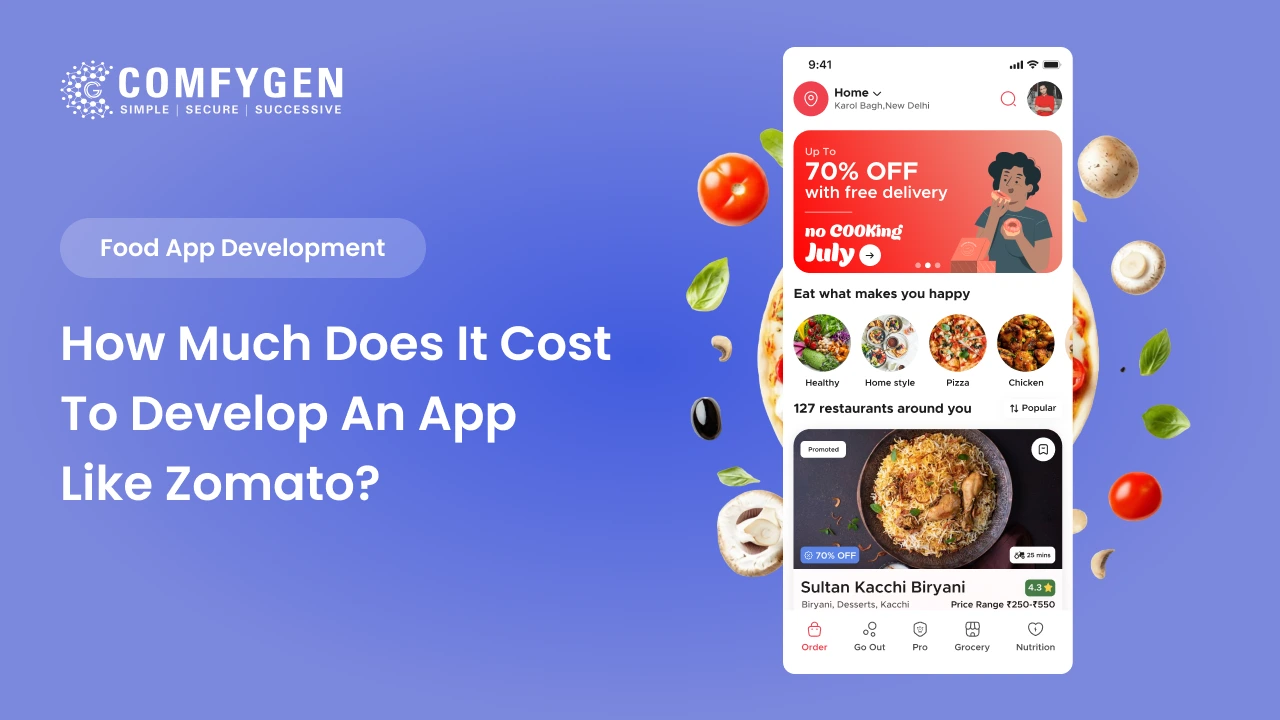





Building an app like Zomato in India costs ₹2 lakh to ₹44 lakh or more. A single-restaurant Android app runs ₹2 lakh to ₹6 lakh. A white-label marketplace with all four apps costs ₹13 lakh to ₹22 lakh. A custom MVP runs ₹22 lakh to ₹44 lakh, and a full multi-city platform starts above ₹44 lakh.
The range looks wide because “an app like Zomato” describes four different products. A ₹3 lakh quote and a ₹25 lakh quote can both be honest. They are pricing different things, and the difference is usually how many apps you get.
Cost to Develop an App Like Zomato: Full Price Ladder
| Tier | What you actually get | Cost (INR) | Approx. USD | Timeline |
| Single-restaurant app | Android ordering app, one menu, basic admin. No restaurant app, no driver app | ₹2–6 lakh | $2,400–$7,000 | 3–6 weeks |
| White-label marketplace | Pre-built customer, restaurant and driver apps rebranded, plus admin dashboard | ₹13–22 lakh | $15,000–$25,000 | 2–4 weeks |
| Custom MVP | Four apps built to your model, live tracking, UPI and cards, admin panel | ₹22–44 lakh | $25,000–$50,000 | 8–12 weeks |
| Full marketplace | Multi-city, commission engine, AI recommendations, dining-out module | ₹44 lakh+ | $50,000+ | 16–24 weeks |
Most quotes online sit in the first row. Most people asking this question need the second or third.
Why Do Zomato App Development Cost Estimates Vary So Much?
Estimates vary because agencies price different products under the same name. The gap is almost always the number of apps included.
A working marketplace is four connected products:
- Customer app for discovery, ordering and tracking
- Restaurant partner app for accepting orders and managing menus
- Delivery partner app for pickup, navigation and delivery
- Admin panel for restaurants, drivers, commissions and reporting
An order moves through all four in real time. That coordination is the actual engineering work. Four apps is roughly three times the effort of one, because each needs its own design, testing cycle and store submission.
When you compare two quotes, ask how many panels each covers before you compare the numbers.
What Does a ₹2 Lakh Zomato Clone App Actually Include?
A ₹2 lakh budget buys an Android app for customers, one restaurant’s menu, a basic admin panel and a single payment gateway. It does not include a restaurant app, a driver app, live GPS tracking, iOS, or commission logic.
Agencies quoting ₹1 lakh to ₹4 lakh are usually being straight with you. Here’s the split.
Included at ₹2 to ₹6 lakh:
- Android customer app
- One restaurant’s menu, or a short static list
- Web admin panel
- One payment gateway
- Order placement and status updates
Not included:
- Restaurant app. Without it, restaurants can’t accept orders, mark items sold out, or update their own menu. Someone at your end does that by phone.
- Driver app. No delivery assignment, no navigation, no live location.
- Live GPS tracking. The most expensive feature in any food app, because it needs the driver app to exist first.
- iOS. Android-only is a sensible India-first choice, but it isn’t the full market.
- Commission and payout logic. Fine if you own the restaurant. A problem if you’re running a marketplace.
If you run one restaurant and want to stop paying aggregator commission, ₹3 lakh is a reasonable spend. If you want restaurants to onboard themselves and drivers to get assigned automatically, it isn’t enough.
What India-Specific Costs Should You Budget For?
Four items that generic cost guides leave out, and that Indian platforms cannot skip.
GST on Food And Delivery
Restaurant service and delivery charges carry different GST treatment, and platforms acting as e-commerce operators have their own collection duties. Your billing engine has to work this out per line item rather than applying one rate to the basket. Rules around delivery charges have been revised more than once, so check the current position on the GST portal before scoping.
Budget ₹1.5 lakh to ₹4 lakh.
UPI and Indian Payment Methods
Cards alone will lose you orders. Indian customers expect UPI, and most platforms also carry wallets, net banking and cash on delivery. Razorpay, Cashfree and PayU each cover the standard set in one integration.
Budget ₹1.5 lakh to ₹4 lakh.
Android First
Android holds the large majority of Indian smartphone users. Launching Android first and adding iOS later cuts your initial spend, and it’s the order most Indian food platforms actually followed.
This is one of the few places where the cheaper path is also the better one.
Regional Languages
Hindi plus one or two regional languages is standard for platforms operating outside the metros. Build it into the design rather than translating after launch.
Budget ₹1 lakh to ₹3 lakh.
Build Your Zomato-Like App Today
Plan your app with the right features, budget, and technology to launch faster and compete confidently.
Get a Free Development Quote
Feature-by-Feature Cost Breakdown
These are components of the tiers above, not extras added on top.
| Feature | Cost (INR) |
| User registration and login | ₹90,000–₹1.8 lakh |
| Restaurant listings and menus | ₹1.8–3.5 lakh |
| Search and filters | ₹1.3–2.6 lakh |
| Cart, ordering and customization | ₹1.8–3.5 lakh |
| Payment gateway with UPI | ₹1.8–4.4 lakh |
| Live GPS order tracking | ₹2.6–5.3 lakh |
| Push notifications | ₹90,000–₹1.8 lakh |
| Ratings and reviews | ₹90,000–₹1.8 lakh |
| Delivery partner module | ₹2.6–5.3 lakh |
| Admin dashboard | ₹4.4–8.8 lakh |
Advanced Features
| Feature | Cost (INR) |
| AI recommendations | ₹3.5–7 lakh |
| Dining-out and table booking | ₹3.5–8 lakh |
| Subscription tier | ₹2.6–5.3 lakh |
| In-app chat support | ₹1.8–3.5 lakh |
| Multi-language | ₹1.8–4.4 lakh |
| Scheduled orders | ₹1.8–3.5 lakh |
| Analytics dashboard | ₹3.5–7 lakh |
| Driver incentive engine | ₹2.6–5.3 lakh |
AI recommendations deserve a note. They need order history to produce anything useful, and on launch day you have none. Capture the data properly from day one and add the engine in year two, once there’s something to learn from. Sorting the rest of your food delivery app features into launch, month-six and year-two tiers is the cheapest planning work you can do before signing a scope.
How Is Zomato Different From a Pure Delivery App?
Zomato combines restaurant discovery and dining-out with delivery. Swiggy started closer to pure delivery and later added groceries and courier services on the same rider network. That difference changes what you build.
The scale is worth knowing before you price anything. Eternal, Zomato’s parent company, reported gross order value of ₹17,190 crore for its food delivery business in the quarter ending December 2025, with roughly 23 million monthly transacting customers across the group (Eternal Q3 FY26 results).
If you want the Zomato model, budget for real search and content infrastructure. A delivery app needs a menu. A discovery platform needs a searchable, reviewable database of restaurants, plus photos, ratings and reservation logic.
If you want the Swiggy model, cost shifts toward dispatch and fleet management instead. Both land in the same overall range, and the general food delivery app development cost tiers hold either way once you strip out the India-specific layer.
Does Cross-Platform Development Cost More Than Native?
No. One React Native or Flutter codebase running on both iOS and Android costs 30% to 40% less than building two separate native apps.
Native still wins for heavy animation or deep hardware access. A food delivery app needs neither. The cheapest sensible routes are cross-platform, or Android-only first.
Plenty of cost guides state this backwards, so it’s worth checking what a quote assumes before you compare it to another one.
How Long Does It Take to Build?
| Tier | Timeline |
| Single-restaurant app | 3–6 weeks |
| White-label marketplace | 2–4 weeks |
| Custom MVP | 8–12 weeks |
| Full marketplace | 16–24 weeks |
White-label is faster than a custom single-restaurant build because the platform already exists. You’re branding and configuring rather than building from nothing.
What Are the Ongoing Costs?
Budget 15% to 20% of build cost every year. That covers:
- Cloud hosting and servers
- OS compatibility updates
- Security patches and bug fixes
- Google Maps and payment gateway usage, which scales with order volume
- Play Store registration at roughly ₹2,000 one-time, App Store at roughly ₹8,500 per year
The API costs are the ones people miss. They’re near zero at launch and grow directly with orders, which means they’re invisible exactly when you’re building the budget.
How Do You Compare Quotes Without Getting Burned?
Five questions that separate a real quote from a number on an email.
How many apps are included? Customer only, or all four? This one question explains most of the gap between ₹3 lakh and ₹25 lakh.
Can I download two food apps you’ve built? Play Store links you can open on your own phone. Screenshots prove nothing.
Is source code ownership in the contract? Full IP assignment, no ongoing license fee, no hosting lock-in.
What happens at 500 concurrent orders? A build that demos well and falls over during a dinner rush is a common and expensive outcome.
Have you handled GST for an e-commerce operator before? If not, you’ll discover the gap at the worst possible time.
Put those five questions to six or eight food delivery app development companies and the list narrows to three inside a week, because the ones who can’t answer in writing drop out on their own.
How Comfygen Builds Zomato-Like Apps
Comfygen has delivered 550+ projects for 400+ clients across 30+ countries since 2019, with a 97% client retention rate. On-demand delivery platforms are the core of that work, covering restaurant ordering, cloud kitchens, grocery and hyperlocal delivery.
Every marketplace build ships all four apps: customer, restaurant partner, delivery partner and admin. Projects run in two-week sprints with a working demo at the end of each one, so you see the build as it happens rather than eight weeks later. Full source code ownership transfers at delivery with no license fee attached.
Founders scoping a custom food ordering platform around their own operating model usually start with a call to work out whether white-label or custom fits before anything gets built.
Final Verdict
Developing a food delivery app like Zomato is an exciting opportunity to enter a booming industry with immense potential. The cost of building such an app depends on various factors, including the features, tech stack, and development process. By starting with essential functionalities and gradually integrating advanced technologies, you can create a scalable and user-friendly platform that meets market demands.
Frequently Asked Questions
How much does it cost to develop an app like Zomato in India?
What is the cost of making an app like Zomato with all four panels?
Can I build a Zomato clone app for ₹2 lakh?
Why do Zomato app development cost estimates vary so much?
Should I launch on Android first in India?
How much does Swiggy app development cost compared to Zomato?
Does cross-platform development cost more?
Do I need to handle GST differently for food delivery?
How long does Zomato-like app development take?
What are the ongoing costs after launch?
Do I own the source code?
Is real-time tracking worth the cost?

Mr. Saddam Husen, (CTO)
Mr. Saddam Husen, CTO at Comfygen, is a renowned Blockchain expert and IT consultant with extensive experience in blockchain development, crypto wallets, DeFi, ICOs, and smart contracts. Passionate about digital transformation, he helps businesses harness blockchain technology’s potential, driving innovation and enhancing IT infrastructure for global success.