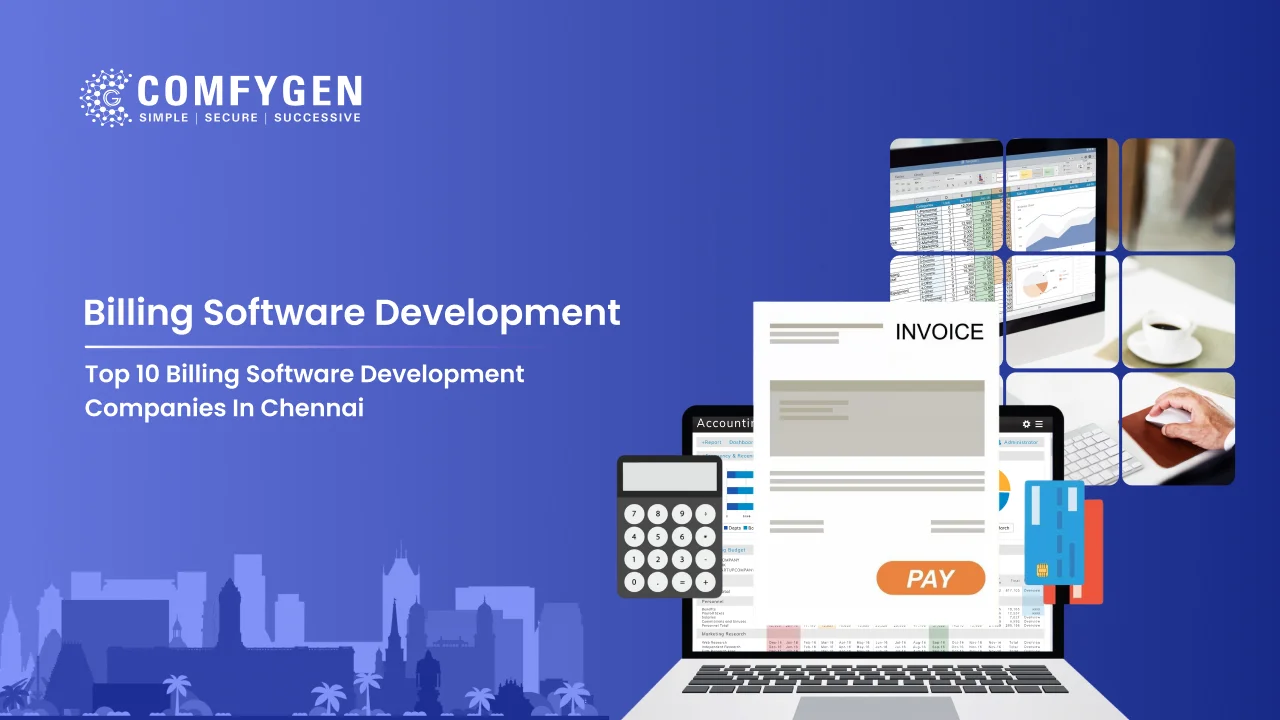





In 2026, billing software development for SaaS has moved far beyond basic invoicing and payment processing. What was once a back-office function is now a real-time, data-driven system shaped by AI-era consumption models, usage-based pricing, and hybrid monetization strategies.
With the global SaaS market expected to reach $315 billion by the end of 2026, businesses are facing growing challenges in managing complex billing workflows, high-volume event ingestion, and scalable payment systems. Modern billing software architecture must support recurring subscriptions, usage-based billing, automated invoicing, and seamless payment software development—all while ensuring compliance and accuracy.
Companies like Comfygen Technologies specialize in custom billing software development tailored for SaaS platforms. By integrating AI-powered billing software development, smart analytics, and secure payment gateways, Comfygen Technologies helps SaaS businesses simplify billing operations, reduce revenue leakage, and improve customer experience at scale.
What is billing software in SaaS?
SaaS billing software has become a core financial infrastructure rather than just an invoicing tool. It automates the entire process of charging customers for cloud-based services by managing subscriptions, recurring revenue cycles, real-time usage tracking, and global tax compliance. Modern billing software development in SaaS goes beyond basic payment collection to support usage-based pricing, hybrid monetization models, and scalable revenue operations. Acting as the strategic engine behind cash flow, SaaS billing software ensures accurate invoicing, seamless payment software development, and consistent revenue recognition while supporting business growth in a competitive digital economy.
Core Functions of SaaS Billing Software
- Subscription Management: Automates the entire customer lifecycle, including free trial conversions, mid-cycle upgrades or downgrades, and renewals.
- The “Billing Engine”: The central logic that applies pricing rules to every customer. It calculates base recurring fees, rates complex usage data (e.g., API calls, tokens), and computes prorations for account changes.
- Dunning Management: An automated recovery system for failed payments. It intelligently retries credit cards and sends customer reminders, which can recover up to 18% of unsuccessful payments.
- Global Tax & Compliance: Automatically calculates and applies region-specific taxes (VAT, GST, US Sales Tax) and ensures revenue is recognized according to international standards like ASC 606 or IFRS 15.
- Self-Service Portals: Provides customers with a branded dashboard to manage their own subscriptions, update payment methods, and view detailed billing history.
Common SaaS Billing Models
Modern SaaS billing software is designed to support a wide range of monetization strategies, allowing businesses to scale revenue efficiently while meeting customer expectations. Below are the most widely used SaaS billing models in today’s subscription economy:
1. Flat-Rate / Subscription Billing
This model charges customers a fixed recurring fee on a monthly or annual basis. It is simple to manage and ideal for SaaS products with a single feature set or standardized service offerings.
2. Usage-Based (Metered) Billing
Also known as pay-as-you-go billing, this model charges customers based on actual usage, such as data storage, API calls, compute time, or transactions processed. It requires real-time usage tracking and accurate billing automation.
3. Tiered Pricing Model
Tiered billing offers multiple pricing plans (e.g., Basic, Pro, Enterprise) with increasing feature access or usage limits. This model helps businesses target different customer segments effectively.
4. Hybrid Billing Models
Hybrid billing combines a base subscription fee with variable usage-based charges or overages. This flexible approach is widely used by SaaS companies with complex pricing structures.
5. Per-User / Per-Seat Billing
In this model, customers are charged based on the number of active users or seats accessing the platform. It is commonly used in B2B SaaS tools like CRM, project management, and collaboration software.
Build a scalable, automated SaaS billing system with Comfygen—get started today.
Why Modern SaaS Companies Depend on Billing Software Systems
Modern SaaS companies depend on advanced billing software systems because the industry has evolved far beyond simple flat-rate subscriptions. In 2026, SaaS monetization is driven by AI-powered, usage-based, and hybrid billing models that disrupt traditional financial workflows. Billing is no longer a back-office function—it has become a core growth engine and strategic advantage.
At Comfygen Technologies, we help SaaS businesses design and implement custom billing & accounting software development solutions that support scalability, automation, and real-time revenue operations.
1. Managing AI-Era Pricing and Usage Complexity
Traditional per-seat pricing is rapidly becoming obsolete. Today’s SaaS businesses rely on usage-based billing software that meters API calls, compute time, tokens, or transactions—models that are impossible to manage manually.
- Real-Time Rating: Modern billing software instantly converts high-volume usage events into accurate, billable charges.
- Proration Automation: Automated proration adjusts pricing for mid-cycle upgrades or downgrades, eliminating costly human errors.
2. Preventing Revenue Leakage and Improving Cash Flow
Manual billing software processes often result in missed charges, leading to 3%–7% revenue leakage annually. Automated billing software development for SaaS helps recover lost revenue and stabilize cash flow.
- Dunning Management: Smart retries and automated reminders recover failed payments and reduce involuntary churn.
- Faster Billing Cycles: Automation reduces billing run times by up to 95%, accelerating revenue collection and freeing finance teams from operational bottlenecks.
3. Ensuring Global Compliance and Financial Security
Operating a SaaS business globally requires strict adherence to tax laws and financial regulations.
- Automated Tax Engines: Modern billing systems apply real-time VAT, GST, and sales tax rules by jurisdiction, reducing compliance risk.
- Revenue Recognition: Built-in compliance with ASC 606 and IFRS 15 ensures audit readiness and investor confidence.
4. Enhancing Customer Experience and Retention
Transparent and accurate billing directly impacts customer trust, retention, and lifetime value.
- Self-Service Billing Portals: Customers can manage subscriptions, update payment methods, and track usage without support intervention.
- Clear Invoicing: Itemized invoices eliminate billing confusion and prevent unexpected charges.
5. Acting as a Single Source of Truth for Revenue Data
Modern SaaS billing software architecture unifies data across CRM, ERP, and product systems.
- Real-Time Insights: Leadership gains visibility into key metrics such as MRR, churn, and expansion revenue.
- Engineering Efficiency: By leveraging specialized billing platforms, development teams can focus on product innovation instead of maintaining fragile in-house billing systems.
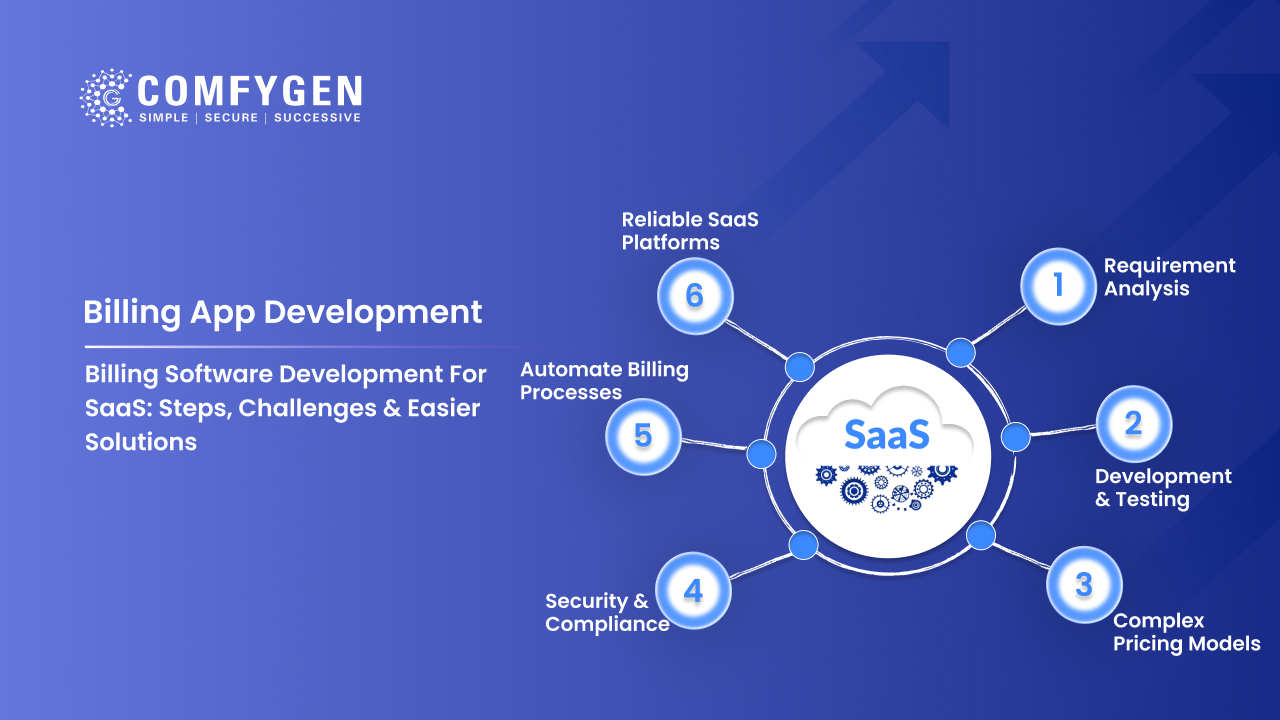
Key Steps in Billing Software Development for SaaS
Building a scalable and reliable billing software system for SaaS requires a structured development approach. At Comfygen Technologies, we follow proven steps to ensure accuracy, flexibility, and long-term growth.
1. Requirement Analysis & Pricing Model Selection
The first step in billing software development for SaaS is understanding business goals and choosing the right pricing model—subscription, usage-based, tiered, hybrid, or per-user. This ensures the billing system aligns with revenue strategy and customer behavior.
2. Designing Billing Software Architecture
A robust billing software architecture is designed to handle high transaction volumes, real-time usage data, and scalability. Modern architectures often use microservices and APIs to support integrations and future expansion.
3. Recurring Billing & Subscription Workflows
This step focuses on automating recurring billing cycles, subscription renewals, upgrades, downgrades, and proration. Efficient subscription workflows are essential for predictable SaaS revenue.
4. Payment Gateway Integration
Secure payment software development includes integrating multiple payment gateways, supporting global currencies, handling refunds, and managing failed payments to ensure smooth cash flow.
5. Invoice Software & Automation
Automated invoice software development enables accurate invoice generation, tax calculation, email delivery, and payment reminders, reducing manual errors and operational costs.
6. Security, Compliance, Tax & Audit Features
SaaS billing systems must comply with PCI DSS, GDPR, VAT, GST, and revenue recognition standards like ASC 606. Built-in compliance protects businesses from financial and legal risks.
7. Testing & Deployment
Comprehensive testing ensures billing accuracy, payment reliability, and system stability before deployment. This step minimizes revenue leakage and customer dissatisfaction.
8. Ongoing Support & Upgrades
Continuous monitoring, performance optimization, and feature upgrades keep the billing system aligned with evolving SaaS pricing models and regulatory requirements.
Benefits of Automated SaaS Billing Software
Automated SaaS billing software plays a critical role in helping modern subscription-based businesses scale efficiently. By eliminating manual processes, automation improves accuracy, cash flow, and customer satisfaction. Below are the key benefits for SaaS companies:
1. Improved Billing Accuracy
Automated billing systems reduce human errors by accurately calculating subscriptions, usage-based charges, and proration. This ensures consistent and transparent invoicing.
2. Faster Revenue Collection
Automation shortens billing cycles, processes payments instantly, and reduces delays, resulting in improved cash flow and predictable recurring revenue.
3. Reduced Revenue Leakage
By capturing every billable event in real time, automated billing software development for SaaS prevents missed charges and minimizes revenue loss.
4. Scalable Pricing Models
Automated systems easily support subscription, usage-based, tiered, and hybrid pricing models, allowing SaaS businesses to scale without operational complexity.
5. Enhanced Customer Experience
Self-service portals, clear invoices, and automated reminders create a seamless billing experience, increasing customer trust and retention.
6. Global Compliance & Security
Modern billing software ensures compliance with tax regulations, data security standards, and revenue recognition rules across multiple regions.
7. Actionable Revenue Insights
Real-time dashboards provide visibility into key SaaS metrics such as MRR, churn, and expansion revenue, enabling data-driven decisions.
Checklist of Features to Review Before Investing in SaaS Billing Software
Choosing the right SaaS billing software is a strategic decision that directly impacts revenue accuracy, scalability, and customer experience. Before investing, SaaS companies should evaluate the following essential features:
1. Flexible Pricing & Billing Models
- Support for subscription, usage-based, tiered, hybrid, and per-user pricing
- Easy plan upgrades, downgrades, and proration handling
2. Automated Subscription Management
- Recurring billing cycles
- Free trials, discounts, and promotional pricing
- Pause, cancel, and renew subscriptions automatically
3. Real-Time Usage Tracking
- Accurate metering of API calls, compute time, storage, or transactions
- High-volume event ingestion without performance issues
4. Payment Gateway Integration
- Multiple global payment gateways
- Support for cards, wallets, and bank transfers
- Refunds, chargebacks, and failed payment handling
5. Automated Invoicing & Tax Calculation
- Branded invoice generation
- VAT, GST, and sales tax automation
- Multi-currency and multi-language support
6. Dunning & Revenue Recovery
- Smart retry logic for failed payments
- Automated reminders and notifications
- Reduced involuntary churn
7. Security & Compliance
- PCI DSS and GDPR compliance
- Secure data encryption
- Revenue recognition standards (ASC 606 / IFRS 15)
8. Reporting & Analytics
- Real-time dashboards for MRR, ARR, churn, and LTV
- Custom financial and usage reports
9. Integration Capabilities
- Seamless integration with CRM, ERP, accounting, and product systems
- API-first architecture for future scalability
10. Scalability & Performance
- Ability to handle rapid user growth and high transaction volumes
- Cloud-ready, future-proof architecture
11. Customer Self-Service Portal
- Subscription and payment management
- Usage visibility and invoice history
- Reduced support workload
Why Choose Comfygen Technologies
Comfygen Technologies is a trusted partner for SaaS billing software development, delivering scalable, secure, and future-ready solutions tailored to modern subscription businesses. With deep expertise in custom billing software development, AI-driven development automation, and complex pricing models, we help SaaS companies streamline revenue operations and accelerate growth.
Our team specializes in building flexible billing software architectures that support subscription, usage-based, tiered, and hybrid billing models while ensuring global tax compliance and payment security. From payment software development and automated invoicing to real-time usage tracking and analytics, Comfygen Technologies provides end-to-end billing solutions designed for accuracy, scalability, and performance.
Conclusion
In today’s subscription-driven economy, billing software development for SaaS is no longer optional—it is essential for scalability, accuracy, and revenue growth. From managing complex pricing models to ensuring compliance and automation, modern billing systems power efficient financial operations. By partnering with an experienced provider like Comfygen Technologies, SaaS businesses can implement secure, flexible, and future-ready billing software that supports growth, improves cash flow, and enhances customer experience.

Mr. Saddam Husen, (CTO)
Mr. Saddam Husen, CTO at Comfygen, is a renowned Blockchain expert and IT consultant with extensive experience in blockchain development, crypto wallets, DeFi, ICOs, and smart contracts. Passionate about digital transformation, he helps businesses harness blockchain technology’s potential, driving innovation and enhancing IT infrastructure for global success.