




If you are planning to build an Android app in 2026, one of the first decisions you will face is the React Native vs Kotlin debate. Both technologies are powerful, widely adopted, and backed by large communities — but they serve very different goals and teams.
The wrong choice can cost you months of development time, budget overruns, or an app that simply does not perform the way your users expect. The right choice, however, can dramatically accelerate your time-to-market and give your product a serious competitive edge in Android app development.
At Comfygen Technologies, we have built hundreds of Android apps using both technologies for startups, SMEs, and enterprises across 30+ countries. This guide is our honest, experience-backed breakdown of React Native vs Kotlin — without the marketing fluff.
What Is React Native?
React Native is an open-source, cross-platform mobile framework created by Meta (formerly Facebook) in 2015. It allows developers to write a single JavaScript or TypeScript codebase that compiles and runs on both Android and iOS. In short, you build once and deploy everywhere.
React Native for Android works by rendering native UI components through a JavaScript bridge — meaning the interface your users see is genuinely native, not a web view wrapped inside a mobile shell. This is a key differentiator from hybrid frameworks like Ionic or PhoneGap.
Key highlights of React Native
- Single codebase for Android and iOS (60–70% code sharing)
- Powered by JavaScript/TypeScript — accessible to a huge developer pool
- Strong ecosystem: Expo, React Navigation, Redux, and thousands of npm packages
- Hot Reload for fast iteration during development
- Backed by Meta and used by Microsoft, Shopify, and Wix
For businesses exploring cross-platform app development, React Native offers a very attractive cost-to-value ratio — especially when you need both Android and iOS coverage without doubling your engineering budget.
What Is Kotlin?
Kotlin is a statically typed, JVM-based programming language developed by JetBrains and officially endorsed by Google as the preferred language for Android app development since 2019. It replaced Java as the go-to Android language thanks to its concise syntax, null safety, and modern features.
Unlike React Native, Kotlin is built purely for native Android development — meaning every API, every component, and every optimization in the Android SDK is first-class and immediately available without any bridging overhead.
Key highlights of Kotlin
- Google’s officially recommended language for Android
- Fully interoperable with Java — legacy code is safe
- Null safety baked into the type system (fewer crashes)
- Jetpack Compose: Google’s modern declarative UI toolkit built for Kotlin
- Coroutines for clean, readable asynchronous code
- Full access to the Android SDK without any bridge or wrapper
React Native vs Kotlin: Head-to-Head Comparison
Now for the real substance of the React Native vs Kotlin debate. Let’s go category by category so you have a clear picture before making a decision.
| Factor | React Native | Kotlin |
|---|---|---|
| Language | JavaScript / TypeScript | Kotlin (JVM) |
| Platform | Android + iOS (cross-platform) | Android only (native) |
| Performance | Good; slight overhead via JS bridge | Excellent; direct native execution |
| Development Speed | Faster for MVPs & dual-platform | Slower for dual-platform; faster for Android-only |
| UI Quality | Native components; some inconsistency | Pixel-perfect native Android UI |
| Device API Access | Via bridge / third-party libs | Full, direct SDK access |
| Code Reuse | 60–70% across platforms | Android-only; no cross-platform reuse |
| Learning Curve | Moderate (JS background helps) | Moderate (JVM background helps) |
| Community & Ecosystem | Very large (npm ecosystem) | Large (JetBrains + Google) |
| Google Support | Community-supported | First-party, officially endorsed |
| App Store Compliance | Fully compliant | Fully compliant |
| Cost to Build | Lower (shared codebase) | Higher if targeting both platforms |
| Best for | Startups, MVPs, cross-platform apps | Enterprise, performance-critical apps |
Performance
In the React Native vs Kotlin performance battle, Kotlin wins on paper — but the gap is narrowing. React Native’s new architecture (Fabric renderer + JSI) dramatically reduced the JS bridge bottleneck introduced in the original framework. For most consumer apps — social, e-commerce, booking, and content apps — the performance difference is imperceptible to end users.
However, for computationally heavy tasks like real-time video processing, complex animations, or AR/VR features, Kotlin’s direct native execution gives it a meaningful edge. If your Android app development involves hardware-level operations, Kotlin is the safer bet.
Development speed and code reusability
React Native clearly wins here. A single team writing one JavaScript codebase can ship an Android app and an iOS app simultaneously. For startups burning through runway, this 40–60% reduction in development time is transformative.
With Kotlin, you write exclusively for Android. If you want an iOS version later, you are starting from scratch with Swift, or you need to hire a separate iOS team. This is why React Native remains a dominant choice for companies that need to move fast.
UI/UX quality
Kotlin with Jetpack Compose produces the most faithful, pixel-perfect Android UI. Google designs Jetpack Compose’s APIs to match Android’s Material You design system exactly — so transitions, ripple effects, and animations feel precisely how Android users expect.
React Native uses native UI components under the hood, which means it generally looks native — but subtle platform-specific behaviors and animations can occasionally feel “slightly off” without extra configuration. Libraries like React Native Reanimated close this gap significantly for most use cases.
Community support and ecosystem
Both ecosystems are mature and well-supported. React Native benefits from the massive JavaScript/npm ecosystem — there are libraries for nearly every use case. Kotlin benefits from JetBrains’ excellent tooling, Android Studio’s first-party support, and Google’s long-term investment in the language’s future.
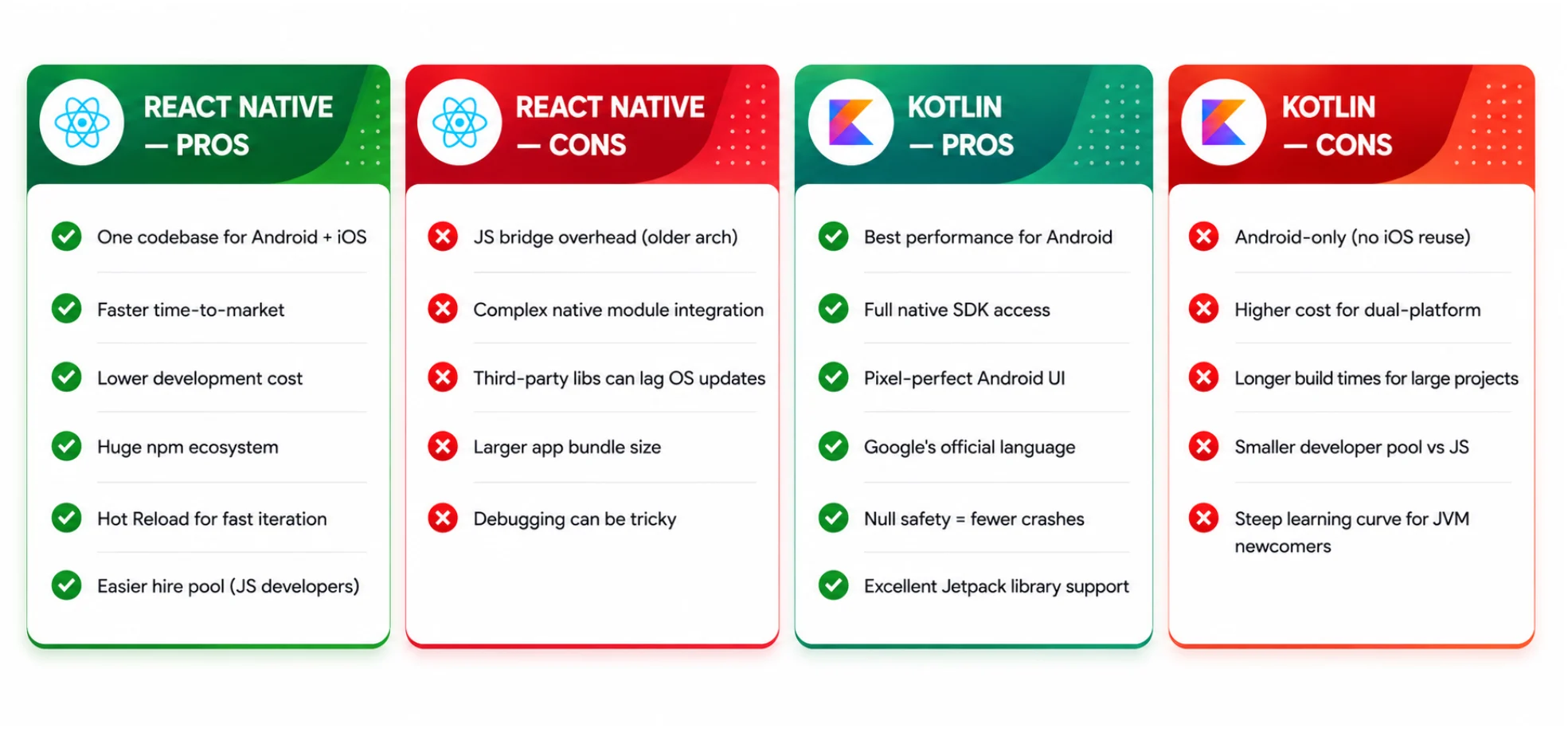
When to Choose React Native for Android
React Native for Android app development is the right choice in the following situations:
Choose React Native when…
- You need both Android and iOS on a tight budget
- Your team already knows JavaScript or TypeScript
- You are building an MVP or early-stage product
- Speed-to-market is more critical than raw performance
- Your app is content-heavy (e-commerce, social, news, booking)
- You want to leverage Expo for rapid prototyping
Industry examples
- On-demand service apps (Uber-like)
- E-commerce and marketplace apps
- Social networking platforms
- Food and grocery delivery apps
- EdTech and e-learning platforms
- Health tracking apps
Companies like Shopify, Discord (partially), and Wix have shipped production React Native apps used by millions. At Comfygen, our React Native development team has delivered cross-platform solutions for clients across fintech, healthcare, and on-demand services — all while keeping development timelines 30–40% shorter than native-only approaches.
Ready to Launch
Your React Native app?
Contact Now
When to Choose Kotlin for Android App Development
Kotlin for Android app development is the professional standard when you need deep platform integration, maximum performance, and a long-term scalable architecture on Android specifically.
Choose Kotlin when…
- You are building exclusively for Android
- App performance is mission-critical
- You need deep hardware or OS-level access
- Building for enterprise with long maintenance cycles
- UI must feel 100% native and follow Material You precisely
- You have a dedicated Android engineering team
Industry examples
- Banking and fintech apps (security-critical)
- Healthcare and clinical apps
- Real-time communication/video calling
- AR/VR and gaming applications
- Smart device and IoT companion apps
- Enterprise internal tools
Google Pay, Gmail, Maps, and virtually every first-party Google app is built with Kotlin. For applications where a poor user experience or security flaw has serious business consequences — like mobile banking app development — Kotlin’s native reliability and Google’s ongoing investment make it the responsible choice.
Learn more about how Comfygen approaches enterprise-grade Android app development services for startups and large organizations alike.
Job Market & Salary: React Native vs Kotlin Developers
If you are a developer choosing which skill to invest in — or a business owner deciding which talent to hire — the React Native vs Kotlin job market picture is an important part of the equation.
React Native developer market
React Native developers are in strong demand globally, particularly in startup ecosystems and product companies that want cross-platform coverage without double the headcount. Since React Native runs on JavaScript, any experienced JS or React developer can transition into mobile development relatively quickly — making the talent pool significantly larger.
Average annual salaries for React Native developers range from $80,000 to $130,000 in the US market (as of 2026), with senior engineers in high-demand markets commanding $140,000+. In India, skilled React Native developers at established firms like Comfygen bring significant cost advantages for businesses looking to hire dedicated developers.
Kotlin developer market
Kotlin developers are in high demand, particularly in enterprises, fintech, and healthcare — industries that run performance-critical Android apps. Because Kotlin requires a deeper understanding of the Android SDK and JVM, the talent pool is somewhat smaller, which pushes salaries higher for senior specialists.
Senior Kotlin Android developers in the US typically earn $110,000 to $160,000 annually, with principal engineers at top tech companies earning considerably more. Kotlin expertise is increasingly listed as a requirement (not just a preference) in Android developer job postings at companies like Google, Samsung, and Spotify.
Which should you learn first?
If you already know JavaScript and React, React Native is a natural, low-friction entry into mobile development. If you are coming from a Java or JVM background, Kotlin is an obvious next step. For developers starting from scratch who want the broadest job market opportunities, learning both over 12–18 months is a genuinely viable career strategy — React Native for speed and cross-platform reach, Kotlin for depth and Android specialization.
Final Verdict: Which Wins the React Native vs Kotlin Battle?
After weighing every angle of the React Native vs Kotlin debate, here is the honest answer: neither wins unconditionally. The right choice depends entirely on your project’s specific constraints and goals.
Decision framework
2. Choose Kotlin if: you are Android-only, performance and hardware access are critical, you are building enterprise or fintech software, or you need a 100% native Android experience with long-term maintainability.
The React Native vs Kotlin question is ultimately a project-fit question, not a technology superiority question. Both are production-ready, battle-tested, and capable of powering world-class Android app development in 2026.
At Comfygen, we are equally proficient in both — and we always recommend the stack based on your specific business goals, not on what’s trending. Whether you’re exploring mobile app development, need white-label app solutions, or want a dedicated team for your next Android project, we are ready to help you build it right.
Frequently Asked Questions (FAQs)
What is the main difference between React Native and Kotlin Multiplatform?
Is Kotlin better than React Native for performance?
Which is easier to learn: Kotlin or React Native?
Which is more cost-effective for app development in 2025?
Can Kotlin Multiplatform share UI code across iOS and Android?
What types of apps should use React Native in 2025?

Mr. Saddam Husen, (CTO)
Mr. Saddam Husen, CTO at Comfygen, is a renowned Blockchain expert and IT consultant with extensive experience in blockchain development, crypto wallets, DeFi, ICOs, and smart contracts. Passionate about digital transformation, he helps businesses harness blockchain technology’s potential, driving innovation and enhancing IT infrastructure for global success.