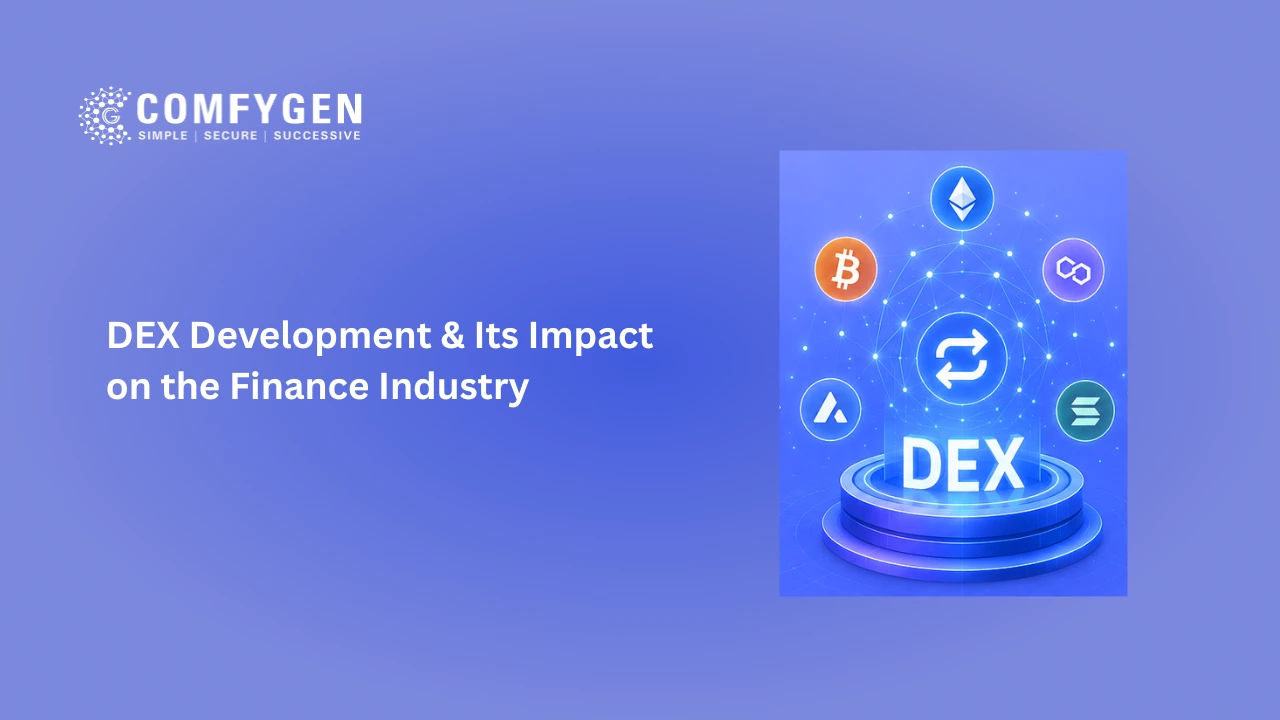





The relationship between decentralized exchanges and the global financial industry has changed completely in the last 24 months. In 2023, DEXs were a parallel system a fringe alternative that crypto-native users tolerated despite friction. In 2026, three DEXs, PancakeSwap, Uniswap, and Hyperliquid sit in the world’s top 10 crypto exchanges by trading volume according to CoinGecko’s CEX & DEX Trading Activity Report 2026, alongside Binance and Coinbase. BlackRock’s tokenized treasury fund (BUIDL) has crossed multi-billion-dollar levels of assets under management. JPMorgan, Visa, and Mastercard have all launched stablecoin and on-chain settlement products. According to BPM’s 2026 Digital Assets and Blockchain Outlook, institutional DeFi engagement is projected to triple from 24% to 74% within two years.
This is no longer a story about “crypto disrupting banks.” It is a story about decentralized exchange infrastructure becoming part of the financial plumbing running alongside SWIFT, Fedwire, and SEPA, sometimes competing, increasingly integrating.
This guide walks through what DEX development looks like in 2026, how DEXs are actually changing finance (with concrete examples), the regulatory environment shaping the industry, where banks are adapting versus pushing back, the cost and process of building a competitive DEX, and what comes next. It is written for founders, fintech product leaders, bank innovation teams, and anyone scoping a serious decentralized exchange development project.
Where DEXs Stand vs Traditional Finance
A few numbers worth grounding the rest of the article on.
- DEX share of global spot crypto trading volume doubled from ~6.9% in January 2024 to ~14% in January 2026, with monthly DEX spot volume crossing USD 231 billion in January 2026 alone according to CoinGecko.
- DEX perpetual futures volume grew roughly 8x in two years, from ~USD 82 billion in January 2024 to ~USD 739 billion in January 2026.
- Hyperliquid alone processed USD 1.6 trillion in perpetuals volume from August 2025 to January 2026 the first perpetual DEX in the global top 10 derivatives venues.
- PancakeSwap and Uniswap each recorded over USD 540 billion in cumulative spot volume in the same six-month window, breaking into the global top 10 spot exchanges.
- Stablecoin market cap is forecast to cross USD 1 trillion in 2026, per Circle’s CEO and corroborated by multiple analyst reports.
- Tokenized real-world assets (RWAs) treasuries, money market funds, real estate, have moved from pilot to multi-billion-dollar deployments. BlackRock’s BUIDL, Franklin Templeton’s BENJI, and Ondo’s USDY are now genuine institutional products.
- 84% of institutions are now using or expressing active interest in stablecoins for yield and transactional use cases according to BPM’s 2026 institutional survey.
The two-line summary: DEXs are no longer a parallel universe. They are a settlement layer, a trading venue, a yield product, and increasingly a regulated piece of financial infrastructure that traditional institutions are choosing to plug into rather than ignore.
What “DEX Development” Actually Means
In 2023, “DEX development” meant a Uniswap V2 fork on Ethereum with an AMM, liquidity pools, and a basic frontend. That product is still buildable in a weekend, but it cannot compete with what exists today.
A 2026 production-grade DEX includes most of the following:
- Trading engine: AMM with concentrated liquidity (Uniswap V3/V4 pattern), on-chain order book (Hyperliquid/dYdX pattern), or a hybrid like Raydium pairs AMM pools with on-chain order book matching.
- Aggregator and intent-based routing: supporting Jupiter (Solana), 1inch, CoW Swap, and UniswapX integrations so retail flow can find your pools.
- MEV protection: private mempool integration (Flashbots Protect, MEV Blocker) or batch-auction architecture inside the DEX itself.
- Cross-chain capability: native or through LayerZero, Wormhole, Across, or LI.FI integrations.
- Wallet integrations: MetaMask, Phantom, Coinbase Wallet, hardware wallets via WalletConnect, plus account abstraction (ERC-4337) for gasless onboarding.
- Oracle integration: Chainlink, Pyth, or Redstone for sensitive pricing operations.
- Smart contract audits: multiple independent audits, often a public bug bounty.
- Compliance optionality: KYC-gated pools, geo-fencing, and OFAC screening for institutional or regulated use cases.
- Frontend, mobile, and analytics layer: real-time charts, portfolio views, and increasingly AI-assisted trading interfaces.
- Tokenomics design: governance token, fee distribution model, ve-tokenomics (Curve/Aerodrome pattern), or simple protocol-owned liquidity.
Building this is not a single-developer project. A serious DEX in 2026 involves smart contract engineers (Solidity or Rust), security auditors, full-stack engineers, devops for node infrastructure, a tokenomics or financial engineering specialist, legal counsel for MiCA/SEC/MAS posture, and a community/liquidity bootstrap team. Comfygen’s DEX development practice covers each layer and cost.
For a deeper primer on how DEXs work mechanically, see our companion blog: What Is a DEX? How Decentralized Exchanges Work.
Six Concrete Ways DEXs Are Reshaping Finance
The version of this article would have listed abstractions more transparency more inclusion more efficiency. The impact is concrete and measurable Six examples
1. Settlement compression from days to seconds
A wire from a US bank to a European counterparty traditionally settles T+1 or T+2 through correspondent banking. On a DEX with a USDC/EURC pair, the same value movement settles in seconds for cents in fees. JPMorgan’s own Liink network and DBS-led Partior are essentially permissioned banking responses to this pressure.
2. Long-tail asset listing in minutes, not quarters
A centralized exchange takes weeks to months to list a new token, with listing fees often in six figures. A DEX lists any ERC-20 or SPL token the moment its smart contract is deployed. This has reshaped capital formation for early-stage projects and created new risks (rug pulls, scam tokens) that the industry is now building tooling against.
3. Yield primitives for treasury operations
Tokenized money market funds (BlackRock’s BUIDL, Franklin Templeton’s BENJI, Ondo’s USDY) let corporate treasuries and DAOs hold cash equivalents that earn 4–5% T-bill yields while staying liquid and on-chain. This blurs the line between holding USDC, holding USDY, and holding a money market fund position at a custodian bank.
4. Programmable, composable financial products
A DEX is not just an exchange. It is a building block. You can swap, deposit the LP tokens into a lending protocol like Aave, borrow stablecoins against them, and route the borrowed funds into a yield strategy all in a single Ethereum transaction. This level of composability does not exist in traditional finance and probably cannot, because legal entities and clearing intermediaries break the chain.
5. New derivative markets
Perpetual DEXs like Hyperliquid, dYdX, GMX, and Drift have opened on-chain leverage and derivatives to anyone with a wallet. Hyperliquid alone is now competing with major derivatives venues on volume. The product has features traditional venues cannot offer programmable funding rates, on-chain transparency of liquidations, integration with on-chain spot markets.
6. Cross-border payments at near-zero cost
A USDC payment from a freelancer in Manila to a client in Berlin settles in under a minute for under $0.10 on Solana or a Layer 2. The equivalent SWIFT wire costs 2–7% in combined fees and FX spread. World Bank data still shows average remittance costs of 6–7%, which is the gap stablecoin-and-DEX rails are aggressively closing. Remitly, Western Union, Coins.ph, and BVNK all integrated stablecoin rails in 2024–2025.
Institutional DeFi How Banks and Asset Managers Are Shaping the Future
For most of the last decade, institutional finance treated DeFi as either irrelevant or as competition to be regulated into the ground. 2024–2025 marked the turn.
A non-exhaustive list of TradFi names now actively operating on or alongside DEXs and DeFi protocols in 2026:
- BlackRock: issued BUIDL (USD Institutional Digital Liquidity Fund) on Ethereum and several other chains. Multi-billion-dollar AUM. Tradable against USDC on certain DEX-adjacent venues.
- Franklin Templeton: BENJI token (FOBXX money market fund) on Stellar, Polygon, and Ethereum.
- JPMorgan: Onyx digital assets platform, JPM Coin for institutional settlements, Partior consortium with DBS and Temasek.
- Visa and Mastercard: both launched stablecoin settlement products and on-chain treasury management infrastructure.
- Standard Chartered, BNY Mellon, State Street: all running custody and tokenization pilots.
- SWIFT: running tokenization pilots with 30+ financial institutions to test interoperability across public and private ledgers.
- Citi: multiple tokenization pilots for treasury and trade finance.
The institutional posture has shifted from “let us regulate this away” to “let us own the infrastructure layer.” a16z crypto’s 2026 outlook frames it well: stablecoins and tokenized assets are becoming a parallel banking system, and the question is no longer if banks will integrate but whether they will lead or follow.
What this means for DEX builders: the addressable market is now institutions, not just retail. A DEX that supports KYC-gated institutional pools, audit-grade reporting, and compliance optionality has a market that did not meaningfully exist in 2023.
Stablecoins as the New Settlement Layer
If there is one product that explains DEXs’ impact on traditional finance better than any other, it is the stablecoin.
The market reality:
- Combined stablecoin market cap is approaching USD 1 trillion, with Circle’s CEO projecting that milestone within the year.
- USDC, USDT, and emerging issuers like Ethena’s USDe, PayPal’s PYUSD, and bank-issued stablecoins are now used as the de facto settlement currency for on-chain commerce.
- Unified stablecoin layers Circle’s Cross-Chain Transfer Protocol (CCTP) and Tether’s USDT0 let stablecoins move natively across chains without traditional bridges. This is critical for DEX liquidity and institutional comfort.
- The GENIUS Act in the US (signed in 2025) created a federal stablecoin regulatory framework, opening the door for US bank-issued stablecoins.
- MiCA in Europe requires stablecoin reserves to be held with regulated custodians, capping issuance scale and reshaping the European stablecoin landscape.
For a DEX, the implications are direct:
- Stablecoin pairs are the dominant liquidity center. USDC/ETH, USDT/SOL, USDC/USDT, EURC/USDC these are the deepest pools on every major DEX.
- Cross-chain stablecoin flows drive the case for intent-based DEXs (CoW Swap, UniswapX, 1inch Fusion) that abstract away bridge complexity.
- Yield-bearing stablecoins (USDY, sUSDe, Maker’s sDAI) are now a major DEX category, with implications for tax treatment, regulatory status, and competitive dynamics with traditional money market funds.
If you are scoping a DEX project in 2026, your stablecoin strategy is not a nice-to-have. It is the product.
RWA Tokenization Bringing Real Assets On Chain
Real-World Asset (RWA) tokenization moved from concept to multi-billion-dollar market between 2024 and 2026. The simple definition: a real-world financial asset (treasury bill, corporate bond, real estate share, private credit position) is represented as a token on a blockchain, can be held in a wallet, and traded sometimes on a DEX.
What is actively tokenized in 2026:
- US Treasuries and money market funds: BlackRock BUIDL, Franklin Templeton BENJI, Ondo USDY, Maple Finance.
- Private credit: Maple Finance, Goldfinch, Centrifuge.
- Real estate: RealT, Lofty, Propy, and a growing number of jurisdiction-specific platforms.
- Commodities: gold (PAXG, XAUT), oil, agricultural products via specialized issuers.
- Tokenized equities: Backed Finance and others now offer wrapped versions of public stocks tradable on certain DEXs.
The impact on DEXs is significant. RWA tokens trade on DEXs alongside cryptocurrencies, which means a single Uniswap or Curve interface can route between USDC, ETH, tokenized T-bills, and tokenized corporate bonds. For a DAO treasurer, this means cash management can happen entirely on-chain. For a retail user, it means access to fixed-income exposure that previously required a brokerage account.
Frontiers’ February 2026 academic paper on tokenization and institutional adoption walks through the lifecycle of a tokenized bond from issuance through settlement using smart contracts and data oracles and concludes that the structural cost advantages over traditional issuance are large enough that adoption is now a matter of regulatory pace, not technical feasibility.
For DEX builders, RWA support is increasingly an enterprise sales feature. Comfygen’s work on DeFi development and DeFi smart contract development for how RWA integration typically pairs with a DEX build.
Cross-Border Payments and Remittances
This is probably the best example of DEXs and stablecoins going head-to-head with traditional systems and even winning.
The traditional cross-border payment stack runs through correspondent banking. A payment from Singapore to Mexico might touch 3–5 banks, each charging fees and adding 6–48 hours of delay. According to The Payments Association’s 2026 cross-border report, USD 195 trillion crossed borders in 2024 with average remittance costs still at 6–7% and settlement still taking 1–3 days.
A stablecoin-and-DEX payment runs differently:
- Sender swaps local currency to USDC at a fiat on-ramp (or already holds USDC).
- USDC moves on-chain (Solana, Ethereum L2, Tron, or Stellar) settlement in seconds, fees of pennies.
- Receiver swaps USDC to local currency at a local off-ramp, or holds it.
Total cost is often under 1%; total time is under a minute. The middleman bank fees, the FX spread, the float on intermediary accounts all eliminated.
This is not theoretical:
- Remitly added stablecoin wallets in 2025.
- Western Union has been actively testing stablecoin transfer rails.
- Coins.ph in the Philippines partnered with Circle for USDC payments.
- BVNK, Stripe (via the Bridge acquisition), and Visa all run stablecoin payment infrastructure for enterprise clients.
- JPMorgan, DBS, and Temasek’s Partior is the bank-led response a permissioned blockchain settlement network for institutional cross-border flows.
The Federal Reserve’s March 2026 paper on payment stablecoins and cross-border payments explicitly notes that stablecoins could “disrupt the correspondent banking model” by eliminating the institutional cost of maintaining foreign branches.
For DEX projects, this means the most defensible use case is no longer “trade altcoins” it is stablecoin-rail cross-border payments at scale. A DEX with deep USDC, USDT, and major-fiat-stablecoin (EURC, USDM, BRZ) liquidity, paired with on/off-ramp partners, is competing directly with SWIFT-based correspondent banking.
Regulatory Landscape MiCA GENIUS Act MAS and What Comes Next
The version of this conversation was regulators dont understand DeFi yet Now they do and the rules are arriving in waves.
United States
The GENIUS Act (2025) created a federal stablecoin framework. The SEC’s posture under the new administration has softened materially compared to 2022–2023. State-level frameworks (especially New York’s BitLicense and Wyoming’s special-purpose depository institution charters) continue to drive structure. The CLARITY Act for digital asset market structure is still in motion.
European Union
MiCA (Markets in Crypto-Assets) is now fully in force. Stablecoins must hold reserves with regulated EU custodians; crypto-asset service providers (CASPs) must be licensed by EU member states; the framework explicitly addresses DEX-adjacent activity though pure permissionless protocols sit in a gray zone. A wholesale CBDC for interbank settlement is being actively developed and may launch in 2027–2028.
Singapore
The Monetary Authority of Singapore (MAS) runs one of the clearest regulatory frameworks for tokenized assets and stablecoins. Project Guardian (asset tokenization) and Project Orchid (purpose-bound digital money) are active institutional pilots.
United Kingdom
The FCA has issued specific guidance for stablecoins and tokenized securities; the Financial Services and Markets Act 2023 brought crypto under broader regulatory perimeters.
India
Under the DPDP Act and PMLA amendments, crypto exchanges are now under FIU registration; DEX regulatory treatment remains under active consultation.
The takeaway for builders regulation is no longer a reason to avoid serious DEX development it is a design constraint to plan for Geo fencing KYC optional pools compliance reporting and OFAC screening are now standard features on any institutionally credible DEX
For a deeper look at how this affects platform choice, see our guide on how to choose a blockchain platform for your business.
How Banks Are Adapting and Where They Face Resistance
The “DEXs will replace banks” framing was always overdrawn. The 2026 reality is more nuanced.
Where banks are adapting
- Custody:BNY Mellon, State Street, Standard Chartered, and Coinbase Custody now hold crypto on behalf of institutional clients. This is now table-stakes for a Tier-1 bank.
- Tokenized fund issuance: BlackRock, Franklin Templeton, Fidelity, and others have launched tokenized money market funds.
- Stablecoins: PayPal, Visa, Mastercard, and several US and EU banks have launched or partnered on stablecoin products.
- Interbank settlement: Partior (DBS/JPMorgan/Temasek), Fnality, and Onyx are permissioned-blockchain answers to interbank settlement friction.
- Tokenization-as-a-service: SWIFT’s pilot with 30+ banks, Citi’s tokenization desk, HSBC Orion all bank-built infrastructure for tokenized assets that can interop with public DEXs.
Where banks are resisting
- Direct DEX integration in retail products: Most major banks still do not let retail customers connect a wallet to a DEX from inside the banking app. Robinhood, Revolut, and a few neobanks are closer.
- Stablecoin acceptance for everyday payments: Card networks are integrating; bank checking accounts are not. This will change with the GENIUS Act and MiCA bedding in.
- Self-custody at scale: Banks make money on float and custody. Self-custody breaks the model. Expect resistance via lobbying and regulation rather than direct competition.
The honest model a hybrid financial system where banks dominate fiat on ramp regulated custody and credit creation DEXs dominate long tail trading programmable financial products and self custody focused users and both increasingly settle through stablecoin and tokenized asset rails that neither owns alone.
Risks DEXs Still Pose to the Financial System
A balanced view requires acknowledging the genuine concerns regulators, banks, and users still have about DEX-driven finance.
Smart contract risk
Even audited code has been exploited. CoinGecko reported over USD 2.4 billion in combined exchange (CEX and DEX) losses to hacks and exploits in just over a year through early 2026.
Money laundering and sanctions risk
Permissionless DEXs cannot enforce KYC by design. OFAC sanctioning of mixing services like Tornado Cash and the ongoing debate over front-end versus protocol liability illustrate the legal complexity. Most credible DEXs in 2026 implement at least front-end OFAC screening and geo-fencing of restricted jurisdictions.
Systemic interconnectedness
As DEXs hold larger pools and tokenized RWAs grow, a single major exploit or oracle failure could propagate into traditional financial markets in ways that are harder to model than a traditional bank run.
MEV and market manipulation
Sandwich attacks, oracle manipulation, and front-running cost DEX users meaningful value annually. The 2026 mitigation intent-based DEXs and private mempools works but is not universal.
Tax and reporting complexity
Composable DeFi transactions can generate thousands of taxable events per year for an active user. Regulators are responding with broker reporting rules (US Form 1099-DA, EU DAC8), but the operational burden on users and protocols is significant.
Run risk on stablecoins
A loss of peg on a major stablecoin (as happened to UST in 2022 and partially to USDC in March 2023) could cascade through every DEX it is paired with. The 2026 stablecoin regulatory frameworks aim to mitigate this with reserve requirements, but the risk has not disappeared.
User error
Self-custody means the user is the last line of defense. There is no FDIC for a hot wallet, no chargeback for a wrong-address send, and no support line for a signed phishing transaction.
These risks do not invalidate the DEX model. They are the reason serious DEX projects in 2026 invest heavily in audits, MEV protection, compliance optionality, and user-protection design.
Building a DEX Scope Architecture and Cost
If you are scoping a DEX project for a fintech, a bank innovation lab, or a crypto-native startup these are the practical 2026 numbers.
Decentralized Exchange (DEX) development cost ranges
|
Project type |
Cost range |
|---|---|
|
Fork-based DEX MVP (Uniswap V2 fork, single chain) |
USD 30,000 – 80,000 |
|
Custom AMM with concentrated liquidity, single chain |
USD 100,000 – 250,000 |
|
On-chain order book or hybrid DEX |
USD 150,000 – 400,000 |
|
Multi-chain DEX or DEX aggregator |
USD 300,000 – 700,000 |
|
Perpetual DEX (leverage, oracles, liquidations) |
USD 250,000 – 600,000+ |
|
Institutional / compliance-grade DEX with KYC, RWA support |
USD 400,000 – 900,000+ |
|
Smart contract security audits (mandatory) |
USD 20,000 – 80,000 per audit |
DEX Development timelines
- MVP fork-based DEX: 8–12 weeks
- Custom AMM with audits and testnet rollout: 4–6 months
- Order book or perp DEX with full audits: 6–9 months
- Institutional DEX with regulatory posture: 9–14 months
What separates a successful DEX from a failed launch
The single most common reason DEX launches stall is not technical it is liquidity bootstrap. A DEX with no liquidity is a website with no users. Successful 2026 launches plan their liquidity strategy before coding starts: liquidity mining incentives, partnerships with market makers, integration into major aggregators (Jupiter, 1inch, CoW solvers), and a credible token launch (or no token at all increasingly the right answer).
Second most common reason: shipping without enough audits. A single missed re-entrancy or oracle manipulation vector can wipe out the project on day one. Two independent audits and an active bug bounty are now baseline.
Third regulatory posture. A DEX that targets US or EU users without a defensible legal opinion on its compliance footing is increasingly a non-starter for serious capital.
For a deeper walk-through of the build process, see Comfygen’s companion guide: A Complete Guide to Developing a Decentralized Exchange: Steps, Costs, and More.
Why Choose Comfygen for DEX Development
Comfygen, a leading decentralized exchange development company in India, has been shipping blockchain development and DeFi products since 2018. Our DEX engineering practice has delivered AMM, order book, aggregator, and intent-based architectures across Ethereum, Solana, BNB Chain, Polygon, Avalanche, and emerging L1s.
What you get when you partner with Comfygen on a decentralized exchange development project:
- A discovery workshop that maps your use case, regulatory posture, and liquidity strategy before code is written.
- Smart contract developer in Solidity, Rust, or Vyper, with multi-pass internal review.
- MEV protection architecture private mempools, batch auctions, or Dutch auction filler design.
- Aggregator and intent integration getting your pools indexed by Jupiter, 1inch, and CoW solvers.
- RWA and stablecoin integration for institutional use cases.
- Pre-launch security audits with reputable third-party firms.
- Frontend, mobile, and analytics layers built for real trader workflows.
- Tokenomics design or no-token product strategy.
- Post-launch monitoring, incident response, and roadmap support.
Conclusion
Decentralized Exchanges (DEXs) are cryptocurrency trading platforms that use smart contracts to enable buy or sell orders.It is not surprising that DEXs are becoming more and more popular as they provide a number of important benefits over centralized exchanges.Comfygen specializes in creating a user interface that is simple and easy to use, ensuring a smooth trading experience. Many businesses just provide tokenization as a supplemental service rather than specializing in it.
Frequently Asked Questions
How are DEXs impacting the traditional finance industry?
DEXs are impacting finance through six concrete channels faster settlement seconds vs days long tail asset listing programmable yield products composable DeFi primitives on chain derivatives and near zero cost cross border payments via stablecoin rails Three DEXs now sit in the global top 10 crypto exchanges by volume and institutional players from BlackRock to JPMorgan have launched on chain products.
Will decentralized exchanges replace centralized exchanges or banks?
Probably not entirely. The picture is a hybrid system. CEXs and banks dominate fiat on-ramps, regulated custody, and credit creation. DEXs dominate long-tail trading, programmable finance, and self-custody flows. Stablecoins and tokenized assets are becoming the shared settlement layer both use.
What is institutional DeFi and how big is it?
Institutional DeFi refers to traditional financial institutions (banks, asset managers, fintechs) using or building on decentralized protocols. According to BPM's 2026 outlook, institutional engagement is projected to rise from 24% to 74% within two years. BlackRock's BUIDL, Franklin Templeton's BENJI, JPMorgan's Onyx, and SWIFT's tokenization pilots are leading examples.
How are stablecoins changing finance?
Stablecoins are becoming a parallel settlement layer for everything from cross-border payments to corporate treasury operations. The combined market cap is approaching USD 1 trillion in 2026. The US GENIUS Act and EU MiCA have created regulatory clarity that is pulling banks, payment networks, and fintechs into stablecoin issuance and acceptance.
What is RWA tokenization and why does it matter for DEXs?
Real-World Asset (RWA) tokenization brings real-world financial assets treasury bills, money market funds, real estate, corporate debt on-chain as tokens. They trade on DEXs alongside cryptocurrencies, which lets a single interface route between crypto, stablecoins, and fixed-income exposure. The market has moved from pilot to multi-billion-dollar deployments.
How much does DEX development cost?
A fork-based MVP starts at USD 30,000-80,000. A custom AMM with audits runs USD 100,000-250,000. A perpetual or institutional-grade DEX is USD 250,000-900,000+. Mandatory smart contract audits add USD 20,000-80,000. Costs depend heavily on team location, feature scope, and the regulatory posture you need.
How long does it take to build a DEX?
A fork-based MVP takes 8-12 weeks. A custom AMM with audits and testnet rollout takes 4-6 months. An order book or perpetual DEX with full audits takes 6-9 months. An institutional-grade DEX with KYC, RWA support, and regulatory posture takes 9-14 months.
What are the biggest regulatory concerns for DEXs?
The EU MiCA framework is fully in force; the US GENIUS Act established federal stablecoin rules and the CLARITY Act for market structure is in motion; Singapore's MAS, UAE's VARA, UK's FCA, and Hong Kong all have working frameworks. The regulation is a design constraint, not a reason to avoid DEX development, KYC-optional pools, geo-fencing, and OFAC screening are now standard.
What are the risks DEXs pose to the financial system?
Smart contract exploits, money laundering and sanctions evasion via permissionless rails, MEV-based market manipulation, oracle failures, stablecoin de-peg cascades, tax/reporting complexity, and user error in self-custody. None invalidates the DEX model but serious DEX projects invest heavily in audits, MEV protection, compliance optionality, and user-protection design.

Mr. Saddam Husen, (CTO)
Mr. Saddam Husen, CTO at Comfygen, is a renowned Blockchain expert and IT consultant with extensive experience in blockchain development, crypto wallets, DeFi, ICOs, and smart contracts. Passionate about digital transformation, he helps businesses harness blockchain technology’s potential, driving innovation and enhancing IT infrastructure for global success.