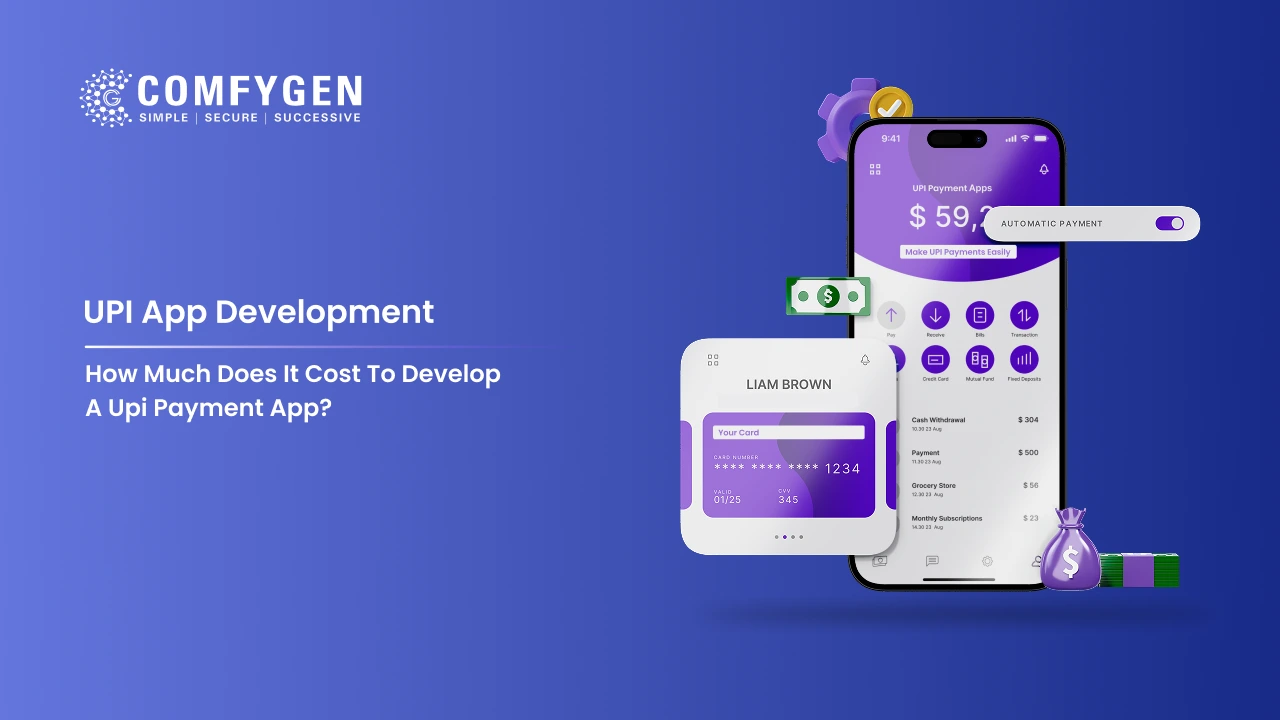





The rapid growth of digital payments in India has made UPI payment app development one of the most lucrative opportunities for startups, fintech companies, banks, and enterprises. With platforms like Google Pay, PhonePe, Paytm, and BHIM transforming how people transact, businesses are now asking a crucial question:
How much does it cost to develop a UPI payment app?
In this in-depth guide, Comfygen Technologies, a trusted UPI payment app development company, explains the complete cost structure, features, integrations, and factors that influence the UPI payment app development cost.
UPI Market Growth Statistics
The rapid expansion of the UPI payment ecosystem highlights why businesses are increasingly investing in UPI payment app development. In 2025, UPI recorded over 228 billion transactions, with a total transaction value nearing ₹300 lakh crore, marking a 33% year-on-year growth in transaction volume and a 21% increase in transaction value compared to 2024. This exponential rise clearly reflects the growing trust in secure UPI payment apps and NPCI-compliant digital payment systems.
Today, UPI accounts for nearly 85% of all digital payment transactions in India, processing an average of 678 million transactions daily. The surge is largely driven by QR code and Scan & Pay adoption, increased merchant onboarding, and strong penetration in Tier-2 and Tier-3 cities. These statistics reinforce the massive market potential for startups and enterprises planning to launch custom or white label UPI payment apps, making now the ideal time to invest in scalable UPI app development solutions.
What Is a UPI Payment App?
A UPI payment app (Unified Payments Interface app) is a mobile-based digital payment application in India that enables instant, real-time money transfers between bank accounts using a smartphone. Developed by the National Payments Corporation of India (NPCI), UPI apps allow users to link multiple bank accounts to a single platform and make secure transactions without sharing sensitive bank details.
Using a UPI ID, registered mobile number, or QR code, users can easily perform person-to-person (P2P) and person-to-merchant (P2M) payments anytime, anywhere. These apps operate 24/7, offering fast, reliable, and NPCI-compliant digital payment solutions. With features like Scan & Pay, bank-level security, and seamless integration, UPI payment apps have become the backbone of India’s digital payment ecosystem and a core focus area for modern UPI app development services.
Core Capabilities of a UPI Payment App
- Bank account linking
- Real-time money transfers
- QR code & Scan and Pay integration
- Bill payments & recharges
- Transaction history & analytics
How Much Does It Cost to Build a UPI Payment App?
The cost to build a UPI payment app varies depending on the app’s complexity, feature set, security requirements, NPCI compliance, and level of customization. Businesses can choose from basic, advanced, white label, or fully custom UPI app development solutions, each with a different investment range.
Below is a clear and informational cost table to help you understand the exact pricing structure.
| UPI App Type | Estimated Cost Range (INR) | Best For | Key Features Included |
| Basic UPI Payment App | ₹8,00,000 – ₹12,00,000 | Startups & small businesses | User registration, bank account linking, UPI ID creation, P2P transfers, transaction history |
| Advanced UPI Wallet App | ₹15,00,000 – ₹25,00,000 | Growing fintech companies | Digital wallet integration, QR code & Scan & Pay, bill payments, merchant payments, enhanced security |
| White Label UPI Payment App | ₹10,00,000 – ₹18,00,000 | Quick market launch | Pre-built UPI framework, NPCI-ready integration, branding customization, faster deployment |
| Custom UPI Payment App | ₹25,00,000 – ₹40,00,000+ | Enterprises & banks | Fully customized UI/UX, advanced admin dashboard, analytics, high scalability, custom workflows |
Cost Explanation
- A basic UPI app is ideal for businesses entering the digital payments space with minimal features and a lower budget.
- An advanced UPI wallet app increases development cost due to added functionalities like wallet balance, QR-based merchant payments, and real-time notifications.
- White label UPI payment app development significantly reduces time-to-market and overall cost, making it suitable for startups looking for quick deployment.
- A custom UPI payment app requires the highest investment due to complex integrations, enterprise-grade security, and complete personalization.
Launch your custom or white label UPI payment app with expert developers.
Key Factors Affecting UPI Payment App Development Cost
The UPI payment mobile app development cost is not fixed. It varies based on multiple technical, functional, and compliance-related factors. Understanding these elements helps businesses accurately estimate the cost to develop a UPI payment app and choose the right development approach.
1. App Features & Functional Complexity
The number and type of features directly impact development time and cost.
A basic UPI app with P2P payment app development transfers costs less, while advanced apps with QR code & Scan and Pay, digital wallets, and merchant payments require higher investment.
2. Platform Choice (Android, iOS, or Both)
Developing a UPI app for Android & iOS platforms increases cost compared to a single-platform solution. Cross-platform apps reduce cost but may have limited customization.
3. UI/UX Design Requirements
A user-friendly and intuitive design is critical for fintech apps. Custom UI/UX Design improves user adoption but increases design and testing efforts.
4. NPCI & Bank API Integration
UPI apps must integrate with NPCI systems and bank APIs for real-time payments. These integrations require strict compliance, secure authentication, and approval processes, which significantly influence development cost.
5. Security & Compliance Standards
UPI apps handle sensitive financial data, making security a top priority. Implementing encryption, two-factor authentication, and fraud detection increases the UPI app development cost but ensures trust and regulatory compliance.
6. Backend & Admin Dashboard Development
A robust backend system is required to manage users, transactions, settlements, and reports. Advanced dashboards with analytics and monitoring tools increase development cost.
7. Third-Party Integrations
Integrations such as SMS alerts, push notifications, analytics tools, and KYC services add functionality but also raise development expenses.
8. Development Team & Location
The experience and location of the UPI app development company affect pricing. Hiring an experienced fintech development partner ensures quality, security, and faster delivery.
Summary Table: Cost-Influencing Factors
The total cost to build a UPI payment app depends on how scalable, secure, and feature-rich the solution needs to be. Businesses should prioritize compliance, security, and user experience while selecting a reliable UPI payment app development partner to achieve long-term success.
| Factor | Impact on Cost |
| App features & complexity | High |
| Platform selection | Medium |
| UI/UX design | Medium |
| NPCI & bank API integration | High |
| Security & compliance | High |
| Backend & admin panel | Medium–High |
| Third-party integrations | Medium |
| Development expertise | Medium |
UPI Payment App Development Cost Breakdown
The UPI payment app development cost is divided into multiple stages and components, each contributing to the total investment required to develop a mobile wallet app secure, scalable, and NPCI-compliant digital payment solution. Understanding this breakdown helps businesses plan budgets accurately and avoid hidden costs.
1. Planning & Requirement Analysis
This is the foundation of UPI app development. It includes business requirement gathering, feature finalization, compliance planning, and technical architecture design
What it includes:
- Market & competitor analysis
- Feature roadmap creation
- NPCI compliance planning
- Technical documentation
Cost Impact: Low
Why it matters: Reduces future rework and cost overruns.
2. UI/UX Design Cost
User experience plays a critical role in UPI apps. A clean and intuitive interface improves adoption and trust.
What it includes:
- Wireframes & prototypes
- User journey design
- Responsive design for Android & iOS
- Accessibility & usability testing
Cost Impact: Medium
3. Frontend App Development
This stage focuses on building the user-facing part of the application.
What it includes:
- User onboarding & login
- UPI ID creation
- P2P & P2M payment flows
- QR code & Scan & Pay functionality
- Transaction history display
Cost Impact: Medium to High
Why it matters: Directly impacts app performance and user satisfaction.
4. Backend Development & Admin Dashboard
The backend is the core engine of the UPI payment app.
What it includes:
- Transaction processing system
- User & merchant management
- Settlement & reconciliation
- Backend admin dashboard development
- Analytics & reporting
Cost Impact: High
5. NPCI & Bank API Integration
This is one of the most critical and cost-intensive parts of UPI payment app development.
What it includes:
- NPCI protocol implementation
- Bank API integrations
- Secure authentication mechanisms
- Real-time transaction validation
Cost Impact: High
Why it matters: Mandatory for UPI functionality and regulatory approval.
6. Security & Compliance Implementation
UPI apps must meet strict security standards due to financial data handling.
What it includes:
- End-to-end encryption
- Two-factor authentication
- Fraud detection & risk monitoring
- NPCI and RBI compliance checks
Cost Impact: High
7. Testing & Quality Assurance
Extensive testing ensures reliability, performance, and security.
What it includes:
- Functional testing
- Security & penetration testing
- Performance & load testing
- Bug fixing & optimization
Cost Impact: Medium
Why it matters: Prevents failures and transaction errors in production.
8. Deployment & App Store Launch
This phase prepares the app for live usage.
What it includes:
- Server configuration
- Play Store & App Store submission
- Compliance documentation
- Production environment setup
Cost Impact: Low to Medium
9. Maintenance & Ongoing Support
Post-launch support is essential for long-term success.
What it includes:
- Bug fixes
- Feature updates
- Security patches
- NPCI updates & compliance changes
Cost Impact: Ongoing (monthly or yearly)
UPI Payment App Development Cost Breakdown Table
|
Development Phase |
Cost Impact |
Explanation |
| Planning & analysis | Low | Defines scope & compliance |
| UI/UX design | Medium | Improves usability & trust |
| Frontend development | Medium–High | Builds payment workflows |
| Backend & admin panel | High | Core transaction engine |
| NPCI & bank API integration | High | Mandatory UPI connectivity |
| Security & compliance | High | Protects financial data |
| Testing & QA | Medium | Ensures stability |
| Deployment | Low–Medium | App launch readiness |
| Maintenance | Ongoing | Long-term reliability |
Explanation:
The cost to develop a UPI payment app depends on how advanced, secure, and scalable the solution needs to be. While basic UPI apps require lower investment, custom or enterprise-grade UPI payment apps involve higher costs due to complex integrations, security layers, and compliance requirements.
Partnering with an experienced UPI payment app development company like Comfygen Technologies ensures transparent pricing, regulatory compliance, and long-term scalability.
Feature-Wise Cost Impact in UPI Payment App Development
The cost to develop a UPI payment app depends largely on the app’s features, complexity, and level of customization. A basic UPI payment app with essential functionalities such as user registration, bank account linking, and person-to-person (P2P) payments typically costs between $30,000 and $60,000. However, the budget increases substantially for advanced or enterprise-grade UPI apps that include features like AI-powered fraud detection, real-time analytics, enhanced security layers, and scalable backend systems, with costs exceeding $300,000. In general, core UPI functionalities remain cost-effective, while feature-rich, high-security implementations drive the overall UPI payment app development cost higher.
Below is a detailed, feature-wise breakdown explaining how different functionalities impact the cost to develop a UPI payment app.:
1. Core Feature Cost Impact (Low to Mid-Budget)
These features form the foundation of any minimum viable UPI payment app (MVP) and are mandatory for basic functionality and NPCI compliance.
Key Core Features:
- User Registration & Secure Onboarding: Includes KYC verification, OTP-based mobile number verification, and bank account linking. These are essential for security and regulatory compliance while remaining relatively cost-effective.
- P2P Fund Transfer: Core UPI functionality that enables instant person-to-person (P2P) payments using a UPI ID or Virtual Payment Address (VPA).
- QR Code Scanning & Generation: Essential for person-to-merchant (P2M) payments, enabling Scan & Pay functionality widely used across retail and small businesses.
- Transaction History: Basic transaction logs with filtering and sorting to help users track payment activity.
Estimated Cost Impact: $5,000 – $15,000 for basic UPI feature integration
2. Advanced Feature Cost Impact (Mid to High-Budget)
Advanced features improve user experience and help businesses differentiate their UPI payment app in a competitive fintech market.
Key Advanced Features:
- UPI 2.0 Features (Drafts & Invoicing): Enables users to pre-authorize payments, view invoices, or approve transactions before payment execution.
- Multi-Bank Account Linking: Allows users to link and manage multiple bank accounts from different banks within a single UPI app.
- Bill Payments & Mobile Recharges: Integration with third-party utility providers for electricity, water, gas, DTH, and mobile recharges.
- In-App Chat Support: Real-time customer support within the app to resolve payment or account-related issues quickly.
- Biometric Authentication: Enhanced security using fingerprint or facial recognition for login and transaction authorization.
Estimated Cost Impact: Adding these features can increase the UPI app development cost to $60,000 – $120,000
3. High-End & Specialized Feature Cost Impact (High-Budget)
These enterprise-grade features are designed for large-scale fintech platforms, banks, and high-volume payment applications.
Key High-End Features:
- AI-Powered Fraud Detection: Real-time monitoring and flagging of suspicious transactions using machine learning algorithms to reduce fraud risk.
- Advanced Analytics & Data Mining: Provides detailed insights into user behavior, spending patterns, transaction volume, and performance reports.
- Loyalty Programs & Cashback Systems: Integrated reward systems to increase user retention and transaction frequency.
- UPI Lite & Offline Payments: Enables low-value transactions even in low or no internet connectivity environments.
Estimated Cost Impact: These features can push the cost to build a UPI payment app to $150,000 – $300,000+
4. Technical & Infrastructure Cost Drivers
Beyond features, technical architecture and infrastructure significantly affect the UPI payment app development cost.
Major Cost Drivers:
- UI/UX Design: A highly intuitive, custom UI/UX with animations and micro-interactions can cost $20,000 – $40,000, but improves user adoption and trust.
- Backend & API Development: A robust backend capable of handling thousands of real-time transactions, including NPCI and bank API integration, is a major cost factor.
- Security & Compliance Measures: Implementing PCI-DSS standards, end-to-end encryption, tokenization, and two-factor authentication (2FA) increases development cost but is mandatory for financial apps.
- Platform Selection: Developing for both iOS & Android UPI apps increases cost compared to a single-platform solution.
Summary of Cost Ranges
| Feature Complexity | Estimated Cost Range | Timeframe |
| Simple (Basic P2P + QR) | $30,000 – $60,000 | 4 – 6 months |
| Moderate (Essential + Bill Pay) | $60,000 – $120,000 | 6 – 10 months |
| Advanced (UPI 2.0, AI, Analytics) | $120,000 – $300,000+ | 10+ months |
Note: Maintenance and updates generally cost an additional 15-20% of the initial development cost annually.
Timeline for UPI Payment App Development
Developing a custom UPI payment app generally takes 3 to 7 months, depending on the app’s feature set, security requirements, and overall complexity. The development process includes detailed planning, UI/UX design, backend architecture, NPCI and bank API integration, and rigorous security testing to ensure a secure, UPI-compliant digital payment solution. In earlier stages of the UPI ecosystem, building the core UPI infrastructure required a significantly longer timeline; however, with modern frameworks and mature APIs, development cycles have become more efficient. That said, advanced UPI apps with features such as AI-powered fraud detection, real-time analytics, and enterprise-grade security layers may still require additional development time. Based on scope and complexity, the cost to develop a UPI payment app—and the cost to build a P2P payment app—typically ranges from $30,000 for a basic solution to $300,000+ for feature-rich, scalable platforms.
Key Stages of Development Timeline
- Planning & Research (2–4 weeks): Defining requirements, user stories, and regulatory compliance (NPCI guidelines).
- UI/UX Design (3–6 weeks): Creating wireframes and prototypes for an intuitive interface.
- Backend & Frontend Development (8–16 weeks): Integrating API with banks, setting up secure servers, and building the user-facing app.
- Testing & QA (4–6 weeks): Rigorous security testing, bug fixes, and performance testing under load.
- Deployment & Launch (1–2 weeks): Publishing on app stores (Google Play, Apple App Store).
Factors Affecting the Timeline
- Functionality: Basic UPI functionality (scan-and-pay) takes less time compared to apps with integrated wallets, loyalty programs, or AI fraud detection.
- Third-Party Integration: Integrating with multiple bank APIs and the NPCI network can impact timelines.
- Regulatory Compliance: Meeting security standards and obtaining necessary certifications from NPCI.
Why Choose Comfygen Technologies for UPI Payment App Development?
Choosing the right development partner is critical to building a secure, scalable, and NPCI-compliant payment solution. Comfygen Technologies stands out as a trusted UPI payment app development company by delivering end-to-end fintech solutions tailored to startups, enterprises, and financial institutions.
Here’s why businesses prefer Comfygen Technologies for UPI app development:
- Expertise in UPI & Fintech App Development
- NPCI & Bank API Integration Specialists
- Custom & White Label UPI Solutions
- Strong Focus on Security & Compliance
- Scalable Architecture for Future Growth
- Transparent Pricing & Cost-Optimized Development
- Android & iOS UPI App Development
- End-to-End Support & Maintenance
Conclusion
The cost to develop a UPI payment app depends on features, security, NPCI compliance, and scalability. A basic UPI app requires a lower investment, while advanced or enterprise-grade solutions cost more due to complex integrations and security layers. By partnering with an experienced UPI app development company like Comfygen Technologies, businesses can ensure secure, compliant, and cost-effective UPI app development with long-term growth potential.

Mr. Saddam Husen, (CTO)
Mr. Saddam Husen, CTO at Comfygen, is a renowned Blockchain expert and IT consultant with extensive experience in blockchain development, crypto wallets, DeFi, ICOs, and smart contracts. Passionate about digital transformation, he helps businesses harness blockchain technology’s potential, driving innovation and enhancing IT infrastructure for global success.