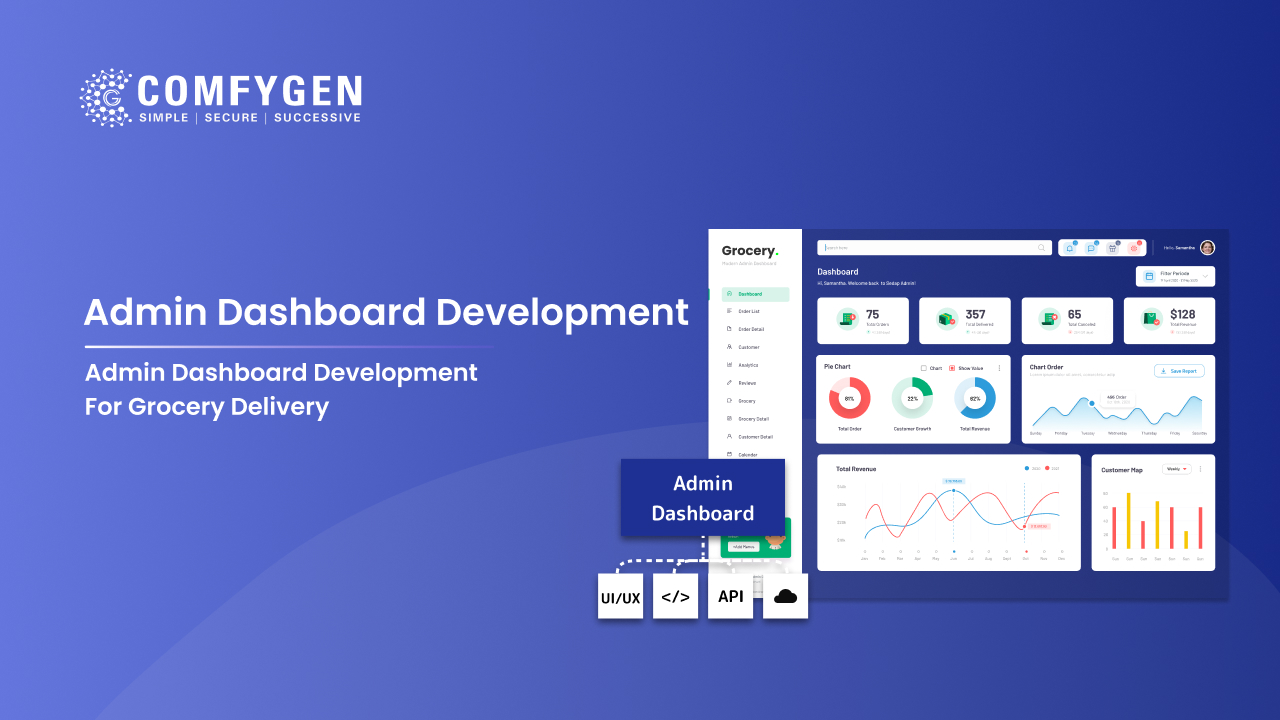





The grocery delivery industry is exploding, projected to surpass $1.5 trillion globally by 2030, driven by urban demand and apps like Instacart and Blinkit. In India alone, the sector hit $6.5 billion in 2025, with 300 million+ users craving quick access to fresh produce amid hectic lifestyles. Yet, behind seamless customer experiences lies operational mayhem. Without a strong admin dashboard development for grocery delivery businesses grapple with scattered orders, stockouts, and delayed deliveries that erode profits by up to 25%.
An admin dashboard centralizes control, enabling real-time oversight of orders, inventory, drivers, and analytics to slash decision-making time by 70%. Imagine spotting low-stock alerts instantly or rerouting drivers via GPS to cut delivery times by 40%—that’s the power of intuitive interfaces built with React and Node.js. For grocery delivery apps, it transforms chaos into efficiency, boosting customer retention and scaling operations seamlessly.
In this complete guide, we will explore everything you need to know about admin dashboard development for grocery delivery apps. From core features and advanced admin dashboard for grocery delivery app functionalities to technology stack, UI/UX best practices, dashboard development costs, and future trends, etc.
What Is an Admin Dashboard in Grocery Delivery Apps?
An admin dashboard in grocery delivery apps is a centralized backend system that allows business owners and administrators to manage, monitor, and control all operational aspects of the platform from a single interface. Often referred to as a grocery app admin panel or backend dashboard for a grocery app, it serves as the control hub that connects customers, vendors, delivery partners, and internal teams in real time.
At its core, the admin dashboard enables administrators to handle essential functions such as product and inventory management, order processing, payment tracking, vendor coordination, and delivery operations. By providing real-time visibility into business activities, the admin panel helps grocery delivery platforms maintain accuracy, efficiency, and scalability as order volumes grow.
Role of Admin Panel in Multi-Vendor Grocery Delivery Apps
In a multi-vendor grocery delivery app development model, the admin dashboard plays an important role in ensuring smooth coordination between multiple stores and suppliers. Through the grocery delivery app admin features, administrators can onboard vendors, assign commission structures, monitor store performance, and manage product listings across different locations. The admin panel also allows real-time tracking of orders, vendor availability, and delivery partner assignments, ensuring faster fulfillment and better customer satisfaction.
Additionally, the admin dashboard acts as a governance layer by enforcing platform policies, managing disputes, processing refunds, and generating performance reports. This centralized control is essential for maintaining consistency, transparency, and trust in a multi-vendor grocery delivery ecosystem.
Difference Between User App, Delivery Partner App, and Admin Dashboard
A grocery delivery platform typically consists of three interconnected applications, each serving a distinct purpose:
- User App: Designed for customers to browse products, place orders, make payments, and track deliveries in real time.
- Delivery Partner App: Used by delivery agents to accept orders, optimize routes, update delivery status, and manage earnings.
- Admin Dashboard: The backend system that oversees and manages the entire platform, including users, vendors, delivery partners, orders, payments, and analytics.
Ready to build a powerful admin dashboard
for your grocery delivery app?
Core Features of Admin Dashboard for Grocery Delivery App Development
A feature-rich admin dashboard is the backbone of any successful grocery delivery platform. It enables administrators to manage daily operations efficiently while ensuring scalability, accuracy, and a seamless experience for customers, vendors, and delivery partners. Below are the core features of a grocery delivery admin dashboard that every modern platform should include.
User Management
User management is a fundamental component of the grocery app admin panel, allowing administrators to control and monitor all platform users from a centralized system.
- Customer Profile Management: Admins can view and manage customer profiles, order history, addresses, preferences, and support requests to ensure a personalized and reliable user experience.
- Vendor and Store Onboarding: The dashboard enables quick onboarding of grocery vendors and stores, including document verification, store details, prodinuct approval, and commission setup.
- Delivery Partner Management: Admins can add, verify, assign, and track delivery partners, monitor their availability, performance, and earnings in real time.
Product & Inventory Management
Efficient product and inventory handling is critical for avoiding stock issues and ensuring timely deliveries.
- Category and Product Listing: Admins can create, edit, approve, or remove product categories and listings across multiple vendors and locations.
- Stock Availability and Alerts: Real-time inventory tracking with low-stock alerts helps prevent order cancellations and improves customer satisfaction.
- Bulk Product Upload: Bulk upload functionality allows vendors or admins to add thousands of products quickly using CSV or Excel files, saving time and effort.
Order Management System
The order management module provides complete visibility and control over the entire order lifecycle.
- Real-Time Order Tracking: Admins can track orders from placement to delivery, including preparation and dispatch stages.
- Order Status Updates: Automated status updates help keep customers, vendors, and delivery partners informed in real time.
- Refunds, Cancellations, and Returns: The admin dashboard allows easy handling of cancellations, refunds, and return requests while maintaining transaction records.
Vendor & Store Management
Vendor and store management features help maintain consistency and profitability in multi-vendor grocery platforms.
- Vendor Commission Settings: Admins can configure flexible commission models based on category, store, or promotional campaigns.
- Store Availability Scheduling: Control store opening hours, holiday schedules, and delivery time slots from the admin panel.
- Performance Tracking: Monitor vendor ratings, order fulfillment rates, revenue contribution, and customer feedback.
Payment & Commission Management
A secure and flexible payment system is essential for smooth financial operations.
- Multiple Payment Gateways: Support for credit/debit cards, UPI, wallets, net banking, and cash-on-delivery.
- Vendor Payouts: Automated and manual payout options with settlement cycles for vendors and delivery partners.
- Invoices and Tax Management: Generate invoices, manage taxes, and maintain compliance with regional financial regulations.
Delivery & Logistics Management
Efficient logistics management ensures fast and accurate grocery deliveries.
- Delivery Zone Configuration: Define serviceable areas, delivery charges, and minimum order values by zone.
- Route Optimization: Smart routing helps delivery partners choose the fastest and most cost-effective routes.
- Delivery Partner Assignment: Automatic or manual assignment of delivery partners based on availability, location, and workload.
Analytics & Reporting Dashboard
Data-driven insights are essential for scaling a grocery delivery business.
- Sales and Revenue Reports: Track daily, weekly, and monthly sales, revenue, and order trends.
- Customer Behaviour Analytics: Analyze purchase patterns, peak order times, and customer retention metrics.
- Vendor Performance Insights: Evaluate vendor sales, fulfillment efficiency, and customer ratings.
Advanced Features to Add in Grocery Admin Dashboard
To stay competitive in the fast-growing on-demand grocery market, businesses must go beyond basic functionality. Incorporating advanced grocery dashboard features helps automate operations, improve accuracy, and deliver a superior experience to customers, vendors, and delivery partners. Below are the key advanced admin features for grocery delivery apps that enhance performance and scalability.
AI-Based Demand Forecasting
AI-based demand forecasting analyzes sales history, trends, customer behaviour, and external factors to predict future demand. In a grocery management system, it helps optimize inventory, reduce waste, prevent stockouts, plan promotions, and improve overall efficiency.
Smart Inventory Replenishment
Smart inventory replenishment uses real-time data and demand forecasts to automate restocking. It triggers orders or vendor alerts when stock is low, reducing manual work, preventing cancellations, and ensuring products stay available.
Real-Time Push Notifications
Real-time push notifications keep everyone updated at every stage of an order. Admins can share order updates, delivery alerts, payment confirmations, promotions, and system messages, improving communication and speeding up issue resolution.
Role-Based Access Control
Role-based access control limits system access based on user roles. Admins can define permissions for teams like super admins, support staff, vendors, and finance managers, ensuring data security, accountability, and smoother workflows.
Multi-Language and Multi-Currency Support
Multi-language and multi-currency support lets grocery platforms operate across regions with ease. The admin dashboard adapts to local languages, currencies, taxes, and preferences, making market expansion smoother and more user-friendly.
Build a smart admin dashboard for your grocery delivery app.
Manage operations, inventory, and growth with ease.
Tech Stack for Admin Dashboard Development
Choosing the right tech stack is essential for building a scalable, secure, and high-performance grocery delivery admin dashboard.
- Frontend Technologies: Frameworks like React.js, Angular, or Vue.js are commonly used to create fast, responsive, and intuitive admin interfaces optimized for desktop and tablet use.
- Backend Technologies: Robust backend frameworks such as Node.js, Django, or Laravel power the business logic, while RESTful APIs or GraphQL ensure smooth communication between systems.
- Database & Cloud: Databases like MySQL, PostgreSQL, or MongoDB handle large volumes of data efficiently, while cloud platforms such as AWS, Google Cloud, or Azure provide scalability, reliability, and performance.
- Security & Compliance: Essential security measures include data encryption, secure authentication, and compliance with regulations like GDPR and PCI-DSS to protect user and payment data.
UI/UX Best Practices for Grocery Admin Dashboards
A well-designed admin dashboard should be clean, intuitive, and easy to navigate. Simple layouts and consistent design elements help admins quickly access orders, inventory, and vendor data without confusion.
Role-based navigation improves usability by displaying only relevant features for each user role, enhancing both efficiency and security. Data visualization through charts and graphs makes it easier to analyze sales, orders, and performance at a glance.
Performance optimization is equally important. Fast-loading, responsive dashboards ensure smooth operation even during high traffic, creating a seamless and productive admin experience.
Cost of Admin Dashboard Development for Grocery Delivery Apps
The cost of developing a grocery delivery app admin dashboard depends on factors like required features, system complexity, and the chosen technology stack. Below is a general cost estimate based on common requirements.
- Basic Dashboard: $5,000 – $10,000
Includes essential features like user management, order tracking, simple inventory management, and basic reports.
- Intermediate Dashboard: $10,000 – $25,000
Adds multi-vendor management, advanced analytics, payment gateway integration, and improved UI/UX.
- Advanced Dashboard: $25,000 – $50,000+
Includes AI-based inventory forecasting, real-time notifications, role-based access, advanced reporting, and high scalability for multiple regions.
Factors Affecting Development Cost
- Real-time order tracking and multi-vendor support
- Advanced analytics and AI-based inventory management
- Integration with multiple payment gateways
- Complexity of UI/UX design and security requirements
How to Choose the Right Development Partner
Choosing the right development partner is crucial for building a robust and scalable grocery delivery admin dashboard. Your partner should not only have technical expertise but also understand the unique challenges of grocery delivery platforms.
Here’s what to look for when selecting a partner like Comfygen Technologies:
- Experience in Grocery Delivery App Development: Ensure the company has a proven track record of building grocery apps and admin dashboards. Review their case studies, client testimonials, and successful project portfolios.
- Customization and Scalability Support: Your admin dashboard should be flexible enough to accommodate new features, multi-vendor operations, and growing user bases. ComfyGen Technologies delivers scalable solutions tailored to your business needs.
- Post-Launch Maintenance and Support: Ongoing support is essential for updates, bug fixes, security patches, and adding new functionalities. ComfyGen Technologies offers dedicated post-launch maintenance to ensure your admin dashboard runs smoothly and evolves with your business.
Conclusion
A well-built grocery delivery admin dashboard is the backbone of a successful on-demand platform. At ComfyGen Technologies, we create scalable, high-performance admin panels that simplify operations, improve decision-making, and support business growth.
As a trusted delivery app development company in India, ComfyGen delivers future-ready dashboards with real-time monitoring, smart inventory control, secure payments, and actionable insights—helping businesses scale faster and stay competitive.
Frequently Asked Questions
What is a grocery delivery admin dashboard?
Why is an admin dashboard important for grocery apps?
What features should a grocery delivery admin dashboard include?
Can the admin dashboard support multiple stores and locations?
Is AI used in grocery delivery admin dashboards?
How long does it take to develop an admin dashboard for a grocery app?

Mr. Saddam Husen, (CTO)
Mr. Saddam Husen, CTO at Comfygen, is a renowned Blockchain expert and IT consultant with extensive experience in blockchain development, crypto wallets, DeFi, ICOs, and smart contracts. Passionate about digital transformation, he helps businesses harness blockchain technology’s potential, driving innovation and enhancing IT infrastructure for global success.