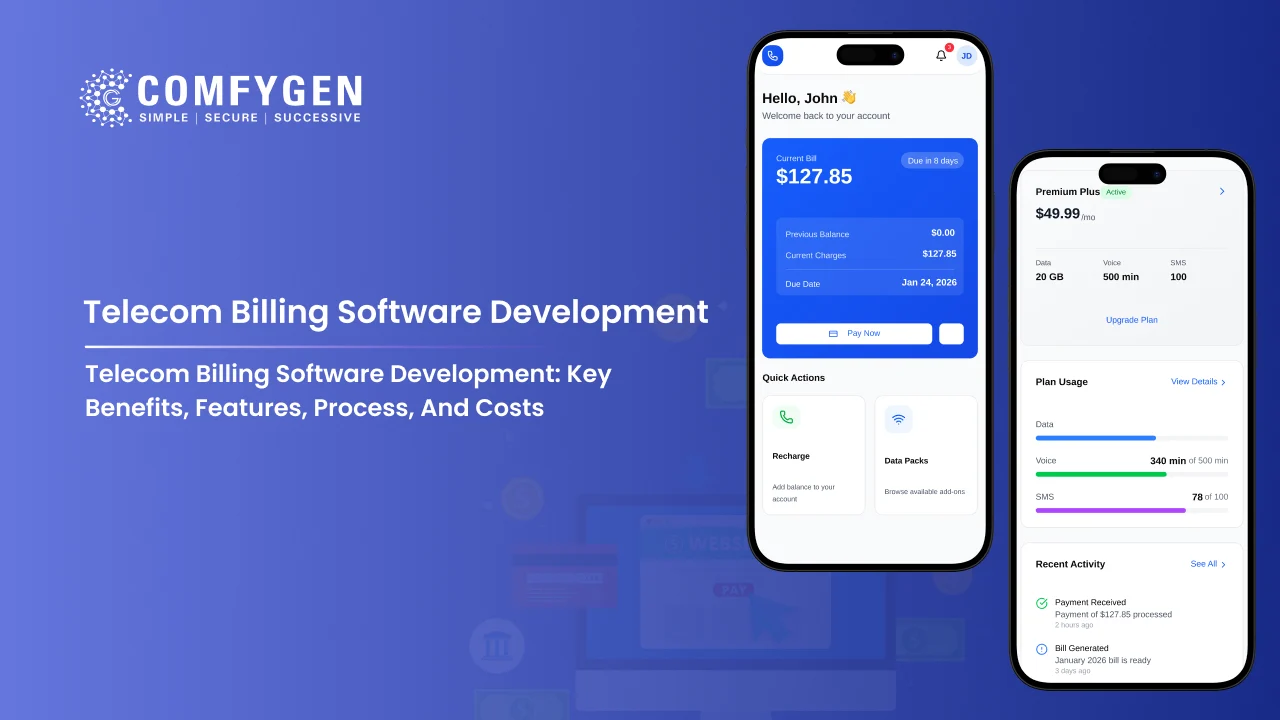





A modern telecom billing software must be built to manage complex billing operations, real-time usage tracking, and dynamic pricing models. Advanced telecom billing systems combine automation, real-time charging, convergent billing, and analytics to streamline telecom billing management, improve revenue assurance, and enhance customer experience. These scalable telecom billing software solutions also support prepaid/post paid billing, CRM/OSS/BSS integration, secure invoicing, and flexible payment processing.
Telecom operators today manage massive volumes of voice, data, SMS, and digital services. To support complex pricing models, real-time usage tracking, and revenue assurance, businesses need a scalable telecom billing software solution. This blog explores telecom billing software development in detail—covering benefits, core features, development processes, costs, and future trends—while showcasing how Comfygen Technologies delivers custom telecommunications billing systems for modern telecom providers.
Market Trends & Growth of Telecom Billing Software
The global telecom billing software market is growing rapidly, driven by 5G deployment, IoT expansion, and large-scale digital transformation across the telecommunications sector. As operators launch data-intensive and usage-based services, demand for advanced telecom billing and invoicing systems continues to rise.
Market Growth & Size
The telecom billing software market, valued at approximately USD 12–20 billion in 2024, is expected to reach USD 45–70 billion by 2030–2032. With CAGR projections ranging from 10.9% to over 23%, businesses are increasingly investing in cloud-based telecom billing systems and real-time charging platforms.
North America dominates due to early 5G adoption, while the APAC region is experiencing rapid growth fueled by mobile expansion, IoT connectivity, and demand for scalable telecom billing management solutions.
Key Market Drivers
Several factors are accelerating the growth of telecom billing software development worldwide:
- Digital Transformation in Telecom: Telecom providers are modernizing legacy platforms to support digital services such as OTT, bundled plans, and on-demand offerings, increasing the need for agile billing software development.
- 5G & IoT Expansion: The rise of 5G and IoT requires telecom billing software capable of handling massive device connectivity, real-time charging, and complex usage-based pricing structures.
- Revenue Assurance & Leakage Prevention: Advanced telecom billing systems help detect billing inaccuracies and prevent revenue leakage through automation and real-time analytics.
- Improved Customer Experience: Customers now expect instant usage updates, transparent invoices, and seamless digital payments—driving adoption of modern telecom billing platforms.
Major Trends Shaping the Market
The evolution of telecom billing is marked by several key trends:
- Cloud-Based Telecom Billing Software: Cloud and SaaS-based billing solutions are increasingly preferred for their scalability, cost efficiency, and faster deployment.
- AI & Machine Learning Integration: AI-powered telecom billing management enables intelligent analytics, fraud detection, automated dispute resolution, and predictive insights.
- Convergent Billing Systems: Telecom operators are adopting convergent billing to manage diverse services—including voice, data, OTT, IoT, and B2B offerings—within a unified platform.
- Open APIs & Ecosystem Integration: Open APIs allow seamless integration with OSS/BSS, CRM, payment gateways, and third-party services.
- Advanced Payment Integration: Modern telecom billing software supports multiple digital payment methods, including UPI, wallets, cards, and international gateways.
Market Challenges
Despite strong growth, telecom operators face challenges such as data privacy concerns, regulatory compliance, and a shortage of skilled professionals to manage complex telecom billing software development projects. Addressing these challenges requires experienced development partners and secure, future-ready architectures.
At Comfygen Technologies, telecom businesses benefit from cutting-edge billing software development solutions that align with market trends, ensure compliance, and support long-term scalability in a fast-evolving telecom landscape.
Telecom Billing Software Development: An Overview for Modern Telecom Businesses
Telecom billing software development focuses on creating intelligent systems that calculate service usage, apply pricing rules, generate invoices, and manage payments accurately. Unlike generic billing software development, telecom billing requires handling high transaction volumes, real-time charging, and complex tariff structures.
A modern telecom billing system acts as the backbone of telecom billing management by ensuring accuracy, transparency, and regulatory compliance. With increasing competition and customer expectations, telecom operators must invest in scalable and automated billing platforms to stay profitable.
Build a scalable and secure telecom billing system today.
How Advanced Telecom Billing Systems Are Transforming the Telecom Industry
Advanced telecom billing software solutions are redefining billing from a back-office function into a strategic growth engine. Through automation, AI-driven insights, and real-time processing, telecom operators gain better revenue control and service agility.
A modern telecom billing management system acts as the backbone of revenue operations, ensuring billing accuracy, compliance, and operational transparency.
Impact on Telecom Operators (CSPs)
- Automation & Operational Efficiency: AI and machine learning integrated into telecommunications billing systems significantly reduce manual processes and human errors—by up to 60%. Automated rating, charging, and invoicing streamline telecom billing management, lower operational costs, and improve billing accuracy across high-volume transactions.
- Revenue Assurance & Fraud Prevention: Real-time rating and usage tracking enable telecom operators to detect billing anomalies instantly, preventing revenue leakage. Advanced telecom billing software also incorporates dynamic risk management and fraud detection mechanisms, ensuring consistent revenue protection across services.
- Agility & Scalability for 5G/6G Services: Cloud-native and SaaS-based telecom billing systems are designed to scale effortlessly as service demand grows. With API-driven architecture, operators can rapidly launch new 5G and future 6G services, bundled offerings, and innovative pricing models without system disruption.
- Data-Driven Business Decisions: Integration with banking CRM and ERP platforms provides unified visibility into customer behaviour, revenue trends, and operational performance. This enables telecom companies to make informed financial decisions, optimize pricing strategies, and enhance long-term planning through intelligent telecom billing management.
- Security & Regulatory Compliance: Modern Ai-based telecom billing software development emphasizes data security and compliance. Robust encryption, access controls, and audit mechanisms ensure sensitive customer and financial data is protected while meeting global standards such as GDPR and PCI DSS.
Benefits for Telecom Customers
- Personalized Billing Experiences: Advanced telecom billing software supports flexible pricing models, including usage-based, hybrid, and tiered plans. Real-time usage visibility helps customers track consumption and avoid unexpected charges, improving transparency and trust.
- Higher Customer Satisfaction & Loyalty: Self-service portals, digital invoices, and faster issue resolution through CRM integration enhance the overall customer experience. Efficient telecom billing management reduces disputes and improves service satisfaction.
- Flexible & Real-Time Payment Options: Modern telecommunications billing systems support multiple digital payment methods and real-time charging through Online Charging Systems (OCS). This flexibility enables customers to pay conveniently while enjoying uninterrupted services.
Key Benefits of Custom Telecom Billing Software Development
Custom telecom billing software development delivers significant business value by enabling telecom operators to gain full control over their billing operations while staying agile in a rapidly evolving market. Unlike off-the-shelf solutions, a custom-built telecom billing system is tailored to specific business needs, service models, and regulatory requirements—helping telecom companies improve efficiency, increase revenue, and enhance customer satisfaction.
Operational Efficiency & Cost Savings
- Automation: Automates usage tracking, rating, and invoicing, reducing manual errors and administrative hours.
- Streamlined Workflows: Centralizes billing, eliminating fragmented tools and optimizing billing cycles.
- Reduced Revenue Leakage: Prevents lost revenue by ensuring accurate, real-time billing and preventing errors.
Revenue Growth & Market Agility
- Faster Time-to-Market: Quickly launch new services (IoT, bundles) and complex pricing plans.
- Customization: Tailor offers and pricing for specific customer segments to boost loyalty and conversion.
- Data-Driven Insights: Provides analytics for better pricing, resource allocation, and decision-making.
Customer Experience & Loyalty
- Transparency: Offers self-service options and transparent bills, increasing customer trust.
- Personalization: Delivers tailored features and better user experiences.
- Improved Service: Faster resolutions and reliable billing enhance overall satisfaction.
Security & Compliance
- Robust Security: Built-in features protect against cyber threats and data breaches.
- Regulatory Adherence: Handles complex data privacy, tax, and digital transaction rules automatically.
Strategic Advantages
- Scalability: Designed to grow with your business, handling increasing volumes and complex services.
- Flexibility & Autonomy: Full control over features, updates, and integrations, avoiding vendor lock-in.
- Seamless Integration: Connects easily with existing CRM, ERP, and other essential business tools.
Must-Have Key Features of a Modern Telecom Billing Software
Core Billing & Charging Capabilities
- Real-Time Charging: Real-time charging is a critical feature of modern telecom billing software. it instantly calculates usage for calls, data, SMS, and digital services, enabling accurate billing and faster revenue realization. This capability significantly improves cash flow and reduces billing delays.
- Convergent Billing: Convergent billing allows telecom operators to consolidate charges for multiple services—such as voice, data, content, and value-added services—into a single, unified bill. This simplifies telecom billing management and enhances billing transparency.
- Flexible Pricing Models: Advanced telecom billing systems support multiple pricing structures, including prepaid, postpaid, hybrid, subscription-based, usage-based, and tiered pricing. This flexibility helps telecom businesses quickly adapt to market demands and launch new service offerings.
Customer Experience & Account Management
- Self-Service Customer Portals: Customer-centric telecom billing software includes self-service portals that allow users to manage accounts, track usage, view bills, and make payments independently. This reduces support costs while improving customer convenience.
- Transparent Invoicing: Clear and detailed invoices with complete usage breakdowns help build trust and reduce billing disputes. Transparent invoicing is a key factor in improving customer satisfaction and retention.
- Multi-Channel Payment Support: Modern telecommunications billing systems integrate with multiple payment gateways to support online payments, mobile wallets, auto-debit, and other digital payment methods, offering customers greater flexibility.
Operations & System Integration
- Automated Billing Operations: Automation streamlines critical processes such as invoicing, dunning (collections), adjustments, and service provisioning. This reduces manual effort, improves accuracy, and enhances operational efficiency.
- Seamless Enterprise Integration: A scalable telecom billing system integrates smoothly with CRM, ERP, OSS/BSS, and third-party platforms. This eliminates data silos and ensures consistent information flow across the organization.
- High Scalability & Performance: Cloud-native telecom billing software is designed to handle growing customer bases, high transaction volumes, and increasing service complexity—making it ideal for 5G, IoT, and future-ready telecom services.
Security & Regulatory Compliance
- Advanced Data Security: Telecom billing software must protect sensitive customer and financial data through encryption, access controls, and secure data storage to prevent breaches and cyber threats.
- Regulatory Compliance Management: Built-in compliance capabilities help manage telecom regulations, taxation requirements such as GST, and reporting standards, ensuring hassle-free audits and legal adherence.
- Fraud Detection & Control: Advanced fraud control mechanisms monitor billing activities to detect anomalies, prevent fraudulent usage, and eliminate double billing issues.
Analytics, Reporting & Business Intelligence
- Business Intelligence & Reporting: Modern telecom billing systems provide detailed reports and dashboards covering revenue trends, usage patterns, and financial performance. These insights support smarter business decisions and strategic planning.
- Error Detection & Revenue Protection: Analytics-driven monitoring helps identify billing inaccuracies, duplicate charges, and system errors early—reducing revenue leakage and improving billing reliability.
Step-by-Step Approach to Telecom Billing Software Development
A successful telecom billing software development project follows a structured, multi-stage approach to ensure scalability, performance, data security, and seamless integration with existing telecom ecosystems. From requirement analysis to cloud deployment and continuous optimization, each phase contributes to building a high-performance telecom billing management system capable of handling complex pricing models, real-time charging, high transaction volumes, and evolving customer expectations.
1. Discovery & Planning (Requirements Gathering)
The process begins with detailed requirement analysis to understand business goals, service offerings, and telecom billing models such as prepaid, post paid, and hybrid charging. Integration needs with CRM, ERP, OSS/BSS platforms, payment gateways, and accounting software are carefully defined.
A scalable architecture is designed using microservices architecture, cloud-native frameworks, and API-first development to support real-time telecom billing operations. The technology stack is selected to ensure high performance, data security, and efficient processing of large-scale usage records across the telecom billing platform.
2. UI/UX Design & Customer Experience Layer
This phase focuses on designing user-friendly dashboards, self-service portals, and admin panels that enhance telecom billing management and customer engagement.
Modern web technologies, responsive UI frameworks, and mobile-first design approaches are used to create intuitive interfaces for usage tracking, payment management, and account monitoring. Smart invoice templates with detailed usage analytics help reduce billing disputes and improve transparency.
3. Core Development (Telecom Billing Modules & Engines)
This stage involves building the core functional components of the telecommunications billing system using scalable backend technologies and real-time data processing frameworks:
-
Mediation System: Captures and processes Call Detail Records (CDRs), SMS logs, and data usage from network elements.
-
Rating & Charging Engine: Applies tariff plans, discounts, bundles, and taxes using real-time charging technology.
-
Billing Engine: Generates automated invoices for recurring and one-time services with accurate calculations.
-
Payment Processing Module: Integrates secure payment gateways, digital wallets, and auto-debit systems.
-
Customer Management System: Handles subscriber profiles, service subscriptions, and support interactions.
This phase often uses AI-enabled automation, rule-based engines, and scalable database technologies to improve accuracy and performance.
4. Integration & Data Flow Management
Seamless system integration is critical for efficient telecom billing operations. The billing platform is connected with CRM systems, ERP platforms, OSS/BSS solutions, network switches, and third-party APIs to ensure smooth data synchronization.
Real-time data pipelines and API integrations enable continuous flow of usage data from multiple sources, ensuring billing accuracy and complete visibility across the telecom billing ecosystem.
5. Testing & Quality Assurance (QA)
Extensive testing ensures the reliability and accuracy of the telecom billing software. This includes validating billing calculations, performing load and performance testing, and ensuring compliance with telecom regulations.
Unit testing and integration testing are conducted to verify that all modules communicate correctly and that data flows without errors throughout the system.
6. Deployment & Go-Live (Cloud & Infrastructure Setup)
Once tested, the telecom billing system is deployed on cloud-based or on-premise infrastructure, depending on business needs. Security configurations, backup systems, and failover mechanisms are set up to ensure high availability.
A pilot launch is often conducted with a limited user base to gather feedback and identify any issues before full-scale rollout.
This phase includes:
-
Functional testing of billing logic and rating accuracy
-
Performance and load testing for high-volume transactions
-
Security testing for data protection and compliance
-
Integration testing across CRM, OSS/BSS, and payment systems
7. Post-Launch Support, Monitoring & Continuous Optimization
Once live, continuous monitoring using AI-driven analytics, performance tracking tools, and automated alert systems ensures system stability and operational efficiency.
Regular updates, feature enhancements, and performance tuning help the telecom billing software adapt to changing telecom regulations, new service models, and evolving customer demands. Advanced reporting and business intelligence tools provide insights into revenue trends, usage patterns, and customer behavior, supporting long-term digital transformation and growth.
Launch future-ready telecom billing software with expert developers.
Telecom Billing Software Development Cost Factors
The cost of telecom billing software development can vary widely depending on business requirements, system complexity, and long-term scalability goals. From basic billing solutions to enterprise-grade telecommunications billing systems, multiple technical and operational factors influence the overall investment. Understanding these cost drivers helps telecom businesses plan budgets effectively and choose the right development partner, such as Comfygen Technologies, for cost-efficient and scalable solutions.
Key Cost Factors in Telecom Billing Software Development
1. Feature Complexity & Functional Scope
The number and complexity of features directly impact development costs. Core modules—such as rating, charging, invoicing, and reporting—form the foundation of any telecom billing system. However, advanced capabilities like real-time usage tracking, AI-powered analytics, personalized pricing, customer self-service portals, and automated revenue assurance significantly increase development effort and cost.
2. Third-Party Integrations
Seamless integration with existing CRM, ERP, accounting software development, payment gateways, and legacy telecom systems requires additional development time. These integrations are essential for efficient telecom billing management, but they add complexity and cost to the project.
3. Security & Regulatory Compliance
Telecom billing platforms handle sensitive customer and financial data. Implementing robust security features—such as data encryption, access control, fraud detection, and compliance with standards like GDPR and PCI DSS—adds to both initial development and ongoing maintenance costs.
4. Scalability & Performance Requirements
A scalable telecommunications billing system must support high transaction volumes, large subscriber bases, and future technologies like 5G and IoT. Designing a cloud-native or microservices-based architecture increases upfront development costs but ensures long-term performance and growth readiness.
5. Platform & Technology Stack
Developing telecom billing software for multiple platforms—web, android & ios App requires additional resources. Similarly, complex technology stacks, real-time processing engines, and advanced analytics frameworks increase development costs compared to simpler solutions.
6. UI/UX Design Complexity
Well-designed dashboards, intuitive self-service portals, and user-friendly admin panels enhance customer experience but require additional design and development effort. Advanced UI/UX design adds measurable value but also affects the overall budget.
7. Data Migration from Legacy Systems
Migrating customer, usage, and billing data from existing systems is a critical but complex task. Data validation, cleansing, and secure transfer processes add to project costs, especially for large telecom databases.
8. Development Team Expertise & Location
The size, experience, and geographic location of the development team directly influence labour costs. Hiring experienced telecom billing software developers ensures quality and compliance but may involve higher hourly rates.
9. Deployment & Infrastructure Costs
Choosing between cloud-based and on-premise deployment significantly impacts costs. Cloud deployment involves ongoing operational expenses (OpEx), while on-premise systems require higher upfront capital investment (CapEx) for hardware and infrastructure.
10. Maintenance & Ongoing Support
Post-launch maintenance—including updates, bug fixes, security patches, and performance optimization—typically costs 15–25% of the initial development cost annually. This ensures long-term reliability and compliance.
Estimated Cost Breakdown
| Cost Factor | Impact on Overall Cost |
| Core Billing Modules | Medium to High |
| Advanced Features (AI, Real-Time Billing) | High |
| CRM/ERP & Payment Integrations | Medium |
| Security & Compliance | High |
| UI/UX Design | Medium |
| Data Migration | Medium |
| Cloud Infrastructure | Ongoing |
| Maintenance & Support | 15–25% yearly |
Cost Optimization Strategies
To manage telecom billing software development costs effectively, businesses can adopt the following strategies:
- Start with an MVP: Launch with essential features and scale gradually using agile development methodologies.
- Leverage Open-Source Components: Use proven open-source tools to reduce development time and cost.
- Adopt Cloud-Based Solutions: Cloud infrastructure offers scalability and reduces upfront hardware expenses.
At Comfygen Technologies, telecom businesses receive transparent pricing, flexible development models, and scalable billing software development solutions tailored to their budget and growth goals.
Maximizing ROI from Telecom Billing Software Investments
ROI increases when telecom operators choose an experienced telecom billing software development company that delivers scalable architecture, future-ready technology, and continuous support.
ROI increases when telecom operators choose an experienced telecom billing software development company that delivers scalable architecture, future-ready technology, and continuous support. comfygen technologies helps telecom businesses reduce costs, prevent revenue leakage, and accelerate digital billing transformation with customized billing software solutions.
Selecting the Right Telecom Billing Development Partner
Choosing the right partner is one of the most critical factors in maximizing ROI. An experienced telecom billing software development company understands industry-specific challenges such as complex pricing models, regulatory compliance, and high-volume transaction processing. The right partner delivers a solution aligned with business goals, ensuring faster deployment, fewer errors, and lower long-term maintenance costs.
Working with a trusted provider like Comfygen Technologies gives telecom businesses access to proven expertise in billing software development, modern technology stacks, and scalable architectures. A reliable partner also provides post-launch support and continuous improvements, helping organizations adapt to market changes without costly system overhauls.
Emerging Trends Shaping the Future of Telecom Billing Software
The future of telecom billing software is being shaped by rapid technological advancements and evolving telecom business models. As telecom operators expand into 5G, IoT App, and digital services, modern telecommunications billing systems are transforming from traditional billing tools into intelligent, real-time revenue platforms. Below are the key trends redefining telecom billing software development and setting new industry standards.
- AI-Driven Telecom Billing & Predictive Analytics: Enables automated billing accuracy, fraud detection, and smarter pricing decisions.
- 5G, IoT & Real-Time Billing Innovations: Supports instant charging for high-speed, data-intensive services.
- Ensures secure, transparent, and tamper-proof billing transactions.
Conclusion
Modern telecom billing software plays a vital role in helping telecom operators achieve accuracy, scalability, and revenue growth. Advanced telecommunications billing systems support real-time billing, automation, regulatory compliance, and enhanced customer experiences across digital services. A reliable telecom billing system also reduces revenue leakage and improves operational efficiency. By choosing custom telecom billing software development, businesses gain flexibility, security, and long-term control. Comfygen Technologies delivers robust and future-ready billing software development solutions that empower telecom companies to streamline billing operations and stay competitive in a rapidly evolving telecom market.

Mr. Saddam Husen, (CTO)
Mr. Saddam Husen, CTO at Comfygen, is a renowned Blockchain expert and IT consultant with extensive experience in blockchain development, crypto wallets, DeFi, ICOs, and smart contracts. Passionate about digital transformation, he helps businesses harness blockchain technology’s potential, driving innovation and enhancing IT infrastructure for global success.