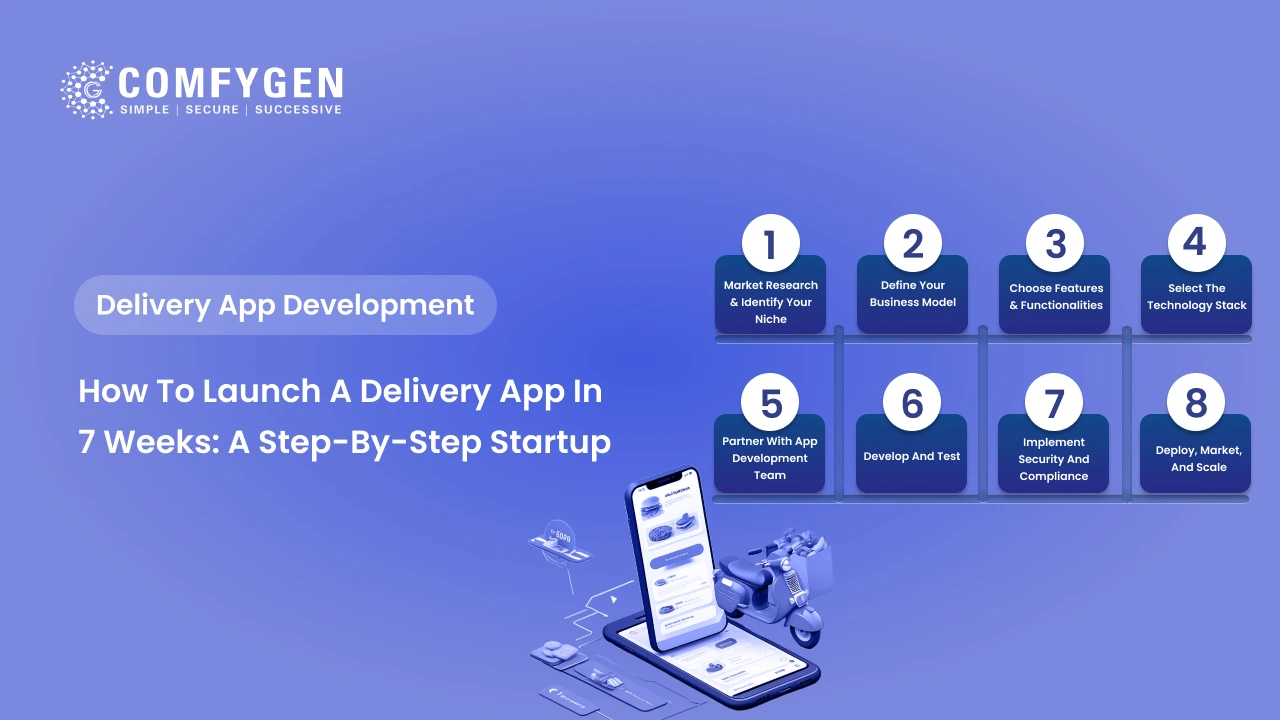





Launch a delivery app in 7 weeks transforms ambitious startups into market contenders by harnessing pre-built delivery app development solutions and strategic outsourcing of delivery app development projects. This streamlined delivery app development roadmap delivers a market-ready MVP solution for food, grocery, or general delivery services.
Emphasising must-have features like real-time GPS tracking, seamless UPI payments, and intuitive order management. Comfygen Technologies allows you to rapid timeline with a cost-effective delivery app development solution expenses by up to 60% while ensuring scalability.
Week 1: Market Research and Planning
For a lunch delivery app in 7 weeks. The first week of building a delivery app sets a strong foundation by focusing on market research, niche selection, and user needs to prevent costly mistakes like adding irrelevant features.
Conduct Market Research
Start with surveys, social media reviews, and competitor analysis to identify customer pain points like slow delivery or high fees. Analyze top Delivery apps in your niche to spot gaps, such as poor vendor support in Indian markets. This step ensures your app addresses real demands without overbuilding.
Pick a Niche
Focus on one specific area, like groceries, food, pharmacy, logistics, parcel, hyperlocal items, or multi-vendor sales, instead of trying to cover everything at once. This keeps your marketing simple and helps attract users faster. A small choice aligns better with early operations in India, where grocery delivery apps like Dunzo target quick grocery and essentials delivery.
Study Competitors
Review just the top three local players, such as Swiggy, Dunzo, or Blinkit in Indian cities, and spot their weaknesses, like slow delivery or poor store support. These gaps highlight real opportunities without endless research. For example, complaints about delays in apps like Borzo or Dunzo can guide your strengths.
Talk to Users
Have short, honest chats with at least ten potential customers to learn their frustrations, such as high prices, late arrivals, slow apps, or missing products. Base your initial features on their feedback, not guesses. This direct input beats analyzing app screenshots.
Week 2: Feature Definition and Tech Stack
Week 2 focuses on defining core features and selecting a tech stack for your lunch delivery app to ensure scalability, user satisfaction, and faster development. This phase builds on Week 1 insights by prioritizing MVP essentials while planning for growth.
Essential Features
Include OTP login for secure access, AI-driven search with filters for cuisine, price, and dietary needs, dynamic carts with customization, multiple payments like UPI/cards/wallets, real-time GPS tracking, and push notifications via Firebase for order updates. Add rider-specific tools like route optimization and earnings dashboards, plus restaurant panels for menu management and analytics. Voice search, loyalty rewards, and AI chatbots enhance retention in 2025 apps.
Recommended Tech Stack
Use React Native for cross-platform iOS/Android apps to save 30-40% on delivery app development time, Node.js backend for handling high traffic, MongoDB for flexible data storage, and blockchain for secure, transparent transactions in payments or tracking. Integrate Google Maps for navigation, Stripe/Paytm for payments, and AWS for cloud scaling. White-label delivery app clones from providers like Appkodes reduce custom coding by up to 70%.
Design Wireframes
Create Figma prototypes for customer (browsing/tracking), restaurant (orders/menu), and rider (navigation/earnings) panels with intuitive UI, accessibility features like voice-over support, and seamless flows. Test for mobile responsiveness and low-data usage, common in Indian markets. Early prototypes catch UX issues before coding starts.
Week 3: Core Buildout
Week 3 is about starting actual development using Agile practices to quickly build and iterate on your delivery app’s core components. Agile sprints run bi-weekly with daily standups to keep the team aligned and progress steady.
Development Focus
-
Frontend: Build responsive user interfaces for customers, vendors, and drivers using React Native or Flutter to cover both iOS and Android efficiently.
-
Backend: Develop Node.js APIs handling user authentication, order management (create, read, update, delete), and real-time updates via WebSocket for fast order tracking and notifications.
-
Pre-built Modules: Integrate white-label delivery app development clone features like rider assignment algorithms and inventory synchronization to speed up development and reduce custom coding effort.
-
Security & IoT: Implement OAuth 2.0 for secure user access and basic IoT sensors to improve estimated delivery time accuracy.
-
Continuous Integration & Deployment: Use GitHub Actions for automated code testing and deployment, performing twice-daily builds to ensure quick feedback and product stability.
Week 4: Integrations and Polish
Week 4 emphasizes integrating key third-party services and refining your delivery app for reliability, user trust, and performance before scaling. This phase connects Week 3’s core build with real-world functionality through APIs and testing.
Key Integrations
-
Mapping & Routing: Embed Google Maps SDK for dynamic routes, real-time traffic updates, and ETA predictions to optimize rider paths.
-
Payments: Add Razorpay or UPI gateways supporting wallets, cards, and one-tap options like Google Pay for frictionless checkouts in India.
-
Analytics: Use Mixpanel or Firebase dashboards to track order funnels, drop-offs, and user behavior for data-driven tweaks.
-
Notifications: Implement OneSignal for push alerts on order status, delays, or promotions to boost engagement.
Security and Advanced Features
Strengthen with JWT tokens for session management, DDoS protection via Cloudflare, and IoT sensors for logistics like temperature monitoring in grocery deliveries. Include AI route optimization and digital proof-of-delivery (e-signatures/photos) for efficiency. Mid-sprint demos and backlog grooming resolve issues early.
Outsourcing Benefits
Indian teams deliver 40-60% cost savings through expertise in these integrations, aligning with 7-week MVP timelines via iterative testing. Comfygen Technologies excels in templated setups for seamless delivery app deployment.
Week 5: Comprehensive QA Execution
Week 5 centers on comprehensive quality assurance (QA) to eliminate bugs, ensure scalability, and deliver a polished delivery app ready for real users. Rigorous testing across unit, integration, load, and user acceptance phases catches issues early, preventing post-launch failures.
Testing Strategies
-
Unit Tests: Use Jest or React Testing Library to validate isolated components like cart calculations, menu filters (veg/non-veg toggles), and customization logic for 100% code coverage.
-
Integration Tests: Run end-to-end API flows from order placement to payment confirmation using tools like Postman or Cypress, ensuring seamless data sync between frontend, backend, and databases.
-
Load and Performance Testing: Simulate 1,000+ concurrent users with JMeter or LoadRunner to test load balancing, achieving sub-2-second page loads and 99.9% uptime under peak Indian evening traffic.
-
User Acceptance Testing (UAT): Deploy beta via TestFlight (iOS) and Google Play Internal Testing (Android) for real-user validation of core flows like pricing accuracy and gateway compatibility.
Week 6: Beta Insights and Polish
Week 6 focuses on gathering beta feedback from 100+ users to refine AI-driven features, fix performance issues, and launch a delivery app store with compliance checks and A/B testing. This iteration phase targets under 5% crash rates and boosts conversions through data-backed polish.
Beta Feedback Collection
Deploy in-app surveys via Typeform or Firebase to capture insights on AI route predictions using TensorFlow models for accurate ETAs, plus bottlenecks like slow loads or inaccurate pricing. Analyze crash reports with Sentry or Crashlytics to prioritize hotfixes, aiming for smooth experiences across customer, vendor, and rider panels. Run 50+ end-to-end simulations testing edge cases like failed payments, rider disputes, and inventory shortages.
Compliance and Optimization
Audit for app store guidelines, ensuring Razorpay PCI-DSS compliance for payments and clear privacy policies meeting GDPR/DPDP standards in India. A/B test UI elements like cart button prominence or checkout flows using Firebase Remote Config to achieve 20% conversion uplifts. Train operations teams on Mixpanel dashboards for real-time order monitoring and anomaly detection.
Deployment and Training
Push hotfixes via GitHub Actions CI/CD for rapid iterations without full redeploys. Comfygen Technologies streamlines this with automated beta pipelines, delivering 40-60% faster polish cycles aligned with 7-week MVP timelines.
Week 7: Launch a delivery app and Go-to-Market
Week 7 completes the 7-week MVP journey by launching your delivery app on app stores, deploying production infrastructure, and executing hyperlocal marketing to hit 5K downloads in Week 1. Monitor key metrics like DAU, 40% retention, and CAC via Mixpanel to inform v2 roadmaps.
App Store Submission
Submit to the Delivery app to Apple App Store (via App Store Connect) and Google Play Console with optimized ASO: compelling screenshots, keywords like “grocery delivery [city]”, and privacy manifests for GDPR/DPDP compliance. Expect 1-7 day reviews; use beta tester feedback to preempt rejections on payments or crashes. Pre-launch checklists cover crash-free sessions (>99%) and Razorpay PCI-DSS audits.
Infrastructure Deployment
Spin up AWS EC2/RDS with auto-scaling groups for traffic spikes, migrate databases via zero-downtime blue-green deployment using GitHub Actions CI/CD. Integrate CloudWatch for monitoring and Route 53 for DNS failover, ensuring 99.9% uptime during Indian peak hours.
Marketing and Analytics
Launch geo-targeted Google Ads, Instagram influencers in your local cities, and SEO for “delivery app [city]” to drive organic traffic. Track DAU/MAU, retention cohorts (target 40% Day 7), and CAC under ₹100 via Mixpanel; A/B test onboarding for 20% uplift. Plan v2 with user-requested features like subscriptions or AR previews. Comfygen Technologies offers bundled launch support for 40-60% cost efficiency.
Conclusion
Launch a Delivery App development roadmap equips startups to launch a best delivery app MVP, blending rapid Agile development with outsourcing for food, grocery, or on-demand success in emerging markets. Post-launch, leverage analytics for AI optimizations, user retention above 40%, and expansions into multi-service platforms, ensuring scalable revenue from commissions and subscriptions. Partner with Comfygen Technologies to sustain innovation via Flutter/Node.js stacks, turning your delivery app into a hyperlocal powerhouse.

Mr. Saddam Husen, (CTO)
Mr. Saddam Husen, CTO at Comfygen, is a renowned Blockchain expert and IT consultant with extensive experience in blockchain development, crypto wallets, DeFi, ICOs, and smart contracts. Passionate about digital transformation, he helps businesses harness blockchain technology’s potential, driving innovation and enhancing IT infrastructure for global success.