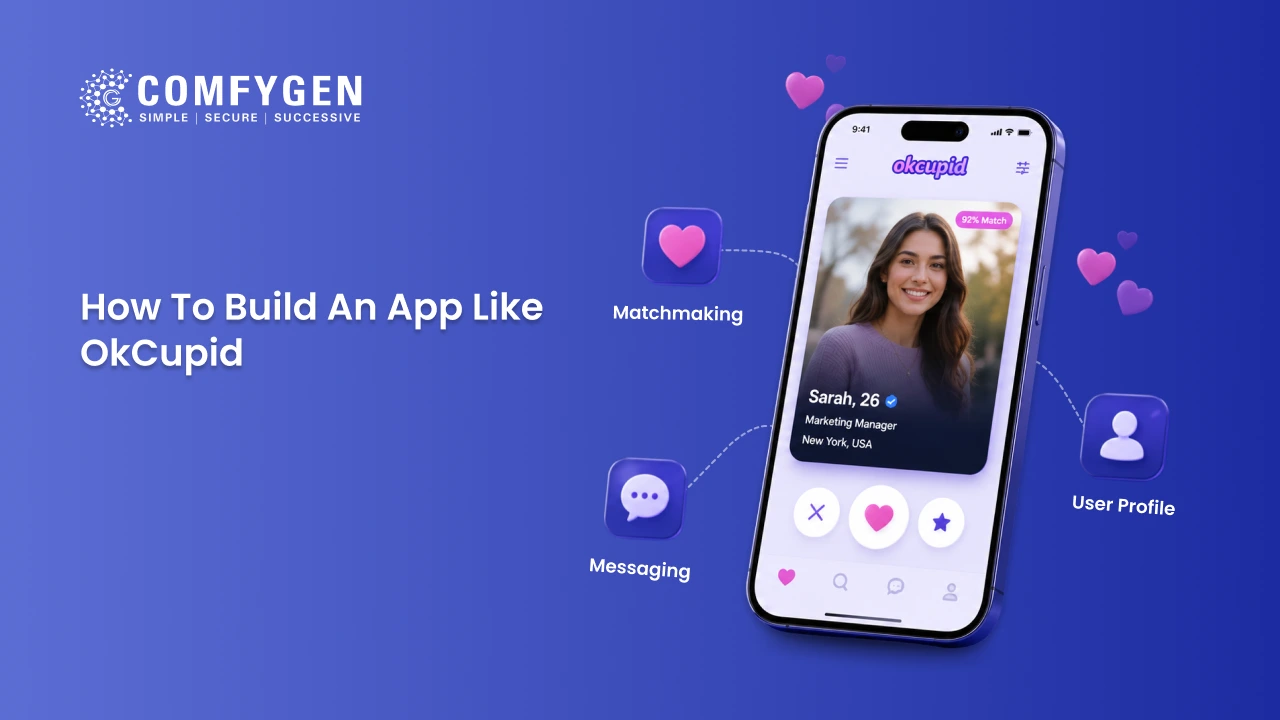





The online dating market is one of the few sectors that held its growth through economic uncertainty. In 2025, global dating app revenue crossed $12 billion, with over 380 million people using some form of online dating platform. That number is expected to reach $24.85 billion by 2035, growing at a 7.91% CAGR.
OkCupid sits at the center of this market. Founded in 2004, it now has over 80 million registered users and approximately 10 million monthly active users worldwide. Unlike swipe-first apps, OkCupid built its reputation on a compatibility-first matching model, asking users to answer hundreds of questions and using those responses to calculate match percentages. The result: users who meet through OkCupid report significantly higher compatibility than those who match by photo alone.
If you want to build a dating app like OkCupid, this guide walks you through everything that matters: how the platform works, which features you need, what technology stack to choose, how the development process runs, what it will actually cost you, and how to earn money once you launch.
Why Build a Dating App Like OkCupid in 2026?
The numbers alone make a strong case. The global online dating services market stood at approximately $12 billion in 2025 and is projected to reach $12.52 billion in 2026. Subscription-based models controlled 69.45% of total revenue in 2025 and are growing at a 12.61% CAGR through 2031. Micro-transactions and virtual gifts are accelerating even faster, at a 14.58% CAGR.
A few specific trends make an OkCupid-style app a better investment today than a swipe-first clone:
Compatibility is winning
Users are experiencing “swipe fatigue.” Apps like Tinder and Bumble are seeing declining payer counts. Tinder’s paying users dropped from 9.6 million in 2024 to 8.8 million by Q4 2025. Meanwhile, Hinge, which focuses on deeper compatibility, grew revenue 38% year-over-year to $550 million. Users want more than a photo. They want to know if someone shares their values.
Gen Z is reshaping what dating apps look like
This demographic is projected to grow at a 13.07% CAGR and prefers video-first, authentic interactions over shallow swiping. They will pay for apps that produce real outcomes.
Asia-Pacific is the Fastest-Growing Region
It commanded 34.85% of global market share in 2025 and is forecast to grow at a 13.12% CAGR through 2031. If you are a developer or investor outside North America, there is a serious opportunity in localized dating platforms.
Niche wins
Platforms targeting specific communities (faith, lifestyle, values) report higher user satisfaction and lower churn than general apps. OkCupid itself succeeded by targeting users who wanted more than looks.
If you are serious about developing a dating mobile application that generates sustainable revenue, the compatibility-first model OkCupid pioneered is the right direction.
How OkCupid Works: The Core Model
OkCupid runs on three interconnected systems: profiles, questions, and a compatibility algorithm. Understanding how they connect is essential before you start building anything similar.
Registration and Profile Creation
Users register with an email or social account. They fill out a profile that goes well beyond name and photos. OkCupid prompts users to write written prompts, state their values, list their interests, and answer personality questions. The platform has over 3,000 questions available. The more questions a user answers, the more precise their matches become.
The Compatibility Algorithm
Each question is weighted based on how much the answer matters to the user and how much they want it to matter to a potential match. OkCupid calculates a compatibility percentage between two users based on their overlapping answers and the weights they assign. This is fundamentally different from a swipe-based model because it surfaces people you will likely get along with, not just people who are nearby and attractive.
Discovery and Matching
Users can browse profiles, filter by distance and preferences, and Like or Skip people. When two users both Like each other, it becomes a match. Paying users get to see who Liked them before matching. Free users match and then discover the like.
Communication
Once matched, users chat through the in-app messaging system. OkCupid allows matched users to send text, photos, and GIFs. Premium plans unlock additional communication tools.
Safety Features
OkCupid uses photo verification, an in-app Safety Center, and content moderation tools that detect inappropriate messages. Users can block and report any account.
This is the foundation of an app like OkCupid. Your job is to build it better, add features OkCupid lacks, and target an underserved segment.
OkCupid vs. Other Dating Platforms: What Makes It Different
Understanding OkCupid’s positioning helps you decide what to build and where to compete.
|
Feature |
OkCupid |
Tinder |
Bumble |
Hinge |
|
Matching basis |
Compatibility questions |
Appearance + location |
Appearance + location |
Prompts + limited daily likes |
|
Gender options |
22 genders, 13 orientations |
Binary + non-binary |
Multiple options |
Multiple options |
|
Free messaging |
After mutual like |
After mutual like |
Women initiate |
After mutual like |
|
Questionnaire depth |
3,000+ questions |
None |
None |
Prompts only |
|
Target user |
Serious relationship seekers |
Casual + serious |
Women-focused, serious |
Relationship-focused |
|
Revenue model |
Freemium + subscription |
Freemium + subscription |
Freemium + subscription |
Freemium + subscription |
OkCupid’s questionnaire-based compatibility scoring is its single biggest differentiator. No other major app does this at scale. If you build a dating app similar to OkCupid, this is the feature you must get right.
Ready to Build Your Own Dating App Like OkCupid?
Turn your idea into a scalable, feature-rich matchmaking platform with expert guidance on design, development, and monetization. Let’s help you launch faster and smarter.
Get a Free Consultation
Must-Have Features for a Dating App Like OkCupid
User Registration and Profile Creation
The sign-up flow needs to be fast but collect enough data to power your matching algorithm. Support social login (Google, Facebook, Apple ID) and email registration. After the account is created, guide users through profile building: photos, a short bio, interests, and basic demographic information.
Build prompts that users can answer to express their personality. OkCupid uses written prompts that surface on the profile. These outperform blank “About Me” fields because they give users a structure to work within.
Photo upload should support multiple images with at least one verification check. Video profiles are increasingly common, especially in Gen Z audiences.
Compatibility Questionnaire System
This is the feature that makes an OkCupid-style app work. Build a database of questions across categories: values, lifestyle, relationship goals, politics, religion, family plans, and personality. When a user answers a question, they also indicate how much they want a match to answer the same way.
Your matching algorithm uses these weighted responses to calculate a compatibility score between any two users. The more questions answered, the more accurate the score. Display this as a percentage on match cards.
Start with 200 to 300 curated questions. Expand based on user data. OkCupid built its library over 20 years. You can build a competitive version much faster.
Smart Matching Algorithm
The algorithm needs to surface the right people at the right time. At minimum, factor in compatibility score, location, basic preference filters (age, distance), and activity recency. As your user base grows, layer in behavioral signals: who the user Likes, how long they spend on profiles, and which questions they answer.
A cold-start problem (new users have no behavioral data) is solvable through the questionnaire. Users who answer 20+ questions immediately start producing useful signals.
Swipe and Like System
Users browse profiles as cards or a list. They Like or Skip each profile. When two users mutually Like each other, the match triggers a notification and opens a chat window. Implement a “Boost” feature where a user can temporarily increase their profile visibility, paid or earned through engagement.
Premium users see who Liked them. Free users see blurred thumbnails. This is one of the most effective freemium conversion levers in the industry.
Real-Time Messaging
Once matched, users chat through the in-app system. Support text, emoji, GIF search (via Giphy API), and photo sharing. Use WebSocket connections for real-time delivery. Display read receipts for premium users.
Add icebreaker prompts in the chat interface for new matches. OkCupid does this well. Reducing friction in the first message increases activation rates significantly.
Advanced Search and Filters
Users need to control who they see. Build filters for age range, distance, relationship goal, dealbreakers (has children, wants children, smokes, drinks), and any answer-based filters from your questionnaire.
Dealbreaker filters are particularly powerful. If a user marks “wants children: yes” as a dealbreaker, they should never see profiles where the answer is “no.” This prevents wasted time and increases the quality of matches.
Push Notifications
Notification strategy directly affects Day-1, Day-7, and Day-30 retention. Send notifications for new matches, unread messages, profile Likes (for premium users), compatibility milestones (“You answered 50 questions!”), and re-engagement prompts for inactive users.
Allow users to configure notification frequency and types. Over-notifying users causes uninstalls. Under-notifying them causes them to forget you exist.
Geolocation
Match users within their chosen radius. Use a configurable distance filter (1 km to 500 km or anywhere). For apps targeting international audiences, support city-based browsing. Protect precise location data: store only approximate coordinates, never exact GPS positions.
Privacy and Safety Controls
Users can block any account with one tap. Reporting a profile flags it for moderation review. Add an option for Incognito Mode where the profile is only visible to people the user has already Liked, preventing exes or colleagues from appearing in their feed. This is a premium feature on OkCupid and converts well.
Advanced Features That Differentiate Your App
These features separate a competitive dating app from a generic clone.
AI-Powered Match Recommendations
Layer a recommendation engine over your base algorithm. Analyze behavioral signals (swipe patterns, response rates, time spent on profiles) and use machine learning to surface increasingly accurate suggestions. As of 2026, Match Group has invested heavily in AI for OkCupid and its portfolio apps. If you build an ML-based recommendation layer from day one, you start ahead of where most competitors were 18 months ago.
In-App Video Calls
Video calling is now expected, not exceptional. Video dates became normalized during the pandemic and stuck. Build secure, end-to-end encrypted video calls directly within the app. Do not force users to share phone numbers or move to external platforms. Keep the entire interaction inside your product.
Add pre-call icebreakers: short games or prompts that reduce awkwardness before the video starts. This dramatically improves first-call completion rates.
Virtual Date Features
A growing share of users, particularly introverts and long-distance matches, want structured virtual date options. Build watch-party functionality (co-watching a short video clip together), collaborative quiz games, and virtual gifting. These features increase time-on-app and provide additional purchase events.
Gamification Elements
Daily challenges, compatibility streaks, and badge systems reward users for consistent engagement. “Answer 5 new questions today” with a small reward (a free boost, extra Likes) creates positive usage loops. Users who engage daily are significantly more likely to find matches and convert to paid plans.
Voice Messages
In-chat voice messages add warmth and personality that text lacks. Many users find their voice more expressive than written messages. Add a 60-second voice clip option to the chat. This is a relatively low-effort feature with a high engagement impact.
Compatibility Insights
Show users why they are compatible with a match. Display which specific questions they answered the same way and where they differ. OkCupid surfaces this on each profile card. It reduces uncertainty about starting a conversation and gives users natural conversation starters.
Video Profiles
Beyond static photos, let users record a 30-second video introduction. Video profiles dramatically increase trust and attract more genuine interest than photos alone. Gen Z users in particular respond well to video-first profiles.
Nearby Events
Suggest local events, bars, or activities based on a user’s interests and location. If a user is matched with someone who both love hiking, surface a local trail event. This drives offline conversion, which is the actual goal of every dating app.
Dark Mode and Accessibility
A surprisingly high percentage of users access dating apps at night. Full dark mode support with proper contrast ratios improves comfort and accessibility. Support font size adjustments and VoiceOver/TalkBack compatibility for visually impaired users.
User Panels: What Each Role Needs
User Panel
- Profile creation and editing
- Questionnaire access and progress tracking
- Match discovery and filtering
- Liked you panel (premium)
- Chat and media sharing
- Video call initiation
- Settings: privacy, notifications, account
- Subscription management
- Reporting and blocking tools
Admin Panel
- User account management (view, suspend, delete)
- Content moderation queue (reported profiles, flagged messages)
- Verification review
- Analytics dashboard (DAU, MAU, match rates, revenue)
- Push notification management
- A/B test configuration for features
- Payment and subscription oversight
- Question bank management
Tech Stack for Dating App Development
The right technology choices reduce your development timeline, support scale, and control your ongoing infrastructure costs.
Frontend (Mobile)
React Native or Flutter for cross-platform development. Both let you ship iOS and Android from a single codebase. React Native has a larger community and more libraries. Flutter produces smoother animations and is gaining fast adoption. Either is a sound choice. A cross-platform approach reduces your frontend cost by 30 to 40% compared to building two native apps.
For specific performance-critical components (camera for video calls, geolocation), you will write some native modules regardless of which framework you choose.
Backend
Node.js with Express for the API layer. Node is excellent for real-time applications because of its event-driven architecture. It handles the high volume of concurrent WebSocket connections that chat and matching require.
Python with Django or FastAPI for the ML components: recommendation engine, matching algorithm, and content moderation classifier. Python has the best ecosystem for machine learning work.
GraphQL or REST API: GraphQL reduces over-fetching for complex profile queries. REST is simpler to implement and easier to cache. Most dating apps use REST with specific GraphQL endpoints for nested data like profile + compatibility + chat history.
Real-Time Communication
WebSockets (via Socket.io or native implementation) for chat and notifications. Real-time delivery with sub-100ms latency is achievable with WebSocket connections on modern infrastructure.
WebRTC for peer-to-peer video calls. Use a TURN/STUN server (Coturn or Twilio’s TURN service) to handle NAT traversal and ensure calls work across different network conditions.
Database
PostgreSQL for user data, profiles, relationships, and transactions. Supports JSON columns for flexible profile fields, and has excellent GIS extensions for location-based queries.
MongoDB for flexible content storage: questionnaire answers, chat logs, activity feeds.
Redis for caching frequently accessed data (active matches, session tokens), and for managing the WebSocket connection pool.
Elasticsearch for advanced search and filter queries. As your user base grows past 100,000 active users, raw SQL queries on filters become slow. Elasticsearch scales this well.
Cloud Infrastructure
AWS or Google Cloud for hosting. Use Kubernetes or AWS ECS for container orchestration. Configure auto-scaling groups so your infrastructure scales with traffic spikes (Friday and Saturday evenings see 3x to 5x normal traffic on most dating apps).
Use S3 or Google Cloud Storage for media (profile photos, video profiles). Serve assets through a CDN (CloudFront or Cloud CDN) for low-latency delivery globally.
Third-Party Integrations
|
Integration |
Purpose |
|
Firebase / OneSignal |
Push notifications |
|
Stripe or Razorpay |
Payments and subscriptions |
|
Twilio |
SMS OTP for account verification |
|
Google Maps / Mapbox |
Location services and nearby event suggestions |
|
Agora.io or Daily.co |
Video call infrastructure (faster than building on raw WebRTC) |
|
SendGrid / AWS SES |
Transactional email |
|
AWS Rekognition or Clarifai |
Photo moderation (nudity detection, face detection for verification) |
|
Giphy API |
GIF search in chat |
Build a Profitable Dating App Like OkCupid
From MVP to full-scale platform, we help you create dating apps that attract users, drive engagement, and generate revenue
Talk to Our Experts
Step-by-Step Development Process
Discovery and Planning
Define your target user segment, geographic market, and differentiation strategy. What does your app do better than OkCupid? Is it a niche community? A regional focus? Better video features? Stronger safety tools?
Conduct user interviews. Talk to 20 to 30 people in your target audience about their frustrations with existing dating apps. Their answers will shape your feature priority list.
Produce a Product Requirements Document (PRD) with user stories, feature list, and technical constraints. Set success metrics for launch: target MAU, conversion rate to paid, and Day-30 retention.
UI/UX Design
Create wireframes for every key screen: onboarding, profile setup, questionnaire, match discovery, chat, video call, settings, and subscription paywall.
Test the wireframes with real users before writing a line of code. Prototype in Figma or Adobe XD. Run usability sessions. The cost of changing a screen at the wireframe stage is roughly 1/10th the cost of changing it after development.
Design with accessibility from the start: sufficient contrast ratios, touch target sizes, and screen reader labels. This also improves your App Store and Play Store discoverability.
Backend Development
Build the API layer, database schema, and core services in parallel:
- User auth service (registration, login, token management)
- Profile service (CRUD for user profiles and media)
- Matching service (compatibility score calculation, match queue management)
- Messaging service (WebSocket connections, message storage, delivery receipts)
- Notification service (push, in-app, email)
- Payment service (subscription management, in-app purchase processing)
- Moderation service (report queue, auto-moderation checks)
Build each service to be independently deployable. This gives you the ability to scale the matching service separately from the messaging service as load increases.
Mobile App Development
Build the mobile app against the API your backend team is building. Use mock APIs during early development so the mobile team does not block on backend completion.
Key screens to build and test thoroughly: onboarding flow (highest drop-off risk), profile creation, questionnaire (engagement driver), match discovery, chat (core retention feature), and subscription paywall.
Instrument every screen with analytics from day one. You need to know where users drop off in onboarding before you can fix it.
Testing
Run functional testing, performance testing, and security testing in parallel.
- Functional: Each feature works as specified across iOS and Android on multiple screen sizes.
- Performance: Load test your backend with simulated peak traffic (Friday evenings). Your chat service needs to sustain concurrent WebSocket connections from at least 10x your expected Day-1 active users without latency spikes.
- Security: Penetration test your API. Dating apps are high-value targets because they hold sensitive personal information. Check for SQL injection, authentication bypass, insecure direct object references in profile and message endpoints, and data exposure in API responses.
- User acceptance: Run a closed beta with 50 to 200 real users. Gather qualitative feedback on match quality, chat experience, and onboarding clarity.
Launch and Growth
Submit to App Store and Google Play. Plan a two-week review buffer. Prepare your App Store Optimization (ASO): keyword-rich title, keyword-optimized description, high-quality screenshots, and an app preview video.
Launch with a PR push in your target market. Identify 5 to 10 micro-influencers in the dating and relationship space for Day 1 distribution. Set up tracking on installs (AppsFlyer or Adjust) before you run a single paid ad.
Post-launch, run weekly retrospectives on user data. Prioritize features based on behavioral signals, not assumptions.
Post-Launch Iteration
A dating app is never finished. OkCupid has released major feature updates every quarter since 2012. Plan for bi-weekly releases at minimum.
Build a clear product roadmap for your first 12 months: what goes in v1.1, v1.2, v1.3. Each release should address a specific retention or conversion problem identified in your data.
Safety and Privacy Architecture
Safety is not an afterthought for dating apps. It is a product requirement and a trust signal that directly affects user acquisition.
Photo Verification
Require users to take a real-time selfie that matches the poses in their profile photos. AI-based liveness detection prevents static photo uploads. This dramatically reduces fake profiles.
ID Verification (optional, premium)
Offer verified badge status for users who submit a government ID. Platforms that offer identity verification are gaining market share as trust becomes the primary differentiator, according to a 2026 WhichDating report on the state of online dating.
Message Moderation
Train a classifier to detect unsolicited explicit content, harassment, and spam in messages. Auto-flag or block content that triggers the classifier. Review flagged content within 24 hours.
Block and Report
One-tap block and report on any profile or message. Report categories should be specific: fake profile, inappropriate content, harassment, scam.
Incognito Mode
Users can pay to browse without appearing in other users’ discovery feeds. Only the profiles they Like can see them. This is a privacy feature that also serves as a significant revenue driver.
Data Privacy Compliance
For users in the EU, GDPR compliance is non-negotiable. For users in California, CPRA applies. Indian users are covered under the Digital Personal Data Protection (DPDP) Act 2023. Privacy policies must state exactly what data you collect, how you use it, and who you share it with. Do not sell or share location data or questionnaire answers with third-party advertisers. Grindr received a €5.7 million fine for doing exactly this.
Safety Center
Build an in-app Safety Center with tips for safe dating, links to emergency resources, and a direct path to report serious incidents.
Monetization Models for Online Dating Platforms Like OkCupid
Subscription Tiers
The most reliable revenue model. OkCupid runs two tiers: Basic and Premium. Basic unlocks a few features. Premium unlocks everything.
For your app, design three tiers:
- Free: Profile creation, questionnaire, limited daily Likes, text chat with matches.
- Basic ($9 to $15/month): Unlimited Likes, advanced filters, see who Liked you (blurred), read receipts.
- Premium ($25 to $40/month): Everything in Basic, plus Incognito Mode, profile Boosts, video chat priority access, and access to compatibility insights beyond the surface level.
Offer monthly, quarterly, and annual billing. Annual plans at a 30 to 40% discount convert well because they remove price friction for committed users.
Boost and SuperLike Credits
Sell individual credits for high-value features. Profile Boosts (appear at the top of discovery feeds for 30 minutes) and SuperLikes (signal strong interest before matching) work well as one-time purchases. These convert users who are not ready for a subscription but want a specific outcome.
Virtual Gifts
Allow users to send digital gifts to matches. Keep it simple: a few gift categories priced at $0.99 to $4.99 each. Gifting increases emotional investment and accelerates the transition from chat to date.
Advertising (limited)
Contextual advertising (event promotions, lifestyle brands) can supplement subscription revenue. Keep ad inventory limited to non-intrusive placements. Intrusive ads kill retention on dating apps faster than almost any other product category.
Referral and Affiliate Programs
Reward users who refer new active users with free Premium credits. Partner with local businesses (florists, restaurants, date-night venues) for affiliate commission on bookings made through in-app recommendations.
What Does It Cost to Build an App Like OkCupid?
Cost depends on four variables: feature scope, platform (iOS-only, Android-only, or both), development team location, and whether you build native or cross-platform.
Breakdown by Development Component
|
Component |
Scope |
Estimated Cost (USD) |
|
UI/UX Design |
Wireframes, prototype, final design system |
$6,000 – $15,000 |
|
Frontend (Cross-platform) |
React Native or Flutter for iOS + Android |
$15,000 – $35,000 |
|
Backend API |
Auth, profiles, matching, messaging, notifications |
$20,000 – $55,000 |
|
Compatibility Algorithm |
Question system + scoring engine |
$8,000 – $20,000 |
|
Real-Time Chat |
WebSocket messaging, media sharing |
$8,000 – $18,000 |
|
Video Calling |
WebRTC integration or third-party (Agora) |
$6,000 – $15,000 |
|
Admin Panel |
Moderation, analytics, user management |
$5,000 – $12,000 |
|
Database Setup |
PostgreSQL + Redis + Elasticsearch |
$4,000 – $10,000 |
|
Third-Party Integrations |
Payments, push notifications, maps, verification |
$5,000 – $12,000 |
|
QA and Testing |
Functional, performance, security |
$5,000 – $12,000 |
|
Deployment and DevOps |
AWS/GCP setup, CI/CD pipeline |
$3,000 – $8,000 |
By App Complexity
MVP (3 to 4 months): Core features only. Registration, basic profiles, simple compatibility matching, chat, basic filters, freemium subscription. Cost: $35,000 to $65,000. Suitable for validating your market before full investment.
Mid-tier app (5 to 7 months): Full feature set from the must-have list plus 3 to 4 advanced features. Cost: $65,000 to $120,000. Suitable for a market-ready product that competes with mid-tier players.
Full OkCupid-scale app (8 to 12 months): Complete feature set including advanced matching algorithm, video calls, AI recommendations, gamification, full admin panel, and multi-platform delivery. Cost: $120,000 to $220,000+.
Developer Rates by Region
|
Region |
Hourly Rate |
|
India |
$15 – $40/hr |
|
Eastern Europe |
$35 – $70/hr |
|
Western Europe |
$70 – $120/hr |
|
North America |
$90 – $150/hr |
Indian development companies like Comfygen deliver full-stack dating app development at a fraction of the cost of North American or European agencies, without compromising on technical quality. This is where building with an India-based team saves you $50,000 to $100,000 on a mid-tier project.
Ongoing Costs (Post-Launch)
- Cloud infrastructure: $300 to $2,000/month (scales with users)
- Third-party APIs (Twilio, Agora, push notifications): $200 to $800/month
- Content moderation (human review): $500 to $2,000/month
- App Store fees (15 to 30% of in-app revenue)
- Maintenance and bug fixes: $2,000 to $5,000/month
Budget 15 to 20% of your initial build cost per year for maintenance and iterative updates.
Cost-Saving Strategies for Startup Founders
Start with an MVP
Build only the features you need to test your hypothesis. A matching app with profiles, a 50-question compatibility system, chat, and a basic subscription paywall validates whether users will pay before you spend on video calls and gamification.
Use Cross-Platform Frameworks
React Native or Flutter cuts frontend costs by 30 to 40% compared to building separate native iOS and Android apps.
Use Third-Party Services for Non-Core Features
Video calling (Agora, Daily.co), push notifications (Firebase), and payment processing (Stripe, Razorpay) are far cheaper to integrate than build from scratch. Agora charges approximately $0.0025 per minute per user for video calls. At 1,000 hours of calls per month, that is $150.
Hire a Full-Service Agency
A single agency handling design, mobile, backend, and QA is cheaper and faster to coordinate than assembling four separate specialist teams. Communication overhead is one of the largest hidden costs in software projects.
Phase your Feature Releases
Launch with the core feature set, generate revenue, and use that revenue to fund advanced features. This keeps you from running out of capital before your first paying user.
How Comfygen Builds Dating Apps
Comfygen has delivered mobile app development projects across consumer social, healthcare, and fintech. Our dating app development team has hands-on experience with the specific technical challenges that dating apps present: real-time messaging at scale, compatibility algorithm design, photo moderation, and subscription billing.
Here is what you get when you work with us:
Technical expertise across the full stack
Our React Native and Flutter development teams build cross-platform apps that perform natively. Our backend team has shipped Node.js services handling hundreds of concurrent WebSocket connections with sub-50ms latency. Our AI development team can build the recommendation engine and content moderation classifier your app needs.
Product-first thinking
We do not just build what you ask for. We challenge assumptions, surface edge cases, and recommend feature priorities based on what we know drives retention and conversion in social apps. Our application consulting services team works with you before development starts to make sure you are building the right thing.
Transparent process
Weekly demos, bi-weekly sprint reviews, and direct Slack access to your team. You always know what is built, what is next, and where risks lie.
Post-launch support
Most dating apps fail in the first six months because of poor moderation, slow bug fixes, or feature stagnation. We offer mobile app maintenance retainers that keep your product stable while you focus on growth.
India-based cost advantage
Building with Comfygen puts a senior full-stack team within your budget. We serve international clients across the US, UK, UAE, and Australia with transparent communication and delivery schedules aligned to your time zone.
If you want to discuss your specific requirements, connect with our team for a free technical consultation.
Final Thoughts
Building a dating app like OkCupid is a real engineering project, not a template exercise. The compatibility questionnaire and matching algorithm at its core are genuinely complex systems. The real-time chat, video calling, photo moderation, and safety architecture require thoughtful technical decisions. The monetization model needs to balance free access (to build network density) with paid conversion (to generate revenue).
The market is there. Over 380 million people use dating apps globally. The shift toward compatibility-first platforms is real and measurable. Users are tired of swiping and want apps that produce relationships, not just matches.
If you have a clear idea of your target audience and what you want to build differently, the investment is defensible. Start with an MVP, validate your matching model with real users, collect behavioral data, and iterate.
Comfygen can take you from concept to launched product. Talk to our team about your requirements and we will give you a realistic scope, timeline, and cost estimate.
FAQ
How long does it take to build a dating app like OkCupid?
A production-ready MVP takes 3 to 4 months. A full-featured app comparable to OkCupid takes 8 to 12 months. Timeline depends on feature scope, team size, and how many revision cycles the design goes through.
What is the most important feature in an OkCupid-style dating app?
The compatibility questionnaire and matching algorithm. Every other feature is secondary. If your matching system does not surface genuinely compatible people, users will churn regardless of how good your UI looks or how fast your chat delivers messages.
Can I build a dating app with a limited budget?
Yes. Start with an MVP focused on the questionnaire, basic matching, and chat. You can launch a functional, monetized dating app for $35,000 to $65,000 if you scope it tightly. Validate the market before investing in video calls, gamification, and AI features.
Is cross-platform (React Native / Flutter) a good choice for a dating app?
Yes. Most successful mid-market dating apps today ship cross-platform. The performance gap between cross-platform and native has narrowed significantly. Unless you are building features that require deep native system integration (camera filters, AR effects), cross-platform is the right choice for cost and speed.
How do I handle fake profiles and scams?
Photo verification via liveness detection eliminates most fake accounts at registration. AI-based message moderation catches romance scam patterns in chat. Rate-limiting new accounts reduces bot activity. Human moderation review of flagged content catches edge cases the AI misses. Plan a moderation budget from day one.
What monetization model works best for a new dating app?
Freemium with a subscription tier performs best for new apps because it allows free user acquisition while generating predictable monthly recurring revenue from a converting subset. Add Boost credits and virtual gifts once you have 10,000+ active users.
What regulations apply to dating apps in India?
Dating apps operating in India and collecting user data must comply with the Digital Personal Data Protection (DPDP) Act 2023. This requires a lawful basis for processing, user consent for sensitive data (health information, political opinions, religious beliefs, sexual orientation), a data retention policy, and a clear mechanism for users to withdraw consent and request data deletion.
How does the OkCupid matching algorithm work?
OkCupid asks users to answer questions, indicate how they want a potential match to answer, and rate how important the question is to them. It then calculates a compatibility score between two users based on how many important questions they answered the same way. The more questions answered, the more accurate the compatibility percentage.
What is the difference between building an app like OkCupid versus an app like Tinder?
Tinder is a swipe-first, appearance-based app. Building a Tinder clone requires a strong swipe UI and basic matching by location and preferences. An OkCupid-style app requires a compatibility engine, questionnaire system, and more complex profile architecture. The OkCupid model is harder to build but produces better match quality and attracts users with serious relationship intent, who convert to paid plans at higher rates.
How much does it cost to maintain a dating app after launch?
Plan for $3,000 to $8,000 per month in combined cloud infrastructure, third-party API costs, content moderation, and developer maintenance. This scales up significantly as your user base grows. At 100,000 monthly active users, infrastructure alone can cost $2,000 to $5,000 per month depending on your media storage and video call usage.
Can Comfygen build a dating app for the Indian market?
Yes. We build mobile app solutions for both Indian and international markets. For India-specific dating apps, we incorporate DPDP Act compliance, UPI payment integration through our UPI payment app development capabilities, and regional language support. We understand the local regulatory landscape and can build a product compliant with Indian data protection requirements from day one.

Mr. Saddam Husen, (CTO)
Mr. Saddam Husen, CTO at Comfygen, is a renowned Blockchain expert and IT consultant with extensive experience in blockchain development, crypto wallets, DeFi, ICOs, and smart contracts. Passionate about digital transformation, he helps businesses harness blockchain technology’s potential, driving innovation and enhancing IT infrastructure for global success.
Based on Interest
Cloud Kitchen Management Software Development: Features, Process, Cost & Compliance Guide
Quick Summary: Cloud kitchen management software development brings order aggregation, kitchen display systems, inventory tracking, and analytics into one dashboard, replacing the…