




Food truck app development costs $8,000 to $90,000+ and takes 10 to 22 weeks. A working MVP needs four things: live GPS location, a digital menu with ordering, at least two payment methods, and order status tracking. Everything else, including loyalty, analytics, and POS sync, belongs in version two.
The food truck business has moved online, and the trucks that win now are the ones customers can find, order from, and pay without walking up to the window first.
If you run a truck, or you’re building a platform for several of them, an app changes three things: how customers find you, how fast you serve, and how often they come back. This guide covers what to build, what it costs in 2026, how long it takes, and how to pick a development partner without getting burned.
The State of the Food Truck Industry in 2026
The global food truck market is worth USD 4.71 billion in 2026 and is forecast to reach USD 6.46 billion by 2031, growing at a 6.52% CAGR.
In the United States, food truck services were valued at USD 2.01 billion in 2025 and USD 2.14 billion in 2026, on track to reach USD 3.56 billion by 2033 at a 7.5% CAGR.
Two things stand out in that data. American growth is running ahead of the global average, and a rising share of that revenue is coming through app-based ordering rather than walk-up traffic. Mordor also points to social media food discovery and urban events as core growth drivers, which is exactly where a mobile app does its work: it turns a one-time event customer into a repeat one.
Franchised operators like Cousins Maine Lobster and Kona Ice are scaling to multiple trucks across states. That shift matters for anyone building an app. A single-truck tool and a multi-truck platform are different products with different budgets, and picking the wrong one early is expensive to undo.
What Is a Food Truck App?
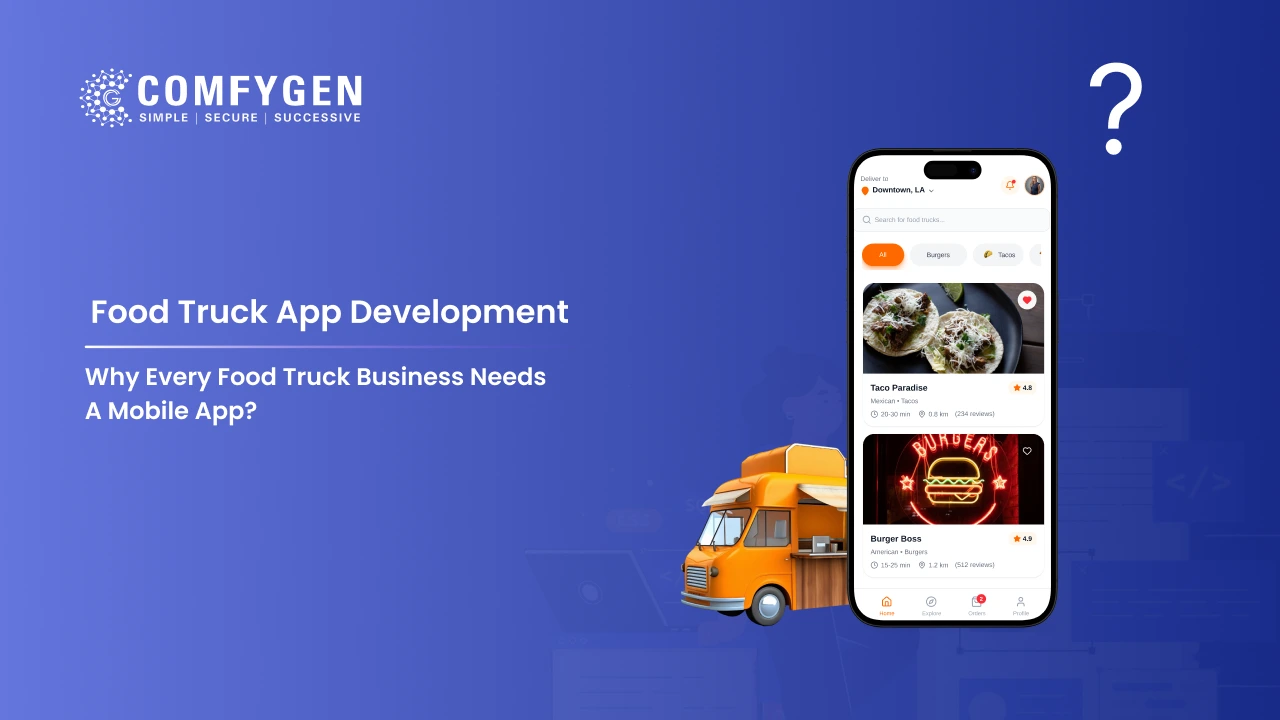
A food truck app is a mobile ordering and management system built for a business that moves.
On the customer side it shows where your truck is parked today, what’s on the menu right now, and lets someone order and pay before they arrive. On the owner side it handles incoming orders, menu edits, sold-out items, sales reports, customer data, and push campaigns from one dashboard.
That’s different from listing your truck on Roaming Hunger, Street Food Finder, or a delivery aggregator. Those platforms help people discover you. Your own app is where you keep them. You own the branding, the customer list, and the order data, and you pay no commission on anything sold through it.
What Food Trucks Lose Without an App
Customers Can’t Find The Truck
Your location changes. If your only location update is an Instagram story, a good share of your regulars miss it that day. Live GPS in an app removes the guesswork.
Queues Cost You Sales
At peak lunch, a long line makes people leave. Pre-ordering fixes this because prep starts before the customer walks up. Same kitchen, more orders served in the same two hours.
You Don’t Own The Customer
Walk-up traffic and social media leave you with no way to reach anyone directly. You can’t tell them you’re parked near their office. You can’t send them a reward that brings them back next week.
Cash Slows Everything Down
Card and wallet payments are now the default for most American customers. A truck that leans on cash loses the person who has a phone in their hand and no wallet.
You’re Guessing on Menu and Inventory
Without order data, pricing and prep quantities are gut calls. An app turns every service into a record of what sold, when, and where.
Must-Have Features: Customer Side
The features you build into your app determine whether customers use it once or make it a habit. Here are the customer-facing features that matter most in 2026.
Real-time GPS location
The single most important feature. Customers open the app and see where the truck is parked, with today’s hours. Add location history so regulars learn your weekly pattern, and route sharing if you run more than one truck.
Digital Menu with Ordering
Item photos, descriptions, customization (extra sauce, no onions, allergens), and direct ordering. The menu has to be editable in real time from the dashboard so you can pull a sold-out item the moment it’s gone.
Pre-Order and Scheduled Pickup
A customer orders at 11:45 for a 12:15 pickup, walks up, and collects in under a minute. This is the feature that raises throughput more than any other, because it lets the kitchen sequence prep instead of reacting to a queue.
In-App Payments
Cards, Apple Pay, Google Pay, and one-tap saved payment methods. Checkout should confirm in under 10 seconds. Faster payment means a shorter line, which improves the experience for everyone still waiting.
Push Notifications
Your only free direct marketing channel. Location updates, today’s special, a time-limited discount on something slow-moving, or a nudge when a loyalty member is one order from a free item.
Loyalty and Rewards
A points system is enough. Earn on every order, redeem for a free item. Once a customer has points with your truck, choosing a different one costs them something.
Order Status Tracking
Received, preparing, ready for pickup. Three states. It stops customers from hovering at the window and cuts the “is it ready yet” questions that slow your staff down.
Ratings and Reviews
An in-app rating gives you quality feedback and catches complaints before they land on Google or Yelp.
Must-Have Features: Owner Dashboard
| Feature | What it does |
| Order management | Live queue of incoming orders with one-tap status changes |
| Menu and inventory | Real-time editing, availability toggles, low-stock alerts |
| Sales analytics | Revenue, order volume, average order value, best sellers by day and location |
| Customer segments | Profiles built from order history and visit frequency |
| Location scheduling | Publish next week’s parking schedule so customers can plan |
| Promotions | Create, schedule, and end offers without calling a developer |
The dashboard is what makes the app worth paying for. A customer app with no owner tooling behind it becomes a maintenance problem within a month.
Food Truck App Tech Stack
| Layer | Recommended options | Why |
| Mobile frontend | React Native or Flutter | One codebase for iOS and Android, cuts build cost 30% to 40% |
| Backend | Node.js or Python (Django) | Handles real-time order events and peak-hour spikes |
| Database | PostgreSQL with Redis caching | Reliable order records, fast menu reads |
| Location | Google Maps SDK or Mapbox | Live truck position, geofencing, customer distance |
| Payments | Stripe, Square, or Adyen | Card, Apple Pay, Google Pay, refunds, payouts |
| Notifications | Firebase Cloud Messaging | Push at zero cost per message |
| Hosting | AWS or Google Cloud | Scales for lunch-rush spikes without over-provisioning |
If your budget is tight, cross-platform mobile development is the biggest single lever. Two native builds cost close to double for a product where the customer-facing screens are identical on both platforms.
POS Integration: What to Know Before You Build
Most trucks already run a POS before they build an app, and the two need to talk to each other. Otherwise your staff enters app orders into the POS by hand, which is exactly the error source you were trying to remove.
| POS | API access | Notes |
| Square | Open API, well documented | Most common on food trucks, easiest integration, handles offline mode |
| Toast | Partner API, approval required | Strong kitchen display support, geared to larger operations |
| Clover | Open API plus app marketplace | Good hardware options, integration effort is moderate |
| Lightspeed | Partner API | Better fit if you also run a brick-and-mortar location |
Two practical points. Square is the lowest-friction option for a single truck and usually adds 40 to 80 hours to a build. Toast and Lightspeed need partner approval, which can add two to four weeks to the timeline before any code is written, so start that paperwork during discovery, not after.
If you have no POS yet, decide on one before app design starts. Retrofitting POS sync into a finished app is far more expensive than planning for it.
Custom App vs Third-Party Platforms
| Factor | Custom app | Third-party platform |
| Brand control | Full | None |
| Customer data | Yours | Theirs |
| Commission per order | None | 15% to 30% |
| Push notifications | Direct | Not available |
| Loyalty program | Yours to design | Platform-wide |
| Upfront cost | $8,000+ | Free to list |
| Cost per order over time | Falls | Stays flat |
Aggregators are good at one job: putting your truck in front of people who’ve never heard of you. Keep using them for that. Your own app handles the part they can’t, which is bringing the same person back next Thursday without paying a cut on every order.
Most successful operators run both. Discovery through the aggregator, retention through the app, and a small in-app discount to move customers across.
Ready to Build Your Food Truck Mobile App?
How a Food Truck App Makes Money
This depends entirely on which product you’re building, and the two get confused often enough to waste real budget.
If You Run The Truck
Your app doesn’t earn revenue directly. It earns by removing costs and lifting sales.
- Commission Saved: Every order that moves from an aggregator to your app keeps 15% to 30% that used to leave.
- Higher Order Frequency: Saved preferences and two-tap reordering raise how often regulars buy.
- Higher Average Order Value: Digital menus can prompt a drink or a side on every order, which is hard to do consistently at a busy window.
- Lower Waste: Sales data tells you what to prep and how much, which cuts food thrown out at close.
- Prepaid Revenue: Weekly or monthly lunch passes give you money up front and guaranteed weekday volume.
If You’re Building a Multi-Truck Platform
Now the app itself is the business, and there are five common revenue models.
- Order Commission: A percentage from each vendor on every order processed.
- Vendor Subscriptions: A monthly fee per truck for listing, dashboard access, and analytics.
- Service or Delivery Fees: A small fee added at checkout on the customer side.
- Promoted Placement: Trucks pay to appear higher in search results or on the map.
- White-label Licensing: Other operators run your platform under their own brand for a licence fee.
Be honest with yourself about which one you’re building. A single-truck app is a $8,000 to $20,000 project. A multi-vendor platform starts around $35,000 and needs a vendor acquisition plan before a line of code gets written.
How to Create a Truck App: Process Breakdown
1. Discovery and Scope
Document your business model, truck count, target customer, launch features versus later features, and existing POS. The output is a requirement document that everything else is built against.
2. UI/UX Design
Wireframes and a clickable prototype for both the customer app and the owner dashboard. Test the prototype before code starts. If ordering takes more than three taps, fix it here, not later.
3. Backend and APIs
Order processing, payment verification, GPS handling, push dispatch, loyalty calculation. This is also where Maps, Stripe, and Firebase get wired in.
4. Application Build
Frontend for your target platforms. In the US the split is roughly 55% iOS and 45% Android, so a cross-platform build usually makes more sense than picking one.
5. Payment and Location Integration
Test the edge cases properly. Failed transactions, timeouts, refunds, and GPS accuracy across devices and weak signals.
6. QA and Testing
Functional load (can it take 30 orders in five minutes?), security, and device compatibility.
7. Store Submission
Google review usually takes 24 to 48 hours. Apple takes 3 to 7 days. Budget for one rejection and a resubmission.
8. Post-launch Support
OS updates, security patches, and new features based on real usage. Plan 15% to 20% of the build cost per year.
Food Truck App Development Cost in 2026
Four things move the number: how many features you launch with, which platforms you target, how deep your integrations go, and where your team is based.
Cost by App Tier
| Tier | What’s included | Cost (USD) | Timeline |
| Basic MVP | GPS location, digital menu, ordering, one payment gateway, order status, basic admin | $8,000 to $18,000 | 10 to 14 weeks |
| Standard | MVP plus loyalty, push notifications, order history, full owner dashboard, reviews, location scheduling | $18,000 to $35,000 | 14 to 18 weeks |
| Advanced | Standard plus analytics, multi-truck support, POS sync, event and catering module, AI recommendations | $35,000 to $60,000 | 18 to 22 weeks |
| Enterprise platform | Multi-vendor marketplace, deep POS and inventory sync, cloud kitchen integration, custom reporting, white-label ready | $60,000 to $90,000+ | 22 weeks and up |
Cost by Region
App Development teams in India charge $25 to $50 per hour. North American and Western European teams charge $100 to $200. For a standard build of 600 to 800 hours, that’s roughly $24,000 against $90,000 for the same scope and quality. This is why many US and UK food businesses keep product ownership in-house and build offshore.
Costs People Forget to Budget
- Store fees: Google charges $25 once. Apple charges $99 a year.
- API usage: Google Maps, Stripe, and push services bill on volume and scale with your orders.
- POS partner fees: Some platforms charge for API access at higher tiers.
- Maintenance: 15% to 20% of build cost annually, every year.
Custom Build vs White-Label
White-label app solutions cost less and launch faster. They work if your needs are standard: ordering, location, payments, basic loyalty. The trade-off is that you can’t add a business rule the platform didn’t anticipate, and deep POS work is usually off the table.
Go custom if you plan to run more than three trucks, need real POS sync, or want a feature your competitors don’t have. Go white-label if you need to be live in six weeks and prove demand first.
How to Choose a Food Truck App Development Company
Ask for live apps, not mockups. Any agency can show you a case study deck. Ask for App Store and Play Store links to food or restaurant apps they built, then open them.
- Get the stack in writing: A team that can’t tell you which framework, which backend, and which payment provider they’ll use hasn’t scoped your project yet.
- Check they’ve done POS work: This is where most food app projects run over. Ask which POS systems they’ve integrated and what went wrong.
- Confirm the support terms: Warranty period, bug-fix turnaround, OS update policy. Get all three in the contract.
- Own your code: Some vendors keep the source or lock you to their platform. Get IP ownership confirmed before work begins.
What’s Coming Next: Exciting New Features That Will Shape the Future of Food Truck Apps
Demand Forecasting
Models that read past sales, weather, and nearby event calendars to predict how much of each item you’ll sell tomorrow. The payoff is less waste and fewer sell-outs at 1pm.
Geofenced Offers
The app triggers a lunch offer automatically when your truck parks within 200 metres of an office block or campus. Opt-in, so it reads as useful rather than spam.
Personalised Menus
The app learns what someone orders and surfaces it first, or suggests the seasonal item they haven’t tried. Lifts average order value with no manual effort.
Catering and Event Modules
Trucks moving into catering and pop-ups need one dashboard covering truck orders, cloud kitchen operations, and event bookings together.
Meal Subscriptions
A customer pays for 20 lunches a month at a set price. Predictable revenue and guaranteed weekday volume, which makes inventory planning far easier.
Building a Food Truck App with Comfygen
Comfygen has been building mobile products since 2019, with 550+ projects delivered for 400+ clients across 30+ countries and a 97% client retention rate. Our on-demand work covers food delivery platforms, quick commerce, and multi-vendor ordering systems, which is the same problem a food truck app solves at a smaller scale.
Projects run on two-week sprints with milestone billing, a demo at the end of each sprint, and full source code ownership handed to you at delivery. If you want a realistic scope and number for your truck or your platform, talk to our team.
Frequently Asked Questions
How much does a food truck app cost?
How long does food truck app development take?
What's the best POS system for a food truck?
Should I build for iOS or Android first?
What features does a food truck app MVP need?
Can I use an aggregator and my own app together?
Do food truck apps need to follow any regulations?
How do push notifications increase sales?
What's the difference between a food truck app and a food delivery app?
Is a white-label food truck app worth it?

Mr. Saddam Husen, (CTO)
Mr. Saddam Husen, CTO at Comfygen, is a renowned Blockchain expert and IT consultant with extensive experience in blockchain development, crypto wallets, DeFi, ICOs, and smart contracts. Passionate about digital transformation, he helps businesses harness blockchain technology’s potential, driving innovation and enhancing IT infrastructure for global success.