The global ride-hailing industry is undergoing a seismic transformation. By 2026, the on-demand transportation market is projected to surpass $230 billion in annual revenue, growing at a compound annual growth rate (CAGR) of over 14 percent. At the heart of this revolution is AI taxi app development — the process of designing, building, and deploying intelligent, data-driven taxi platforms powered by artificial intelligence, machine learning, and real-time automation.
Gone are the days when a GPS-tracking mobile app was sufficient to compete in the ride-hailing space. Today’s passengers demand real-time ETA predictions, personalized ride experiences, seamless multi-gateway payments, and safety features that work invisibly in the background. Today’s fleet operators and investors demand automated dispatching, demand forecasting dashboards, driver performance analytics, and revenue intelligence that does not require a team of analysts to interpret. AI taxi app development is precisely the technology layer that delivers all of these outcomes simultaneously — and at scale.
In this in-depth guide, we cover everything that businesses and investors need to know before committing to an AI taxi app development project in 2026: the specific features that define world-class platforms, the seven business benefits that translate directly into ROI, a transparent cost breakdown by app tier and development phase, the modern technology stack powering today’s leading platforms, and a practical step-by-step roadmap to move from vision to market launch. If you are evaluating where to deploy your next technology investment in the mobility sector, read every section carefully — this is the most comprehensive resource on AI taxi app development published this year.
What Is AI Taxi App Development and Why Does It Matter in 2026?
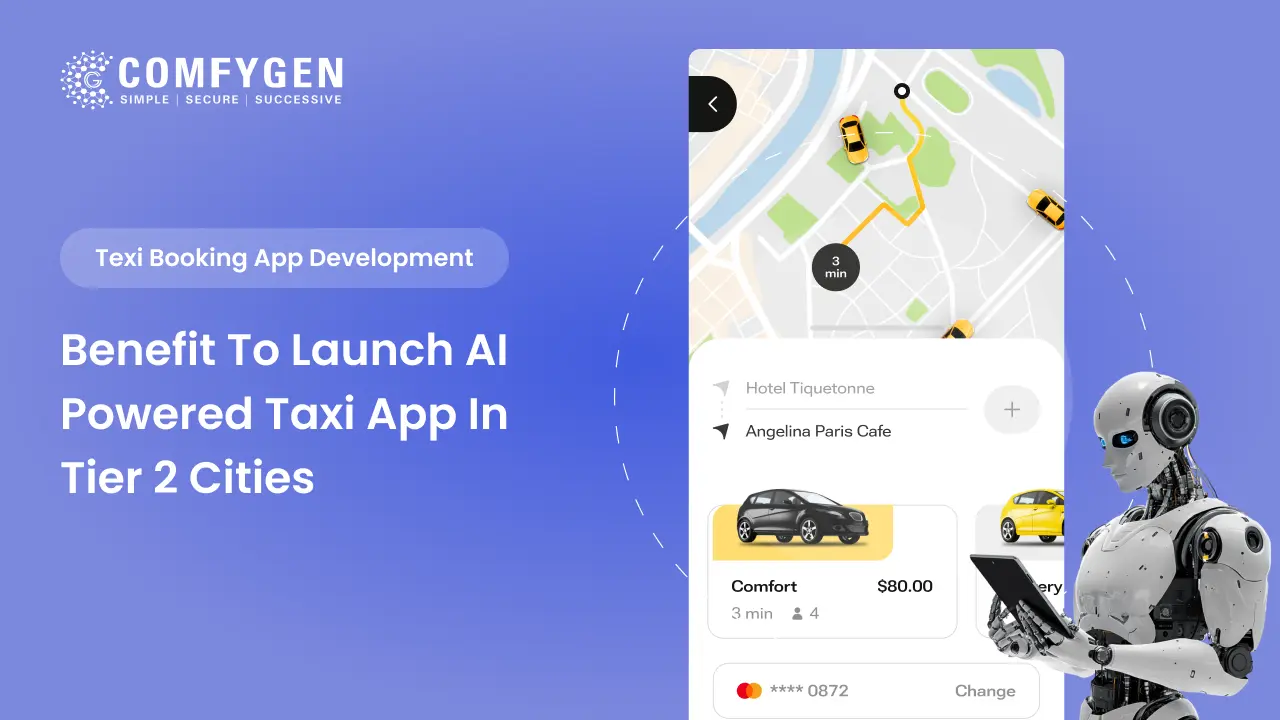
AI taxi app development is the end-to-end process of conceptualizing, engineering, and launching a ride-hailing or on-demand taxi platform that leverages artificial intelligence, machine learning models, and predictive analytics to automate and continuously optimize its core operations. This is a fundamentally different category of product from first-generation taxi apps that simply matched a nearby driver to a requesting passenger on a static map.
In an AI-powered taxi platform, the system learns continuously from operational data — every completed trip, every cancellation, every pricing outcome, and every driver behavior pattern becomes an input that improves the platform’s decision-making over time. The AI manages driver-rider matching, predicts demand fluctuations before they occur, adjusts pricing dynamically to balance supply and demand, and personalizes the experience for each individual rider based on their unique history and preferences. The result is a platform that becomes measurably smarter, more efficient, and more valuable with every passing month of operation.
Why does this matter specifically in 2026? Three converging forces make this year the optimal time to invest in AI taxi app development. First, the cost of enterprise-grade AI infrastructure has dropped dramatically, making sophisticated capabilities accessible to mid-market operators for the first time. Second, riders globally have been conditioned by market leaders to expect intelligent, frictionless experiences — platforms that cannot deliver this are losing users to competitors who can. Third, regulatory frameworks in the EU, US, and major Asian markets are beginning to mandate AI-assisted safety monitoring and reporting for commercial transportation platforms, making AI infrastructure a compliance requirement rather than simply a competitive advantage.
Traditional Taxi App vs. AI-Powered Taxi App: A Direct Comparison
| Capability |
Traditional Taxi App |
AI-Powered Taxi App (2026) |
| Driver Matching |
Closest driver by distance only |
AI-optimized match using ETA, rating, history & preference |
| Pricing Model |
Fixed rate or manual surge |
Dynamic real-time AI surge pricing by zone, time & demand |
| Demand Forecasting |
No forecasting capability |
Predictive ML heatmaps by zone, hour, day & weather |
| Route Optimization |
Standard GPS directions |
AI traffic-aware routing updated in real time |
| Rider Experience |
Generic, one-size-fits-all |
Fully personalized based on individual trip history |
| Fraud Prevention |
Manual review processes |
Real-time AI anomaly detection on every transaction |
| Driver Management |
Manual performance reviews |
Automated AI scorecards with behavioral analytics |
| Business Intelligence |
Monthly PDF reports |
Live AI dashboard with predictive revenue modeling |
| Scalability |
Requires proportional staffing |
AI handles operational complexity asymmetrically |
| Competitive Moat |
Feature parity, easily copied |
Data-driven advantages that compound over time |
Key Features of a Successful AI Taxi App in 2026
The feature architecture of your AI taxi app is the most direct determinant of user retention, driver satisfaction, and investor confidence. A world-class on-demand taxi platform in 2026 operates across three distinct feature layers: the passenger-facing experience, the driver-facing experience, and the business intelligence and operations layer. Each layer must be engineered with equal care — weakness in any one layer creates cascading problems throughout the entire business.
Passenger-Side Features: The Experience That Wins and Retains Riders
-
AI-Powered Smart Booking with Accurate ETA
Instead of static estimates, machine learning analyzes live traffic, driver location, demand trends, and weather to predict ETAs within 60–90 seconds. More accuracy means more trust and fewer abandoned bookings.
-
Dynamic AI Surge Pricing
The system monitors supply and demand zone by zone in real time. Prices rise when demand spikes and adjust downward when supply is high. This keeps the marketplace balanced while maximizing revenue per driver-hour.
-
Intelligent Driver-Rider Matching
Matching goes beyond proximity. The algorithm factors in real traffic routes, ratings history, language preference, vehicle type, and even past ride interactions. Better matches lead to higher ratings and stronger loyalty.
-
Multi-Gateway Payments with AI Fraud Detection
Support for cards, digital wallets, UPI, corporate billing, and crypto ensures flexibility. Behind the scenes, AI analyzes device behavior, transaction patterns, and geolocation signals to block fraud instantly.
-
Advanced Scheduling and Recurring Trips
Riders can schedule trips in advance. The system auto-assigns the best driver closer to pickup time and learns recurring patterns for one-tap rebooking. This increases booking frequency and retention.
-
AI-Powered Safety Suite
Includes live trip sharing, SOS alerts, driver behavior monitoring, route deviation detection, and masked communication. Strong safety systems improve trust, compliance, and first-time rider conversions.
-
AI-Driven Personalization
The app learns rider habits, preferred vehicles, destinations, and booking times. Personalized suggestions and targeted offers increase engagement. Platforms using AI personalization often see 40–60 percent higher monthly retention.
Business and Admin Features: Designed for Investor-Grade Operations
-
AI Demand Forecasting Dashboard
The system analyzes historical trips, weather, local events, and day-of-week trends to predict demand 72 hours in advance by zone. This allows proactive driver positioning, smarter incentives, and better-timed promotions. Operators typically see 15–25 percent higher trip completion rates during peak hours compared to reactive models.
-
Real-Time Fleet Management & GPS Operations Center
A live map shows every active vehicle with trip status, driver details, and ETA. Supervisors can filter by zone, category, or performance tier. Automated alerts flag delays, route deviations, or inactive vehicles. The result is faster intervention and stronger compliance tracking.
-
AI Driver Performance Analytics
Each driver has a real-time scorecard based on acceptance rate, cancellations, ratings, on-time pickups, safe driving behavior, and hourly revenue. This supports fair incentives, early churn prevention, and data-backed performance management at scale.
-
Automated Revenue & Financial Reporting
Daily, weekly, and monthly reports break down revenue by zone, vehicle type, driver cohort, payment method, and promotions. Commissions and payouts run automatically. Corporate invoices are generated without manual effort. Clean financial visibility signals operational maturity to investors.
-
Multi-City Expansion Architecture
The platform is built to scale geographically. New cities can be launched by configuring pricing, compliance, driver pools, and local payment systems—without rebuilding the core system. Growth doesn’t require proportional increases in engineering resources.
-
Corporate & B2B Management Portal
Enterprise clients manage employee travel through a centralized dashboard with spending controls, approval workflows, and consolidated invoicing. Corporate accounts bring higher trip values, recurring revenue, and lower acquisition costs—making B2B a strong profitability lever.
Want to calculate the projected ROI of your AI taxi platform?
Speak with our mobility investment experts — free, no-obligation consultation available today
Start Your Project
Business Benefits of Investing in AI Taxi App Development
Features describe what your platform does. The benefits of taxi app development describe what your business gains. For businesses and investors evaluating an AI taxi app development project, the following seven benefits represent the concrete, measurable returns that a well-executed platform delivers across every dimension of business performance.
Benefit 1: Lower Operational Costs
AI-driven dispatch removes the need for large manual teams. Smart routing cuts fuel use by 12–18 percent. Automated chatbots handle up to 80 percent of routine support queries. For a platform running thousands of trips daily, these efficiencies can recover the AI investment within 18–24 months.
Benefit 2: Smarter Revenue Scaling
Traditional taxi growth increases staffing costs. AI platforms scale differently. The same matching system can handle 100 rides or 10,000 with minimal added overhead. As trip volume grows, cost per ride drops and margins improve. That’s real leverage.
Benefit 3: Real-Time Data Intelligence
Every trip generates insight. AI turns ride data into clear decisions—where demand is rising, which drivers perform best, what pricing works, and which marketing channels bring high-value riders. Decisions shift from guesswork to measurable action.
Benefit 4: Higher Retention and Lifetime Value
Personalized booking suggestions, smart pricing offers, and tailored rewards increase loyalty. Platforms using AI-driven personalization consistently see 40–60 percent higher monthly retention compared to generic apps. Retention drives valuation.
Benefit 5: Strong Competitive Moat
AI platforms improve with time. More trips mean better forecasting, smarter matching, and stronger fraud detection. Competitors can copy features, but they cannot instantly copy years of data. That data becomes your moat.
Benefit 6: Multiple Revenue Streams
Beyond trip commissions, AI taxi apps unlock surge pricing, subscription plans, in-app ads, corporate accounts, premium ride categories, and white-label licensing. Diversified revenue strengthens stability and increases enterprise value.
Benefit 7: Built for the Future
AI-native architecture supports regulatory compliance, advanced safety monitoring, and eventual autonomous vehicle integration. What you build today becomes the foundation for tomorrow’s mobility ecosystem.
AI Taxi App Development Cost in 2026: Complete Breakdown
Transparency in cost estimation is a prerequisite for sound investment decision-making. AI taxi app development cost is not a single number — it is a range determined by the interaction of several well-defined variables. Understanding these variables empowers you to scope your project correctly, evaluate development proposals accurately, and budget with confidence. Below is the most detailed cost breakdown available for AI taxi app development projects in 2026.
AI Taxi App Development Cost by Investment Tier (2026)
| Investment Tier |
Estimated Cost Range |
Timeline |
Ideal For |
| MVP / Validation Build |
$15,000 – $30,000 |
3–5 months |
First-time operators, single-city pilot, market validation |
| Growth-Stage Platform |
$30,000 – $70,000 |
5–8 months |
Funded operators, city-scale commercial launch |
| Investor-Ready AI Platform |
$70,000 – $150,000 |
8–14 months |
Multi-city operators, VC-backed ventures |
| Enterprise AI Suite |
$150,000 – $300,000+ |
12–18 months |
National platforms, white-label licensing, PE targets |
Budget Allocation by Development Phase
| Phase |
Budget Share |
Deliverables |
| Discovery & Technical Architecture |
8–12% |
System design, API specs, data architecture, project plan |
| UI/UX Design |
10–15% |
All app screens, admin dashboard, driver app, design system |
| Frontend Development |
20–25% |
Passenger app (iOS/Android), driver app, admin web panel |
| Backend & AI/ML Engineering |
30–40% |
Core APIs, databases, AI models, all third-party integrations |
| Quality Assurance & Testing |
10–15% |
Functional, load, security, regression, and UAT testing |
| Deployment & Infrastructure Setup |
5–8% |
Cloud configuration, CI/CD pipeline, production launch |
| Year 1 Post-Launch Support |
15–20% annually |
Bug resolution, feature iterations, AI model retraining |
Technology Stack for AI Taxi App Development in 2026
For investors and business owners evaluating AI taxi app development partners, understanding the technology architecture underpinning the platform is essential for assessing both the quality of the proposed solution and the long-term scalability of the investment. The following technology stack represents the modern, battle-tested architecture that powers world-class ride-hailing platforms in 2026 — built for performance, security, and horizontal scalability from the ground up.
| Architecture Layer |
Technologies / Platforms |
Business Rationale |
| Mobile Apps (Passenger & Driver) |
Flutter 3.x / React Native |
Single codebase for iOS & Android — 30% cost reduction vs. native builds |
| Web Admin Panel |
React.js + Next.js |
Fast, SEO-capable, real-time dashboard rendering |
| Backend API Layer |
Node.js (primary) + Python (AI services) |
Node handles high-concurrency real-time operations; Python powers ML |
| AI Demand Forecasting |
TensorFlow / PyTorch + custom training pipeline |
Trains on your operational data to produce platform-specific predictions |
| Personalization Engine |
Collaborative filtering + OpenAI API integration |
Hybrid ML models that improve accuracy with every additional user trip |
| Mapping & Real-Time Routing |
Google Maps Platform / HERE Maps API |
Industry-standard accuracy with live traffic data and route optimization |
| Payment Processing |
Stripe + PayPal + Razorpay (region-dependent) |
Global payment coverage with built-in PCI DSS Level 1 compliance |
| Real-Time Communication |
Socket.io + Firebase Realtime Database |
Sub-100ms latency for live driver location updates and in-app messaging |
| Primary Database |
PostgreSQL (transactional) + MongoDB (user profiles) |
Relational integrity for financial data; document flexibility for behavioral data |
| Search & Analytics |
Elasticsearch + Apache Kafka |
Sub-second search across millions of records; real-time event streaming |
| Cloud Infrastructure |
AWS (primary) / Google Cloud (ML workloads) |
Auto-scaling compute, 99.99% SLA uptime, global CDN for low-latency delivery |
| Security Layer |
OAuth 2.0 + JWT + AES-256 encryption |
Enterprise-grade authentication, token management, and data encryption at rest |
| Monitoring & Alerting |
Datadog / New Relic + PagerDuty integration |
Real-time performance monitoring with automated incident escalation |
How to Launch Your AI Taxi App Development Project: A 5-Step Roadmap
For businesses and investors who have completed their evaluation and are ready to move from analysis to execution, the following five-step roadmap provides a clear, actionable framework for launching your AI taxi app development project with confidence and strategic clarity.
Step 1: Define Your Business Model
Decide how you create and capture value.
-
Aggregator model connects independent drivers and earns per-trip commissions. Fast to launch, asset-light, highly scalable.
-
Fleet owner model operates company vehicles. Full control, but higher capital and operational costs.
-
SaaS licensing model builds and licenses the platform to operators. Recurring revenue with minimal operational risk.
Your choice shapes everything—capital needs, tech architecture, and growth strategy.
Step 2: Research Your Target Market
Study competitors, pricing, driver supply, customer pain points, and gaps in service. Don’t try to copy dominant players like Uber or Lyft in saturated markets. Focus on underserved niches—corporate mobility, accessible transport, premium travel, or last-mile connectivity. Precision beats imitation.
Step 3: Build a Disciplined MVP
List every desired feature, then prioritize by business impact and technical complexity.
Your MVP should include booking, real-time tracking, AI driver matching, dynamic pricing, secure payments, core safety tools, and an admin dashboard. Advanced personalization, forecasting, and multi-city tools can follow after real user feedback.
Step 4: Choose the Right Development Partner
This decision determines success or failure. Look for:
-
Proven ride-hailing platform experience
-
In-house AI engineering expertise
-
Verifiable client references
-
Strong security and compliance standards
A weak partner costs more in rework than careful selection ever will.
Step 5: Launch, Measure, Improve
Launch is the starting line. In the first 90 days, focus on data quality. Track daily metrics—trip completion rate, acceptance rate, revenue per trip, retention, and ratings. Use real data to guide updates. The platforms that win are the ones that build tight feedback loops and improve continuously.
Conclusion
AI taxi app development in 2026 is no longer an experimental idea—it is a proven way to build a scalable and competitive mobility business. By partnering with Comfygen Technologies, companies can leverage AI-powered features such as smart route optimization, demand prediction, dynamic pricing, and automation to improve efficiency, reduce costs, and enhance customer experience. This enables startups, fleet owners, and investors to launch future-ready ride-hailing platforms faster and stay ahead in a rapidly evolving market.
With the right strategy, technology architecture, and development partner like Comfygen, businesses can create long-term competitive advantages driven by real-time data and continuous AI learning. Whether you aim to transform an existing transport operation or build a next-generation mobility platform, Comfygen provides the expertise and innovation needed to shape the future of urban transportation.
What is AI taxi app development?
AI taxi app development uses artificial intelligence to enable smart ride matching, demand prediction, dynamic pricing, and real-time route optimization.
Why is AI important for taxi apps in 2026?
AI helps taxi apps improve efficiency, reduce cancellations, optimize fleet usage, enhance safety, and deliver better user experiences in a competitive market.
What features does an AI-powered taxi app include?
Key features include intelligent driver-passenger matching, live traffic-based routing, predictive demand forecasting, dynamic fare calculation, and fraud detection.
Can AI taxi apps scale for high user traffic?
Yes. AI taxi apps built on cloud-based architecture are designed to handle large volumes of real-time data and high user demand smoothly.
Is AI taxi app development secure?
AI taxi apps follow enterprise-grade security practices, including data encryption, secure payments, user verification, and regulatory compliance.