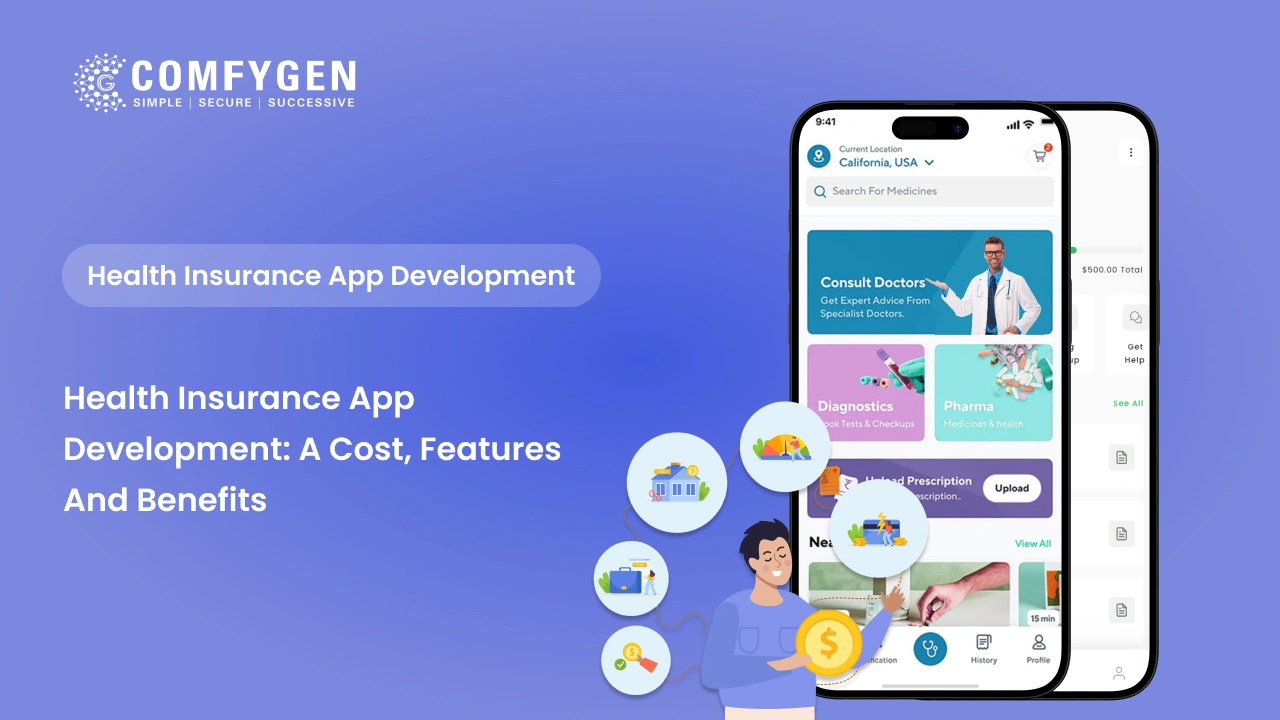





Health insurance is no longer being handled through paperwork and long customer care calls. The users want to have immediate access to policies, claims, renewal, and support on their smartphones. This has caused health insurance app development to become the priority of insurers, startups, and digital health platforms that want to remain relevant and competitive.
An effective health insurance application makes the complicated insurance tasks easy since it consolidates policy management, claim tracking, cashless hospital search, and communication with the customers into a single secure platform. Simultaneously, it assists insurance companies to save on operational expenses, enhance consumer confidence, and have more effective control over data and compliance.
This guide will deconstruct all you need to know about health insurance app development, such as the cost of development, features required, and actual benefits to the business. This overview will inform you of the practical decisions to make before investing, whether you are planning a new insurance platform or upgrading an existing system.
What Is a Health Insurance App?
A health insurance app is a mobile or web-based application that allows users to manage their health insurance policies digitally. Instead of depending on paperwork or customer support calls, users can view policy details, renew plans, submit and track claims, find network hospitals, and access support directly from the app.
For insurance providers, a health insurance app acts as a centralized platform to manage customers, policies, claims, and payments in real time. It helps automate routine operations, reduce manual errors, and improve transparency across the insurance lifecycle.
What this really means is better convenience for policyholders and higher efficiency for insurers. A well-designed health insurance app bridges the gap between complex insurance systems and everyday users by making insurance simple, accessible, and easy to manage from a single digital interface.
Market Trends & Growth of Health Insurance Apps
Health insurance apps are experiencing rapid growth due to digital adoption, AI integration, and rising demand for convenient claims processing and personalized services. The global market is projected to show strong growth, with significant opportunities in regions such as India and North America. Key trends include mobile experience improvements and telehealth features.
Market Size & Growth
The insurance mobile apps market, including health segments, is projected to reach USD 18.13 billion in 2025, growing at a CAGR of 20.01% through 2033. Health insurance platforms alone were valued at USD 3.36 billion in 2025, with an 8% CAGR to 2033, driven by telehealth and efficient claims management. Healthcare insurance mobile apps are forecasted for a 45.4% CAGR through 2030, led by North America.
Key Trends
Insurers are enhancing mobile apps with AI chatbots, personalized recommendations, and pharmacy integration, boosting scores from 57 to 63 out of 100 in 2025 benchmarks. Trends emphasize self-service portals, transparent coverage info, and real-time provider matching for better member satisfaction. Hyper-personalization via AI, edge computing for monitoring, and federated learning for privacy are shaping 2026 developments.
Regional Insights
In India, digital health insurance platforms reached INR 155 billion, fueled by mobile apps, AI underwriting, and government schemes like Ayushman Bharat. Canada’s health insurance market hits USD 73.60 billion in 2025 at 10.55% CAGR, with apps offering gamified wellness and telehealth amid rising digital platforms. North America leads mHealth adoption due to infrastructure, while Asia-Pacific grows fastest via telemedicine and insurtech.
Driving Factors
Smartphone penetration, the rise of chronic diseases, and post-COVID awareness are accelerating app usage for claims, wellness tracking, and policy management. Regulatory support and tech like blockchain for data security further propel expansion, especially in underserved areas.
Types of Health Insurance Apps
Health insurance applications are designed to serve different user groups and business models within the insurance ecosystem. Understanding the types of health insurance apps helps insurers and startups choose the right solution based on their target audience and operational goals. With custom health insurance app development, businesses can tailor features, workflows, and integrations to meet specific market needs.
1. Individual Health Insurance Apps
Individual health insurance apps are built for single policyholders who want to purchase and manage their own health coverage. These apps allow users to compare insurance plans, calculate premiums, buy or renew policies, upload documents, and track claims in real time. By offering personalized policy recommendations, digital policy storage, and instant notifications, individual insurance apps enhance customer convenience and engagement while reducing dependency on agents.
2. Family & Group Insurance Apps
Family and group health insurance apps are designed to manage multiple members under a single policy. These apps enable users to add or remove family members, view coverage details for each insured person, and track claims separately. Group insurance apps are also widely used for associations or small groups, helping insurers simplify policy administration and improve transparency across all covered members.
3. Corporate / Employer Insurance Apps
Corporate or employer health insurance apps cater to organizations offering health coverage as an employee benefit. These platforms allow HR teams to manage employee enrollment, policy renewals, and claims efficiently. Employees can access policy details, submit claims, and find network hospitals, while employers gain insights through analytics dashboards. Such apps improve employee satisfaction and streamline corporate insurance management.
4. Agent & Broker Management Apps
Agent and broker management apps are designed for insurance intermediaries who handle policy sales and customer relationships. These apps help agents onboard customers, manage leads, track commissions, and assist with claims processing. By digitizing agent workflows, insurers can increase sales efficiency, maintain compliance, and strengthen their distribution network.
5. Hospital & TPA Integration Apps
Hospital and Third-Party Administrator (TPA) integration apps connect insurers directly with healthcare providers. These apps facilitate cashless claim processing, real-time treatment updates, and faster approvals. Seamless integration with hospital systems improves claim accuracy, reduces fraud, and ensures smooth coordination between insurers, hospitals, and TPAs—making them a critical component of modern digital insurance solutions.
Build a secure, scalable health insurance app with Comfygen
and turn complex insurance operations into a smooth digital experience.
Must-Have Features of a Health Insurance App
A successful health insurance application must combine usability, security, and intelligent automation to meet the expectations of modern users and insurers. Well-designed health insurance app features improve customer satisfaction, streamline claims processing, and enhance operational efficiency. Below are the essential insurance mobile app functionalities categorized by user panel, admin panel, and advanced capabilities.
1. User Panel Features
The user panel is the most visible part of a health insurance app and directly impacts customer experience and retention. It should be intuitive, fast, and secure.
- Secure user registration & profile management
- Policy purchase & renewal via app
- Insurance plan comparison
- Instant premium calculator
- Digital policy documents
- Real-time claim tracking
- Cashless hospital locator
- Push notifications & alerts
2. Admin Panel Features
The admin panel is the backbone of insurance app operations, enabling insurers to manage users, policies, and claims efficiently.
- Faster claims approval workflow
- CMS for easy content updates
- Real-time analytics & reporting
- Fraud detection & risk control
3. Advanced Features (High-Value SEO)
Advanced features turn standard insurance apps into intelligent, AI-driven platforms. AI-based policy recommendations study user profiles, medical history, and behavior to suggest the most suitable health insurance plans.
- AI-based policy recommendations
- Chatbots for 24/7 support
- OCR document upload
- Predictive analytics
- Blockchain-based claims
- Wearable & health data integration
Health Insurance App Development Cost
The health insurance app development cost depends on multiple factors such as app complexity, feature set, technology stack, and compliance requirements. Since health insurance apps handle sensitive medical and financial data, they require advanced security, scalable architecture, and regulatory compliance—making their development cost higher than standard mobile applications.
On average, the cost to build a health insurance app can range from $15,000 to $120,000+, depending on business goals and technical requirements. Below is a clear cost breakdown to help insurers and startups plan their budget effectively.
Cost Breakdown by Health Insurance App Development Type
- Basic Health Insurance App ($15,000 – $30,000)
Suitable for startups or MVPs, a basic app includes essential features such as user registration, policy listing, premium calculator, digital policy access, and basic claim tracking. It supports limited integrations and minimal customization. - Mid-Level Health Insurance App ($30,000 – $60,000)
A mid-level app includes advanced user features, admin dashboards, policy comparison, payment gateway integration, push notifications, and third-party API integrations. This version is ideal for growing insurers aiming for better automation and user experience. - Advanced Enterprise Health Insurance App ($60,000 – $120,000+)
Enterprise-grade apps are built for large insurance companies and include AI-driven recommendations, fraud detection, OCR-based document processing, real-time analytics, blockchain integration, and high-level security compliance. These apps support multiple user roles, large data volumes, and global scalability.
Factors Affecting Health Insurance App Development Cost
Several variables influence the final development cost:
- App complexity & features: More advanced features, such as AI, chatbots, and predictive analytics, increase development time and cost.
- Platform selection: Developing for Android, iOS, Web, or cross-platform impacts pricing and timelines.
- UI/UX design: Custom, user-centric designs with accessibility standards add to overall cost but improve engagement.
- Third-party API integrations: Payment gateways, hospital databases, TPAs, CRM systems, and analytics tools affect cost.
- Security & compliance requirements: HIPAA, GDPR, IRDAI compliance, data encryption, and secure authentication significantly influence pricing.
- Development team location: Hiring developers in India is more cost-effective compared to the USA or Europe, while still delivering high-quality solutions.
| App Type | Estimated Cost (USD) | Best For |
| Basic Health Insurance App | $15,000 – $30,000 | Startups, MVPs |
| Mid-Level Health Insurance App | $30,000 – $60,000 | Growing insurance businesses |
| Advanced Enterprise Health Insurance App | $60,000 – $120,000+ | Large insurers, enterprises |
Health Insurance App Development Process
The health insurance mobile app development process follows a structured, step-by-step approach to ensure security, scalability, and regulatory compliance. Understanding how to develop a health insurance app helps insurers and startups plan timelines, reduce risks, and deliver a high-quality digital insurance solution.
- Requirement Analysis & Market Research:
Define business goals, target users, core features, and regulatory requirements to align the app with market needs. - UI/UX Design:
Create simple, user-friendly designs and prototypes to ensure smooth navigation and better user engagement. - App Development (Frontend & Backend):
Build responsive interfaces and secure backend systems for policy management, claims processing, and admin control. - API & Third-Party Integrations:
Integrate payment gateways, hospital systems, TPAs, and notification services for seamless data flow. - Testing & Quality Assurance:
Test the app for functionality, performance, security, and compliance to ensure a bug-free experience. - Deployment & App Store Launch:
Deploy the app on cloud servers and publish it on app stores, following platform guidelines. - Maintenance & Updates:
Provide regular updates, security patches, and performance improvements to keep the app reliable and future-ready.
Benefits of Health Insurance App Development
The benefits of health insurance apps extend to both policyholders and insurance providers by simplifying processes, improving transparency, and enabling faster digital interactions. With the growing demand for mobile-first services, the advantages of insurance mobile apps make them an essential part of modern insurance ecosystems.
Benefits for Users
- Easy policy access anytime:
Health insurance apps allow users to access policy documents, coverage details, and payment information anytime, anywhere, eliminating the need for physical paperwork or agent dependency. - Faster claims processing:
Digital claim submission, document upload, and real-time status tracking significantly reduce claim settlement time, providing users with quicker financial support during medical emergencies. - Transparent coverage details:
Users can clearly view inclusions, exclusions, network hospitals, and claim limits within the app, building trust and helping them make informed decisions. - Improved customer experience:
Features like instant notifications, chat support, premium calculators, and intuitive navigation create a smooth and hassle-free insurance experience.
Benefits for Insurance Companies
- Reduced operational costs:
Automation of policy management, claims processing, and customer support minimizes manual work and lowers administrative expenses. - Higher customer retention:
Personalized offers, timely reminders, and seamless digital services improve customer satisfaction and long-term loyalty. - Faster policy sales:
In-app policy comparison, instant payments, and digital onboarding accelerate the sales cycle and increase conversion rates. - Real-time data insights:
Advanced analytics provide valuable insights into customer behavior, claim patterns, and revenue trends, supporting data-driven decision-making. - Scalable digital infrastructure:
Health insurance apps are built on scalable cloud-based systems, enabling insurers to expand services, onboard more users, and adapt to future market demands efficiently.
How to Choose the Right Health Insurance App Development Company
Choosing the right health insurance app development company is essential to building a secure, scalable, and compliant solution. At Comfygen, we follow a structured approach to deliver reliable and future-ready insurance applications tailored to business needs.
Industry experience is critical, as insurance apps involve complex workflows like policy management and claims processing. Comfygen’s experienced insurance app developers understand these challenges and deliver solutions aligned with industry standards.
Strong compliance knowledge ensures the app meets regulations such as HIPAA, GDPR, and IRDAI. Comfygen prioritizes data security, privacy, and regulatory compliance across all development stages.
A proven portfolio and case studies reflect the company’s capability to deliver real-world insurance solutions. Comfygen’s track record demonstrates expertise in building scalable and high-performance apps.
With deep technology stack expertise and reliable post-launch support, Comfygen ensures your health insurance app remains secure, updated, and competitive in the long run.
Conclusion
Health insurance app development has become a powerful digital solution for insurers, startups, and enterprises looking to improve customer experience, streamline claims, and scale operations efficiently. With features like real-time policy access, faster claims processing, advanced security, and AI-driven insights, health insurance apps create long-term value for both users and insurance providers.
At Comfygen, we specialize in delivering secure, scalable, and custom health insurance app development solutions tailored to your business goals. Whether you want to modernize existing insurance systems or build a health insurance app from scratch, our expert team ensures compliance, performance, and future-ready technology.
FAQs
How much does it cost to build a health insurance app?
What features should a health insurance app have?
How long does it take to develop a health insurance app?
Are health insurance apps secure?
Which technologies are used in health insurance apps?

Mr. Saddam Husen, (CTO)
Mr. Saddam Husen, CTO at Comfygen, is a renowned Blockchain expert and IT consultant with extensive experience in blockchain development, crypto wallets, DeFi, ICOs, and smart contracts. Passionate about digital transformation, he helps businesses harness blockchain technology’s potential, driving innovation and enhancing IT infrastructure for global success.