




The mobile app market reached $330 billion in 2025 and is on track to cross $377 billion in 2026. Over 320 billion app downloads are expected this year. Every one of those downloads represents a business that made a smart technical decision early — starting with who they chose to build their product.
Most app projects that fail do not fail because the idea was bad. They fail because the wrong people built it. Poor architecture decisions made in week one compound into costly rewrites six months later. Weak QA processes mean bugs that drive users away. Vague contracts lead to budget overruns and missed deadlines.
This guide covers every part of the process to hire mobile app developers the right way in 2026 from understanding what type of developer you need, to evaluating portfolios, negotiating contracts, managing costs, and avoiding the mistakes that derail most projects.
Why the Mobile App Market Makes This Decision Critical
The numbers tell a clear story. The global mobile application market is projected to grow from $330 billion in 2026 to over $1.2 trillion by 2034, at a compound annual growth rate of 14.3%. Total app downloads worldwide are forecast to exceed 320 billion in 2026. Consumer spending across the App Store and Google Play hit $167 billion in 2025, up more than 10% year over year.
India alone is the world’s largest app download market, driven by 783 million+ smartphone users and 190% app install growth rate. Globally, users spend an average of 4 hours and 37 minutes per day on mobile apps.
What this means practically: the window to establish a mobile presence before your competitors is not unlimited. Every month you delay launching a well-built app is a month a competitor fills that space instead. That urgency makes who you hire mobile app developers from one of the highest-stakes decisions your business makes this year.
Benefits of Hiring Mobile App Developers vs. Building In-House
Many founders default to assuming in-house is safer. It rarely is. Here is what you actually get when you hire mobile app developers in India from a professional team.
Faster Time to Market
Professional teams have built apps before. They know where the obstacles are. They have pre-built components, established workflows, and no learning curve on the tools they use daily. A dedicated team can cut development time by 30 to 40% compared to assembling a new in-house team from scratch.
Access to a Full Skill Set From Day One
A single hire only gives you one specialization. A professional mobile app development team brings iOS developers, Android developers, UX designers, QA engineers, and a project manager — all coordinated, all experienced.
Scalability Without HR Overhead
Need to add a backend developer mid-project? A development partner scales the team without the recruiting delays. Need to reduce scope? You adjust the engagement, not manage a layoff.
Risk Management From Prior Experience
Teams that have shipped dozens of apps have already encountered the problems you have not thought of yet. They know which third-party APIs break in production, which architecture decisions create bottlenecks at scale, and which compliance requirements apply to your industry.
Focus on Your Core Business
When you outsource app development, your team focuses on product decisions, marketing, and business growth. The technical execution stays with people whose only job is to do it well.
Quality Assurance Built In
Professional teams test before they ship. Functional testing, performance testing, security audits — these are standard in a proper development engagement, not afterthoughts. Recall that 88% of users abandon an app after encountering bugs in their first session. One broken launch can permanently damage your brand.
Types of Mobile App Developers You Can Hire
Not every developer who says “mobile” means the same thing. You need to know which type fits your project before you start sourcing.
Native App Developers
Native developers build for a single platform using its preferred language and tools. iOS app development uses Swift (and Objective-C for legacy codebases). Android app development uses Kotlin (with Java for older projects). Native apps offer the best performance, deepest access to device features, and the most polished platform-specific user experience. If your app is performance-intensive — real-time video, AR, complex animations — or if your users are concentrated on one platform, native is the right call.
Cross-Platform App Developers
Cross-platform developers write one codebase that runs on both iOS and Android. React Native development uses JavaScript, which means the talent pool is large and adoption is proven at scale by companies like Meta, Shopify, and Airbnb. Flutter development uses Dart and produces fast, visually consistent apps on both platforms. Cross-platform typically costs 20 to 40% less than building two separate native apps and covers the majority of business use cases well.
Hybrid App Developers
Hybrid apps wrap web technologies (HTML, CSS, JavaScript) inside a native shell. Frameworks like Ionic and Cordova fall here. Development is fast and inexpensive initially, but performance in complex or animation-heavy apps tends to fall short of native and cross-platform options.
Full-Stack App Developers
Full-stack developers handle both the mobile front-end and the server-side back-end. They work across the mobile interface, APIs, databases, and server logic. For a startup that needs an MVP shipped fast with a lean team, one or two strong full-stack developers can cover a lot of ground efficiently. As the product scales, specialized developers typically take over individual layers.
Three Hiring Models: In-House, Freelance, Dedicated Team
How you structure the engagement matters as much as who you hire.
In-House Development Team
Building an internal team gives you maximum control over culture, IP, and institutional knowledge. But it comes at a cost. A US-based senior mobile developer earns $130,000 to $170,000 annually in base salary. Add benefits, equipment, office space, and management overhead, and the fully loaded cost runs 1.3x to 1.6x base salary. Recruiting, onboarding, and ramping up a team of four to six people takes three to six months before a single line of production code ships.
In-house is the right model when your app is the business — when it requires continuous proprietary innovation and when you have the budget and time to invest in a permanent team.
Freelance Developers
Freelancers work well for contained, well-defined tasks: fixing a specific bug, building a single feature, creating a UI prototype. Platforms like Upwork and Toptal surface candidates quickly, and rates range from $30 to $150 per hour depending on experience and location.
The risk is accountability. Freelancers work across multiple clients simultaneously. Mid-project departures, communication gaps, and inconsistent availability are common. For anything involving a full product build, relying on freelancers introduces more coordination risk than most teams can absorb.
Dedicated Development Team (Recommended for Most Projects)
A dedicated development team is a structured, professional unit — developers, QA, design, and project management — working exclusively on your project with contractual accountability. You get the full benefit of specialization without the overhead of building a permanent team.
When you hire mobile app developers through an Indian agency like Comfygen, the blended team rate runs $25 to $60 per hour — compared to $100 to $200 per hour for equivalent US teams. That difference represents a 60 to 70% cost reduction, not a quality compromise. India graduates over 1.5 million engineers annually, and established Indian agencies serve Fortune 500 clients and US-listed companies.
This model scales with your project. You can expand the team during heavy development phases and reduce it during maintenance periods without any HR complexity.
Build Your App with the Right Development Team
Hiring mobile app developers doesn’t have to be complicated. Our experts help you find the perfect developers based on your project goals, budget, and timeline.
Schedule a Free Consultation
Where to Find Mobile App Developers
Clutch.co and GoodFirms
Clutch.co and GoodFirms are the most reliable starting points for finding agencies. Both platforms list companies with verified client reviews, published ratings, and filtered search by technology stack, location, and project size. Every review on Clutch is verified through a reference call process, which makes it meaningfully more trustworthy than self-reported portfolios.
GitHub
GitHub shows you real code from individual developers. Look at their repositories, read their commit history, and check how they respond to issues raised by other contributors. A developer who writes clean, documented code on open-source projects typically applies the same standards to client work.
LinkedIn is useful for background verification. Review work history, check endorsements from specific technical skills, and look at what technical content they engage with. Developers who actively participate in technical discussions are typically more current on their craft.
Toptal and Lemon.io
Toptal and Lemon.io pre-screen developers and have higher quality floors than raw freelance platforms. Rates are higher as a result, but the vetting reduces your evaluation burden significantly.
Referrals
Referrals remain the fastest path to a trustworthy hire. If you know founders or CTOs who have shipped mobile apps, ask directly who built them and whether they would use them again.
Essential Technical Skills to Evaluate
When you set out to hire mobile app developers, a job title on a resume is not enough. These are the specific competencies to verify.
Platform-Specific Languages
Swift for iOS, Kotlin for Android. If hiring for cross-platform, JavaScript fluency for React Native or Dart proficiency for Flutter. Ask candidates to walk through a recent project and explain their language choices — developers who cannot articulate why they used a particular approach are often less skilled than they appear.
Back-End and API Integration
Production apps connect to servers. Look for familiarity with RESTful and GraphQL APIs, server-side languages like Python development or Node.js development, and databases — SQL (PostgreSQL, MySQL) and NoSQL (MongoDB, Firebase). A developer who only handles the front-end mobile layer creates bottlenecks for every feature that touches a server.
Architecture Patterns
Mobile architecture patterns — MVC, MVVM, MVP, Clean Architecture — are not academic. They determine whether your codebase is maintainable in 12 months or a rewrite-in-progress. Ask candidates which pattern they prefer and why, and have them describe how they would structure a specific feature. Vague answers here are a warning sign.
Security Practices
Data encryption at rest and in transit, secure token storage, certificate pinning, proper authentication flows — these are table stakes for any production app in 2026. Ask specifically: how do you store user authentication tokens on iOS? What approach do you take to prevent man-in-the-middle attacks? Concrete answers show real experience.
UI/UX Implementation
Developers do not need to be designers, but they need to implement designs accurately. Understanding of UI/UX design principles, accessibility requirements, touch target sizing, and responsive layout across screen sizes separates developers who ship polished products from those who ship technically functional but rough ones.
Testing and QA
Look for unit testing, integration testing, and UI testing experience. Platform-specific tools include XCTest and Xcode Instruments for iOS, and JUnit and Espresso for Android. A developer who does not write tests is transferring QA risk to you.
CI/CD Familiarity
Continuous integration and deployment tools (Bitrise, Fastlane, GitHub Actions) allow teams to automate testing and app store submissions. Developers familiar with these pipelines ship faster and break production less frequently.
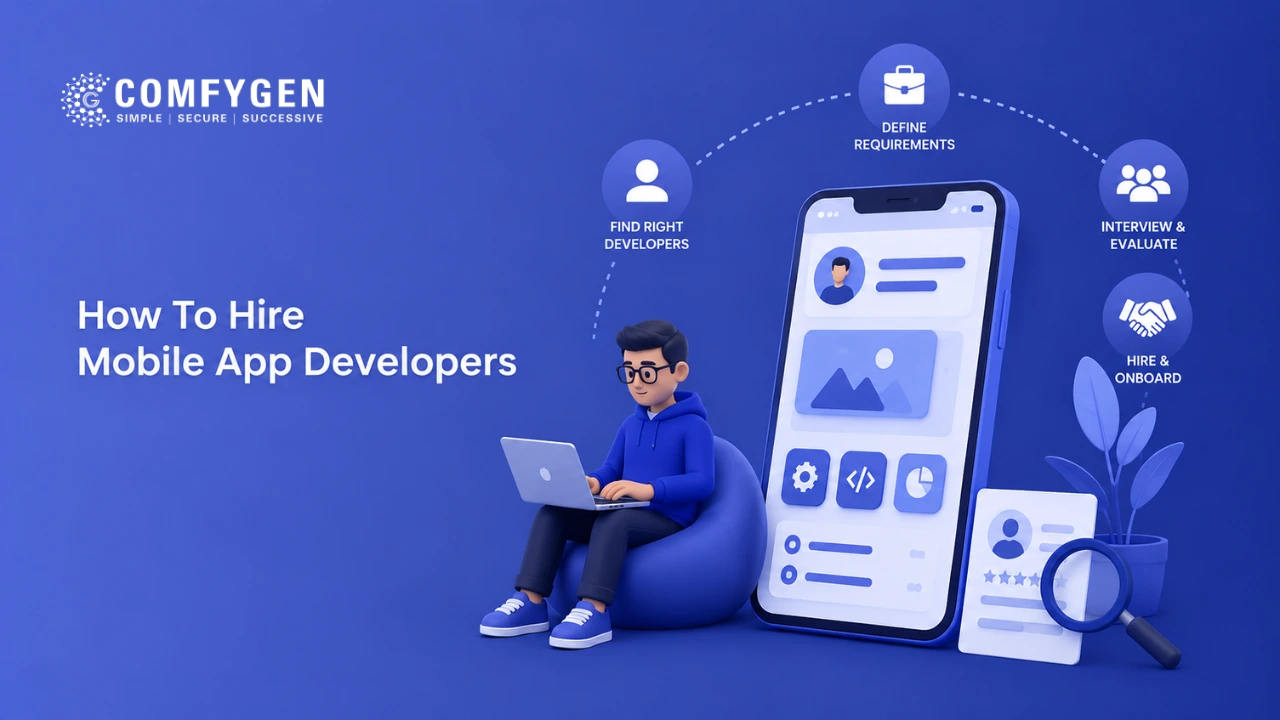
Step-by-Step Process to Hire Mobile App Developers
Step 1: Document Your Project Before Any Conversations
Write a clear project brief before approaching any developer or agency. Include target platform (iOS, Android, or both), core user flows, list of features, third-party integrations required, any performance or compliance requirements, and expected timeline. Developers who receive a vague brief give you a vague quote. A well-documented scope produces accurate proposals and becomes your benchmark for evaluating work quality throughout the engagement.
Step 2: Choose Your Hiring Model
Decide between in-house, freelance, or dedicated team based on your budget, timeline, and how central ongoing development is to your business. If you are shipping a product to market, a dedicated team from a professional agency almost always produces better outcomes than assembling freelancers. If you need a startup app built fast and cost-effectively, a dedicated team at Indian rates gives you the best combination of quality, speed, and budget.
Step 3: Source Candidates from Verified Channels
Use Clutch.co or GoodFirms for agencies. Use GitHub or referrals for individual developers. Prepare a shortlist of three to five candidates who have delivered relevant prior work. More than five makes the evaluation process unmanageable; fewer than three limits your comparison data.
Step 4: Review Portfolios Critically
Download and test live apps. Request client references — not just names, but actual contact information. Ask references what went wrong on the project and how the team handled it. Any vendor who claims a perfect track record with zero issues is not being honest with you.
Step 5: Run a Technical Assessment
For individual developers, a small paid coding task is the most reliable signal of real skill. Assign a well-scoped problem — building a simple feature, debugging a provided codebase, or reviewing an architecture document. For agencies, request their technical documentation or architecture diagrams from a past project. How they think structurally tells you more than any interview answer.
Step 6: Conduct Structured Interviews
Cover both technical and process questions. Ask: how would you architect a specific feature in my app? What architecture pattern would you use and why? How do you handle requirement changes mid-sprint? What is the last production bug you caught, and how did you catch it? Strong candidates give specific, example-driven answers. Weak candidates answer in generalities.
Step 7: Check References
Contact at least two references per shortlisted agency or developer. Ask specifically: what was the biggest challenge on this project, and how did the team respond? Would you hire them again, and for what type of work? Listen for concrete detail — vague positive answers are often polite non-endorsements.
Step 8: Negotiate and Formalize the Contract
Before signing, confirm: complete IP ownership of all code produced for your project, a milestone-based payment schedule tied to deliverables not time elapsed, a defined process for scope changes with associated cost implications, post-launch support obligations and their duration, and confidentiality terms. Never start development on a verbal agreement or a contract that lacks milestone-based payment triggers.
How Much Does It Cost to Hire Mobile App Developers in 2026?
Cost depends on four variables: the developer’s location, their experience level, the hiring model you choose, and the complexity of your project. Here are current 2026 benchmarks.
Hourly Rates by Region:
| Region | Hourly Rate (USD) | Typical Project Budget |
|---|---|---|
| USA / Canada | $100 – $200 | $50,000 – $300,000+ |
| Western Europe | $80 – $150 | $40,000 – $200,000 |
| Eastern Europe | $50 – $100 | $25,000 – $120,000 |
| India | $20 – $60 | $10,000 – $80,000 |
| Southeast Asia | $20 – $50 | $10,000 – $70,000 |
Hourly Rates in India by Experience Level:
| Experience Level | Hourly Rate (USD) |
|---|---|
| Junior Developer (0–2 years) | $15 – $25 |
| Mid-Level Developer (3–5 years) | $25 – $40 |
| Senior Developer (5+ years) | $40 – $60 |
| Blended Agency Rate (full team) | $25 – $60 |
By App Complexity:
| App Type | Estimated Cost |
|---|---|
| Simple app (3–5 screens, basic features) | $10,000 – $30,000 |
| Mid-complexity (10–20 screens, APIs, user accounts) | $30,000 – $80,000 |
| Complex app (fintech, healthcare, real-time features, multi-role) | $80,000 – $200,000+ |
One number most clients underestimate: post-launch maintenance runs 15 to 25% of initial development cost annually. A $50,000 app costs $7,500 to $12,500 per year to maintain with OS updates, security patches, and compatibility fixes. Budget for this before your first sprint begins.
Indian agencies deliver 60 to 70% lower costs than equivalent US teams with no compromise in output quality for established firms. India produces 1.5 million engineering graduates per year, and the country’s top-tier agencies routinely serve Fortune 500 and Silicon Valley clients.
Don’t Let the Wrong Hire Delay Your App Launch
Partner with skilled mobile app developers trusted by businesses worldwide. Build scalable, high-performance apps with confidence.
Talk to Our Experts
Industry-Specific Considerations
Different industries carry different technical and compliance requirements. When you hire mobile app developers, make sure they have delivered in your sector.
Healthcare
Healthcare app development must account for HIPAA compliance in the US and equivalent data protection laws in other markets. This affects everything from database design to API security to how user data is transmitted and stored. Developers without healthcare experience frequently miss these requirements until legal review forces expensive rewrites. Comfygen also builds telemedicine apps and doctor appointment platforms with these compliance requirements built in from day one.
Finance
Finance app development requires PCI-DSS compliance for payment processing, strong authentication standards, and often integration with banking APIs that have their own certification requirements. Mobile banking app development adds regulatory layers around KYC, AML, and audit logging.
E-commerce
E-commerce app development needs to handle payment gateway integration, inventory sync, real-time notifications, and high-concurrency during sale events. Performance under load is a real requirement, not a nice-to-have.
On-Demand Services
Food delivery app, taxi app, and logistics app development all require real-time location tracking, push notification reliability, and multi-role user management (customer, driver, admin). These are non-trivial architecturally.
Social Media
Social media app development requires high-concurrency infrastructure, content moderation considerations, real-time messaging, and scalable media storage. A developer who has not built a real-time feed before will make architectural choices that become expensive to undo at scale.
Post-Launch Support and Maintenance Planning
Most app budgets treat launch as the finish line. It is not. It is the starting line for ongoing maintenance.
Apple and Google each release one major OS version annually, plus multiple minor updates throughout the year. Each update can break existing functionality if not tested against. Apps that go unmaintained accumulate broken features, security vulnerabilities, and eventually app store removal warnings.
A proper post-launch support plan covers: monthly OS compatibility checks and patches, performance monitoring with defined response SLAs, security audits on a quarterly or semi-annual basis, and planned feature updates based on user feedback.
When scoping a development engagement, ask the agency specifically: what is included in post-launch support? How do you handle a critical bug reported 60 days after launch? What is your response time SLA? A vendor without clear answers to these questions is not set up to support your app long-term.
Comfygen offers structured post-launch maintenance plans across all mobile projects. You are not handed a completed build and left to manage it alone.
Challenges in Hiring App Developers and How to Overcome Them
The skills Gap is Real
The demand for senior mobile developers has outpaced supply for several years. If you are hiring in-house in the US or Western Europe, expect competition from better-funded companies for the same talent. The most direct solution: expand your hiring geography to India or Eastern Europe, where the same skill level is available at a fraction of the cost.
Non-Technical Founders Struggle to Evaluate Technical Candidates
You cannot easily assess whether a developer’s architecture choices are sound if you do not write code yourself. The practical solution: engage a technical advisor for an hourly review of candidates before you commit, or evaluate agencies through their process transparency, client references, and live portfolio apps rather than technical interviews you are not equipped to run.
Vague Requirements Produce Vague Work
The most common source of project failure is a scope document that was not specific enough at the start. Invest time before development begins in writing user stories, mapping user flows, and defining acceptance criteria for each feature. This investment pays back multiple times over.
Time Zone and Communication Differences
Working with offshore developers in India means a 9.5 to 13.5-hour time difference depending on your location. The practical solution: establish fixed overlap hours (usually morning India, evening US) for daily standups and key decision conversations. Require async updates in a shared project management tool so neither side is blocked waiting for the other to wake up.
Mid-Project Developer Turnover
This happens more with freelancers than agencies. An agency replaces the developer; a freelancer departure stalls your project. Build into your contract an obligation on the agency to maintain continuity with documented handoffs if staffing changes occur.
How to Hire Mobile App Developers Through Comfygen
Comfygen is a mobile app development company based in Jaipur, India, with clients across the US, UK, UAE, and Europe. We have delivered 250+ projects across healthcare, fintech, logistics, e-commerce, and on-demand sectors.
Our process is straightforward.
Discovery
We start with a detailed scoping session — not a sales call. We ask specific questions about your users, your backend, your integrations, your compliance requirements, and your launch timeline. You receive a written proposal with deliverables, milestones, and costs before we begin.
Team Assembly
We assign developers with direct experience in your industry and your tech stack. An iOS app project gets iOS specialists. A React Native development project gets React Native specialists. You are not paying for a team to learn your stack on your timeline.
Structured Development
We work in two-week sprints. You get a dedicated project manager as your single contact. Progress updates come at every sprint review. Blockers are surfaced immediately, not buried until the next meeting.
QA Built In
Our QA team works alongside development, not after it. Every release goes through functional testing, performance benchmarking, and security checks before it reaches you. We also offer specialized application consulting services for businesses evaluating their technical architecture before development begins.
Post-Launch
We offer structured maintenance plans covering OS updates, bug fixes, and feature enhancements. You do not need to manage an app alone after go-live.
Get in touch at
Email: sales@comfygen.com
WhatsApp No.: +91 9587867258
Conclusion
Hiring top mobile app developers in India is paramount for success in today’s digital landscape. Our comprehensive guide provides invaluable insights into navigating the complex process of hiring skilled professionals who align with your project goals. From assessing technical expertise to evaluating soft skills and cultural fit, our step-by-step roadmap ensures informed decisions. With the demand for mobile apps on the rise and the mobile app market expanding rapidly, hiring dedicated developers through platforms like Comfygen offers a streamlined approach to building innovative digital solutions.
FAQs
How do I hire mobile app developers without a technical background?
Start with a plain-language description of what your app needs to do — screens, user actions, outcomes. Use that to get written proposals from three agencies. Evaluate them based on how they communicate (clear and specific vs. vague), whether their references are contactable, and whether their live portfolio apps are downloadable and well-reviewed. You do not need to write code to identify a vendor who operates transparently and communicates well.
What is the difference between hiring a freelancer and a dedicated team?
A freelancer works independently, often across multiple clients at the same time, and takes on contained tasks. A dedicated development team is a structured unit — developers, QA, a project manager — committed to your project with professional accountability. For any full product launch, a dedicated team produces more reliable outcomes because there is shared context, proper testing, and continuity built into the engagement model.
How long does it take to build a mobile app?
A simple app with basic features takes 2 to 4 months. A mid-complexity app with user accounts, API integrations, and 10 to 20 screens takes 4 to 7 months. Complex apps in fintech, healthcare, or logistics can take 8 to 18 months. These timelines assume a clear, written scope from the start. Poorly defined requirements are the single most common cause of delays.
Should I build a native app or a cross-platform app?
Native (Swift for iOS, Kotlin for Android) gives you the best performance and platform-specific feature access. Choose native if your app is performance-critical, deeply integrated with device hardware, or if your audience is concentrated on one platform. Cross-platform (React Native or Flutter) lets you support both iOS and Android from one codebase at 20 to 40% lower cost than building two separate native apps. Most product launches benefit from starting cross-platform and going native on specific components if performance requirements demand it later.
How do I verify a developer's portfolio is real?
Download every app they list. Check the App Store and Play Store ratings. Read user reviews — especially recent ones. Check the last update date. Contact one or two of their past clients directly. Ask the agency what the specific developer's role was on each project. If they cannot provide live app links, treat the portfolio as unverified.
What should I look for in a development contract?
The contract must specify full IP ownership for you, a milestone-based payment schedule tied to delivered work, a defined process for handling scope changes with cost impact, post-launch support terms, and a confidentiality agreement. Never start development without these elements in writing.
How much does it cost to maintain a mobile app after launch?
Budget 15 to 25% of your initial development cost annually. A $50,000 app costs $7,500 to $12,500 per year to maintain, covering OS compatibility patches, bug fixes, security updates, and minor feature updates. Skipping maintenance does not save money — it means your app breaks on new devices and accumulates security vulnerabilities.

Mr. Saddam Husen, (CTO)
Mr. Saddam Husen, CTO at Comfygen, is a renowned Blockchain expert and IT consultant with extensive experience in blockchain development, crypto wallets, DeFi, ICOs, and smart contracts. Passionate about digital transformation, he helps businesses harness blockchain technology’s potential, driving innovation and enhancing IT infrastructure for global success.
Based on Interest
Cloud Kitchen Management Software Development: Features, Process, Cost & Compliance Guide
Quick Summary: Cloud kitchen management software development brings order aggregation, kitchen display systems, inventory tracking, and analytics into one dashboard, replacing the…